Living in a City Can Impact a Tree’s Health—BU Researchers Aim to Figure Out Why
Biologist Jennifer Bhatnagar and her team hope their findings can help cities, including Boston, maintain green areas in urban environments
Living in a City Can Impact a Tree’s Health—BU Researchers Aim to Figure Out Why
Living in a City Can Impact a Tree’s Health—BU Researchers Aim to Figure Out Why
Growing up, we’re taught about how important trees are to the environment: they serve as a habitat for animals, provide fruits and nuts we can eat, and absorb carbon dioxide and turn it into oxygen. Trees also bring big benefits to cities: they cool down neighborhoods, support biodiversity, and prevent flooding.
Because of all these benefits, many cities around the world, including Boston, are spending millions of dollars planting trees in an effort to make urban areas greener—but municipal leaders are finding their trees often literally struggle to take root.
“In some parts of Boston, we only have a 52 percent survival rate of the trees that are planted,” says Jennifer Bhatnagar, a Boston University College of Arts & Sciences associate professor of biology and director of the biogeoscience program. With a team of her students, she’s exploring the long-term effects on trees from living in a city.
Bhatnagar studies microorganisms in the environment—specifically ones within plants and soils. Most of her work has been focused on terrestrial ecosystems, such as forests or grasslands. But she started the city tree project after being approached by two researchers in her lab, Kathryn Atherton (CDS’23,’25) and postdoctoral researcher Chikae Tatsumi, who were interested in studying urban ecosystems.
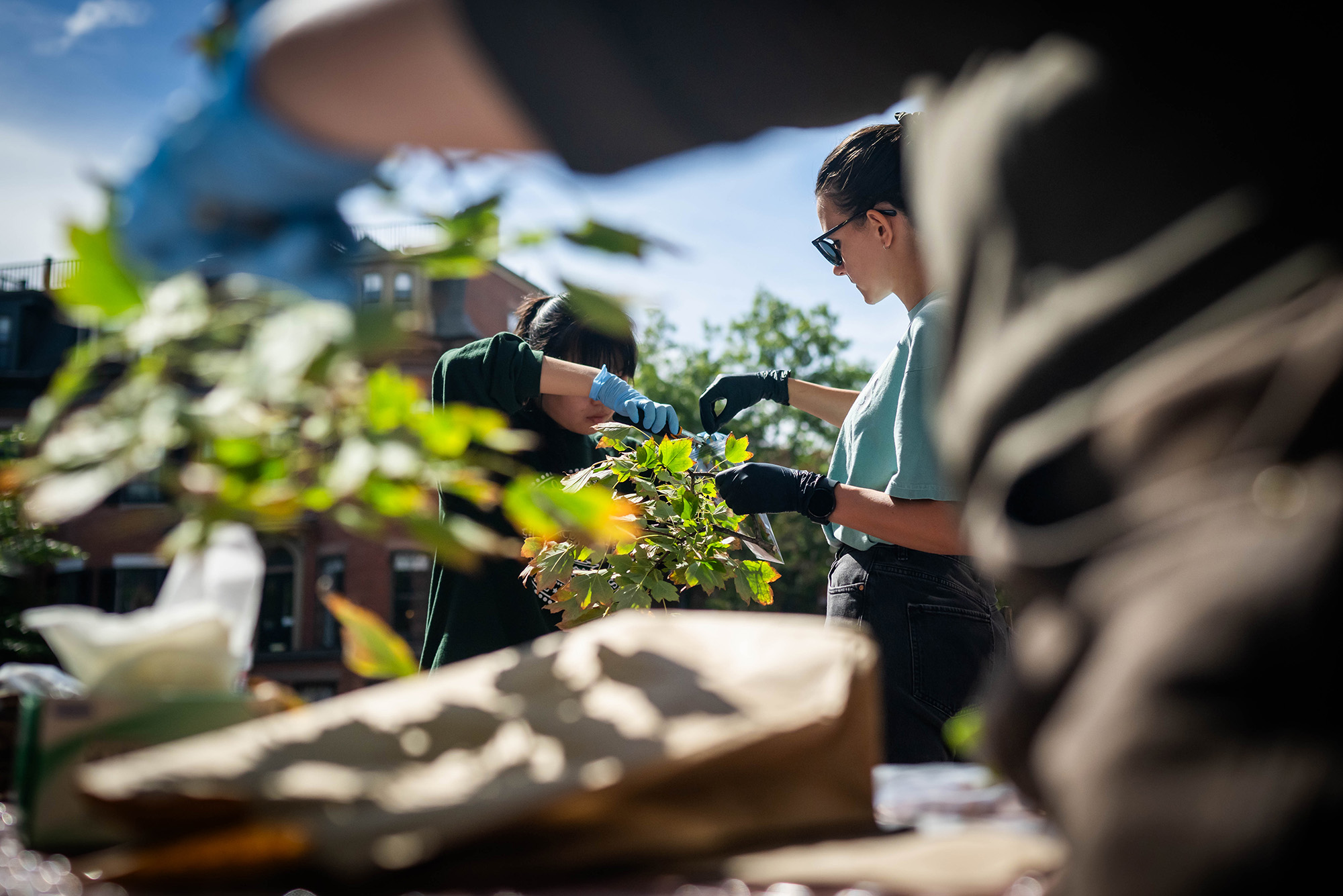
Trees that are planted in cities are interacting with tons of atmospheric pollution every day, says Bhatnagar. She and her team are focusing on what the pollution does to a tree and the microorganisms that live on it. To that end, they have been going around Boston collecting leaves in different parts of the city.
“We’re looking at the microbes that live on the surface of the leaves and then the microbes that live inside the tissue of the leaves,” says Atherton, a recent PhD student in bioinformatics and member of BU’s Graduate Program in Urban Biogeoscience and Environmental Health.
Bhatnagar and Atherton take the leaves to Jake Nash, a BU postdoctoral researcher and expert in molecular ecology, who isolates and looks at the DNA and RNA of a leaf after it has metabolized city pollutants.
The team has discovered that the microbial communities that live on urban trees are very different from those on leaves from more rural areas. By analyzing these differences, Bhatnagar hopes they can determine how to best help trees withstand the stress of an urban environment. They recently published a paper in Nature Cities outlining some of their findings on urban tree microbiomes. (Read an interview with Bhatnagar and Atherton discussing their microbiome paper in more detail.)
“I hope this work can help folks who want to plant trees in cities to manage them and help them survive,” says Bhatnagar.
In the video above, watch as Bhatnagar explains how her research is being conducted and how it can help municipal leaders keep their cities green.
The Bhatnagar Lab of Microbial Ecology’s research on urban trees is funded by the Department of Agriculture’s National Institute of Food and Agriculture, the National Institutes of Health’s National Institute of General Medical Sciences, a National Science Foundation Research Traineeship, the W. M. Keck Foundation, and the following Boston University programs and grants: BU URBAN, Initiative on Cities, Microbiome Initiative Accelerator Program, Patricia McLellan Leavitt Research Award, and the Peter Paul Professorship fund.