MET’s Construction Tech, AI, and Project Management Symposium Looks to the Future of the Built Environment
 In a gathering of industry leaders, academics, alumni, and students, Boston University Metropolitan College (BU MET) recently hosted yet another groundbreaking symposium—this time taking a close look at the ways emerging technologies are reshaping the infrastructure and built environment industries.
“Construction at BU: AI, Robotics, Digital Twins, and Project Management Principles” was the theme of the symposium proceedings, which highlighted the growing convergence of construction management, artificial intelligence, robotics, digital twins, and evolving project management methodologies. The half-day event was held Tuesday, April 7, 2026, at Metropolitan College’s 1010 Commonwealth Avenue location. In their welcoming remarks, BU MET leadership emphasized the College’s commitment to innovation, interdisciplinary collaboration, and giving students the preparation they need to succeed amid the rapidly changing future of construction and project delivery.

A series of keynote presentations focused on the transformative upside of AI, robotics, and digital twins across the construction lifecycle, as speakers explored the ways artificial intelligence is improving project planning, safety management, forecasting, and decision-making, while robotics applications demonstrated advances in automation, precision, and productivity in architecture and construction environments.
As discussions went on, the central tension of AI—namely, the environmental impact of data center stressors measured alongside AI’s potential for contributing to sustainability efforts—proved to be a key topic theme that struck a chord with participants.
Boston University itself was the highlighted example of one keynote speaker, who explained the ways the University is currently leveraging advanced technologies in capital planning and project delivery, providing attendees with a practical and highly relevant institutional perspective on innovation in action.
One theme that consistently cropped up throughout the symposium was the idea that while technology is changing rapidly, core project management principles remain essential—even as the very definition of a “project” continues to evolve. Discussions emphasized the importance of key skillsets like leadership, communication, stakeholder engagement, adaptability, and systems thinking in an increasingly digital and automated environment.
Given its relevance to the day’s programming, attendees also received an overview of BU MET’s Construction Management & Technology master’s program, getting a primer on the expanding possibilities in preparing the next generation of professionals for a technology-driven construction industry.
The symposium also proved to be a valuable networking opportunity for students, alumni, faculty, and industry professionals, strengthening the sense of community throughout BU’s growing Construction Management & Technology program. Informal conversations during the networking reception continued well beyond the formal program, with participants exchanging ideas on future collaborations, research opportunities, internships, and industry partnerships.
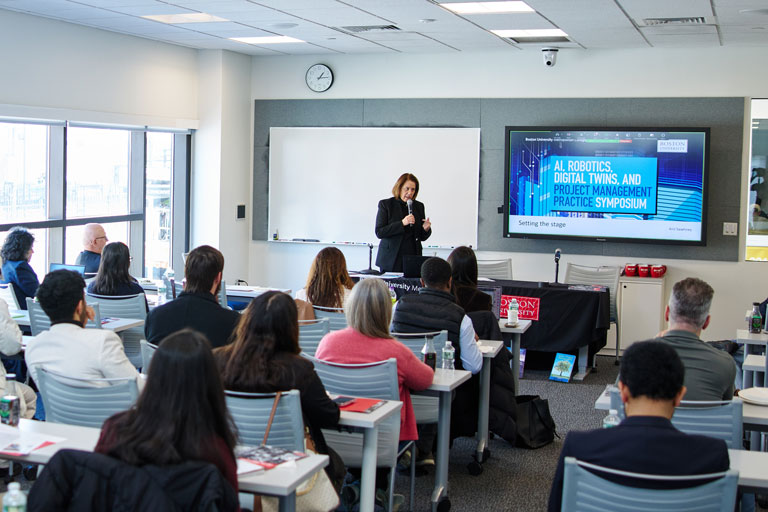
Following the lively networking break, attendees participated in two engaging panel discussions. The first focused on construction technology, examining the current state of the industry, future trends, workforce development, and opportunities for students and young professionals entering the field. Industry practitioners and technology experts shared insights into how AI-driven tools, robotics platforms, and digital twin systems are already changing expectations for project teams and organizations.
The second panel, “Voices from the Field and the Classroom,” featured Boston University alumni and current students who reflected on their educational experiences and discussed how technology is shaping their careers in construction, engineering, and project management. Their perspectives reinforced the importance of bridging academic preparation with real-world industry application—much like BU MET champions in all its programs.
Hosted and organized by BU Metropolitan College’s Construction Management & Technology program and the Department of Administrative Sciences, the industry-meets-academics event was a reflection of BU’s ongoing leadership at the intersection of project management, construction innovation, and emerging technologies. With enthusiastic participation from professionals, students, faculty, and technology leaders, it proved to be a successful demonstration of both the opportunities and challenges facing the construction industry as it embraces AI, robotics, and digital transformation.
The Construction at BU symposium’s resounding success has already sparked discussion of future workshops, collaborative initiatives, student projects, and expanded industry engagement activities as Boston University continues to build momentum in the rapidly evolving construction technology space.
To learn more about the MS in Construction Management & Technology at BU MET, visit our website.