
Food Waste Diversion
BU is committed to our Zero Waste Plan, which aims to divert 90% of all waste produced at the University from landfills and incinerators by 2030. Composting is just one part of BU’s waste diversion initiatives but is an important way of reducing the University’s greenhouse gas emissions. As was found in the Zero Waste Plan, 44% of materials disposed of in landfills and incinerators is potentially compostable, so expansion of our food waste diversion system is a significant part of the effort to achieve Zero Waste.
BU RACCOON (Residential & Community Composting and Organics Network)
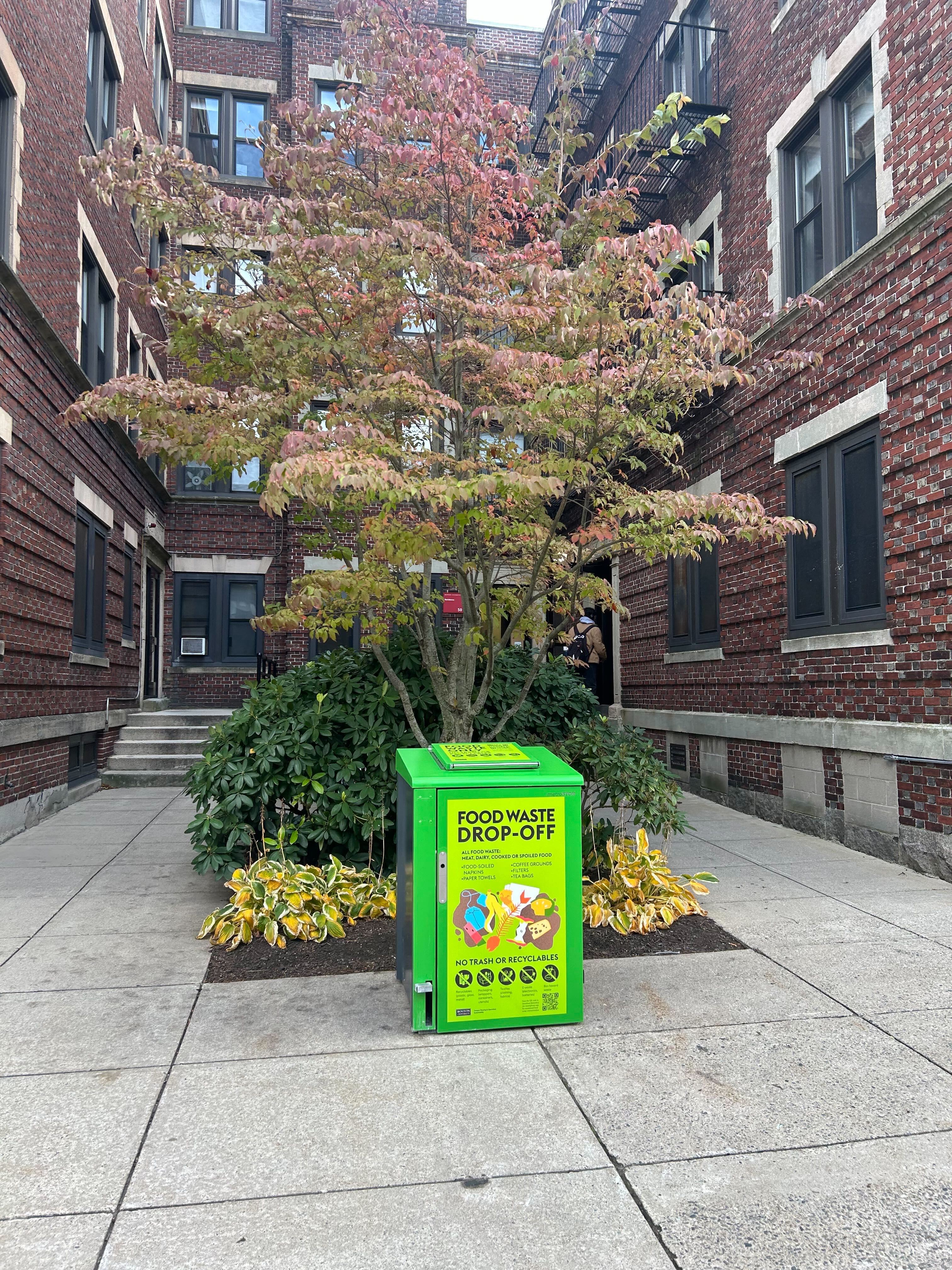
Continue to support Boston University’s commitment to sustainability and Zero Waste through BU RACCOON (Residential & Community Composting and Organics Network)! This new program, which launched in the fall of 2025, includes two secure drop-off locations on Buswell Street. These food waste bins are opt-in, meaning you must sign up to participate.
Boston University has partnered with MetroKey, a company that helps to operate lockable compost bins. These lockable bins aim to keep pests out and food scraps in. Unlocking the bins is easy. Simply download the MetroKey app at the link below, sign in with your BU e-mail address, and select BU RACCOON as the location. Once downloaded, open the app and select the bin nearby to unlock.
Download the app today to participate. Do not use your personal email; only BU emails will be accepted with this program.
With the provided compostable paper bag, found in the nearest laundry room, place leftovers and spoiled food inside. Once full, bring it to the nearest drop-off station. Finally, unlock the bin with the MetroKey app through an account connected to your BU e-mail. BU RACCOON will be initially launched in locations on South Campus. The two locations will be found at the front of 14 Buswell and in the courtyard in front of 50-52 Buswell.

Do’s and Don’ts of the Food Waste Bin
DO use the food waste bins for…
-
- Edible food scraps (like unfinished meals)
- Inedible food scraps (like spoiled food, peels and rinds, eggshells, etc.)
- Soiled paper goods (like unbleached napkins, unlined paper food containers)
Tip: With paper goods, if it is compostable, it will usually say so!
DO NOT use the food waste bins for…
-
- Bioplastics like PLA
- Waxed paper (coffee cups, lined food containers, milk cartons)
- Regular plastic containers or bags (head to our “How To Recycle” page for more info)
- Metal
- Glass
- Cardboard
Avoid Contamination
Sorting your waste incorrectly leads to the contamination of our food waste bins. Contamination is when trash or recycling items are placed in the food waste bin, which means the whole bin needs to be disposed of as trash. If after looking at our signage, you are still unsure if an item can be composted, the best option is to put it in the trash.
Where is Food Waste Collected?
Food waste is collected behind the scenes at all dining halls, George Sherman Union, the Law School, Questrom Catering, Questrom Starbucks, BU Children’s Center, Raising Canes, Hillel House (Granby Commons), BU Pub, and the Dunkin Donuts in Student Village.
Front-of-house bins are available for those dining at George Sherman Union and Questrom Starbucks.
Questions?
The Zero Waste Plan aims to expand BU’s food waste program in the coming years.
If you are interested in learning more about our program or would like to lead an expansion project, please reach out to our Zero Waste Manager; Sarah Healey.