news
Notes about Contributors
Deborah Stein is a Ph.D. candidate in the Department of History of Art & Architecture at Boston University, focusing on nineteenth-century American art as well as the history of American art collecting and museum formation. Her dissertation project is entitled “Charles Callahan Perkins, Classical Sculpture, and the Rhetorical Tradition in Mid-Nineteenth Century Boston.” More
The Kunstkammer Gallery at the Museum of Fine Arts, Boston
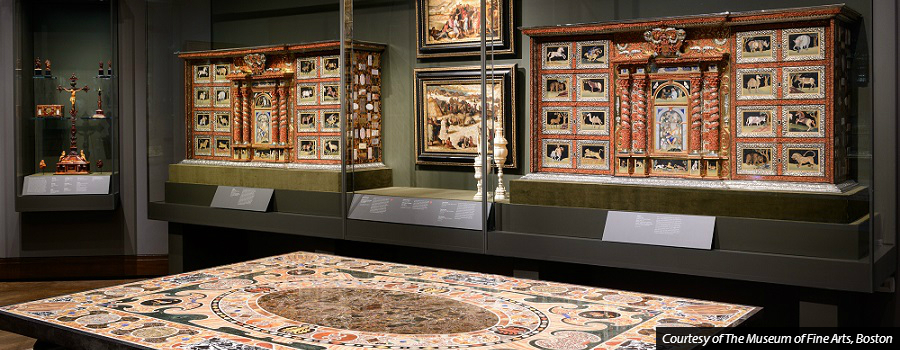
The newly installed Kunstkammer Gallery at the Museum of Fine Arts, Boston, which opened on June 4, 2014 as part of the museum’s larger project to renovate the display of European art in the Evans Wing, aims to replicate for the modern viewer the dazzling experience of entering just such a space in the Renaissance and Baroque era. The museum’s re-creation of a sixteenth- to seventeenth-century encyclopedic kunstkammer—literally, “art room” or cabinet of curiosities, conceived as the universe in microcosm—showcases a diverse array of naturalia, artificialia, and exotica. These objects splendidly attest to the period’s fascination with works wrought by nature or man (or, more often than not, an elision of the two) and exotic materials hailing from far-flung shores.
Classical Rhetoric and the Institutional Fine Arts in Nineteenth-Century Boston
On July 4, 1876, the Museum of Fine Arts, Boston, located in a purpose-built Ruskinian Gothic building in Copley Square, opened its doors for the first time to an enthusiastic public. [1] The day was doubly celebratory as it was also the nation’s centennial. Visitors were greeted throughout the Museum by a display of diverse art objects largely borrowed from institutional lenders, most particularly the classically-oriented painting and sculpture collections of the Boston Athenaeum, which had been to that point the city’s leading arts organization. In addition to the Athenaeum’s collection, there were Renaissance and Baroque engravings as well as collections of Egyptian, Cypriot, and Italian antiquities. Also on view was a collection of eighty-six plaster casts, many of them sourced from European manufacturers, intended to visually represent the history of antique sculpture. [2]
The State of Museums in Boston: A Conversation with Professor Melanie Hall
This interview was conducted via email between graduate students Bridget Hanson and David Silvernail, and Professor Melanie Hall, Director of Museum Studies and Associate Professor, History of Art & Architecture
Q: The inaugural issue of Sequitur features reviews of recent contemporary exhibitions and catalogues in Boston museums. How would you characterize the growing prominence of contemporary projects, and the difference in contemporary curatorial strategies at the MFA, the Gardner Museum, and the ICA/Boston?
There has been a significant rise in interest in contemporary art internationally during the past 15-20 years, but such interest can also be subject to external forces. In the case of the MFA’s Permission to be Global, the works come from an individual collector: Ella Fontanals-Cisneros, founder and president of CIFO. More