Queer Care in the Work of Aaron McIntosh
by Madeline Drace
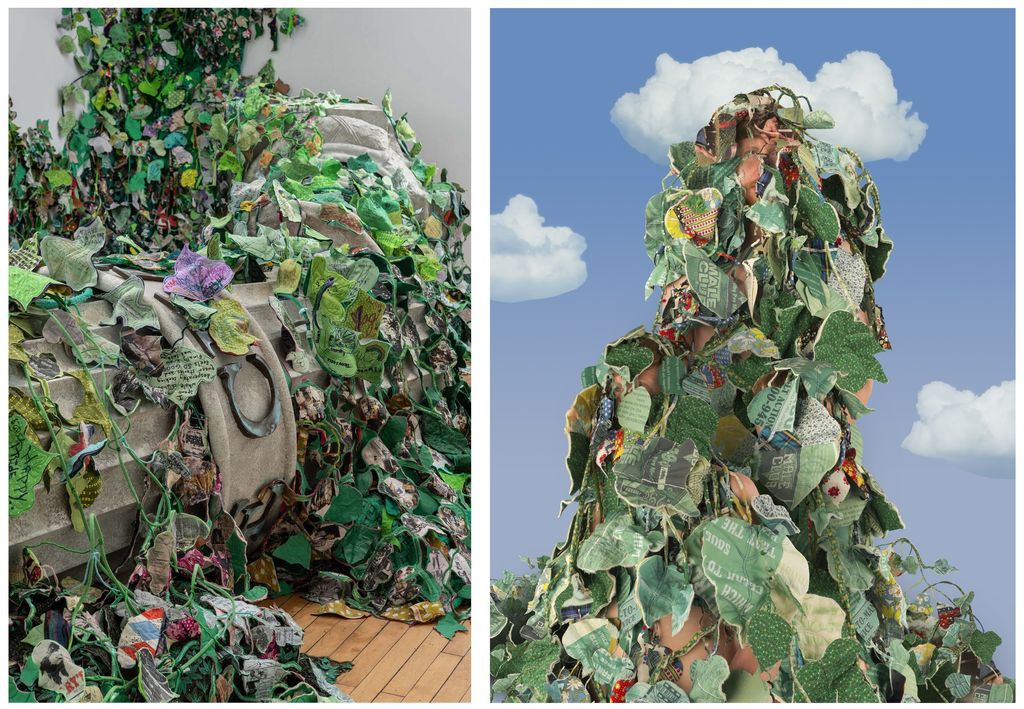
Right: Aaron McIntosh (born 1984). Invasive Species (2013). Collaboration with Nick Clifford Simko. Digital collage on archival print. Photo: Artist.
Tennessee-born interdisciplinary artist Aaron McIntosh describes himself as a fourth-generation quilter. He has applied the care and attention inherent in generational craft to building a body of work that manifests the beauty and complexity of queerness—love, community, identity, expression, experience—that, in defiance of prejudice and conservatism, not only exists but thrives in the Southern United States. Since 2015, he has been the steward of the Invasive Queer Kudzu project: a community workshop-based endeavor that invites queer people and allies in the South to gather and record their stories onto quilted fabric leaves of kudzu, a fast-growing plant commonly vilified as a weed. Despite being denigrated as an invasive plant, kudzu has come to be a dominant visual and ecological “calling card” of the South. What McIntosh’s work shows is that, even if queer Southerners similarly find themselves in “inhospitable soil,” they are still rooted in the culture and history of the South. With every workshop, the Queer Kudzu vines grow as more leaves are added to this lush, botanical archive of thousands of queer stories. Invasive Queer Kudzu has been exhibited throughout the US and internationally. McIntosh currently teaches as an Associate Professor in the Fibres & Material Practices program at Concordia University in Montreal.
This interview has been edited for clarity and brevity.
Madeline Drace: What drew you to quilting?
Aaron McIntosh: I don’t remember times when I didn’t sew and quilt. I’m from a family of makers. Starting around six, my grandmother, Axie McIntosh, had me in her lap sewing little blocks together. She was a lap quilter. I also had great-grandfathers who were noted quilt makers in their communities. It was a very gender inclusive craft. That’s not most people’s experience in the United States, but that was my own family’s experience.
My practice, even to this day, is interested in challenging many of those notions around gender and textiles, and intersections of craft and art. Quilts are akin to painting: expressive with room for abstract and formal-based thinking but also traditionally used in a narrative context.
MD: This issue’s theme is “with love.” What are some of the ways that love and care appear in your work?
AM: Care is present in a lot of different ways, coming from a craft tradition: caring about how things are done, handling materials and techniques with care. Quilt-making is a way that I connect with my heritage in a material and process-based way. Actual physical love or connection is really challenging, coming from a very conservative Christian family that doesn’t accept a lot of aspects of my queerness. It’s been a way to connect, care, show care, maybe find love across generations, even generations I didn’t know. I think about those great-grandfathers who were quilters. Were they also queer and just unable to be out in their time?
In the Invasive Queer Kudzu project, there are a lot of stories of love, finding love against the odds, finding love in unusual places in people’s southern existences.
MD: Projects like Invasive Queer Kudzu can be really place-specific, both to the whole South or individual sites. I’d love to hear more about this relationship between place and love.
AM: I grew up with the motto, “Bloom where you’re planted,” and some people see that as a kind of forceful positivity, but I actually have always taken it to heart, and I love that it’s a plant metaphor connected to place.
I’ve long related to the weed as a metaphor, a mascot for queerness. Weeds tend to grow of their own volition. They thrive in a lot of ways on their own terms. It’s human culture that decides what becomes a weed.
Queerness, like weeds, is, in different cultural moments, inconvenient, but it’s there. Kudzu never really invaded; it was introduced by the US Department of Agriculture for soil erosion control. It’s metaphorically rich in a sort of Southern Gothic understanding of the region. This all ties back to this idea of love of place, because so many people really hate the vine, but no one suggested other ways that we could think about it differently.
The project officially launched in 2015, right on the verge of Obergefell v. Hodges that would overturn state legislations against gay marriage. At that time, a lot of the national news was about how the South was holding gay marriage back. I could showcase my own love for the region, not run away from it, not let national narratives paint the South in these really broad strokes. The people in the communities who are here and who work towards social justice: that’s a big part of the love for the region that’s in the project.

MD: Your work also connects place with history. What effects do you think history has on love?
AM: Physical meeting spaces have their own weird histories. Queer Kudzu recreated one of the longest-running queer nightclubs in the United States. The Club Hippo in Baltimore opened in 1974. It closed in 2015, and was a giant loss in the community. When I moved to Baltimore in 2010, there were 11 gay and lesbian bars in the city. There’s now one. So much of that community has the weight of history in terms of changing—whether by force or economic precarity—the physical gathering spaces that queer people used to inhabit. Now that’s all moved online, which has a different ethics of care, how you go about meeting, convening, and communicating with other queer people.
In Richmond, Virginia, I’m looking in the queer archives, the GLCCB.1 I find so few images of queer Black people in a majority Black city [before 2020]. What does that say about who is making images, who is keeping images, who has the energy, the time, the wherewithal, the organizational capacity, the emotional bandwidth? All those things to build an archive. It’s the opposite of nostalgia: these are problematics. There’s a lot of recuperative work happening within queer archives in the South and elsewhere because it is not exclusive to the South. You can be in Boston and find the same weird racial omissions in their queer archives.
Those are lessons for archives in general. But I find that younger people, younger artists, are really, really interested in archives.

MD: Invasive Queer Kudzu has hosted community workshops, bringing people together in community to build the archive. How do these workshops practice community care?
AM: We often do a lot of community work together. People are taught how to stitch their leaf and quilt it, wire it, and add it to the vine that we all make on site. That’s been a nice way for me to think about my own intergenerational legacy outside of blood relation in passing on skills like they were passed on to me.
I always encourage people that any story is valid and welcome in this project: good, bad, ugly. A lot of people are really proud to write where they’re from in the South. That speaks to this larger love of the region, even when it’s complicated, even when it’s hard to find a way to thrive.
The basic goal for the project is that a queer person sees themself in the story of the South, as part of a lineage of other Southern queers that came before them. This is something they can touch and feel: turn leaves over, look at them. That community building happens in the archive itself: the intermingling of these stories from the present against the backdrop of the stories from the past. It’s a nonlinear way to stitch these communities together and stitch these histories together.
At the project’s last big exhibition run in Richmond, Virginia, my friend Julie Gartrell—who is queer and from a family of weavers—taught us how to weave kudzu baskets. I served biscuits and kudzu jelly. We had daytime dance parties in the kudzu vines. This art project can engage with different communities to highlight the diversity of queer Southern life as it is.
MD: How do you think projects like Invasive Queer Kudzu can respond to our current moment?
AM: This current federal administration is a devastating reversal of a lot of very long, hard-fought and won advancements for queer and trans people in the United States. That’s why the project keeps continuing and being shown. These queer communities would really love tangible demonstrations that we’re still here, that we’re not fully erased because there’s a federal government trying to erase our very existence.
We sadly are heading into a darker time of queer acceptance. I think the project resonates with people for that simple act of being visibly queer. And while that saddens me, I guess it becomes a kind of testimony to our times, to the fragility of liberation.

____________________
Madeline Drace received her BA in Art History and English from Emory University in 2015 and her MA in Art History from Tufts University in 2018. She is currently pursuing her PhD in Visual Studies at the University of California, Santa Cruz.
____________________
1. Gay, Lesbian, Bisexual, and Transgender Community Center of Baltimore, now The PRIDE Center of Maryland.