Isamu Noguchi: Landscapes of Time
Clark Art Institute, Williamstown, MA
July 19, 2025–October 13, 2025
by Jessica Braum
A quiet constellation titled Akari Light Sculptures (c. 1951–76), poetically luminous and palpably weightless, floats at the center of Isamu Noguchi: Landscapes of Time (July 19, 2025–October 13, 2025), immediately capturing the viewer’s gaze and establishing a sense of ephemerality that attunes visitors to Noguchi’s enduring engagement with the concept of time (fig. 1). Located in the Michael Conforti Pavilion of the Clark Art Institute, a rectangular gallery space bounded by glass on three sides, the exhibition presents a non-chronological selection of the artist’s works framed by Noguchi’s “fascination with time [and]…his broader search for belonging.”1 By tracing flows of influence, material processes, and cultural intersections, the exhibition showcases Noguchi’s formal innovation and emphasizes the ethical and imaginative possibilities of engaging with time and transnational cultural currents as forces that shape human experience and artistic expression. Addressing these themes together is an ambitious undertaking, one that exposes a tension between the exhibition’s conceptual scope and its cohesive execution.
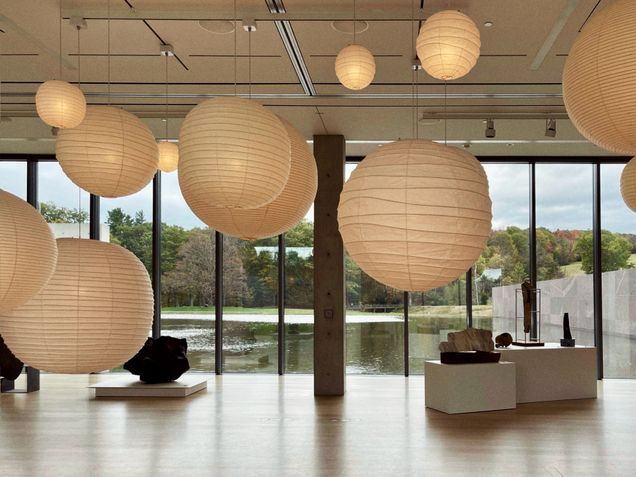
Yet the dominant sensory appeal of the Akari risks flattening the curatorial narrative, reducing Noguchi to a poetic modernist rather than an artist deeply engaged with questions of material, space, and time. Noguchi himself conceived of the Akari not merely as decorative objects, but as extensions of his early experiments with self-illuminating sculpture—a series of works linked by their internal light and by titles invoking the lunar.2 This titular reference to the moon is instructive; Noguchi likened his memory of confinement in Poston, an internment camp in Arizona, where Japanese Americans were forcibly relocated during World War II, to “that of the moon, a moonscape of the mind… an illusion within the confines of a room or a box, where the imagination may roam to the further limits of possibilities, to the moon and beyond.”3 The Akari thus echo this interior landscape of imagined expansiveness. However, the curators’ decision to foreground washi paper lanterns, objects traditionally associated with Japan, offers an entry point while also reinforcing a simplified narrative of cultural symbolism—an emphasis that gestures toward the exhibition’s investment in curatorial cohesion.
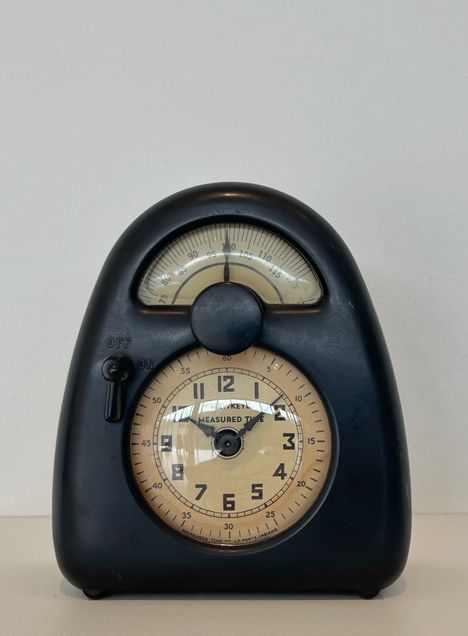
Moving outward from the Akari at the center, the gallery’s perimeter offers a more expansive view of Noguchi’s engagement with time across media, scale, and collaborative practice. The selection of artworks reflects six decades of Noguchi’s practice and situates him within the broader discourse of global modernism. The earliest work on view, Measured Time (1932), a design for a commercial kitchen timer, is tightly framed within the exhibition’s thematic parameters, leaving less room for a more nuanced understanding of the artist (fig. 2). The object offers a literal expression of the curatorial premise, standing in stark contrast to the surrounding sculptures, whose engagement with time is more abstract and complex. The didactic text’s reference to Noguchi’s “lifelong preoccupation with time” sits uneasily with the object, underscoring the exhibition’s occasional overreliance on thematic coherence.
Nevertheless, subsequent works introduce a more layered account of Noguchi’s engagement with time and his disregard for hierarchies between disciplines, as well as his dialogues with other interlocutors. For example, Spider Dress and Serpent for Martha Graham’s Cave of the Heart (1946) link Noguchi not only with Graham, one of his most important collaborators, but also with theater through his work on set and costume design. This multidisciplinary engagement was formative, offering him a conception of space as “an open volume within which the illusion of infinite space may be created.”4 The work The Seed (1946; fabricated c. 1979), a tripartite abstraction with a polished metallic finish, recalls the sculptural syntax of Constantin Brâncuși, with whom Noguchi apprenticed as a stonecutter in Paris.
A large-scale photograph of Sculpture to Be Seen from Mars (1947) spans the gallery’s innermost wall, depicting a sand model for an unrealized monumental sculpture composed of colossal earth mounds that together suggest the shape of a human face. Flanking this image in a striking reversal of scale, a selection of maquettes and plaster models invites viewers to imagine the ambition of Noguchi’s public works and play equipment. Slide Mantra Maquette (1985), a scale model for a ten-foot marble slide constructed for the 1986 Venice Biennale, exemplifies Noguchi’s philosophy of “humanizing space” (fig. 3).5 Its spiral form unites ascent and descent—progress and return—embodying Noguchi’s belief that the past is not simply gone but remains embedded within the motion of life and art.

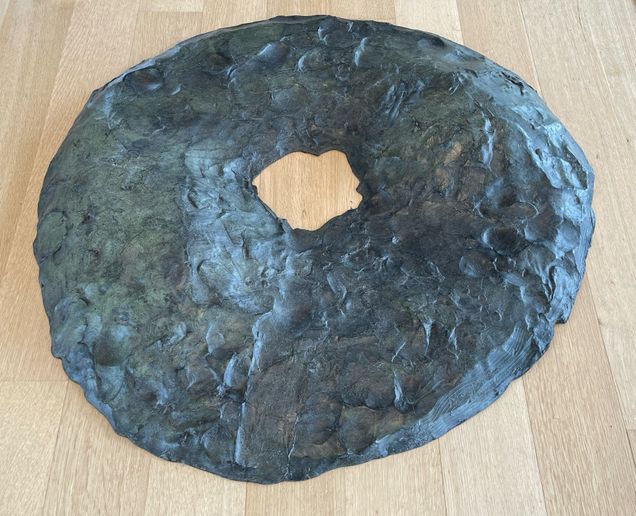
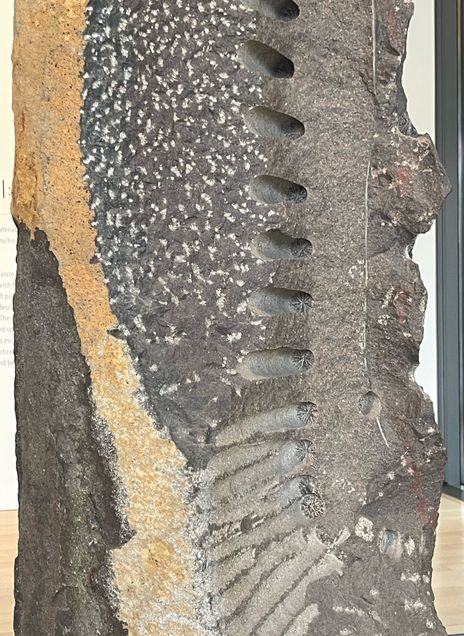
Noguchi’s broader practice resists linearity and embraces what he called a “radiant” sense of time, extending in all directions—past, present, and future alike.6 His reflections on “the quality of enduring” and the necessity of imperfection point to an understanding of sculpture as a living process, inseparable from nature, memory, and human experience.7 Two of the most evocative pieces in the exhibition, This Earth, This Passage (1962; cast 1963) and Age (1981), may be read as unfolding meditations on duration, recurrence, and geological time. This Earth, This Passage, displayed directly on the floor, materializes Noguchi’s exploration of time by recording his circular steps in wet clay, later cast in bronze (fig. 4). The resulting form captures cyclical motion, the imprint of walking as both process and residue, suggesting the overlap of past and present, history and imagined futures. Age, a basalt sculpture, stands close to the gallery’s entrance, its surface bearing an expansive language of carved marks intertwined with traces of natural processes (fig. 5). Noguchi deliberately left portions of the stone’s ochre surface untouched, preserving the natural crust formed by slow oxidation, a record of the material’s own transformation. The variety and rhythm of carved marks are, at times, painterly: some recall drops of ink dispersing in swirls and loops of water, while others reveal the stone’s resistance to Noguchi’s tools, recalling a lesson he learned as Brâncuși’s stonecutter, that “the large saws…must not be forced but gently cut of their own weight. The wide blade of the axe leaves its mark, and that is how it should be left—the direct contact of man and matter.”8 Together, these works visualize sculpture as an interaction between artist and matter, positioning time and change as both human-directed processes and geological forces.
The exhibition’s ambition to address time, belonging, interdisciplinarity, and cross-cultural experience reveals a productive yet unresolved tension between conceptual breadth and spatial limitation. Some of the larger works, including Time Thinking and Spin-off #2 from Sunken Garden, Chase Manhattan Bank Plaza, are positioned in a tight linear sequence along the gallery’s windowed left wall, where the narrow proportions of the space dampen their spatial vitality.
Curated by Matthew Kirsch and Kate Wiener, Landscapes of Time succeeds in conveying Noguchi’s sensitivity to material and his commitment to working across disciplines, yet his more speculative and cross-cultural investigations remain only partially realized. Noguchi’s own reflections on belonging—rooted in a bicultural life between Japan and the United States, as well as in a peripatetic, world-spanning practice—underscore the multiplicities that shape his practice. His sculptures inhabit the interstice between permanence and transience, matter and imagination, suggesting that belonging itself may reside within this movement, a continual becoming that, like his imagined moonscape, transforms constraint into boundless possibility.
A final, unexpected impression arises from the viewer’s engagement with the gallery’s atmosphere. Because the exhibition text was distributed as a pamphlet rather than mounted on the walls, visitors frequently read aloud to one another, generating a low hum of voices throughout the space. Fragments of biography and interpretation, floating alongside the works, lent an auditory dimension to Noguchi’s search for meaning across time, place, and material, quietly echoing the luminous Akari at the exhibition’s center.
____________________
The artworks and reproductions thereof are expressly excluded from any open-access or open license grant of rights. All rights are expressly reserved by ARS on behalf of the Artist, Estate or Foundation.
____________________
Jessica Braum (she/her) is a doctoral candidate in Art History at Temple University. Her dissertation examines Kim Lim’s print and sculptural practice through transnational feminist frameworks, reassessing postwar British and Southeast Asian art histories. Engaging feminist theories and multidisciplinary methods, she studies artists working across geographic and cultural contexts. Her writing has appeared in Asian Diasporic Visual Cultures and the Americas, ASAP/Journal, and Passage.
____________________
1. Clark Art Institute and The Isamu Noguchi Foundation and Garden Museum, Isamu Noguchi: Landscapes of Time (Clark Art Institute, 2025), 1.
2. Naguchi’s self-illuminating sculptures include Lunar Infant (1944), Lunar Landscape, and Red Lunar Fist (1944).
3. Isamu Noguchi, A Sculptor’s World (Thames & Hudson, 1968), 45.
4. Clark Art Institute and The Isamu Noguchi Foundation and Garden Museum, Isamu Noguchi: Landscapes of Time, 3-4.
5. “Isamu Noguchi: The Sculpture of Spaces.” 1995. Films On Demand. Films Media Group. Accessed October 22, 2025, https://fod.infobase.com/PortalPlaylists.aspx?wID=103640&xtid=32843.
6. Isamu Noguchi, “The Road I Have Walked,” in The Inamori Foundation: Kyoto Prizes & Inamori Grants, (Inamori Foundation, 1990), 125.
7. Noguchi, “The Road I have Walked,” 123.
8. Benjamin Forgey, “Isamu Noguchi’s Elegant World of Space and Function,” Smithsonian 9 (April 1978): 49, https://archive.noguchi.org/Detail/bibliography/1592.