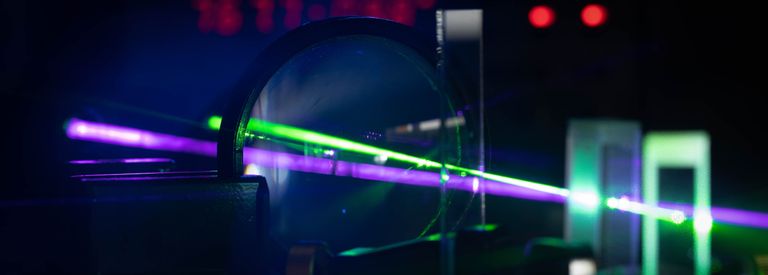
Could Twisting Beams of Light Make the Internet Faster—and Greener?
BU engineer Siddharth Ramachandran is developing a technology that could cut the power needed to transmit data—and maybe one day improve brain imaging

Optical coherence tomography enables longitudinal evaluation of cell graft-directed remodeling in stroke lesions
Faculty: David Boas | Outlet: ScienceDirect
Photonics Center 2024 Symposium “Lighting the Brain” Highlights Six Neurophotonics Experts as well as Student Presenters
On November 21, 2024, Professor Chen Yang gathered speakers across industry and academia for her organized symposium “Lighting the Brain,” the topic of the 26th annual Photonics Center Symposium. With a blend of Boston University and external presenters, an audience of graduate students, faculty, staff, and international colleagues were invited to learn about the recent […]
Darren Roblyer and Team Featured on MedicalXpress
It might not be as simple as shining a phone flashlight on your finger, but the principles of diffusive glow apply to many of Roblyer’s medical device inventions for tracking health.
High-throughput single-cell sorting by stimulated Raman-activated cell ejection
Faculty: Ji-Xin Cheng | Outlet: Science Advances
Brian Walsh Featured in Bostonia Article
“Even though it sounds like kind of a wacky idea at first, it is actually pretty reasonable to store digital data in space.”
Ji-Xin Cheng Featured in Laser Focus World
Professor Cheng’s research team was recently featured on “Photonics Hot List” for their work on using microwaves to treat brain disease.
Professor Ramachandran Appointed Editor-in-Chief of Top Optics Journal
Distinguished Professor of Engineering Siddharth Ramachandran is about to take on a vital role as the Editor-in-Chief of Optics Express, beginning in January 2025.
Engineered Microwaves Might Fight Epilepsy, Pain, and Parkinson’s
Team led by Professors Ji-Xin Cheng and Chen Yang succeeds in suppressing seizure-causing neurons
Xin Zhang Featured in American Scientist Article
The article, “Custom-Tuned Materials,” features Professor Zhang’s work on MEMS, noise control, and the use of AI in research.