David Lake: From Philosophical Explorations to Practical Applications
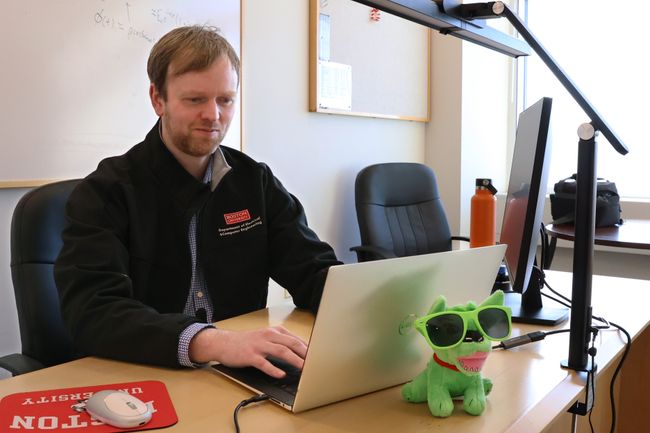
Assistant Professor David Lake (ECE) is a new faculty member at the Photonics Center. We sat down with him to learn a little bit about his life, his research, and who he is.
By Jack Osmond
*This interview has been edited for clarity and concision.
I’m curious to hear about your background. Where are you from originally?
I grew up geographically not too far away from here. I’m from around Halifax, Nova Scotia up in Canada. I did my undergrad there at King’s College and transferred to physics at Dalhousie University. I did my graduate studies at the University of Calgary in physics, went over to Caltech eventually for a postdoc and found myself here at BU. So, I’ve come full circle, moved back east, and I’m very happy to be here.
What drew you to live and work in the U.S.?
Well, a lot of it really was a matter of following the science! I’ve had the chance to visit and work at a number of universities and I do feel that there really is something of a global academic culture. Wherever you go, you find people from all over the world brought together by a shared interest in a particular topic. I think this ability to unite people is one of the things that makes academic research so interesting!
How did you become interested in science generally and your specific research field?
I actually started out as a philosophy major, so it has been an interesting journey to arrive where I am today! In one of my philosophy classes, we read a play about quantum physics called “Copenhagen.” The philosophical implications of quantum mechanics really grabbed me. There was this notion that interacting with the universe unavoidably manipulates it—something we like to call “measurement” in quantum physics. I wanted to learn about this a little bit more, so I took some physics classes on the side, and eventually switched to physics as my major. Over time, as quantum effects have become more important for real technologies, the field has moved in a more applied direction, and I’ve moved along with it—from philosophy, into physics, and now into engineering.
Your research focuses on “quantum hardware using photonics and superconducting devices.” Could you explain what that is for people who are unfamiliar?
Maybe it’s best we first talk about the quantum part, then address the hardware part.
The word “quantum” is one of these words you hear a lot these days. Quantum, generally, is a way of describing the world at really, really small scales. It’s a subject that people sometimes find difficult because when things are really, really tiny, we lose our intuition for how objects ought to act. There’s an intrinsic randomness in how things behave, so we need a consistent mathematical framework to describe what measurements will give you on average.
Quantum hardware looks to use these weird and wonderful quantum effects to do useful and interesting things. Fundamentally, different types of quantum hardware platforms are good at different things you might want to do. For example, if you want to send quantum signals over long distances, light is your friend. It’s high frequency: you can arrange to have very little noise coming into your channels, and you can send this over long distances at room temperature.
The trouble with light is it’s not very good for logical processing. That’s where other platforms come into play. If you want to do information processing, one of the best options is to use superconducting qubits. 
Superconducting circuits are built from metals that, when cooled, have no resistance. And this allows you to create devices that can implement quantum gates and manipulate quantum information. The tradeoff is that they must be kept at extremely low temperatures to limit noise. You can develop a lot of interesting hardware in that space: things that can perform gates or manipulate quantum information. But it needs to be held at very low temperatures to prevent noise from entering the system.
Our work sits at the intersection of these platforms. Quantum processors, quantum communication channels, and quantum memories often work best in different physical systems. We’re trying to connect them—building hardware so that a quantum processor can talk to a quantum communication channel or a quantum memory made from a different technology.
In BU terms, you could say we’re looking for “convergence” in quantum hardware.
Keeping on BU terms, what made you want to conduct this research at the Photonics Center specifically?
There’s a heavy focus in the Photonics Center on silicon photonics, which is incidentally the platform that I really believed in and wanted to push forward. Silicon is a standard material of the semiconductor industry. It’s well understood, comparatively easy to work with, and has many advantages for scalable technologies.
In terms of the research community, I was really attracted to this notion of convergence at BU. I think it’s particularly important in the quantum space. These quantum devices always operate on the edge of what’s possible. You need to operate at low temperatures, you need to have very sensitive measurement equipment. All the parameters of your system are going to be on the edge of what’s possible.
This idea of convergence – bringing together people from different departments – really is necessary to get this stuff to work and is another reason why I was excited to join BU.
And lastly, I’m just excited to be back on the East Coast. I grew up fairly close to here, in Halifax. It’s nice to be somewhere that feels a lot more like home as well.
What are your research goals, specifically, while at BU?
My ultimate research goal at BU is to develop this platform and prove that it’s a viable approach. And there’s a lot of very interesting science and engineering problems that we’re going to discover along the way.
In the near term, we’re especially excited to get the optical side of the work up and running. We’ll be working with single quantum emitters and aiming to demonstrate clear quantum effects—such as quantum interference between optical emitters—on a silicon platform. Along the way, we expect to encounter a lot of interesting scientific and engineering challenges.
Are the Photonics Center’s shared facilities particularly helpful for your research?
Absolutely. Having the OPF (Optoelectronic Processing Facility) in particular is going to be an amazing resource. Having fabrication facilities and lab space in such close physical proximity is crucial.
Quantum hardware development is inherently iterative. You design a device, fabricate it, test it in the lab, figure out what went wrong or what can be improved, and then go back to fabrication. Being able to run that entire loop—design, build, test, refine—within the same building is invaluable for the success of the research.
As you’re just getting set up, what is the plan for your lab group?
We’ve already begun the process of renovations in the main lab, which will be in the basement.
I’m also actively looking for students right now to build up the research program. Something unique to this program is that students will get to be involved in all aspects of the experiment. This involves quantum research, more mathematical concepts, design work, but also fabrication that can be done right here in the photonics facility and testing in the dilution refrigerator.
I’m really excited for the opportunities that we can offer students here at BU, and also to get the research up and started.
What kind of students are you looking for specifically?
First and foremost, I’m looking for students who are genuinely interested in the subject matter. That’s something you can’t fake, and it’s essential for a successful graduate experience. I often give the unsolicited advice that you shouldn’t pursue a graduate degree just because you feel you “should”—your heart really has to be in it.
More specifically, I’m looking for students who are excited about quantum hardware and about working at the intersection of different material platforms. A background in engineering or physics is ideal, along with comfort in both hands-on experimental work and the conceptual side of quantum mechanics.
So for our last question, I want to ask you a little bit about yourself. When you’re not in the lab or in the classroom, what are your hobbies?
I really enjoy bike-packing, and there are great opportunities for that around Boston. I also like gardening and cooking. And I do some creative writing in my spare time. It’s a nice counterbalance to the day-to-day of scientific work to have a creative outlet.