
PhD Student Savannah Schisler measures sustainable thermodynamics through a mechanical lens.
by Jack Osmond
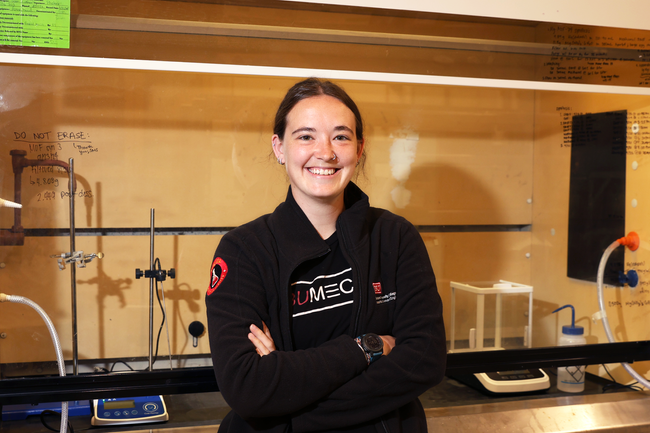 Savannah Schisler’s path to pursuing her PhD in Mechanical Engineering was far from traditional. She grew up on a farm in Littlestown, Pennsylvania, an experience which nurtured an early interest in sustainability and a desire to understand the fundamentals of the world around her. She found that being on a farm nurtured her sense of wonder – equipment would break, things would go wrong, and she had to find innovative and effective solutions.
By the time she reached high school, she found that physics and engineering allowed her to understand why and how certain solutions work. Her curiosity inspired her to become the first member of her family to pursue a college education.
Originally, she was interested in Aerospace Engineering and enrolled at UC Davis. However, she eventually transferred to the University of Rochester, which has no Aerospace Engineering degree. So, she took matters into her own hands and combined mechanical engineering and physics into a “DIY” Aerospace Engineering degree. Though this interest was short lived – she quickly found that fundamental physics were far more intellectually exciting to her than the idea of building rockets. As Schisler puts it, she found she “actually really enjoyed the physics. And Mechanical Engineering is very applicable. It’s a good way to apply the physics.”
After rediscovering her love of physics, she also discovered an interest in thermodynamics and heat transfer: in essence, how different materials, in different states, conduct thermal energy.
As Schisler was preparing for PhD programs, an undergraduate professor put her in contact with Boston University’s Assistant Professor Sean Lubner (ME, MSE), who at the time was just beginning work at the Photonics Center. Professor Lubner had yet to set up his laboratory, meaning Schisler would have to help with that process – not a typical responsibility of PhD students.
Despite this minor hurdle, Schisler was eager to help Professor Lubner set up his lab. The first year and a half of her PhD program was a mix of helping to purchase equipment and literature review, rather than conducting research. Because of this delay, Schisler was apprehensive about finishing her PhD on time, which normally takes five years.
Thankfully, the Department of Defense awarded Schisler the National Defense Science and Engineering Graduate (NDSEG) Fellowship, a prestigious award for applicants who have “demonstrated ability and special aptitude for advanced training in science and engineering.” This award – a testament to the importance of her research – will allow Schisler to complete her PhD with another three years of funding. But with the laboratory now operational, what does that research look like?
Schisler’s research arises from a straightforward but crucial question: how do variations in a material’s environment affect how it conducts heat? The type of material she studies is called a Metal-Organic Framework (MOF), a type of porous polymer made of clusters of metals connected by organic linkers. MOFs have a variety of practical applications, including administering drugs, sensing toxic gases or other molecules in the environment, and gas storage and sequestration. The Lubner Group is using them to develop carbon capture technology – a crucial piece of tech in solving the climate crisis. Yet there’s a crucial gap in MOF research: what are their thermal properties? This is where Schisler comes in.
“My goal is to try to develop and understand how to measure these materials, because experimentally measuring thermal properties of MOFs, particularly at the single crystal or intrinsic level, is very understudied.” 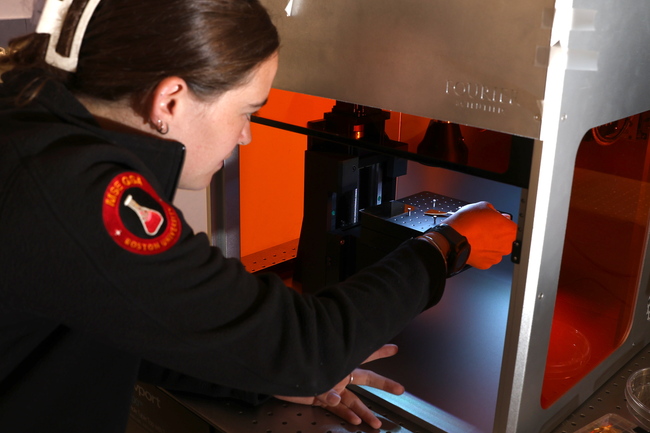
Specifically, Schisler looks at how these materials conduct heat differently in the presence of different environmental stimuli at different length scales. A single crystal might conduct heat more or less efficiently than a bulk MOF powder or pellet. Schisler hopes that by studying both single crystals and bulk properties of the material, she can experimentally observe the thermal properties, enabling a deeper understanding of how these materials interact with our world and environment.
“We don’t put one single crystal out in the world, you know?” she explains. “So, understanding its intrinsic properties is important. But then, actually understanding how it exists in the world is more applicable, and also very important.”
In addition to her cutting-edge research, Schisler is also deeply engaged in the Photonics Center community. Now in her fourth year as a PhD, she has become the president of SAGE, or the Student Association of Graduate Engineers. As she explains it, “SAGE is really just a way for all of the graduate engineers, masters and PhD, to find a community. Grad school is hard, especially when you’re taking classes, doing research, and balancing life. Maybe you’re doing a master’s thesis and you only have a short amount of time. There’s a lot of mental endurance that’s required and you need balance. I think SAGE does a good job of trying to hit that for both groups.”
Beyond providing professional support for graduate students, SAGE seeks to create community spaces beyond professional development and research. As president, Schisler has expanded access to social events like pub nights, apple picking, hockey games, and even ski trips. Some upcoming events include seeing the Harry Potter musical and an end of year banquet.
“Building community. That’s super important,” she says.
Outside of her engagements at the Photonics Center, Schisler enjoys playing field hockey and maintains a robust collection of 35 houseplants – two testaments to her patience, dedication, and time management skills. Schisler says these activities help her to maintain a solid work-life balance, an essential aspect of her success as a PhD candidate.
 “A PhD is absolutely a marathon, not a sprint,” she describes. “So, finding balance is really important. You can’t work 80-hour weeks every week. Maybe there’s a time when you will, when you have all the deadlines at the same time. But you just can’t do it every week. Taking care of yourself is really important.”
Another crucial factor in her success is understanding that it’s okay to not be perfect. “It’s okay to fail. Sometimes failure is beneficial.” She continues, “in research, there is no answer key. Nobody knows, and that’s okay. My big thing is to just realize, it’s okay not to know, because nobody knows your topic. That’s the point. You’re discovering something new.”
Schisler’s new discoveries extend beyond her research: as a first-generation student, she’s had to navigate through the unknown throughout her entire journey, from college to her research today. Thankfully, she has had the support of caring and dedicated professors who nurtured her love of science and research. Schisler’s experience inspired her to help other first-generation students. “One day,” she explains, “I hope to be like that for first-generation students and encourage the growth of first-generation students and women in STEM roles.”