Bert Metz Speaks at Pardee House Seminar
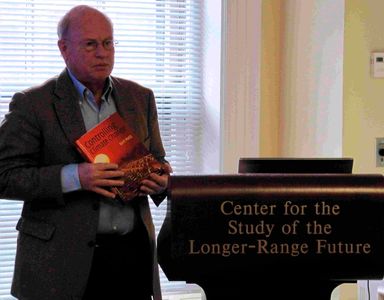
Dr. Bert Metz kicked off the first Pardee House Seminar of this semester with a discussion on his new book “Controlling Climate Change After Copenhagen” on February 2, 2010. The event brought together a full-room of BU faculty and students, including a number who had been at Copenhagen last December.
Dr. Metz was the co-Chair of the IPCC Working Group III for the Third and Fourth IPCC Assessments, work for which the IPCC was awarded the 2007 Nobel Peace Prize. Dr. Metz has also served as a chief negotiator for the Netherlands and the European Union in the period leading up to the Kyoto Protocol. He now serves as a Senior Fellow at the European Climate Foundation. The talk was moderated by Professor Adil Najam, Director of the Frederick S. Pardee Center for the Study of the Longer-Range Future.
Dr Metz started the talk by giving an overview of the Copenhagen climate meetings in December. He expressed pessimism on the outcome of the meetings and described the acrimonious process of drafting the Copenhagen Accord which was not a unanimous political declaration. He also discussed points of the Copenhagen Accord, highlighting the general and unclear language which do not provide any mechanisms, governance or commitment to the points. Dr Metz went on to discuss climate change as a development issue and as a driver of development. He stressed that response to climate change must be rooted in development for national self-interest to be met and climate agreements to be reached.
Dr Metz’s presentation was followed by a lively discussion and audience questions. Some of the issues discussed included the European Union’s strategy and plan at the Copenhagen climate talks, the credibility of the IPCC reports given the current media accusations, the need for political will for climate change and the relevance of the UN process. In conclusion, the author pointed out the large impact of mitigation effects on developing countries over the next two to three decades and moving towards a low carbons strategy would be the most hopeful solution for the longer-range future.
Dr Metz’s presentation can be downloaded here.