New ‘Pardee Paper’ on Nuclear Energy Released
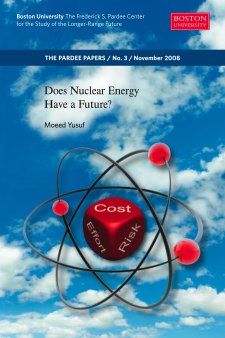
The Frederick S. Pardee Center for the Study of the Longer-Range Future releases the second monograph in its Pardee Papers Series. The paper, titled “Does Nuclear Energy Have a Future?” is written by Pardee Center Research Fellow Moeed Yusuf.
Moeed Yusuf argues that although nuclear energy optimists suggest that a nuclear renaissance is under way, beyond such claims there is little objective analysis that corroborates the positive outlook. He shows that the literature on nuclear energy is highly polarized, with much of the debate being situated within the ideological and normative realms.
This paper moves away from the what should to the what is likely in order to present a realistic projection of the potential for the increased development of nuclear energy over the next two to three decades. It examines the relative importance of the key determinant factors likely to affect the future of nuclear power in a cost-benefit framework. The factors examined include economic competitiveness, concern for climate change, safety and security issues related to nuclear technology, public perception about the energy source, and the quest for energy security.
Moeed Yusuf’s analysis suggests that nuclear energy is likely to
remain economically uncompetitive and investment-starved over the projected period. Public perceptions, both in the developed and developing world, are also likely to become increasingly wary. Measures required to improve the popular sentiment – better safety and security – would increase costs substantially without guaranteeing positive transformation in the outlook. This is especially true as the proliferation risks present a virtually insurmountable barrier. These impediments would overshadow nuclear power’s merit in terms of carbon emission reductions as well as its partial attractiveness in terms of reducing energy vulnerability of countries.
The paper is available for download at our Publications Library.