Sargent College in the BU Archives
by Kate Silfen, Health Sciences Librarian
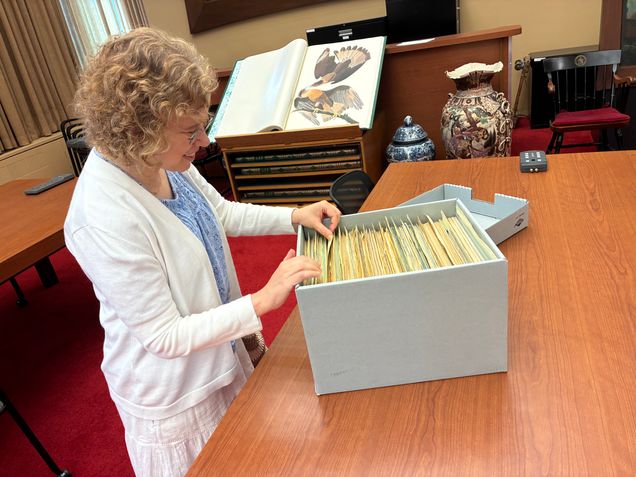
As a health sciences librarian, I spend most of my time helping researchers find current peer-reviewed articles. This past summer, I had the privilege of exploring an entirely different type of source. I spent some time exploring special collections at The Howard Gotlieb Archival Research Center at the Boston University Libraries. The Gotlieb Archival Research Center houses the University’s rare books and archival material. Here, you will find the personal papers of cultural and historical icons, including the Reverend Martin Luther King, Jr., Dr. Howard Thurman, and Elie Wiesel, and the University Archives. If you are interested in BU’s early history, you will find many documents that tell the University’s unique story.
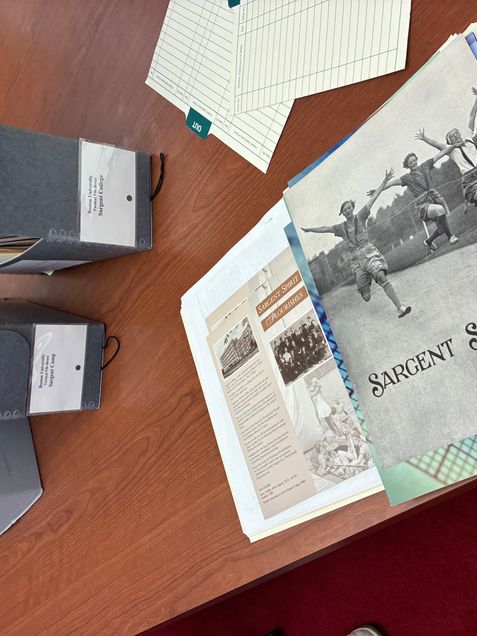
You will also find extensive archives that document the history of Sargent College of Health and Rehabilitation Sciences. In these documents, you will learn about the school’s humble beginnings as “Dr. Sargent’s Normal School of Physical Education.” Initially housed at an annex on Harvard’s campus, the college eventually moved into a carriage house on Church & Palmer Streets in Cambridge, where it remained until 1904. You can read about Sargent’s journey from a school for physical education teachers to a comprehensive school for allied health and the rehabilitation sciences. There are pamphlets from the “Sargent Camp” where campers could engage in physical exercises, form lasting friendships, and engage in good-natured mischief. A pamphlet titled “The First 100 Years of Leadership and the Challenges Ahead” provides an excellent overview of Sargent’s storied past. I especially enjoyed reading “Sargent Clippings,” which gives humorous accounts of the academic year. In a “Sargent Clipping” from 1908, a student jokingly noted that Dr. Sargent taught Freshman Physiology for the first time in many years, and concluded that he must not have liked it, since he did not teach it again!
 The Howard Gotlieb Archival Research Center also has an extensive collection of materials that document the extraordinary career of George K. Mackechnie, who served as Dean of Sargent College from 1945 to 1972. Mackechnie began his journey at Boston University when he enrolled as an undergraduate in the College of Business Administration in 1925. Mackechnie soon realized that this was not the right fit for him, and he changed his major to education. He later earned his master’s from the School of Education (now named Wheelock College of Education & Human Development) and joined the faculty, where he taught history and social sciences. While teaching, Mackechnie served as an assistant to Sargent College’s Dean Wilder, helping find a suitable location for Sargent’s camp in Peterborough, New Hampshire. Mackechnie was later promoted to director of undergraduate studies. In August of 1945, BU President Daniel March promoted Mackechnie to Dean of Sargent College. By the time Dean Mackechnie retired in 1972, Sargent College had evolved from a physical education school for women to a co-educational school for the allied health professions, including both undergraduate and graduate programs in physical therapy and occupational therapy.
Dean Mackechnie’s impact on Boston University went beyond his impressive work at Sargent College. While he was a professor at Wheelock, Mackechnie spearheaded a study to assess the feasibility of starting a nursing program at Boston University. As a result of the study, a division of nursing education was added to the School of Education, laying the groundwork for the opening of the School of Nursing in 1946. While serving as Dean of Sargent College, Dr. Mackechnie also served as interim dean of the School of Fine and Applied Arts for two years and received praise for his role in promoting the arts at Boston University.
As I was looking through Mackechnie’s papers, I was especially fascinated to learn about his friendship with Dr. Howard Thurman, former Dean of Marsh Chapel, whose papers are also held in the Gotlieb Center. By attending Thurman’s services at Marsh Chapel, Mackechnie found a worship service where no one was excluded, something he had been seeking for a long time. He and Thurman planned programs together, and Sargent students often enlivened services at Marsh Chapel with interpretive ritual dances of “Deep River,” “Go Down Moses,” and other worship music. When Howard Thurman died in the spring of 1981, a heartbroken Mackechnie decided to devote himself to preserving the ideals of his dear friend. When the Howard Thurman Center for Common Ground was established in 1986, Dean Mackechnie became its first director. Mackechnie went on to write a book titled Howard Thurman: His Enduring Dream, which you can find at the Howard Gotlieb Archival Research Center and Mugar Library. You can learn more about the history of Sargent College by reading Dean Mackechnie’s Optimal Health: The Quest.
I hope you will take some time to explore both the Sargent College and Mackechnie collections at the Howard Gotlieb Archival Research Center to learn more about Sargent College’s place in BU’s history. You are warmly invited to make an appointment to see these special collections in the Reading Room at Gotlieb Center.
Works Cited
Mackechnie, George K. Optimal Health: The Quest. Boston, Boston University, 1970.
Sargent Clippings. 1908. Sargent College Collection. BU-01481. Box 17. Folder 17. Howard Gotlieb Archival Research Center.
Smith, Trudie. 70 Stories About Boston University. Date Unkown. Sargent College Collection. BU-01481. Box 17. Folder 17. Howard Gotlieb Archival Research Center.