Comrades in Law School
BU Law students and alumni with military or first responder backgrounds reenergize their community of support.
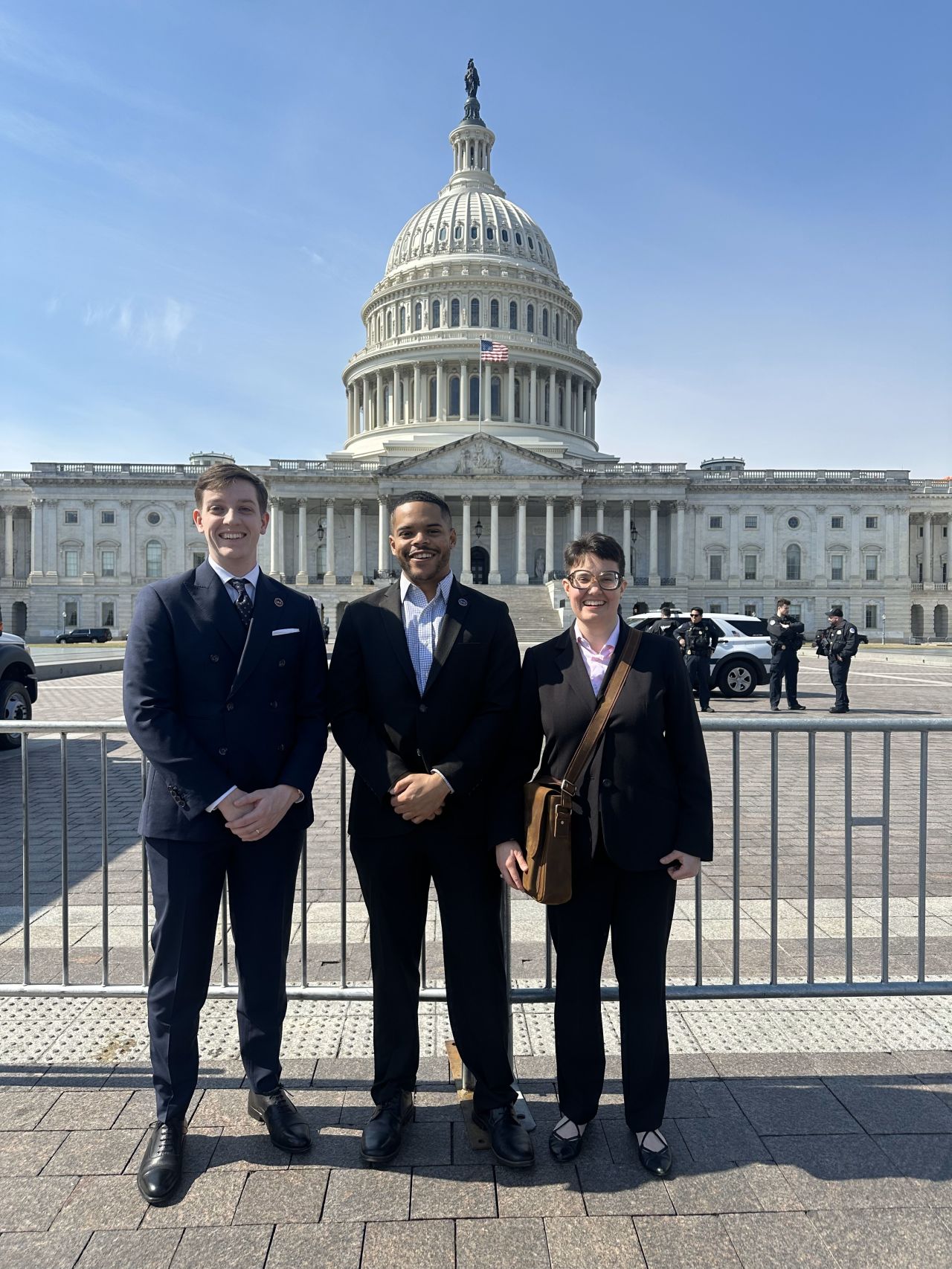
Nicholas Wainwright (’25), Tyler Roderick (’26), and Sofia Steinberger (’26) joined Student Veterans of America for Washington Week, where they advocated for the veteran community on Capitol Hill.
Comrades in Law School
BU Law students and alumni with military or first responder backgrounds reenergize their community of support.
In June 1968, seven days after Rick McCombs (’73) graduated from Yale University, he received a draft notice from the U.S. Army. After six months of basic training, McCombs was deployed to Vietnam to serve with the 4th Infantry Division. Later, he was transferred to MACV (Military Assistance Command of Vietnam), where he did reconnaissance work, monitoring seismic activity along the Ho Chi Minh Trail and calling in air and military strikes. McCombs operated from two firebases near the Laotian and Cambodian borders that saw heavy fighting. “It was not a great place to be,” he says.
After almost 15 months in Vietnam, McCombs, then 23, returned home with the rank of sergeant, to a divided nation and a changed reality. He remembers landing at the Detroit airport early in the morning and making his way through the crowded terminal wearing army fatigues. “It was like watching the Red Sea part,” McCombs says. “Nobody was nasty to me, but people avoided me.”
Reacclimating wasn’t easy, and McCombs was relieved to arrive at Boston University School of Law (BU Law) in September of 1970. “Law school saved my butt because there were at least 30 or 40 veterans in my class,” he says. “It was like walking into a family. We offered each other a whole lot of support, and we integrated ourselves into the fabric of the law school in that first year. The five or six of us in my section—we stuck together.”
Today, McCombs heads a successful private investment firm, after a 40-year career in Big Law. He has established two BU Law funds dedicated to supporting student veterans: the Rick McCombs Veterans Assistance Fund and the Rick McCombs Veterans Assistance Endowed Fund, both for BU Law student veterans who have served within any branch of the U.S. Armed Forces. The funds cover scholarships; stipends for veterans who have secured unpaid nonprofit, government, or judicial internships; and, when needed, travel expenses and the cost of interview attire for those pursuing judicial clerkships.
“I am an advocate for the people who have had to serve and who have been put in harm’s way,” McCombs says. “I wanted to make their transition from the military to academic law as easy as possible. I wanted to get rid of some of the sharp edges if I could.”
And McCombs believes BU Law and society at large reap benefits from supporting military veterans. “Folks who survive the military experience generally are motivated to succeed, and they’re not afraid to lead,” he says.
McCombs has been joined by others in supporting these students. Nearly 50 fellow alumni responded to a fundraising challenge initiated by McCombs in 2021 to support veterans, resulting in almost $50,000. In addition, fellow alumnus and Dean’s Advisory Board Member, Sean Solis (’03), has established the Sean M. Solis Military Scholarship Fund, which provides BU Law students who are veterans or actively serving in any branch of the United States armed forces scholarships and financial aid.
Two BU Law students and veterans—Nicholas Wainwright (’25), an Army reservist and commissioned officer, and Tyler Roderick (’26), a Marine Corps veteran—have benefited from such alumni support and are building more community. In 2023, the pair revived a student veterans association that had waned during the COVID pandemic. This year, the group’s executive board voted to change the name to the Military & First Responders Association (MFRA), broadening the scope of membership beyond veterans to include paramedics, firefighters, students interested in the JAG program, and families of service members. “We wanted to fully represent the members we have and expand the potential for future members,” Roderick says.
This fall, six new veterans joined the JD class of 2028. Much like McCombs and his veteran peers did back in 1970, they, with the help of MFRA, have been able to form a strong community of support that has already helped with their transition to law school.
MFRA aims to foster a robust community of student and alumni veterans and first responders who can provide career support while offering a sense of camaraderie. “We hope to build an informal city-wide network of veteran students from BU Law and other Boston law schools and to expand awareness of veterans issues at BU,” Wainwright says. For the last two years, the group has participated in networking events for veterans interested in Big Law and has plans to host its own events for law firms looking to recruit veterans.
The group also has formed a partnership with National Veterans Legal Services Program (NVLSP), a nonprofit that recruits and trains thousands of volunteer attorneys and advocates to provide free legal representation to veterans, service members, and their families seeking to receive benefits for disabilities resulting from military service. Wainwright says this connection—as well as others that MFRA hopes to grow—opens up opportunities and internships to students interested in pursuing careers in public interest or who need pro bono hours for bar admission.
“I’ve networked with BU Law students and alumni who are considering veterans law as a career path,” says Kenneth Meador (’18), a senior appellate attorney with NVLSP and an Army veteran who served three tours in Iraq as a combat medic. “We’re always looking for law clerks and interns who are interested in helping veterans as part of their academic goals.”
In the spring, BU Law sponsored three student veterans, including Tyler Roderick, to attend Washington Week, an event that convenes student veterans from around the country on Capitol Hill. “We went down to D.C. and got to meet with congressional staffers to advocate against cuts to veterans’ disability benefits and what we felt were indiscriminate firings of veterans working in the federal government,” Roderick says. “It was a great experience.”
Roderick’s military background also informs his legal research work. Recently, he had the opportunity to travel to a national security and international business roundtable in London to present research findings with Professor Erika George about the human rights implications of using autonomous warfare like facial recognition and drones.
Moving forward, Roderick says MFRA is focused on building partnerships with other local student veteran organizations. The group is planning joint events with veteran student groups at BU’s Questrom School of Business, Boston College, and Suffolk University Law School.
Referring to the excellent work of MFRA leaders, Dean Angela Onwuachi-Willig proclaimed, “The BU Law community is grateful for the service and the leadership of veteran student leaders like Nicholas and Tyler, who are not only pathbreaking leaders within the veteran student community, but also standouts all around at BU Law. Because of their advocacy and the excellent work and commitment of our Admissions Office, students with a military or first responder background can now more easily find their ‘tribe’ of people who can relate to their past service experiences and who can support them through their law school experience. The generosity of our veteran alumni like Rick McCombs has helped to make this community possible. Indeed, their generosity has made law school a possibility for many, and it has helped to construct a strong network for students to use to build their legal careers.”
Roderick is hopeful that these more robust opportunities will attract more veterans—and their unparalleled commitment to public service—to BU’s campus.
“People don’t realize how unique a veteran perspective is,” Roderick says. “Many of us who enlist come from low-income backgrounds and have overcome some very difficult, almost immovable barriers. Veterans bring a mentality of leaving for others better than you got. We bring expertise, leadership, cultural awareness, and a level of maturity that comes from having traveled the world for missions. We know how to work together with people for a common purpose.”