
| Pedestrian Space | Program | Participants | Abstracts |


Fred Sandback at Boston University
An installation of Fred Sandback’s Untitled (Sculptural Study, Six-part Vertical Construction), c. 1983/2022 is on display Mar 25- Apr 30, 2026 in the CILSE lobby, 610 Commonwealth Ave.
On the insomnia in Zamora: Photographs by Laura Roush
On the insomnia in Zamora: Grief, silencing, and sidewalk memorials in Michoacán, Mexico.
Del insomnio zamorano. Lo que no se platica, pero que la noche permite mostrar.


Between 2020 and 2023, Zamora, Michoacán, was ranked first in homicide and disappearance rates, not only within Mexico but among world cities without a declared war. And yet, in daytime conversations, local residents made light of the violence, or avoided the topic altogether. These photos were taken on night walks in Zamora during those same years. First, they tried to capture the hundreds of sidewalk memorials, whose use of candles made them noticeable mainly after dark. Upon spending time with some of the families that created these tiny altars, the photographer widened her scope to document different ways that people in western Mexico communicate, or avoid communicating, about the crisis of disappearance. From an archive of hundreds of pictures, families of disappeared people also helped select pictures and contributed most of the captions, reflecting on two competing urges: to stay quiet, and to be seen.
Pressing onward: Photographs by Samuel Fernando Rivera Andrade
Pressing onward: Injured bodies and spaces of care in migration across Mexico


Migration is an intrinsic part of life for most species, including humans. For many centuries, we have pulled up stakes and moved on, in search of resources and greater certainties for building lives that are livable. But migratory flows are shaped by borders, and all their methods for channeling people’s movements, both officially and informally. States, ever more intertwined with international markets, are constantly refining technologies for regulating flows of goods and people. Limits on freedom of movement show up in migration policies that quietly reproduce racist, heteronormative, classist, and ableist frameworks and inequalities. These make evident a paradox in liberal policies themselves: the “freedom of movement” they promote for some people creates restrictions for others. People with lower incomes, and those outside the “mythical norm” (Audre Lorde, 1984), such as those with non-ideal bodies, are pushed into a hierarchy where their movements are subject to greater vigilance, and their bodies subject to punishment.
These photographs focus on a particular group of migrants: people with disabilities, who have been affected by migration control regimes on the routes connecting Central America, Mexico, and the United States, and at their borders. Compassionate local people, moved by the sight of ailing migrants in perpetual movement, have often shown solidarity by providing food, clothing donations, and maps, or tending migrants’ wounds. On routes where no solidarity groups exist, migrants themselves create “nests”: improvised shelters where they can rest together, and leave them for migrants who will arrive later. Several of these images offer glimpses of these nests–nidos—built with refuses and hardly noticeable to non-migrants. Migrants who will continue on, and those who stay to seek asylum in Mexico, use their time in these minimal shelters to teach and to learn: how to dress wounds, how to make found objects into prosthetics and crutches, and how to take care of themselves and each other.
Avanzar persistente: cuerpos lesionados y espacios de cuidado en tránsito migratorio por México.
Fotografías de Samuel Rivera
La migración es una característica intrínseca en la mayoría de las especies incluyendo los humanos, quienes por siglos nos desplazamos buscando recursos y certezas que garanticen una vida que se pueda vivir. Sin embargo, estos desplazamientos se han ido configurando como un fenómeno estructural y político a partir de la formación de fronteras y formas paralegales y legales de gobernar los movimientos humanos. Los Estados, cada vez más coligados con los mercados, han logrado mantenernos inmersos en una dinámica donde cada día se pulen formas de regulación del movimiento de las personas y las mercancías, tanto de forma local como transnacional. La libertad o restricción del movimiento de las personas, se refleja en la aplicación de políticas migratorias sesgadas que entre líneas reproducen marcos racistas, heteronormativos, clasistas y capacitistas, reforzando desigualdades estructurales; esto es una paradoja de las propias políticas liberales, ya que la “libertad de movimiento” que promueven, es restricción para otros. Bajo este panorama encontramos que las personas con menor ingreso económico, así como aquellas fuera de la norma mítica (Audre Lorde, 1984) es decir con cuerpos no hegemónicos, son empujadas a un escalafón de mayor control y castigo de sus movimientos.
Esta serie de fotografías enfoca a un grupo particular de migrantes, aquellos con discapacidad/es, quienes se han visto afectados —y a su vez afectan con sus múltiples transitares— por regímenes migratorios y de control de movimiento presentes en el corredor migratorio Centroamérica-México-EE.UU. y sus fronteras. Algunas personas interpeladas por el continuo transitar de las personas migrantes y las dolencias que los acompañan, se han organizado para solidarizarse con ellos brindando alimentos, donaciones de ropa, mapas y curando sus heridas, pero en los trayectos donde estos grupos o actores solidarios no se encuentran, las propias personas migrantes buscan crear rincones de cobijo y descanso para quienes caminan por días. Varias de las imágenes muestran estos lugares improvisados de descanso y cuidados, son espacios donde pocas veces se nos ocurre mirar, ya que son construidos con materiales y cosas que parecen fútiles/insignificantes o sobre ruinas de viejas construcciones. En estos entornos, tanto las personas migrantes como algunas personas que ya son solicitantes de refugio en México aprenden y adecúan, maneras de cuidarse y cuidar a sus colegas, convirtiendo en aliados potenciales a los objetos que para muchos son desechos, pero que en este contexto son parte esencial de ensamblajes de cuidado más complejos.
Pedestrian Cinema: Favorite Poem Project
Pedestrian Cinema
Dates: Thursday, Mar 26 – Friday, Mar 27
A street-level illuminated screen reflects the public back to itself in this public art installation playing a 48-hour repeated silent reel for passersby, highlighting the changing conditions of landscape and humanity with the passage of time. Each film portrays a member of the public in the process of contextualizing and finding meaning in art in their environment.
The Favorite Poem Project and Maria Clara Cortes, in alignment with Fred Sandback and Pedestrian Space honor the intention of placing art “in the middle of things rather than on the periphery.”
The Favorite Poem Project:
At the Favorite Poem Project, we believe that poetry is a vocal, bodily art with a vigorous presence in the everyday – not just in college classrooms. Founded by U.S. Poet Laureate and former Boston University Professor Robert Pinsky, the FPP seeks to document and celebrate this presence, giving voice to the American audience for poetry through short video documentaries, educational resources, books, events, and more: favoritepoem.org
This illuminated projector will feature ten short videos of regular people sharing and discussing their favorite poems. Pinsky says:
“saying the words of a poem aloud make one feel more able, more capable than in ordinary life. […] It is a form of collaboration, or mutual possession.”
As you walk by, day or night, one of these poems may speak to you, too.
María Clara Cortés at Boston University
Tribute to Fred Sandback – A propos of Pedestrian Space
Intervention made with acrylic yarn | Museo de Arte, Universidad Nacional, Bogotá, 2026.
The Art Museum at Universidad Nacional, located inside the campus in Bogotá, has been closed since May 2022. The roof’s insulating layer was melted by tear gas canisters fired by police on many occasions at protesters, among them students, and pieces of the paint covering the inside are now constantly falling off.
I made this intervention, departing from the concept of Pedestrian Space proposed by Fred Sandback, a space occupied by the walker and by the sculpture when it descends from the podium. My sculptures, Sandback said in 1973, have to do with complex, three-dimensional spatial situations. I regard them as my particular way of complicating and articulating the given situation, the existing space.
The Art Museum at Universidad Nacional is in the middle of political conflict, not only related to the government and the decisions related to public education, but also to the internal tensions of power inside the University; in this sense, with the Tribute to Sandback – A propos of Pedestrian Space, I’m interested in drawing attention to the way the actual state of the space of the Museum is a reflection of economic, ideological and political conditions. If Sandback´s sculptures had lines that defined clearly the shapes he proposed in the space, in this intervention I wrap the space around the columns and cross the central patio, in order to create disorganized figures that superpose and cross; the lines made with acrylic yarn, the same kind the artist used for his pieces, prevent visitors from circulating freely and create violent tensions in the central part of the Museum.
Homenaje a Fred Sandback – A propósito del espacio peatonal
Intervención realizada con lana acrílica | Museo de Arte, Universidad Nacional, Bogotá, 2026.
El Museo de Arte de la Universidad Nacional, situado dentro del campus de Bogotá, está cerrado desde mayo de 2022. La capa aislante del techo se derritió por los botes de gas lacrimógeno lanzados por la policía en numerosas ocasiones contra los manifestantes, entre ellos estudiantes, y ahora trozos de la pintura que recubre el interior se desprenden constantemente
Realicé esta intervención a partir de la idea del Espacio Peatonal propuesto por Fred Sandback, un espacio ocupado por el caminante y por la escultura cuando ésta desciende del podio. Mis esculturas, decía Sandback en 1973, tienen que ver con situaciones espaciales complejas y tridimensionales. Las considero mi forma particular de complicar y articular la situación dada, el espacio existente.
El Museo de Arte de la Universidad Nacional se encuentra en medio de un conflicto político, no solo relacionado con el gobierno y las decisiones que comprometen la educación pública, sino también con las tensiones internas de poder dentro de la Universidad; en este sentido, con el Homenaje a Sandback – A propósito del espacio peatonal, me interesa llamar la atención sobre la forma en que el estado actual del espacio del Museo es un reflejo de las condiciones económicas, ideológicas y políticas. Si las esculturas de Sandback tenían líneas que definían claramente las formas que proponía en el espacio, en esta intervención envuelvo el espacio alrededor de las columnas y cruzo el patio central, con el fin de crear figuras desorganizadas que se superponen y se cruzan; las líneas hechas con hilo acrílico, del mismo tipo que el artista utilizó para sus piezas, impiden que los visitantes circulen libremente y crean tensiones violentas en la parte central del museo.
Pedestrian Cinema
A street-level illuminated screen reflects the public back to itself in this public art installation playing a 48-hour repeated silent reel for passersby on Commonwealth Avenue March 26-27, 2026, highlighting the changing conditions of landscape and humanity with the passage of time. Each film portrays a member of the public in the process of contextualizing and finding meaning in art in their environment.
Río Magdalena:
Río Magdalena hace parte de Duraciones y recorridos, una serie de videos y acciones simbólicas que hablan de la condición cambiante de seres que están en el paisaje (árboles, piedras, ríos, pastos) cuyas dimensiones temporales y edades me sobrecogen. Pienso las acciones como conversaciones con esos seres que me permiten tener una conciencia distinta de mi propia dimensión temporal, de la experiencia del paso del tiempo, y de la vida en la Tierra.
En el video Río Magdalena, camino repetidamente a lo largo de su orilla, imitando el continuo pasar del agua. Mi acción surge de la pregunta por la cualidad de ese ser antiguo que, en su continuo pasar, cambia y fluye incesantemente. Al caminar junto al río, me interesa, por un lado, resaltar la imposibilidad de que el tiempo se repita igual; y por otro, registrar la forma en que ambos, el río y yo, momento a momento, al pasar, somos distintos. El río Magdalena, o Caripuaña, que significa río grande, es una de las fuentes de agua más importantes de Colombia; se formó hace más de dos millones de años, mucho tiempo antes de que los humanos pobláramos sus orillas y camináramos a su lado.
Río Magdalena is part of Duraciones y recorridos (Durations and Journeys), a series of videos and symbolic actions that refer to the changing condition of beings in the landscape (trees, stones, rivers, grasses) whose temporal dimensions and long ages surprise me. I conceive these actions as conversations with those beings, which allow me to have a different awareness of my own temporal dimension, my experience of the passage of time, and the duration of life on Earth.
In the video Río Magdalena, I walk repeatedly alongside the Magdalena River, echoing the continuous flow of its water. The action arises from my query on the quality of this ancient being that, in its continuous flow, ebbs and twirls incessantly. As I walk alongside the river, I am interested, on the one hand, in highlighting the impossibility of time repeating itself and, on the other hand, in highlighting the way in which both the River and I, moment by moment, are different as we go by. The Magdalena River, or Caripuaña (big river) is one of the most important watercourses in Colombia. It was formed more than two million years ago, long before we humans populated its banks and walked alongside it.
BUCH Gallery
loading slideshow...

Vigil at the Sanctuary of the Virgin of Guadalupe, terminal point of the Womens’ Silent Procession | Velada al final de la procesión del silencio de las mujeres, Santuario Guadalupana, Zamora, 29 marzo de 2024
According to local authorities—municipal and religious—about 15,000 women participated in the procession in 2024. They were received by the Sanctuary’s Rector, Father Raul Ventura, who congratulated them: “Zamora is consolidating as a top destination for religious tourism.” Autoridades municipales y religiosas confirmaron la asistencia de 15,000 mujeres en la procesión. Fueron recibidas en la explanada del santuario por su Rector, el padre Raúl Ventura, quien las felicitó: “Zamora se consolida como líder en el turismo religioso.”

“Today we accompany the Virgin in her pain, in hopes she will accompany us in ours” | Nos acompañamos con el dolor de la Virgencita el día de hoy, esperanzadas de que ella se conmueva con nosotras
The Womens’ March of Silence during Holy Week grew exponentially between 2020 and 2024. In Michoacán, the church formerly organized the Marcha del Silencio strictly as a men’s activity, re-enacting the Stations of the Cross. Women’s organizations at particular parishes pressured for recognition of a womens’ march to re-enact the vigil of Mary, mother of Christ, after the crucifixion. There have been struggles to control the meaning of the event in Zamora; for some groups the aim is to appeal to the Virgin as a bereaved mother in a violent time. La Marcha del Silencio de las mujeres creció exponencialmente entre el 2020 y el 2024.En Michoacán, siempre se había promovído la Marcha del Silencio de los hombres, que representa las estaciones de la cruz. Organizaciones de mujeres en parróquias específicas presionaron para el reconocimiento de una procesión posterior que representaría la noche oscura de la Virgin en su duelo siguiendo a la crucifixión. Ha habido disputas por el significado del evento y de su crecimiento. Para muchas, el sentido es de apelar a ella como otra madre afligida en un tiempo violento.

He has a pretty good idea of peoples’ reasons for being awake at night. Zamora, October 2022. Conoce los motivos que tienen sus clientes para circular de noche. Zamora, octubre de 2022
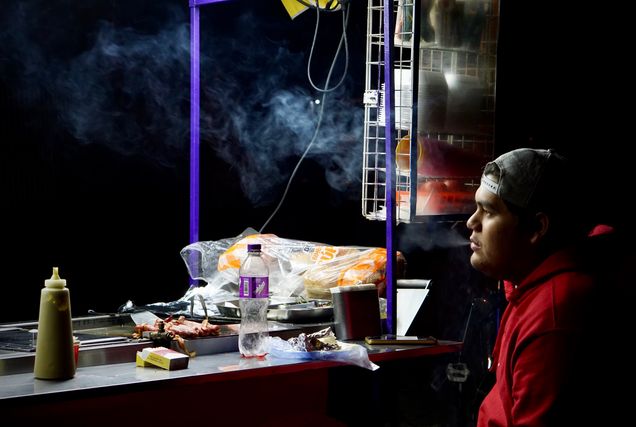
“Why blame the night, if they kill you by day?” | “¿Qué culpa tiene la noche, si te matan de día?”
Food stands, with their bright lights, draw together sleepless neighbors and strangers, a nocturnal sociability they won’t give up easily. Taxi drivers, policemen, overnight hospital staff coincide. After midnight, the conversations grow more philosophical, as they connect bits of stories that will never appear in a newspaper. Colonia Duero, Zamora, Michoacán, 2022. Los puestos de comida con sus luces convocan de lejos a convivir con vecinos o desconocidos, una sociabilidad que no se rinde. Taxistas, personal de urgencias, policias coinciden. Después de la medianoche, la conversación suele volverse más filosófica. Se juntan pedacitos de noticias que nunca saldrán en un periódico. Colonia El Duero, Zamora, enero de 2022.

Family observing a nine-day period of mourning called a novenario. | Novenario pandémico, Colonia El Duero, Zamora, Michoacán, 2020.
The picture on the small altar is of a loved one who had died of Covid. Zamora, Michoacán, 2020.
The BUCH Gallery, located just outside the offices of the BU Center for the Humanities at 725 Commonwealth Ave, launches its inaugural exhibit as part of the Pedestrian Space forum March, 2026: Photos of Zamora featuring photographers Laura Rousch and Samuel Rivera.
These photographs explore and dissect notions of access, accessibility, safety and their opposites.