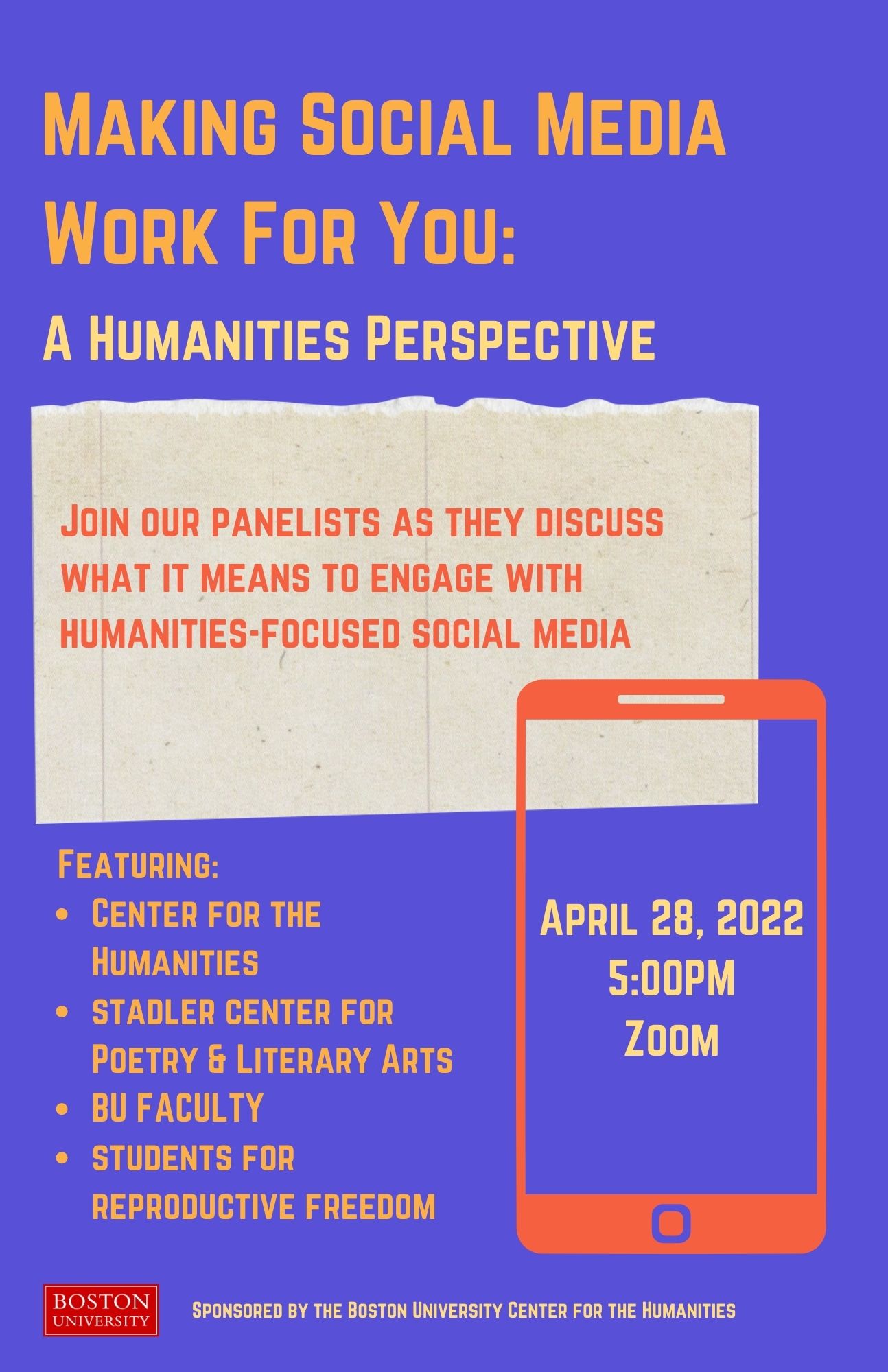
 Although many people consider social media dangerous at worst and a waste of time at best, it can also serve as a forum for generative conversations that.“Making Social Media Work for You: A Humanities Perspective” examined how members of the BU community can engage with social media to participate in academic discussions and to promote projects and events in the humanities.
BUCH student staff member and Social Media Coordinator Giovanni DiMaggio led a virtual conversation with a broad range of panelists who use social media for organizational, academic, and advocacy purposes. Although they all acknowledged the inherent flaws of social media platforms, each panelist has also successfully harnessed social media to advance their work in the humanities.
Undergraduate David Winner (CAS ‘23 PH & WLL) explained how labor-intensive humanities projects have leveraged social media to crowdsource contributions. He used the example of UCL Transcribe Bentham, a project that recruited volunteers to transcribe over 29,000 pages of philosopher Jeremy Bentham’s unstudied manuscripts. The project’s success owes much to this large base of self-proclaimed “Bentham-ites” who collaborated via various social media platforms.
Professor Hannah Čulík-Baird (Classical Studies) organizes an annual online conference, Res Difficiles, which aims to “create a space where those who study and teach the ancient Greco-Roman world can address inequities within the field of Classics.” She discussed the utility of her professional Twitter account (@opietasanimi) in communicating and collaborating with Res Difficiles participants, panelists, and audience members from around the world, many of whom she has never met in person.
Joshua Garcia, social media manager for the Bucknell Stadler Center, uses social media to promote the Stadler Center’s events and to highlight poetry by members of its community. He drew an analogy between a social media post and a highway billboard, emphasizing that both are often viewed for just a few seconds. He acknowledged the challenge of designing social media posts about nuanced humanities content for brief viewer interaction.
Undergraduate Giovanni DiMaggio (CAS ’22 EC & PH-PO) found that the recent expansion of BUCH’s social media on Instagram and Facebook has brought more visibility to the Center on campus. Much of BU’s vast community does not physically pass by the Center, but social media heightens students’ awareness of humanities offerings and activities university-wide.
The panel discussion brought forth a nuanced view of social media. Thoughtful use of different platforms has allowed all panelists to find audiences for exciting work in the humanities and to engage with online communities that share common interests.
By Giovanni DiMaggio