News
NSF, NIH Remind Grantees to Report Foreign Support
BU IN DC
Dean Jeffrey Hutter, Maria Kukuruzinska, and Marianne Jurasic of the Goldman School of Dental Medicine met with National Institute of Dental and Craniofacial Research Director Martha Somerman and National Institutes of Health Principal Deputy Director Lawrence Tabak on June 27.
Christina Rice and Jay Darby of the School of Law presented their students' comments regarding opportunity zone tax incentives at a U.S. Department of the Treasury public hearing on July 9.
Roscoe Giles of the College of Engineering spoke about the future of exascale computing at a meeting of the Basic Energy Sciences Advisory Committee at the U.S. Department of Energy on July 11.
NIH, NSF REMIND GRANTEES TO REPORT FOREIGN SUPPORT
Last week, both the National Institutes of Health (NIH) and the National Science Foundation (NSF) issued notices reminding grantees of their obligation to report international sources of financial support for their research. The announcements from both agencies emphasized that "international collaboration is essential to pursuing the frontiers of science," but reflect concern by federal scientific agencies that other nations are not "upholding the [scientific] values of openness, transparency, and reciprocal collaboration." NSF plans to launch an electronic form for investigators to submit bio-sketches by early next year, in order to make disclosures easier. NIH does not view its announcement as a change in its existing policy.
BUZZ BITS...
- National Institutes of Health Director Francis Collins announced last week that National Institute of Environmental Health Sciences (NIEHS) Director Linda Birnbaum will retire in October after leading NIEHS for ten years. NIEHS Deputy Director Robert Woychik will serve as acting director while a search for a replacement is conducted.
- The National Science and Technology Council Joint Committee on Research Environments met on July 9 to discuss new initiatives the federal government could undertake to ensure safe and inclusive research environments, rigor and integrity in research, research security, and reduced administrative burden.
- The National Oceanic and Atmospheric Administration (NOAA) is requesting public input on its draft research plan for the years 2020 through 2026. The current draft identifies reducing the societal impact of extreme weather, sustainable use of the ocean and coastal resources, and a robust research enterprise as priority areas. Comments are due by August 26.
DOE SEEKS INPUT ON MICROELECTRONICS INITIATIVE
The U.S. Department of Energy's (DOE) Office of Science plans to significantly increase research activities and funding for microelectronics, and specifically to meet the needs of more compact and efficient high-performance computers and a modernized electricity grid. Last week, DOE announced it is seeking recommendations for its new basic research initiative in microelectronics, and asking stakeholders whether a focus on the following topics is appropriate: materials, chemistry, surface science and plasma science and technologies; device physics and circuits; component integration, architecture, and algorithms; and next-generation tools for synthesis, fabrication, and characterization. Investigators who want to play a role in shaping the agency's future funding opportunities in microelectronics should submit comments prior to August 30.
Buzz Bits. . . IRS Releases Draft Endowment Tax Rules
BU IN DC
Ziv Feldman and Peter Garik of the Wheelock College of Education participated in the 2019 Noyce Summit sponsored by the National Science Foundation on July 11.
BUZZ BITS...
- The National Institutes of Health announced that National Eye Institute (NEI) Director Paul Sieving will retire on July 29 after nearly twenty years in the role. NEI Deputy Director Santa Tumminia will serve as interim director during the national search for a replacement.
- The U.S. Senate confirmed Lane Genatowski as the director of the Advanced Research Projects Agency-Energy at the U.S. Department of Energy. Mr. Genatowski, an investment banker from Houston, was first nominated in July 2018.
- The U.S. Senate also confirmed Robert L. King to be the assistant secretary for postsecondary education at the U.S. Department of Education. Dr. King previously served as president of the Kentucky Council on Postsecondary Education and chancellor of the State University of New York system. He has been serving as a senior advisor to the Department while awaiting confirmation.
IRS RELEASES DRAFT ENDOWMENT TAX RULES
On July 3, the Internal Revenue Service (IRS) released draft guidance on how it plans to implement the private college endowment excise tax that was signed into law in December 2018. While Boston University is not among the 40 institutions subject to the tax at this time, the University joined the higher education community in opposing the tax because it takes away financial resources nonprofit colleges can use for students. The 1.4% tax on net investment income applies to private colleges with more than 500 full-time, tuition-paying students and assets valued at $500,000 or more per student. The draft IRS guidance is open to public comment until October 1.
GRANTS NEWS YOU CAN USE
The Office of Naval Research (ONR) released a special notice on June 28 to solicit basic and applied research proposals for new artificial intelligence (AI)-based techniques to advance future naval applications. ONR is seeking AI research proposals in eight fundamental and/or applied research topics: AI for Predictive Maintenance; Rapid Learning of Task Procedures; Scalable Verification and Validation Tools for Artificial Intelligence in the Naval Domain; Brain-Inspired Deep Learning with Spiking Neurons; Brain-based computation; Explainable AI Systems; Mission-focused AI; and Predictive Adaptations to Support Human Performance and Injury Prevention. White papers are strongly encouraged and due on August 15, and full proposals are due on October 15.
Elmore Delivers Boston’s Famed July 4th Speech
 COMMUNITY RESOURCE
Elmore Delivers Boston's Famed July 4th Speech
Kenneth Elmore, BU's associate provost and dean of students, delivered the Independence Day oration at Faneuil Hall, joining a 246-year tradition at Boston's iconic marketplace. Let's celebrate
 RESEARCH HIGHLIGHT
How Does CTE Impact Women?
While the country cheered on Team U.S.A in the women's World Cup, researchers at the BU CTE Center launched a first-of-its-kind study that will analyze the brains of female former professional soccer players, with support from the National Institute on Aging. Find out why.
 ON THE CHARLES RIVER
A Part of LGBTQ History
Nearly 50 years ago, BU was home to the first publicly advertised gay student group in the area. The gathering spot has been recognized on the History Project's Stonewall 50 map. See where history was made.
IN CASE YOU MISSED IT...
BU School of Medicine Dean Karen Antman is taking a leading role to end gender harassment in medicine... BU political scientists Neta Crawford and Rosella Capella Zielinski warn about the cost of war with Iran in The Boston Globe... BU Global Development Policy Center researchers explain how the pharmaceutical industry will benefit from the U.S.-Mexico-Canada trade agreement in The Hill... Cara Stepp of BU Sargent College and Steve Ramirez of the BU College of Arts & Sciences were awarded the Presidential Early Career Award for Scientists and Engineers.
Policymakers Address Artificial Intelligence
BU IN DC
The Pardee School of Global Studies hosted an alumni event to welcome incoming freshmen from the Washington, D.C., area on June 24.
POLICYMAKERS ADDRESS ARTIFICIAL INTELLIGENCE
Last week, the National Science and Technology Council released an updated National Artificial Intelligence (AI) R&D Strategic Plan to reflect changes in the field since the report was first released in 2016. The report includes a new mandate for expanded federal public-private partnerships. It also calls for better understanding of the legal, ethical, and social scope of AI, robust investments in federal research, and designing methods of human-AI collaboration. Congress also explored the public policy implications of AI this week, with a hearing on ethical AI in the House, and one on how algorithmic decision-making online affects consumers in the Senate.
BUZZ BITS...
- The U.S. House of Representatives continues to work through the annual budget process, passing five spending bills on Wednesday that would increase budgets for the National Science Foundation, the National Aeronautics and Space Administration Science Mission Directorate, and the National Endowments for the Arts and Humanities. The U.S. Senate has not begun work on its annual spending bills, making it unlikely a final spending package will be approved soon.
- This week, the U.S. Senate passed the National Defense Authorization Act, an annual defense policy bill that lists artificial intelligence and quantum information as defense research priorities. The House plans to vote on its bill after the July 4th break.
- The White House Office of Science and Technology Policy and the U.S. Department of Veterans Affairs are seeking input on a federal research strategy to address mental health and suicide among veterans.
GRANTS NEWS YOU CAN USE
The U.S. Department of Education’s Institute of Education Sciences (IES) has announced its fiscal year 2020 competitions for education research. IES plans to host eight competitions that address a range of relevant topic areas through the National Center for Education Research and the National Center for Special Education Research. While much of the funding call mimics last year’s topics and priorities, the current notice introduces two new competitions focused on the systematic replication of findings in education and special education research. Applications for all the competitions will become available July 11, with most proposals due by August 29.
Karen Engelbourg Named Senior Vice President for Development & Alumni Relations
A key player in University’s first comprehensive fundraising campaign, she’ll succeed Scott Nichols

Karen Engelbourg, BU’s vice president for development, has been promoted to senior vice president for development and alumni relations, succeeding Scott Nichols. Photo by Jackie Ricciardi.
Boston University has tapped Karen Engelbourg, vice president for development and a pivotal player behind the success of the University’s first comprehensive fundraising campaign, as the new leader of Development & Alumni Relations (DAR).
She will take over October 1 as DAR senior vice president from Scott Nichols following the campaign’s conclusion in September. Engelbourg has managed individual giving during the $1.5 billion campaign, overseeing a 90-person team. (The fundraising target was reset after gifts surpassed the initial $1 billion goal.) She was selected for the position as a result of a national search conducted by a six-member committee of trustees and senior leaders.
“This is an exciting time for both DAR and the University,” Engelbourg says, “allowing us to deepen collaborations with BU schools and colleges.”
She continues her family’s legacy of BU involvement: her father, Saul Engelbourg, is a College of Arts & Sciences professor emeritus of history and her husband and her brother are both Questrom School of Business alumni.
Working with the campaign, she says, has given her insights into “building a culture of philanthropy. BU’s alumni have turned out to be incredibly generous and supportive of the strategic priorities laid out by President [Robert A.] Brown and the trustees.” She cites one datum: before the campaign, BU had received a total of 34 gifts of $1 million or more in its 173 years, and during the 7 years of the campaign it netted more than 200 such commitments from individuals, foundations, corporations, and groups.
“That has been a sea change and transformative for BU,” she says, as has the almost $500 million given to the campaign by BU school, college, and other advisory boards.
“Karen has led the principal and major gift effort of our campaign with incredible skill and energy,” says Brown, who appointed Engelbourg. “I expect that the new strategic plan for Boston University—due for completion and consideration by the trustees early next year—will expand our aspirations and set the stage for a new, more ambitious fundraising effort in the near future. Expanding Development & Alumni Relations to lead this next effort will be critical to our success. I have every confidence that Karen Engelbourg is the person to lead this effort.”
“Simply put, no one could be better prepared,” Nichols says. “She’s been leading our efforts on some of the most important cases for the University. She is, without question, the most qualified person in the country to take this job.” With philanthropy “very much a team sport, what Karen excels at is building and leading a highly effective, professional team that integrates beautifully.”
Kenneth Feld (Questrom’70), chair of the Board of Trustees and a member of the search committee, lauds Engelbourg’s “understanding and planning of what is needed organizationally for BU to transition from the ending of the current campaign to the creation of the next campaign. With her knowledge and experience, Karen has the ability to take BU to the next level in fundraising, alumni engagement, and international support.”
“Karen stood out in our interviews as having the best vision for how the development office could be revamped to prepare for the next campaign,” adds search committee member Carla Meyer (SSW’78), vice chair of the Board of Trustees. “With sophisticated research, data analysis, and strategic deployment of development staff, she will devise a strategy that will appeal to a broad spectrum of alums, including those who are young, diverse, or international.”
“The quality of BU’s academic enterprise,” Engelbourg says, “its emphasis on scholarship, and accessibility for the best and brightest to come here really motivate me. I am also motivated to focus on developing a more diverse organization to more effectively embrace our diverse groups of alumni and other potential donors.”
“Karen has the leadership skills and the experience to take on this critical role and to drive the next phase of our comprehensive campaign, as well as leading our next generation of work in alumni relations,” says Jean Morrison, provost and chief academic officer, who was a member of the search committee.
The current campaign’s success relied on an alumni body that ranks 19th in the world for wealth. All told, more than 150,000 individuals and groups have given to BU’s campaign, their gifts creating, among other things, 250 new scholarships; new research support for the School of Medicine that includes the Shamim and Ashraf Dahod Breast Cancer Research Center; a facelift of the campus, with new buildings such as the Joan and Edgar Booth Theater and the Rajen Kilachand Center for Integrated Life Sciences & Engineering; and support for academic units, leading, for example, to the naming of the Questrom School of Business and the Frederick S. Pardee School of Global Studies.
“Karen assumes the leadership of Development & Alumni Relations at a critical time for the University,” Brown says. The current campaign’s success “has created new energy among our alumni and friends and has demonstrated the critical importance of alumni engagement and philanthropic support in sustaining and accelerating our progress.” (Brown has made outreach to alumni a focus of his presidency.)
Engelbourg came to BU in 2010 as MED’s assistant dean for development, and she assumed the position of DAR vice president of development in 2013. Prior to that, she was an assistant vice president at Brandeis, director of donor relations and principal gifts officer at Boston Children’s Hospital, and director of major gifts at Harvard Medical School.
She is a graduate of Brandeis, where she earned a B.A. in history.
Authors, BU Today staff.
BU Establishing New Data Sciences Faculty Unit
New academic entity aims at preparing students for work of tomorrow

The creation of the Faculty of Computing & Data Sciences and the construction of the Center for Computing & Data Sciences (shown above) will help BU equip generations of students with data science expertise. Image courtesy of KPMB Architects.
With BU planning to build a state-of-the-art Center for Computing & Data Sciences at the heart of its Commonwealth Avenue campus, President Robert A. Brown and Provost Jean Morrison announced this week they will propose to the Board of Trustees to create a novel collaborative, interdisciplinary faculty unit that will further strengthen the University’s commitment toward this exploding field in research and education.
In a letter sent to the BU community, Brown and Morrison said the aim of the new unit, to be called the Faculty of Computing & Data Sciences (CDS), will be to bolster University efforts to hire and retain faculty across all the disciplines that intersect with computing and data sciences. And it will facilitate educational and research programs that will attract ambitious and academically accomplished undergraduate and graduate students who will be well prepared to do the work of the future. The new Faculty of Computing & Data Sciences, they said, will have a collaborative structure that serves as an interface between the traditional academic departments and faculty and students interested in computing and data sciences.
“The creation of the Faculty of Computing & Data Sciences and the construction of the Center for Computing & Data Sciences gives Boston University the ingredients to be a leader in the development of computing and data sciences and their applications across the University and to educate generations of students with this competency,” says Brown.
Morrison, who also serves as BU’s chief academic officer, says the distributed nature of the Faculty of CDS is well suited to a field that has been embraced by departments across the University.
“Student demand for education in computing and data sciences is pervasive across our schools and colleges,” she says. “There are exciting opportunities for research in these disciplines and in their application, and the University is responding to these opportunities.”
Brown says the structure of the new academic unit was recommended by a special Task Force to Envision Data Sciences at Boston University, chaired by Daniel Kleinman, associate provost for graduate affairs and a College of Arts & Sciences professor of sociology, and Azer Bestavros, a William Fairfield Warren Distinguished Professor, a CAS professor of computer science, and founding director of the Rafik B. Hariri Institute for Computing and Computational Science & Engineering.
“In meetings with the faculties of BU’s schools and colleges the task force found support for a new kind of academic unit,” Brown says. “The Faculty of CDS will be led by a newly appointed associate provost for computing and data sciences, and will be composed of members with full-time appointments in the new unit and faculty members with 50 percent appointments in the CDS and 50 percent in a traditional school or college.”
Morrison says strategies for faculty hiring and academic programs will be developed in consultation with an academic advisory council composed of academic leadership and faculty from the schools and colleges with the largest interfaces with the Faculty of CDS. The Hariri Institute will have a similar advisory group focused on setting the research priorities of the Institute.
The provost will solicit input into who should serve as the associate provost for computing and data sciences, and will lead the formation of committees to advise on important administrative policies and strategic faculty issues such as tenure, curriculum, and new programs.
Bestavros praises the University’s decision to create this type of new unit. “Setting up a faculty body with some significant number of members who are also embedded in existing departments and colleges marks an important departure from the typically siloed organization of academic units,” says Bestavros. “It speaks volumes to BU’s forward-looking institutional strategy that recognizes the significant synergies that result from connecting like-minded scholars from a multitude of traditional disciplines with one another.”
The move to create a new faculty unit comes less than a year after BU unveiled proposed plans to build its Center for Computing & Data Sciences at the corner of Comm Ave and Granby Street. The dramatic building, which would bring the mathematics and statistics and computer science departments under one roof, would be the first major teaching center on the Charles River Campus in half a century, and if approved by the city of Boston, the tallest building on campus.
BU’s investment in the world of data and computer sciences comes at a time when companies large and small are gobbling up unfathomable amounts of data every day and finding new ways to study and analyze and use it. Google handles 40,000 searches per second, or 3.5 billion per day. Four million videos are watched on YouTube a day, nearly 500,000 tweets are sent on Twitter every second, and roughly 11 million Apple Pay transactions are made every day.
Kleinman, whose role includes the oversight of BU’s roughly 2,000 doctoral students, says the interdisciplinary nature of the new effort offers significant benefits to the University. “Ideally, it’s about crossing boundaries and building bridges, so a traditional college and departmental structure is likely not the best way to bring the greatest possible benefits of data science to BU,” says Kleinman. “Instead, we need a porous organization, one that interested faculty and students can enter with ease. Furthermore, given the challenges of building an interdisciplinary field in a disciplinary environment, which universities are, we need an entity that can offer tenure to faculty who might not easily fit in disciplinary units, and that can provide salary support for faculty fully or partially appointed in the new unit. The new Faculty of CDS has been conceived with a clear recognition of the challenges of building an interdisciplinary initiative in a university organized primarily around disciplines.”
Stan Sclaroff, dean of Arts & Sciences and a professor of computer science, says the creation of the new Faculty of CDS will help deepen the data science research and teaching that is now happening in programs across the University, on both the Charles River Campus and the Medical Campus.
“The establishment of joint faculty appointments in the Faculty of CDS provides a crossroads for like-minded faculty and students who are applying data science methods in the social sciences, natural sciences, and humanities,” says Sclaroff. “It also does so for faculty from the professional schools like LAW, Questrom, Communication, MED, School of Public Health, and elsewhere, whose research is propelled by massive advances in the computational and data sciences.”
“Experts in fields like electrical and computer engineering, computer science, and mathematics and statistics are forging foundational advances in core areas of data science, like machine learning, algorithms, and statistics,” he says. “Continued advances in these areas feed directly into cross-disciplinary, computational, and data sciences applied research. Thus, having a faculty of data science affiliation and access to community promises to be a powerful attractant for top faculty and students. And the planned Data Sciences Center provides a locus for the data science community on the Charles River Campus.”
In their letter to the community, the president and the provost said they hope to have the detailed planning of the Faculty of Computing & Data Sciences well underway by the time the Board of Trustees moves to approve its formation at its September meeting.
BU’s Initiative on Cities Gets New Codirector
Katharine Lusk has played a key role in University’s urban research

Katharine Lusk, who has served as executive director of BU’s Initiative on Cities since its founding in 2014, has just been named codirector of the institution. Photo by Jackie Ricciardi.
Katharine Lusk, who helped grow BU’s Initiative on Cities (IoC) into an urban information highway where data travels between political leaders and academic researchers, has been promoted to codirector of the institution.
Lusk, who has been the IoC’s executive director since its founding in 2014, will retain those duties. She came to BU at the behest of the late Thomas Menino (Hon.’01), longtime Boston mayor, and is taking his old title as codirector. She had served as a policy advisor to Menino at Boston City Hall prior to his arrival at the University, spearheading his efforts to make Boston the first city in the country to achieve pay equity for women. Prior to entering public service, she worked as a brand strategist and researcher for several Fortune 500 companies.
“The new title is a reflection of the evolution of my role,” Lusk says. She has “been playing an expanded role with regard to research,” leading studies, for example, of policy networks among cities and mayors’ action on public health.
She and Lucy Hutyra, a College of Arts & Sciences associate professor of earth and environment, have worked on a project, funded by the National Oceanic and Atmospheric Administration, to hook up city leaders and carbon-cycle researchers to assist municipal efforts against climate change. Lusk also cites several projects with Azer Bestavros, a William Fairfield Warren Distinguished Professor, a CAS professor of computer science, and founding director of BU’s Rafik B. Hariri Institute for Computing and Computational Science & Engineering, including a paper on effective ways that cities, universities, businesses, and federal agencies could collaborate on community problems.
For students, she helped spearhead MetroBridge, the IoC program that has various BU classes team up with New England municipalities to address urban problems.
“Katharine’s vision and drive have been central to the success of the IoC,” says Graham Wilson, founding codirector of the IoC and a CAS professor of political science. “Her new title reflects the reality of her important role. I’ve greatly enjoyed working with Katharine and look forward to continuing to do so.”
As codirector, Lusk says, she hopes to launch new IoC initiatives, including a nascent “public impact fellowship,” to “equip more tenure-track and tenured faculty with the knowledge and skills needed for policy impact.”
“We see some of this work happening already but have heard from faculty that they wish they had an expanded toolkit to draw on as civically and politically engaged scholars,” she says. “It’s been rewarding to lead some related efforts for doctoral students as part of BU Urban,” the University’s new PhD program teaching interdisciplinary skills in addressing urban pollution and extreme weather events. “I’m looking forward to building on that” with faculty, she says.
In fact, this is something of a golden age for “being an urbanist at BU,” says Lusk, who serves on the advisory boards for BU’s Center for Innovation in Social Work & Health, the City Planning and Urban Affairs program, the Institute for Sustainable Energy, and the Urban Climate Initiative, and is a Hariri Institute fellow.
“I’m a firm believer that the way we break down barriers between silos is by connecting people, and I enjoy being a human bridge. My peers at other institutions think I’m a bit nuts to serve on so many advisory boards,” with city-related student work happening at numerous BU programs. But “it’s important to have a seat at different tables, to be able to offer my perspective, connect people with common interests, and bring the perspectives and lessons of others into our work.”
Author, Rich Barlow can be reached at barlowr@bu.edu.
Congress, NIH Address Harassment in Academia
BU IN DC
School of Medicine Dean Karen Antman attended the Association of American Medical Colleges (AAMC) Council of Deans Administrative Board meeting on June 18th and spoke at AAMC's Leadership Conference on Sexual Harassment on June 19.
Shamiran Mako and Joshua Shifrinson of the Pardee School of Global Studies attended Bridging the Gap's International Policy Summer Institute from June 9 through 13.
CONGRESS, NIH ADDRESS HARASSMENT IN ACADEMIA
On Thursday, the House Science, Space, and Technology Committee unanimously passed the Combating Sexual Harassment in Science Act (H.R. 36), a bipartisan bill to create uniform guidelines for reporting sexual harassment by grantees to federal research agencies. The Committee's vote came soon after a National Institutes of Health (NIH) advisory committee released interim recommendations that propose: treating professional misconduct as seriously as research misconduct; requiring NIH applicants to attest they have not violated their institution's anti-harassment policies; providing victims of sexual harassment with a path for reentry into research; and developing alternative funding models that give trainees independence from their mentors. The NIH committee plans to further develop these proposals and issue a final report in December.
BUZZ BITS...
- The U.S. House of Representatives passed four spending bills on Wednesday that would increase next year's NIH budget by $2 billion, the U.S. Department of Energy Office of Science budget by $285 million, and Federal Work-Study financial aid by $304 million. The U.S. Senate has not yet considered similar legislation.
- The House Ways and Means Committee approved a bill on Thursday that would repeal a tax nonprofit organizations, such as colleges, pay for the parking and commuter benefits they provide to employees; the tax was enacted in the 2017 Tax Cuts and Jobs Act. It is unclear when the bill will be considered by the House or Senate.
- The U.S. Department of Energy announced a new policy earlier this month that prohibits employees and contractors, including personnel at national labs, from participating in foreign talent recruitment programs from China, Iran, North Korea and Russia.
GRANTS NEWS YOU CAN USE
Are you looking to take the next step in your research and compete for large federal grants that support centers and significant collaborations? The latest guide from Lewis-Burke Associates is now available for the BU community and provides the status and timing of flagship funding opportunities across federal agencies. With topics ranging from the National Institutes of Health Specialized Programs of Research Excellence in Human Cancers (SPOREs) to the Department of Defense Multidisciplinary University Research Initiatives (MURI) Program, the compendium is an excellent resource for investigators who are considering pursuing notable federal grants.
Adelaide Cromwell (Hon.’95), Founder of BU’s African American Studies Program, Dies at 99
A distinguished sociologist from a distinguished family
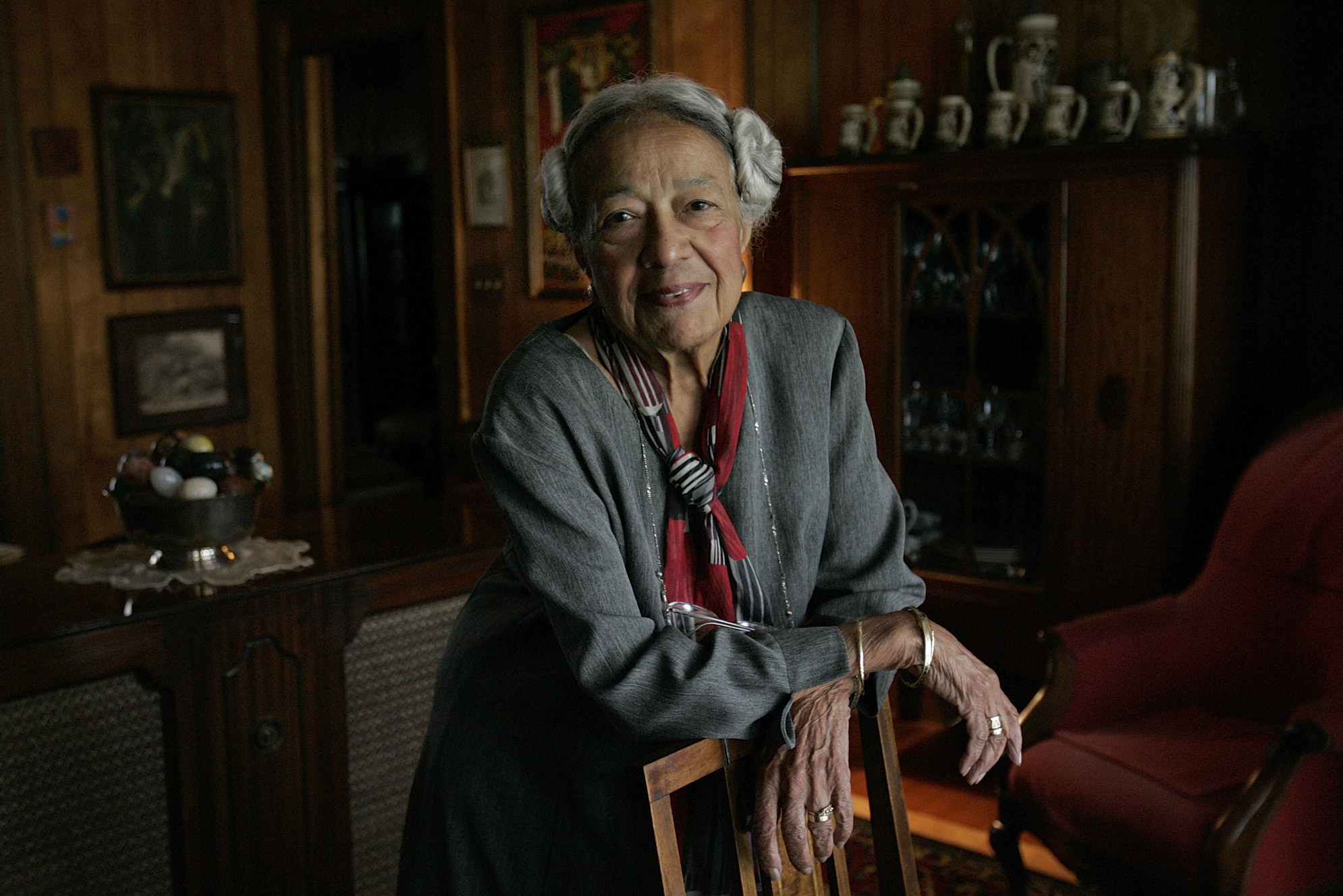
Adelaide Cromwell, a sociologist renowned for her research on black leadership who joined the BU faculty in 1951 and cofounded the University’s African Studies Center and founded BU’s African American Studies program, died June 8, five months shy of her 100th birthday. Photo by Suzanne Kreiter/Boston Globe staff.
It isn’t every professor who can study her own heritage. Classicists aren’t ancient Greeks; computer scientists aren’t, well, machines. But sociologist Adelaide Cromwell (Hon.’95), scion of an African American family of overachievers, forged a distinguished career studying a group she knew intimately: black leaders, political and otherwise, here and in Africa—including her own relatives.
“Mercedes Africans,” she called them.
The longtime Brookline resident, who died June 8 in hospice care, five months shy of her 100th birthday, cofounded the University’s African Studies Center in 1953, two years after joining the faculty. More than 90 faculty and researchers spanning BU are affiliated with the Center today, which not only oversees courses here but arranges study for Terriers at Harvard, Northeastern, MIT, Tufts, and Boston College. At the time of her death, she held the title professor of sociology emeritus.
In 1969, Cromwell founded BU’s African American Studies program, the country’s second such program after San Francisco State’s and the first to offer a graduate degree in the subject. She began the program partly as a response to the civil rights movement and the shock following the assassination of the Rev. Martin Luther King, Jr. (GRS’55, Hon.’59) the year before.
“As with the great upsurge of activism in the late 60s, many programs began to be pressured to address the interests of black students, but also to address the racism of both faculty and students in higher education,” says Louis Chude-Sokei, a College of Arts & Sciences professor of English, the George and Joyce Wein Chair in African American Studies, and director of the African American Studies Program. “There was a general lack of knowledge and information about black peoples and their contributions to history and the world.”
“She was a leading figure in rectifying that via establishing the program” before retiring from BU in 1985, he says. “She was an expert on the black elite in America and in Africa.”
When Colby College awarded Cromwell an honorary Doctor of Laws in 2011, her citation read, “Your books, edited volumes, and articles on Africa, on Boston’s black upper class, on African feminism and African education, and on your own family’s historical connections to the making of America compose a rich scholarship that reaches across three centuries and that unveils the contributions of black Americans to a changing America and world.”

Cromwell received the Spirit of King Award in 2014 at BU’s Black Alumni Welcome Reception. Photo by Jackie Ricciardi.
Cromwell was born in Washington, D.C., in 1919. Her book Unveiled Voices, Unvarnished Memories: The Cromwell Family in Slavery and Segregation 1692–1972, published when she was 87, is a family history that recounts her relatives’ many firsts.
Her father was Washington’s first black certified public accountant, she said. Her aunt, Otelia Cromwell, was the first African American woman to receive a doctorate from Yale University.
Otelia Cromwell was a 1900 graduate of Smith College in Northampton, Mass., from which her niece received her own bachelor’s degree in 1940, and where Adelaide would become, in the late 1940s, the first African American faculty member. She’d broken the race barrier already, in 1946, as the first black faculty member at Hunter College in New York City.
In addition, the Cromwells were related to Edward Brooke (LAW’48, Hon.’68), the late US senator from Massachusetts who was the first African American popularly elected to the Senate.
Cromwell earned a master’s degree from the University of Pennsylvania and a doctorate in 1953 from Radcliffe, where her dissertation focused on Boston’s African American elites. Focusing on such lesser-known communities as Martha Vineyard’s black residents and African American graduates of prestigious Boston Latin School, the book was published more than four decades later as The Other Brahmins: Boston’s Black Upper Class 1750–1950.
What remained constant through her multi-institution career was her scholarly interest in black leadership. She traveled numerous times to Africa, visiting countries from Ghana to Liberia to the then Belgian Congo. (Her trip predated its 1960 independence and later rebirth as the Democratic Republic of the Congo.)
These inquiries yielded a body of work that Colby College’s citation lauded: “We honor you today for nourishing a spirit of inquiry and discovery in African studies and in African American studies that has inspired scholars and communities throughout the world.”
A memorial service for Cromwell will be held at Marsh Chapel on November 5 at 1 pm.
BU Provost Testifies on Harassment in Science
 BU IN DC
BU Provost Testifies on Harassment in Science
Boston University Provost Jean Morrison explained how BU is combating sexual harassment before a House Science, Space, and Technology Committee hearing.
Here's what she said
 ON THE CHARLES RIVER
New COM Dean Is a Trailblazer
Mariette DiChristina (COM '86), the first female editor-in-chief of Scientific American, will become the new leader of the BU College of Communication.
Read the breaking news
 RESEARCH HIGHLIGHT
Framingham Heart Study Hits The Road
The landmark study on cardiovascular disease will use a $21 million grant from the National Institutes of Health to research health conditions in the rural South.
Get to the heart of the matter
IN CASE YOU MISSED IT...
The BU Global Policy Development Center has released new policy briefs on the risks of the new United States-Mexico-Canada Agreement (USMCA)... Azer Bestavros of the BU Rafik Hariri Institute for Computing and Computational Science & Engineering spoke about ethical artificial intelligence at the Amazon Public Sector Summit... School of Public Health Dean Sandro Galea outlined the social and political underpinnings of poor health on NPR... Neta Crawford of the BU College of Arts & Sciences explains the Department of Defense's role in climate change.