News
Tutoring Program Celebrates 20 Years
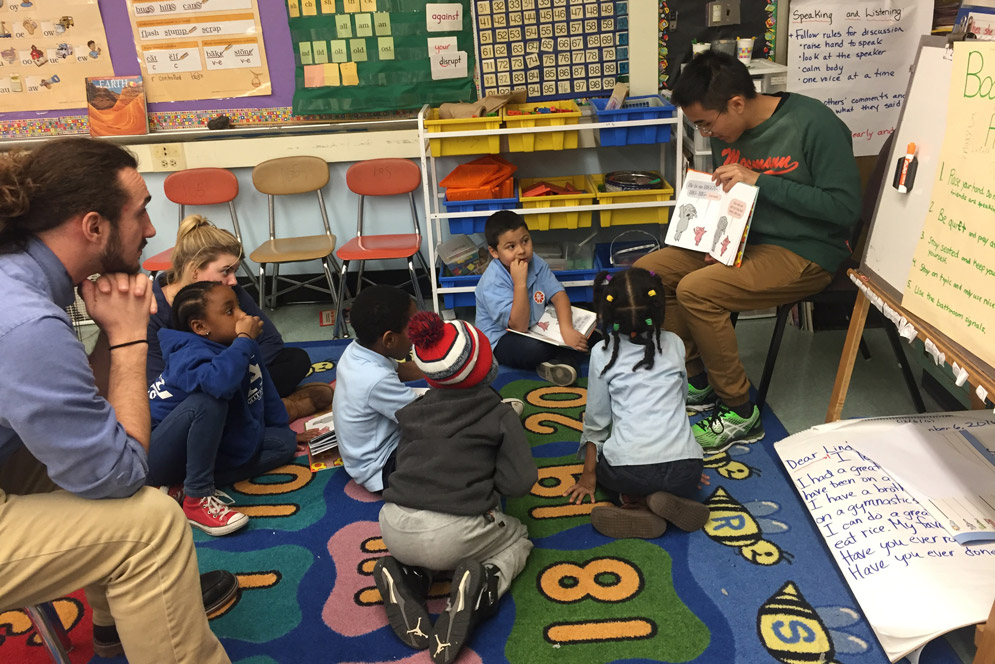 ON THE CHARLES RIVER
Tutoring Program Celebrates 20 Years
The BU Initiative for Literacy Development brings Federal Work Study students into Boston public schools. Celebrate with us
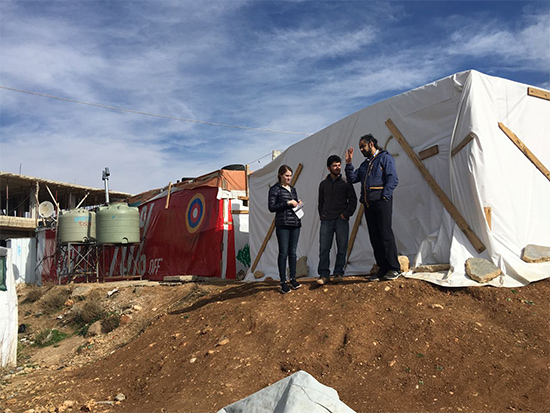 STUDENT LIFE
Improving Life in Refugee Camps
BU engineering students apply their skills to help Syrian refugees in Lebanon. Find out how
 FACULTY EXPERT
Lobsters on the Line
BU biologist Kari Lavalli learns what’s killing crustaceans. Take a look
IN CASE YOU MISSED IT...
BU School of Public Health medical ethicist George Annas commented on the federal regulation of fertility clinics to The Associated Press... Pacific Standard featured research by Spencer Piston of the BU College of Arts and Sciences showing that African American political candidates are punished by voters for making ambiguous statements... Kevin Gallagher of the BU Pardee School of Global Studies coauthored an op-ed in The Hill about China's involvement with Africa.... Scientific American featured research by BU School of Medicine biophysicist Esther Bullitt that shows saliva may protect the body from traveler's diarrhea... BU School of Theology students traveled to the U.S.-Mexico border to learn about migrant ministry.
BU, MIT, Harvard Advocate for Research, Students
BU IN DC
Karl Kirchwey of the College of Arts & Sciences and Tamzen Flanders of the Center for the Humanities participated in the National Humanities Alliance's annual Humanities Advocacy Day on March 12 and 13.
Timothy Longman of the Pardee School of Global Studies provided a briefing to the new U.S. ambassador to Rwanda at the State Department on March 12.
BU, MIT, HARVARD ADVOCATE FOR RESEARCH, STUDENTS
On Friday, Boston University, Harvard University, and the Massachusetts Institute of Technology jointly urged the Massachusetts congressional delegation to augment federal programs which support students and research. The universities thanked lawmakers for their long-standing support for student aid and federal research agencies and asked them to continue their advocacy as Congress begins crafting the annual spending bills for fiscal year 2019. The memorandum identifies the National Institutes of Health, the National Science Foundation, the National Endowment for the Humanities, Pell Grants, and other investments as critical to the future of Massachusetts.
BUZZ BITS...
- Acting Administrator of the National Aeronautics and Space Administration (NASA) Robert Lightfoot announced he will retire at the end of April. He has led NASA on an interim basis since January 2017. The Trump Administration nominated Congressman Jim Bridenstine (R-OK) to serve as NASA Administrator in the fall, but his nomination is currently stalled in the U.S. Senate.
- The House Committee on Science, Space, and Technology held a hearing to review the National Science Foundation budget on Thursday. Lawmakers praised American leadership in science, offered competing opinions on the value of the social sciences, and inquired about the agency's plans to address harassment in science.
EVENT NEWS YOU CAN USE
As part of its Strategic Communications series, BU Research will present "Science Through Video: How to Tell a Compelling Story" on March 22 at 1:30 p.m. Journals, funding agencies, and media outlets often seek video assets when reporting on science. This informative panel discussion will help investigators learn how to use a camera -- such as the one in a cell phone -- to bring their science to life. Space is limited, and registration is encouraged.
Medical and Charles River Campus Groups Join in National School Walkout Yesterday
Part of countrywide school demonstrations after last month’s Florida shootings
 Some Medical Campus ralliers wore doctors’ coats, a reminder of gun victims they treat, others donned orange, the color of the national walkout against gun violence. Photo by Jackie Ricciardi.
Students and staff on both BU campuses joined the National School Walkout yesterday to protest gun violence, four weeks to the day after a gunman murdered 17 people at a Florida high school.
At least 300 people on the Medical Campus, some braced against freezing temperatures with just their white lab coats, crowded together off Talbot Green. Planned by students at the Schools of Medicine and Public Health, the rally, like those at more than 2,500 middle and high schools and some universities across the country, lasted 17 minutes, one for each of the students and teachers killed at Marjory Stoneman Douglas High School in Parkland, Fla.
On the Charles River Campus, the walkout drew several dozen people to gather on Marsh Plaza.
“A national movement has started,” declared Medical Campus keynote speaker Eileen Costello, a MED clinical professor of pediatrics and chief of ambulatory pediatrics at Boston Medical Center, MED’s affiliated hospital. “I speak for many pediatricians at Boston Medical Center and across the nation who are saying: Stop this now.
“How can members of Congress listen more to the NRA than to the voices of our children?” she asked. The National Rifle Association (NRA) opposes most suggestions for tightening gun safety laws. “We must stand with these students, our children, and our patients and call for laws that will keep automatic weapons of mass destruction out of civilian hands.”
“We call upon our national, state, and local leaders to take swift and decisive action,” Rebecca Webb (MED’20), one of the rally’s organizers, told the crowd.
Before the rally, BU Today spoke to several people attending the walkout. Co-organizer Aldina Mesic (SPH’18), a research study assistant at SPH, said that she was optimistic that the Florida tragedy, unlike previous mass shootings, would spur action against gun violence.

Students on Marsh Plaza were among demonstrators at more than 2,500 schools seeking tighter gun safety laws. Photo by Cydney Scott.
She cited Florida’s just-passed gun reforms, which include raising the allowable age for gun purchases to 21, something the NRA opposes, as well as an NRA-backed provision to arm school personnel.
“There’s clearly momentum around the country to address it in a number of ways,” Mesic said. “I do think that something will change and something will come of this.”
Co-organizer Anita Knopov (MED’19) voiced similar optimism. “The national dialogue has changed since the Parkland shooting,” she said. “We’ve seen stores distancing themselves from the NRA” by discontinuing discounts and other perks they’d offered to NRA members.
“And we’ve seen individual companies making new rules about the age of…buying a gun,” Mesic added. Dick’s Sporting Goods and Walmart have raised the minimum age for gun purchases to 21 since the Florida shooting.
“We just want to move it from just talking about thoughts and prayers…and expecting our national policymakers to actually do something to address the gun violence in this country,” she said.
Nicole Jeter (SPH’19) took time off from her maternal and child health class to attend the rally because “I have cousins and family that are in elementary schools, and I’ve seen the effect that it [news of violence] has on those children.” The large national walkout, she said, would have the “impact of everyone coming together to voice their opinions and to show the importance of working together.”
“Our MED faculty and students who rotate through our very busy emergency room at BMC see the toll that guns take every day in Boston,” said Karen Antman, dean of MED and provost of the Medical Campus.
“Students have taken the lead on this issue, starting with Florida, and now across the United States. I see no more effective group out there right now. Our generation has not succeeded. Maybe they can.”
Nikolas Cruz, the 19-year-old alleged Stoneman Douglas High School gunman, is facing the death penalty if convicted. His lawyers, who have offered a guilty plea in exchange for a life prison sentence, are expected to raise mental health issues to try to save his life. Cruz was a former student at the school where he went on a rampage on Valentine’s Day.
Author, Rich Barlow can be reached at barlowr@bu.edu.
Student Volunteers Share ASB Experiences on Instagram
Last week, 275 BU students and chaperones fanned out across the country, to Puerto Rico, and to Montreal for Alternative Spring Breaks, the annual week of service where students volunteer with local nonprofits. This year, students worked on projects ranging from environmental reform and public health to immigrant and refugee services and food justice. Along the way, they posted photos and videos documenting the highlights of their trip under the hashtag #BUASB.
Congratulations to all who donated their time and labor to help others.
Visit BU Today to view photos and highlights from some of the trips.
Collegiate Recovery Program Shows Students They’re Not Alone
Offers support for those recuperating from substance use
 The CRP stresses that recovering students have the same class and University obligations as their peers. Photo by Sophie Park (CAS’20).
- Collegiate Recovery Program is a supportive community for students facing addiction
- Students in CRP explain its importance
- Group dispels isolation, stigma that students in recovery can feel
The local bar was Megan’s study room.
During her sophomore year at another university, Megan began stopping by a local bar on weekend mornings to do schoolwork and grab a bite. She had few friends and was having roommate issues. After her schoolwork was done on a Sunday, she’d put away the laptop and drink while watching afternoon football—sometimes staying to watch the night game, where she’d continue drinking.
As Megan began drinking more, she went to class less. After graduating, she took a job back home and kept drinking until a cop pulled her over for a DUI. “I blew a .31 [blood alcohol content], almost four times the legal limit,” she says. She received a plea deal that required her to remain sober for a year, which she did, but she then resumed drinking. A year and a half ago she entered a recovery program.
Now closing in on graduation from the School of Law, Megan participates in the Collegiate Recovery Program (CRP), a year-old group for BU students in recovery from substance use run by Wellness & Prevention at Student Health Services. The program augments the University’s existing substance-related programming; it requires that participants’ full names be withheld in this story.
One of the CRP’s aims is dispelling the isolation and stigma that can beset a person in recovery, and through the program, Megan says, she’s been introduced to “people in similar situations—educated, in school, around my age—to maybe become friends with or at least hang out with every now and then. It was nice to meet some sober people.”
Open to any member of the University community who is in recovery or wants to begin it, the CRP’s goal is to help students stay sober and thrive. The program is clearly meeting a demand: starting out with just 2 attendees, Megan says, it grew to 30 within its first months. The program is currently funded by a three-year grant from the Nevada nonprofit Transforming Youth Recovery.
“The CRP has exceeded my expectations, but in a way, it has simply met them, as I already knew that these students could do remarkable things,” says Leah Barison, the Wellness & Prevention counselor leading the program. “Students have gotten sober, stayed sober, taken time off when needed, and returned to the CRP community.”
As with similar programs at other schools, the BU CRP hopes to help create a designated University residence for those in recovery in the future, Barison says. (Currently, BU designates certain suites within dorms as substance-free.)
Participants attest to the program’s value.

Source: Collegiate Recovery Program. Infographic by Meaghan Glendon.
“I moved around a fair amount throughout middle school and high school and was very accustomed to being the new girl; I was never very comfortable with myself,” says a sophomore in the program. That discomfort, as well as living in Cambodia, where legal alcohol restrictions were scant, led to her first drink: “I felt that I had found a solution to the void I had always been trying to fill.”
Arriving at BU, she was hospitalized for dangerous drinking before her freshman year classes even began, and again three weeks later. Barison worked with her, and it took several more months and almost flunking out before she committed to sobriety.
College can be a treacherous path for those in recovery; while some peers support her efforts at sobriety, the student says she also encounters “people who try to convince me that I can drink, that if I just controlled my drinking, I’d be fine.” The CRP is important because “when I was first getting sober freshman year,” she recalls, “I was under the impression that I was alone and didn’t realize there were other students at BU going through the same thing. The CRP brings us together.”
A junior in the CRP recalls starting to drink in eighth grade. In high school, he developed bipolar disorder, and after arriving at BU, became addicted to cocaine. He says living at the University can be hard on those in recovery; students sometimes violate the alcohol ban in freshman dorms, and none of the living-learning and specialty residences are designated for those in recovery, as for other communities.
BU takes pains to point out, through its mandatory first-year alcohol education program and other initiatives, that the perception of all students as Animal Houseimbibers is myth (more than one-third of Terriers don’t drink at all). But “I didn’t necessarily surround myself with people that were abstaining” before recovery, the junior says.
“I was around people that were responsible drinkers—plenty of them—but they were still drinking and doing recreational drugs. Being around a responsible drinker is still a triggering situation for me.”
A friend told him about the CRP, which offers communal activities with “fellow students who are having the same struggles,” he says, “anything from going to a BU hockey game together to seeing a movie together to having a paint night together to exploring different parts of Boston together.”
Today, he says, “I’ve kept sobriety and maintained sobriety and have definitely an amazing life right now. I have a wonderful relationship with my family, I’m doing great in school, my mental health symptoms are managed and going very well.”
A senior in the CRP says there is a damaging public misconception “that people who struggle with addiction are weak or lack willpower.… Someone who wants help may believe this misconception and then think that they’re not worthy of help.”
She “really fell in love with” the CRP, she says, because it fights that myth. “It’s really helpful to have a network of people who are going through something similar and are all here to support each other.”
For more information about the Collegiate Recovery Program, email Leah Barison at lbarison@bu.edu.
Author, Rich Barlow can be reached at barlowr@bu.edu.
BUILD Tutoring Program Celebrates 20 Years
Pairs work-study and Boston public school students
BUILD tutors and students at the Tobin School in Roxbury at their weekly book club. Photo courtesy of Michael Dennehy.
- The BU Initiative for Literacy Development (BUILD) sends work-study students to local public schools to tutor children and help develop literacy skills
- The organization celebrates its 20th anniversary tonight
- BUILD is co-run by BU Financial Assistance, Student Employment, and the School of Education
When Christine George signed up as a freshman for a work-study job reading to kids in Boston public schools, she wasn’t sure what she was getting herself into. It turned out to be a profound experience. Almost four years later, George (Sargent’18) is still working as a tutor and says it led to her decision to become a speech pathologist after graduation.
“I might have impacted a child’s life in small ways, but they have changed mine for the better,” she says.
George is one of 90 work-study students tutoring through the Boston University Initiative for Literacy Development (BUILD), a program that pairs BU students from virtually every school and college with more than 700 local public schoolchildren to help them develop literacy skills (some math tutoring is also provided). The tutors work with students from preschool through fifth grade at 13 in-school and after-school sites.
Tonight the initiative will host a private celebration in honor of its 20th anniversary, with US Representative Michael Capuano (Hon.’09) (D-Mass.), Rahn Dorsey, the city of Boston’s chief education officer, Robert A. Brown, BU president, Jean Morrison, BU provost, School of Education faculty and staff, program coordinators, and current and former tutors attending.
Since its founding, BUILD has supported approximately 13,500 children, says Michael Dennehy (CAS’92, SED’01), director of BU’s College Access and Student Success office. “Twenty years speaks to the sustained commitment of Boston University, the Boston Public Schools, and the federal government to partner to improve literacy outcomes for elementary school students in Boston,” Dennehy says. “These milestones are important to acknowledge and this celebration is the perfect venue in which to do so.”
BU has spent about $5 million through its work-study program to pay tutors and approximately $2 million of its own funds on scholarships and operational costs, says Mary Ann French, student employment services director.
Co-run by BU Financial Assistance, Student Employment, and SED, BUILD was created in 1997 after President Bill Clinton challenged the nation’s colleges to support elementary school literacy programs. BU responded by committing a portion of its federal work-study funds to provide tutors for the federal program America Reads, its local counterpart ReadBoston, and America Counts.
BUILD not only aims to help children improve their reading and writing skills, but also to encourage independence and self-confidence. “Elementary school literacy is a strong predictor of postsecondary enrollment, so to have BU undergrads working with BPS students is really a level of engagement that emphasizes the importance of college and literacy from an early age, and carries through with other commitments,” says Dennehy, whose office coordinates the University’s Boston resident scholarship programs, such as the Menino Scholars and the Community Service Scholars, among others.
“I think it’s important that our students spend time with the tutors, because they get an opportunity to see that this is a goal they can achieve as well,” says Safiya Sanyika, William Monroe Trotter Innovation School after-school program director. “It’s attainable to be in college, it’s attainable to be at a prestigious school getting a quality education regardless of where you come from.”
Colleen Courtney, student employment services manager, says the tutoring jobs are among the highest paying work-study jobs on campus. Student tutors work an average of two days a week at the same site to instill a sense of routine. The tutors and lead tutors are overseen by three SED graduate student coordinators: Aaron Seligson-Goldman (SED’19), LB Moore (SED’17,’18), and Shana Jones (SED’18).
“It’s a major commitment for the tutors,” French says. “The job requires a special kind of person, because their impact on these kids can last forever.”
Once placed in a school, BU tutors employ an array of methods to help the children develop their literacy skills. Exercises and lessons might include reading out loud, writing responses, literacy games that get children up and moving (acting out a book or a letter scavenger hunt to build a word, for example), writing for the school newspaper, and book clubs. “Our tutors receive a lot of training from SED faculty, so when they go out to the sites, they have the classroom management skills and the literacy training skills that they need,” Dennehy says.
Evelyn Ford-Connors (SED’12), an SED senior lecturer in literacy and reading education and associate director of the Donald D. Durrell Reading and Writing Clinic, says tutors participate in extensive training and workshops on topics like working with second language learners and strategies for teaching reading. She says that some previous workshops have focused on how to do interactive read-alouds using picture books and ways to encourage children to respond to texts through writing and discussion, and others teach strategies that build children’s reading fluency and improve comprehension. “I can’t say enough about the quality of this wonderful program, and I’m delighted to play a small part in this important work,” Ford-Connors says. “As we move into BUILD’s next decade, I believe that the initiative’s efforts to actively engage children in the wonder of books will continue to open doors for Boston schoolchildren.”
“This tutoring looks a little different than what’s done in a typical classroom,” says graduate coordinator Jones, who is working on a master’s in counseling. She tries to incorporate lessons from her graduate studies into her BUILD advising duties. “Tutors can break the students into small reading groups and really regulate what they are giving out to the students. The tutors tell us they are fulfilled from their jobs, that they can see the improvement, and that they enjoy the one-on-one time and seeing the kids develop.”
Author, Amy Laskowski can be reached at amlaskow@bu.edu.
Improving the Odds of Completing High School on Time
SED-based Center for Promise studies what it will take to help more students

America’s on-time graduation rate is at an all-time high, with more than 80 percent of students walking across that coveted stage. But not everyone gets an equal share in the joy: African American, Hispanic, and low-income students graduate at rates significantly below the national average. For one group in particular, the chances of collecting a diploma are miserable. In five states, fewer than 50 percent of English-language learners (ELLs) graduate in four years; in two-thirds of states, the number is below 70 percent.
At the School of Education–based Center for Promise, researchers are studying what it would take to get more students graduating on time; the goal is to get the national rate above 90 percent by 2020. One way to help many states, including Massachusetts, step over that threshold is to increase the number of ELLs earning the right to wear a cap and gown. The Bay State graduated 87.3 percent of its class of 2015; the rate for ELL youth, who make up roughly a tenth of students, was 64 percent.
“When we look at the data around ELL students in this country, the graduation rates are some of the worst among any subgroup; it’s not that they can’t succeed, but clearly something’s not going right,” says Jonathan F. Zaff, founder and executive director of the Center for Promise. The center studies the academic and social factors that help young Americans succeed—or not. “All young people have potential, and what we as a society need to do is align the strengths and resources of our community with what the young person needs.”

Statistics from America’s Promise Alliance.
In 2017, the Center for Promise partnered with the Massachusetts Department of Elementary and Secondary Education (DESE) on a study to “really get into the lives of youth whose first language is not English,” says Zaff, and to understand what it will take to improve their chances of prospering.
The researchers, funded by Pearson Education, a company that provides education publishing and assessment services, conducted a statistical analysis of statewide data, such as free lunch eligibility and grades, on more than 13,000 students whose first language is not English (FLNE)—a group that includes English language learners, plus those who’d previously mastered English, but at some point did not speak it. They also interviewed 24 Latinx (the center uses this gender-inclusive alternative to Latina or Latino) youth from across the state.
“When we look at the data around ELL students in this country, the graduation rates are some of the worst among any subgroup; it’s not that they can’t succeed, but clearly something’s not going right.”
—Jonathan F. Zaff
After compiling results, the team found many FLNE students were performing well—sometimes better than their native peers—and that the language spoken at home didn’t always dictate outcomes. For instance, among low-income Spanish-speaking students, those who were longtime residents of the United States had strong graduation rates; their peers who’d been in the country for fewer than two years struggled. Researchers found that one year might make all the difference for those stragglers—their graduation rates jumped significantly when five-year, rather than four-year, graduation figures were considered.
In their report, the researchers conclude that regardless of whether schools are constrained by laws or resources, educational programs don’t tend to reflect the diversity of FLNE students’ needs. Zaff, also an SED research associate professor in applied human development, says tailoring interventions for specific groups—internships and flexible schedules for older youth who may already be part of the workforce, language-learning programs for students’ parents—could “provide the support and opportunities that FLNE youth need to succeed academically.” He adds that the DESE is now working with a coalition of school districts to implement strategies designed to keep FLNE youth in school.
It’s typical that the center, which is the research arm of America’s Promise Alliance—a coalition of more than 400 corporations, nonprofits, and professional associations—produced recommendations not solely focused on the classroom. Its research projects frequently cover health, well-being, and other factors impacting a young person’s chances of success.
Zaff gives the example of “Don’t Call Them Dropouts,” the center’s nationwide study of 18-to-25-year-olds that was supported by Target and published in 2014. Researchers found most dropouts didn’t deserve that label, concluding that toxic circumstances—violence at home, serious health issues, homelessness—“made schooling less salient to their lives, preventing them from finishing school,” he says. Many students found help hard to come by. When one of them, Antonio, tried to tell adults at school about his difficulties at home—including absent parents and an experience with homelessness—“they didn’t care,” he said in the report. “You know from the way that they come at me on a regular basis…they don’t try to talk to me.”
The center recommended starting community navigator programs—adults mentoring youth through traumatic life events—and school-based early-warning systems to flag students facing issues that could push them out of education. In a national follow-up study, Zaff says, the center concluded “it’s a ‘web of supports’ that youth need in order to stay on track in school or to reengage if they have disengaged.”
Zaff hopes that a greater appreciation for the adversities bombarding youth, especially those who might seem hard to reach or appear threatening to some adults, encourages more people—from teachers to school janitors—to make a connection with them. It can often be enough, he says, just to recognize the issues facing a young person and point them in the right direction for help.
“If we can start to change people’s understanding about who these young people are and about what they deal with on a daily basis, then we’ve made progress.”
Andrew Thurston can be reached at thurston@bu.edu.
President Nominates Humanities Chair
BU IN DC
Dean Adil Najam of the Pardee School of Global Studies hosted a reception for alumni and graduate students on March 5. He was joined by Robert Sherbourne.
Ambassador Robert Loftis and Holly Chase of the Pardee School of Global Studies accompanied more than twenty graduate students on meetings with foreign policy leaders between March 4 and 7.
Dean Sandro Galea of the School of Public Health hosted an alumni reception, featuring remarks by Candice Belanoff and attended by many SPH faculty and staff, on March 6. Dean Galea also attended meetings of the Public Health Leadership Forum and the Association of Schools and Programs of Public Health.
Casey Taft of the School of Medicine testified before the Personnel Subcommittee of the Senate Armed Services Committee regarding domestic violence in the military on March 8.
PRESIDENT NOMINATES HUMANITIES CHAIR
On March 1, the White House announced its intent to nominate Jon Parrish Peede as chairman of the National Endowment for the Humanities (NEH). Mr. Peede has been serving as acting chairman since May 2017, and has championed new grants for capacity-building and for cultural organizations impacted by recent hurricanes. He previously served as publisher of the Virginia Quarterly Review and in several senior roles at the National Endowment for the Arts. Congress rejected the White House's previous proposal to close the NEH, and is expected to consider Peede's nomination later this year.
GRANT NEWS YOU CAN USE
The U.S. Agency for International Development (USAID) released its Science, Technology, Innovation, and Partnerships (STIP) Annual Program Statement (APS) this week. The STIP APS serves as a flexible vehicle for USAID to engage with the higher education community across a range of research and development issues. While the APS is not a request for applications or proposals, it describes the type of activities that will be supported, the funding available, the process to submit applications, the criteria for evaluation, and additional resources for the community. Funded addenda will be subsequently published to this APS.
EVENT NEWS YOU CAN USE
BU Research is offering an informative "How-To" seminar entitled "NIH Policies and Clinical Trial Requirements" on Wednesday, March 14 at 3 p.m. The session will provide an overview of how investigators can comply with National Institutes of Health (NIH) policies on clinical trials registration, good clinical practice training, and Certificates of Confidentiality. Space is limited, and registration is encouraged.
Follow Your Ears
BU researchers study how people with hearing loss locate sounds
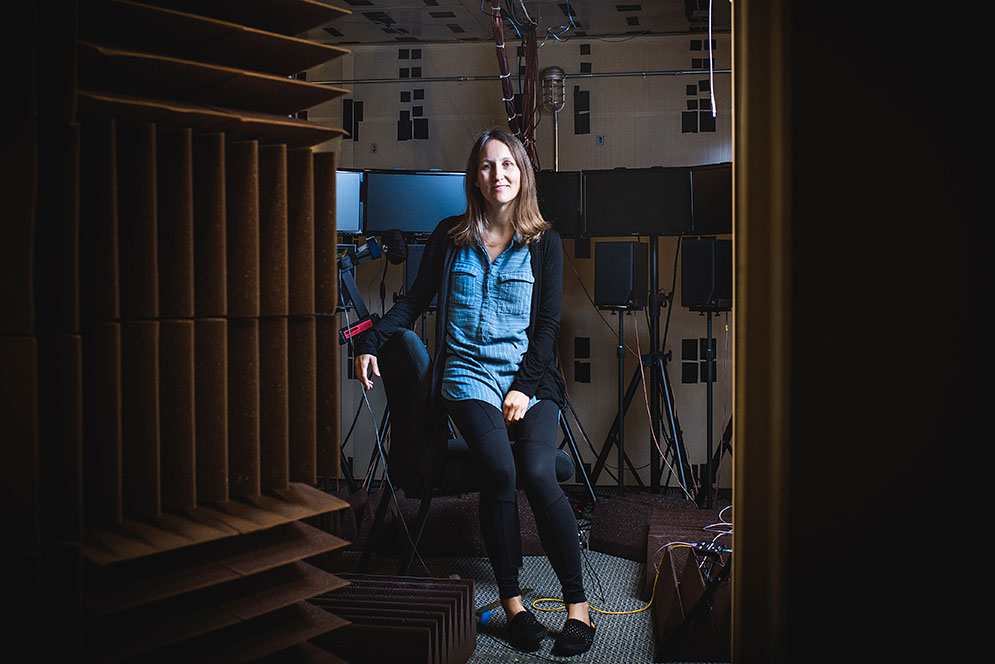
Virginia Best (above) and colleague Gerald Kidd are studying how people with hearing impairments locate sounds, a skill called spatial hearing. Photo by Jackie Ricciardi.
The next time you’re at a loud party, close your eyes and listen. At first, the sounds are just a fog of noise. But quickly you begin to pick out individual voices and locate them, even without looking. This ability to locate voices using sound alone is called spatial hearing, and it helps listeners follow conversations in noisy places, like cocktail parties and restaurants. For people with normal hearing, it happens almost effortlessly. But people with hearing loss often have trouble with spatial hearing, even when they have hearing aids on. Why?
“This is a problem that conventional hearing aids don’t solve,” says Gerald Kidd, a Sargent College of Health & Rehabilitation Sciences professor of speech, language, and hearing sciences, who heads BU’s Psychoacoustics Lab. “In a room full of people talking—a party, a social situation—sometimes people with hearing loss are lost and they disengage. It has a real human consequence.”
With the support of a five-year, $1.5 million National Institutes of Health grant, Virginia Best, a Sargent research associate professor of speech, language, and hearing sciences, will be examining how spatial hearing works differently in people with hearing impairments. The new research brings together Kidd and Best, the lead investigator, with experts in audiology, neuroscience, and biomedical engineering: neuroscientist Barbara Shinn-Cunningham, a College of Engineering professor of biomedical engineering, H. Steven Colburn, an ENG professor of biomedical engineering, who develops neural models of spatial hearing, and Jayaganesh Swaminathan, a Sargent research assistant professor and a hearing aid researcher at the Starkey Hearing Research Center in Berkeley, Calif. Their discoveries may one day guide the development of new hearing aids that give hearing-impaired listeners the location information they have been missing, potentially solving the cocktail party problem in a way not currently possible with traditional hearing aids.
Just as having two eyes helps us locate things in three dimensions, our two ears help us pick out the location of sounds. “A sound off to the right gets to your right ear a little bit before it gets to your left ear, and it also tends to be a little louder in the ear that’s closer,” says Best. The differences are so small that we don’t consciously notice them: the time delay is just a matter of microseconds, and the volume difference (that is, the difference in sound pressure on the ear) can be as little as a decibel. Yet the brain uses this tiny ear-to-ear discrepancy to draw up a remarkably precise mental sound map, accurate to about one degree, that it uses to locate and focus attention on a single voice.
For people with hearing loss, though, this process breaks down, and Best wants to find out why. One hypothesis is that people with hearing loss are not getting the full timing and volume information they need to locate sounds accurately. Another possibility is that they are getting all the right information, but the brain cannot decipher it properly, so the resulting mental sound map comes out fuzzy.
Before they can begin to test these ideas, Best and her colleagues must first figure out how to untangle spatial hearing from other functions that are undermined by impairments. This is tricky, because although we often think that people with hearing loss experience the world with the volume knob turned down, the reality is more complicated. For some listeners, low-pitched sounds are clear while high-pitched sounds are muffled, for others, it’s the other way around, while still others experience distortion all across the sound spectrum. “We want to estimate how much of the real-world difficulty experienced by a person with hearing loss can be attributed to the audibility of sounds, and how much can be attributed to spatial factors,” says Best. “These results could also help guide our colleagues in audiology and in the hearing-aid industry to focus their efforts in the appropriate places.”
Next, Best and her colleagues will bring volunteers into the lab to test their spatial hearing. Using headphones and arrays of loudspeakers, they will find out how well people with hearing impairments can locate the sources of computer-generated sounds. Similar experiments have been done before, but unlike those earlier studies, the new experiments will use speech-like sounds instead of electronic beeps. “Our sounds will still be computer-generated, but they will be more natural in their acoustical structure and their content,” says Best. By using realistic sounds, she hopes to more closely mimic the challenges hearing-impaired listeners face in the real world.
While the researchers will compare hearing-impaired volunteers with volunteers who hear normally, they will also be looking for differences within the hearing-impaired group. The goal is to see if some subgroups—for instance, elderly people—have bigger spatial hearing losses than others. In the past, it has been difficult for them to isolate pure hearing loss from normal aging, because they so often go hand in hand. But Boston, with its large population of students and other young people, is an ideal place to study hearing loss clear of age-related confounds.
Best and her colleagues will also be taking a closer look at how listeners tune in to specific speakers in noisy environments. This process of zeroing in happens quickly and automatically for people with normal hearing, usually within just a few words or sentences. Best wants to find out whether listeners with hearing loss experience something similar and to discover more about how it happens.
Ultimately, the researchers hope that they can use what they learn to help build better hearing aids. Some new noise-reducing hearing aids send exactly the same sounds to both ears, blotting out potentially helpful spatial cues. But, says Best, “there are ways of maintaining some of that spatial information, and it might be that different listeners need that to different extents, depending on how sensitive they are to that spatial information.” Best and Kidd have already tried this on a version of their visually guided hearing aid, an experimental device that uses eye tracking to guide a beam of amplification toward sounds coming from a particular direction. Early results are promising, but, says Kidd, it will take more basic research to invent a hearing aid that can untangle the cocktail party problem. “The real essence of the problem, the ability to hear one talker in uncertain and difficult situations,” he says, “is something that hasn’t been solved yet.”
Author, Kate Becker can be reached at kate@spacecrafty.com.
Hearts, Minds, and Microbubbles
Sargent, ENG profs collaborate to prevent strokes that cause dementia

BU faculty Tyrone Porter and Kathleen Morgan are using a $2.5 million grant from the National Institute on Aging to develop a drug, and a delivery system, that may help prevent blood vessels from bursting and causing early-stage dementia. Photo by Jackie Ricciardi.
- Stiffened arteries can cause microbleeds in the brain, possibly leading to dementia
- A prototype drug might control artery stiffness
- Microscopic bubbles and ultrasound beams could deliver the drug straight into artery walls
Memory loss in old age starts small, with misplaced keys or wallets. In some people, it can be the sign of a far more serious disorder. Dementia can eventually set in, robbing people of the memories of faces, names, and important events. It’s devastating for both patients and family members—and it’s distressingly common. According to the World Health Organization, more than 47 million people currently suffer from dementia worldwide.
While Alzheimer’s disease is probably the most well-known form, dementia also comes in other, lesser-known varieties, like vascular dementia—caused when tiny blood vessels burst in the brain, leading to microstrokes and minute bleeds. The resulting condition is closely linked with other age-related memory disorders.
“I suspect that vascular dementia and Alzheimer’s are really just two different angles on the same disease,” says Kathleen Morgan, a Sargent College of Health & Rehabilitation Sciences professor of health sciences. “There are plaques in the brain tissue of Alzheimer’s patients that are visible at autopsy, but we know that if you have them, you’ll probably see evidence of microbleeds as well.”

Morgan holds a vial containing a mouse brain removed from an aged mouse. It’s comparable to the brain of a 75-year-old human. She and collaborator Tyrone Porter are using mice to test a prototype drug that could prevent stroke-causing microbleeds. Photo by Jackie Ricciardi.
And if burst blood vessels are implicated in early-stage dementia, Morgan says, it may be possible to stop that damage before it starts. With a $2.5 million grant from the National Institute on Aging (NIA), she is examining a synthetic prototype drug that could prevent microbleeds in mouse brains. She’s joining forces with Tyrone Porter, a College of Engineering associate professor of mechanical engineering, working across disciplines to develop a new delivery system for the drug. Their solution uses a novel system of microbubbles—tiny bubbles of inert gas smaller than capillaries—along with a focused ultrasound beam to help push the drug into a very specific part of the body: the large blood vessels next to the heart.
Most brain bleeds, Morgan says, actually start in the aorta, the body’s largest artery, which connects directly to the heart. With each beat, the heart exerts enormous amounts of pressure straight onto that conduit, which is made of smooth muscle cells that expand and contract like a rubber hose as blood flows past them. “Those smooth muscle cells are very important for controlling the pressure of your vascular system on a beat-to-beat basis,” she says.
In younger bodies—both mouse and human—smooth muscle in the aorta expands with each beat, acting as a sort of shock absorber for the pressure coming out of the heart. In older bodies, though, it becomes gradually less elastic, meaning that the energy of each pulse travels farther through the vascular system. If the aorta becomes stiff enough, blood can surge at high pressure straight into tiny, sensitive blood vessels in the brain, which may burst under the strain.
Morgan is developing new ways to reverse the stiffening of arteries. If she can restore some of the aorta’s elasticity, she reasons, it may be possible to prevent new microbleeds. To test this idea, she’s concocted a new peptide—a small chain of amino acids—that can control smooth muscle stiffness.

Morgan and Porter’s drug delivery system. The scientists attach the drug to microbubbles smaller than capillaries and use a focused ultrasound beam to guide the bubbles and then burst them, delivering the drug directly into smooth muscle cells. Eventually, they hope their system may be used to deliver drugs to the large blood vessels next to the heart. Illustration by Tyrone Porter.
In smooth muscle tissue, she says, elasticity is determined in part by two types of long, stringy molecules called actin and myosin, which form a web inside each cell. As the two strands latch onto each other, they restrict the cell’s movement, stiffening its structure. “It’s a bit like a Chinese finger trap,” says Morgan. “The harder you tug on actin, the harder it clamps down.” The peptide her team has created, however, can effectively stop this process in its tracks by binding to the molecules, preventing them from grabbing onto their counterparts in the first place. As a result, the cell remains relaxed and supple. Morgan can control how stiff or loose the tissue gets by controlling the amount of peptide she administers.
The challenge is delivering those molecules directly to the smooth muscle inside a living aorta. Unlike other drugs, releasing this one system-wide—or even artery-wide—could be disastrous. “Smooth muscle tissue isn’t just in the aorta. It’s in your vascular system, urinary tract, uterus, lung tissue, and digestive system,” she notes. “If the peptides got into those tissues, it could cause incontinence, premature labor, all sorts of awful things.”
To get the drug exactly where it’s needed, however, you first have to dig into the artery itself.
“The cells we need to target don’t come in contact with flowing blood. They’re behind a layer or two of other cells and connective tissue in the blood vessel walls,” says Porter. To break through those layers and deliver the drug directly to smooth muscle cells, he’s attaching Morgan’s peptides directly to the outside of each microbubble. Focused ultrasound can be used to push the microbubbles toward the aortic wall and pop them to release the peptide. The popping process also subtly and reversibly disrupts the lining of the aorta, making the blood vessel wall temporarily permeable. “Once that happens, the peptide can flow directly into the spaces that open up in the vessel wall and go straight into the smooth muscle tissue,” he says.
These microbubbles themselves are simple to make, Porter adds, and the FDA has already approved them for use. “Microbubbles have been used for years as contrast agents for ultrasound. They scatter sound much better than tissue, so they’re used to distinguish blood from the chambers in heart and surrounding muscle,” he says. They’re also tiny enough to fit through the smallest blood vessels in the body and eventually disappear as the gas, which is harmless, escapes into the blood and is expelled out of the body through the lungs.
In addition to being relatively safe, the clinical advantage of this approach is that it can be done with a standard ultrasound probe commonly used in a cardiac echo test. Using a low-powered ultrasound beam, a technician can track where the bubbles are going, then pop them at a specific location by simply turning up the strength of the beam. Existing ultrasound tools “can focus the beam down to the millimeter, so it’s extremely accurate,” Porter says.
Until now, Morgan has been able to test her peptide and its new delivery system only on smooth muscle cells in a petri dish. With the new NIA grant, however, she and her collaborators are looking to scale up their research, and they will use their approach for the first time on a living animal.
“My earlier work was just on the fundamental mechanics of these peptides. Moving into a whole mouse is a big leap for someone used to sitting at a bench dealing with cells,” she says with a laugh. “The people I’ve connected with here at BU make it feasible, though. That’s how you get basic discoveries translated into practical ones—you have lots of scientists working in parallel. You need teams instead of a single investigator.
Author, David Levin can be reached at delevin@bu.edu.