
High enrollment courses can feel overwhelming for both instructors and students alike. Faculty may feel limited in what types of assignments to assign to students before and after lecture periods to make sure students are arriving informed and ready to dive deeper into course topics—especially when considering how to grade and incentivize student work. Students may feel isolated within a large class, be unsure of how to prepare for class, and feel daunted by the prospect of higher stakes assignments without appropriate scaffolding for the learning process.
Research suggests that integrating deliberately designed and highly structured learning cycles into course schedules benefit both instructors and students regardless of course size, but they are especially important in higher enrollment courses.
These approaches focus on not only teaching students the course content but purposefully training students in how to learn the content and to critically engage with the course’s core learning objectives.
Educational Benefits
- Clarifies academic pathways: Through high structuring, students understand where the course fits in their specific academic pathway, see how their learning contributes to both their success in the course and their future courses, know what work and effort is required of them, and learn important life and study skills (Gavassa et al. 2019).
- Builds understanding and belonging: High-structure provides students with reliability and consistency, so they know what is required of them every week of the course (Hogan and Sathy, 2022). This also establishes a comfort level with the course and instructor that can lower stress-levels, increase engagement, promote a sense of belonging, and support completion.
- Strengthens memory retention: The spacing and repetition of learning in a consistent and intentionally timed way helps learners develop long-term knowledge (Carpenter, Pan & Butler, 2022). It is the combination of spacing and retrieval that provides the greatest enhancement of learning.
- Promotes active learning: Deliberately structured learning cycles help facilitate increasing students’ cognitive engagement with course materials—moving from passive learning to more active, constructive, and interactive forms of learning to support critical thinking within the discipline (Chi & Wylie, 2014).
In Practice
Highly structured learning pathways require pre-planning and developing new resources/question banks for weekly knowledge checks and activities. This often requires a significant revamping of the course calendar to fit the desired learning cycles. It may also require creating in-class polling questions and small group activities to make sure students are applying pre-lecture and in-lecture content in meaningful ways.
Highly structured learning pathways, especially when paired with a variety of low-stakes assessments helps students arrive to classes ready to engage more deeply with course content and assists in teaching students how to effectively learn and succeed in the course.
BU Large Course Initiative Examples
In collaboration with several programs in BU’s College of Arts and Sciences, the Institute is engaged in a multi-year initiative to redesign the student experience in large classes that typically have 100 or more students. This initiative provides an opportunity to reimagine and develop new approaches to course redesign, student assessment, classroom teaching techniques and the creation of instructional resources that promote engagement and learning in some of BU’s largest introductory courses.
In this video, Dr. Michaelyn Hartmann, former Lecturer of Biology in the College of Arts & Sciences, explains how her team used structured learning pathways in introductory Biology to better equip all students to come to class prepared.
Biology 1 & Biology 2
General Chemistry 1
Basic Statistics and Probability & Applied Statistics
Learning Cycle Example
Here is an example of a proposed learning cycle developed by the Institute team for a given week in a highly structured course. Please note that this is not a prescribed learning pathway, but rather a template for instructors to adopt and adapt to their weekly learning cycles.
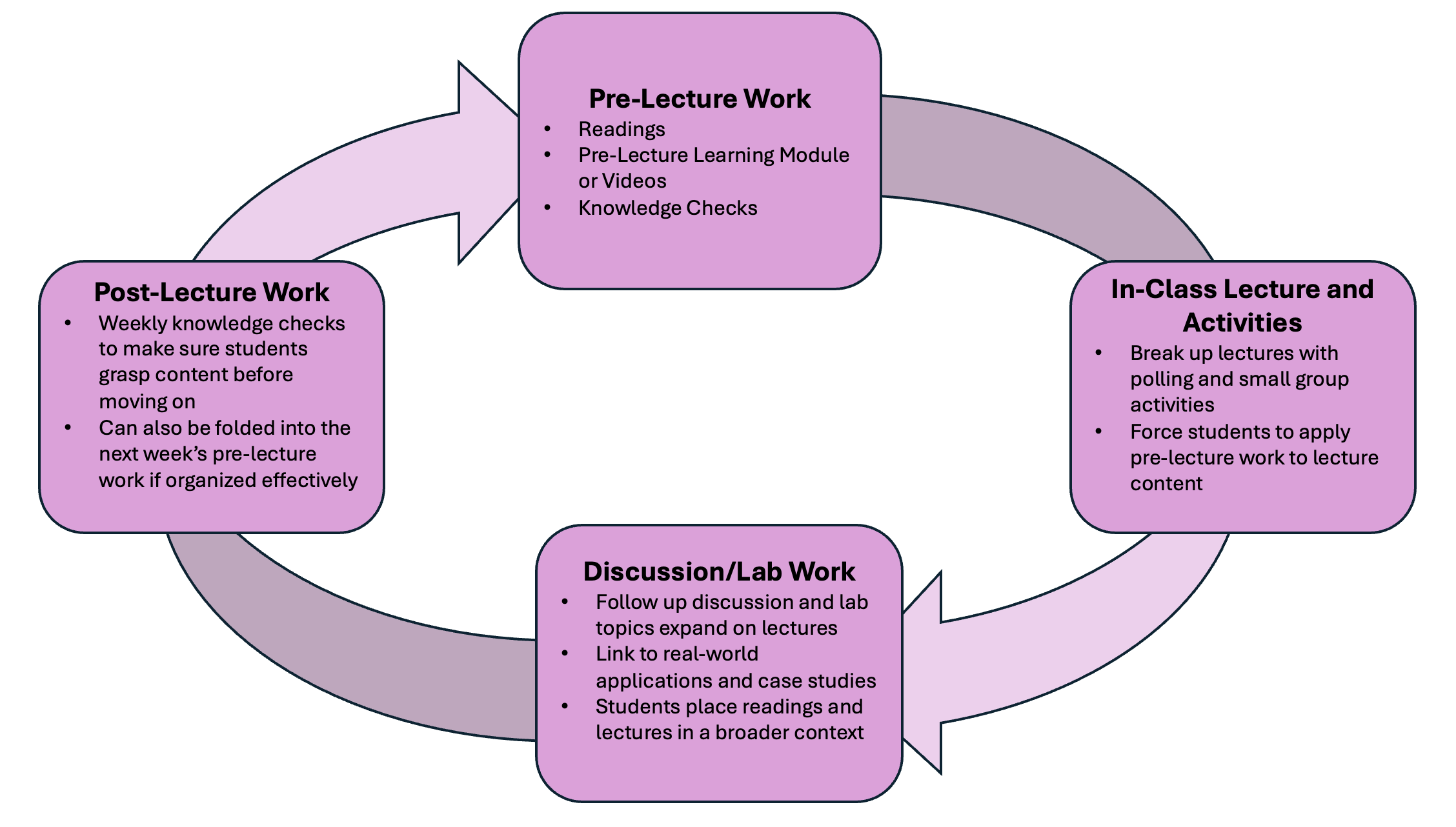
In this learning cycle, students engage with course content in a structured way.
- Students begin by reviewing readings and pre-lecture materials alongside a knowledge check to ensure each student is arriving to lecture with the necessary pre-requisite knowledge to engage more critically with course content.
- Lectures focus on applying and expanding on pre-lecture work, breaking up passive listening with active engagement with the course content through polling and small group work.
- Discussions and/or Lab topics should directly relate to lecture content, applying the course content to real-world examples and targeted case studies.
- Finally, post-lecture work forces students to continue engaging with the content and preparing them for the next week with deliberate framing.
Supporting Technology
Structured learning pathways can be administered in a variety of formats. While most of the work of creating these structured learning pathways happens outside a particular educational technology, here are a few technologies that can be leveraged for specific parts of a highly structured learning cycle.
Learning Modules and Quizzes
 Pre-lecture readings and knowledge checks can be facilitated using
 Community-Building Tools
 Piazza
Classroom Response Systems
 In-class polling, through
 Additional Resources
- Carpenter, Shana K., et al. “The Science of Effective Learning with Spacing and Retrieval Practice.” Nature Reviews Psychology, vol. 1, no. 9, 9, Sept. 2022, pp. 496–511. www.nature.com, https://doi.org/10.1038/s44159-022-00089-1.
- Chi, Michelene T. H. & Ruth Wylie (2014) “The ICAP Framework: Linking Cognitive Engagement to Active Learning Outcomes, Educational Psychologist,” 49:4, 219-243, https://doi.org/10.1080/00461520.2014.965823
- Crimmins, M. T., & Midkiff, B. (2017). High structure active learning pedagogy for the teaching of organic chemistry: Assessing the impact on academic outcomes. Journal of Chemical Education, 94, 429–438. https://doi.org/10.1021/acs.jchemed.6b00663
- Gavassa, Sat et al. “Closing the Achievement Gap in a Large Introductory Course by Balancing Reduced In-Person Contact with Increased Course Structure.” CBE life sciences education vol. 18,1 (2019): ar8. https://doi.org/10.1187/cbe.18-08-0153
- Glodowski, Kathryn, and Rachel Thompson. The Effects of Guided Notes on Pre-Lecture Quiz Scores in Introductory Psychology. Journal of Behavioral Education, vol. 27, no. 1, Mar. 2018, pp. 101–23. https://doi.org/10.1007/s10864-017-9274-7.
- Hogan, Kelly A., and Viji Sathy. Inclusive Teaching: Strategies for Promoting Equity in the College Classroom. West Virginia University Press, 2022.
Connect with the Institute for Excellence in Teaching & Learning team with questions or to schedule a consultation at excellence@bu.edu.