Creatives in Practice: Dan DiPiero
The musicology & ethnomusicology assistant professor is researching, presenting, publishing, and writing books on the wave of contemporary queer and feminist indie rock bands, and on the role gender plays in the reception of music
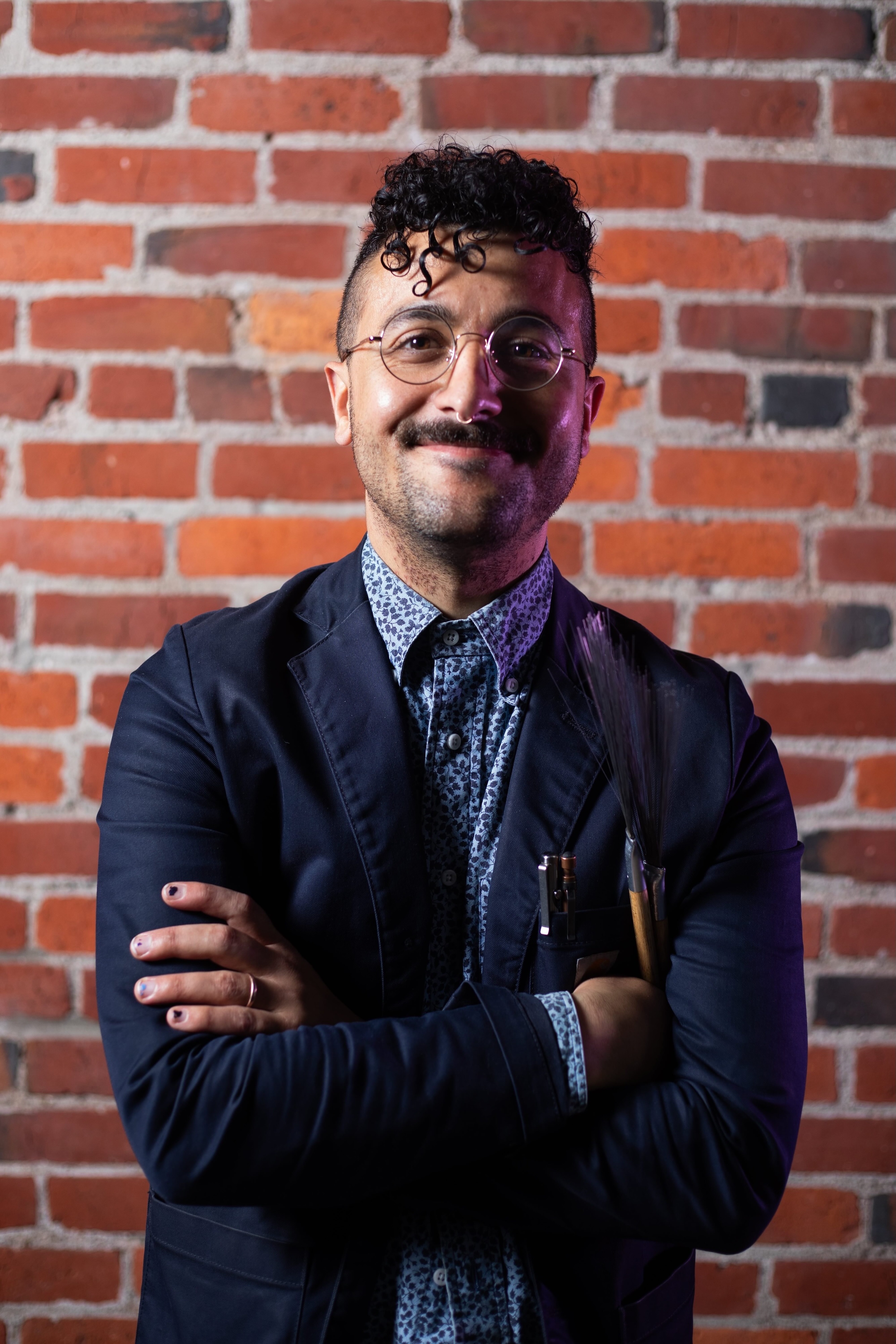
CREATIVES IN PRACTICE: DAN DIPIERO
The assistant professor of music in musicology & ethnomusicology at Boston University is researching, presenting, publishing, and writing books on the wave of contemporary queer and feminist indie rock bands that have been remaking the genre, and on the role gender plays in the reception of music.
One thing that gravitates the next generation of artists to Boston University College of Fine Arts? Knowing that their professors, advisors, and mentors are also working artists, gaining real-world experience and bringing that back into the classroom through their curriculum, lessons, and talks. In CFA’s Creatives in Practice series, your favorite CFA faculty and staff members share the work they’re doing off campus, locally, nationally, and globally.
Musician, writer, teacher, scholar, and podcaster Dan DiPiero specializes in cultural studies and popular music. This past spring, DiPiero, assistant professor of music in musicology & ethnomusicology at Boston University School of Music, presented new research at highly respected conferences and at the Rock and Roll Hall of Fame.

At the Rock Hall in Cleveland, Ohio, DiPiero spoke about research conducted for his second book, Big Feelings: Queer and Feminist Indie Rock After Riot Grrrl. “The talk centered on the wave of contemporary queer and feminist indie rock bands who have been remaking the genre in the past decade, including groups like Soccer Mommy, Indigo De Souza, and the Ophelias,” explained DiPiero, whose book situates these musicians in essential socio-cultural contexts, and shows how indie rock feminisms have shifted since the 1990s, rejecting overt political messages in favor of sonic catharsis, and reflecting the complex, ambivalent feeling of being young while the world burns. “At the Rock Hall, we also jumped back in time to discuss the history of indie music, and the way that gender has affected public reception of indie rock vs indie pop in the 1980s.”
DiPiero also traveled to Washington, D.C., for the International Association for the Study of Popular Music Conference and to Los Angeles, CA, for the Pop Conference hosted by USC Thornton School of Music. “At these two conferences, I spoke about some research I’m publishing in the Journal of the American Musicological Society later this year about Sabrina Carpenter and her performances of ‘tragic heterosexuality,’ a term that scholar Jane Ward coined to discuss the way that straight culture has been historically overdetermined by patriarchy, resulting in the bad deal for women that Carpenter’s music so often emphasizes.”
In CFA’s Creatives in Practice series, DiPiero shares forthcoming projects he’s working on, including his third book, tentatively called Crush: Essays on Love and Music, and how he applies what he learns on the road and as a musician to the courses he teaches at BU School of Music. Fairly new to Boston, DiPiero also shares how exciting it has been to live in an arts-rich city.

Oxford Handbook of Pop Music Roundtable, organized by Eric Weisbard, at the Pop Conference 2025. Dan DiPiero is second from the right.
Q&A WITH DAN DIPIERO
CFA: Tell us more about the new book you’re working on, Crush: Essays on Love and Music.
DiPiero: I aspire for this to be a public-facing or crossover academic book that will interrogate both the social history and the philosophical potential of the crush as a concept. It will theorize this particular effect through popular music, which has so often been a privileged site for the exploration of crushing feelings. It will also attempt to incorporate reflections from my own experiences of music loving (as Vivian Luong would have it), as well as just plain crushing.
The result will be a text that blends personal narrative, scholarship, and popular music writing into a series of reflections oriented around one theme: the crush. Its main argument will be that in a cultural milieu characterized by a reactionary resurgence of traditional masculinity, it is more important than ever to remain attentive to the lessons that crushing tries to teach, if only we can remain open to its unpredictable possibilities.
How does your real-world experience in the field connect to your role as a faculty member at CFA?
Everything I do at BU is informed by my experiences, whether that means teaching jazz history after 20 years of professional playing or talking to my musicology students about the nuts and bolts of peer-reviewed research. As a musician and scholar, I’m constantly trying to bring research and practice together because I think that effort nuances our understanding of both areas at once.
Everything I do at BU is informed by my experiences, whether that means teaching jazz history after 20 years of professional playing or talking to my musicology students about the nuts and bolts of peer-reviewed research. As a musician and scholar, I’m constantly trying to bring research and practice together because I think that effort nuances our understanding of both areas at once.

What inspires you about this role? How do you think it makes you a better artist and scholar?
It’s inspiring to be at BU for a million reasons. My colleagues are incredible, second-to-none experts, and my students are brilliant. BU has an incredible history as an institution, and though I’m new to the city, Boston is buzzing with all my favorite things: public transit, great bookstores, lots of music, and exciting research. I am very privileged and proud to be a part of such a long-standing and illustrious department, and I look forward to continuing to work with the next generation of music scholars.
What advice would you give your students about building a sustainable career in the arts?
Organize at whatever level you can. Don’t go at it alone.
Any fun facts or other information you’d like to share about this work?
The contemporary concept of a crush really originates at the Seven Sisters schools, so there’s a bit of New England history involved at its heart. (The Seven Sisters is a legendary consortium of historically women’s liberal arts colleges based in the Northeast of the United States).

Connect with Dan!
Dan DiPiero is a musician, writer, and Assistant Professor of Music at Boston University. His research focuses on the affective connections between aesthetics and politics, with a particular emphasis in U.S. improvised and popular music.
At BU School of Music, DiPiero teaches courses in popular music studies, musicology, and graduate methods with 2025-2026 courses including Writing about Music, Popular Music and Culture, History of Jazz, and Crush Course: Love Songs and Social Critique.
Send him an email at ddipiero@bu.edu, check out their website for more on his work, and tune into his podcast on popular music studies called cry baby pod, available on all platforms.
DiPiero is also a member of Turtle Boat, a free-jazz project led by Abhilasha Chebolu, featuring her compositions and contributions by Alex Burgoyne and DiPiero. Formed in 2015 (ish) after a decade of playing together in all kinds of different groups and styles, Turtle Boat finds common ground in the shared investment in the introspective side of free playing.
About Mentioned Programs
Offering graduate degrees in Musicology, Ethnomusicology, and Musicology and Ethnomusicology, as well as an undergraduate Bachelor of Art, the program is led by a prolific, supportive, and inclusive department, dedicated to the shared purpose of innovative, engaged, and rigorous scholarship. Students are engaged in interdisciplinary, disciplinary, historical, translational, analytical, and cross-cultural thinking.
This Series

Also in
Creatives in Practice
-
February 5, 2026
Creatives in Practice: Wendy C. Goldberg
-
January 12, 2026
Creatives in Practice: Daniel Parsley
-
December 10, 2025
Creatives in Practice: Joshua Fineberg