
PhD in Bioinformatics
Program at a Glance
|
64 Credits to Graduation |
Customizable Research Track |
3 Lab Rotations in 1 Year |
|
50+ Faculties Across 5 Colleges |
Fully Funded Fellowships Available |
Projected 17.4% Industry Growth |






Program Overview
Are you ready to evolve the future of biological and medical science using the most advanced computation and data processing tools? Join leading researchers in the Boston University Bioinformatics PhD program who are driving the next generation of biological and biomedical discovery. The program includes 50+ active faculties from five colleges and focuses on the molecular biology and physics of the cell. Your Doctorate in Bioinformatics from BU will help you set the global standard in academia and industry.

Why Choose the Boston University Bioinformatics PhD?
Foundational Research. Lasting Impact.
Your pursuit of a Doctorate in Bioinformatics demands an environment dedicated to pushing boundaries.
Multidisciplinary Leadership
Join a highly multidisciplinary and cross-disciplinary environment that encourages research in departments across the entire campus. 50 faculties, five colleges: Engineering, Arts and Sciences, Dentistry, Medicine, and Public Health. You have a wide range of opportunities to pursue complex topics with dozens of different faculty, ensuring your project is unique and impactful.
 Cutting-Edge Access
This is a pioneering program, established as the first of its kind in the U.S. in 1999 by Charles DeLisi, initiator of the Human Genome Project. You gain access to advanced research and technology, working with top-tier researchers to execute groundbreaking research projects.
Impactful Tool Development
Go beyond analysis. You are empowered to develop novel computational tools and software (algorithms, packages) that become forerunners in the field and are used by thousands in the community.
 Translational Expertise
Apply your skills to data that matters. You will work with complex, clinical-oriented data sets from patients, such as high-throughput genomic data from Boston Medical Center. Your goal is to understand the mechanism of diseases (like why a tumor is growing) and move the understanding of the disease forward.
How to Apply

The Boston Advantage: Global Research Leadership
Boston is the world's most concentrated biotech hub—a crucial advantage for your Doctorate in Bioinformatics. Research spans genomics, systems & synthetic biology, ML/AI, computational genomics, multi-omics, databases/HPC, structural biophysics, and experimental molecular biology—with students matching to labs across BU MED, ENG, CAS, and CDS. Your research at BU gives you direct access to the institutions and thought leaders that are driving foundational scientific breakthroughs.
You gain access to the best partners and resources for your dissertation.

Our program has a partnership with 200+ organizations, including AstraZeneca, Dana Farber Cancer Institute, the BROAD Institute, Novartis, Pfizer, Massachusetts General Hospital and Biogen, empowering you with cutting-edge research and novel technology to ensure your dissertation is a top-tier project that defines the frontier of the field.
Beyond the lab, your research is designed to have a global impact: you are strongly supported to travel the globe to present your findings at major international conferences through our Student Research Seminars. While your focus is on research, we provide valuable connections and help secure your future as a leader in academia or R&D.
Join a huge network of alumni who live and work in the Boston area and hold influential positions at top biotech companies and research centers globally.

The Path to Your Doctorate
The Boston University Bioinformatics PhD is a definitive commitment to research leadership.
- Full-Time Commitment: The PhD is a full-time program focused entirely on your research and academic growth.
- Credit Structure: The program requires a total of 64 credits, which includes a mix of core lecture/laboratory courses, essential seminar courses, and critical research credits.
- Customized Research Track: While there is a set of required core courses, your precise course of study is highly customizable. It will be determined in consultation with your academic advisor and tailored to reflect your specific scientific background and pioneering interests.
- Direct Admission: Prospective students who have completed a bachelor’s degree may apply for direct admission to the PhD program, starting your research journey immediately.
Requirements for the Doctorate in Bioinformatics
Lab Rotation Requirement
Annual Report
Teaching Requirement
Qualifying Oral Examination
Qualifying Thesis Defense Examination
Required Courses for the Doctorate in Bioinformatics
Student Profiles for the PhD in Bioinformatics

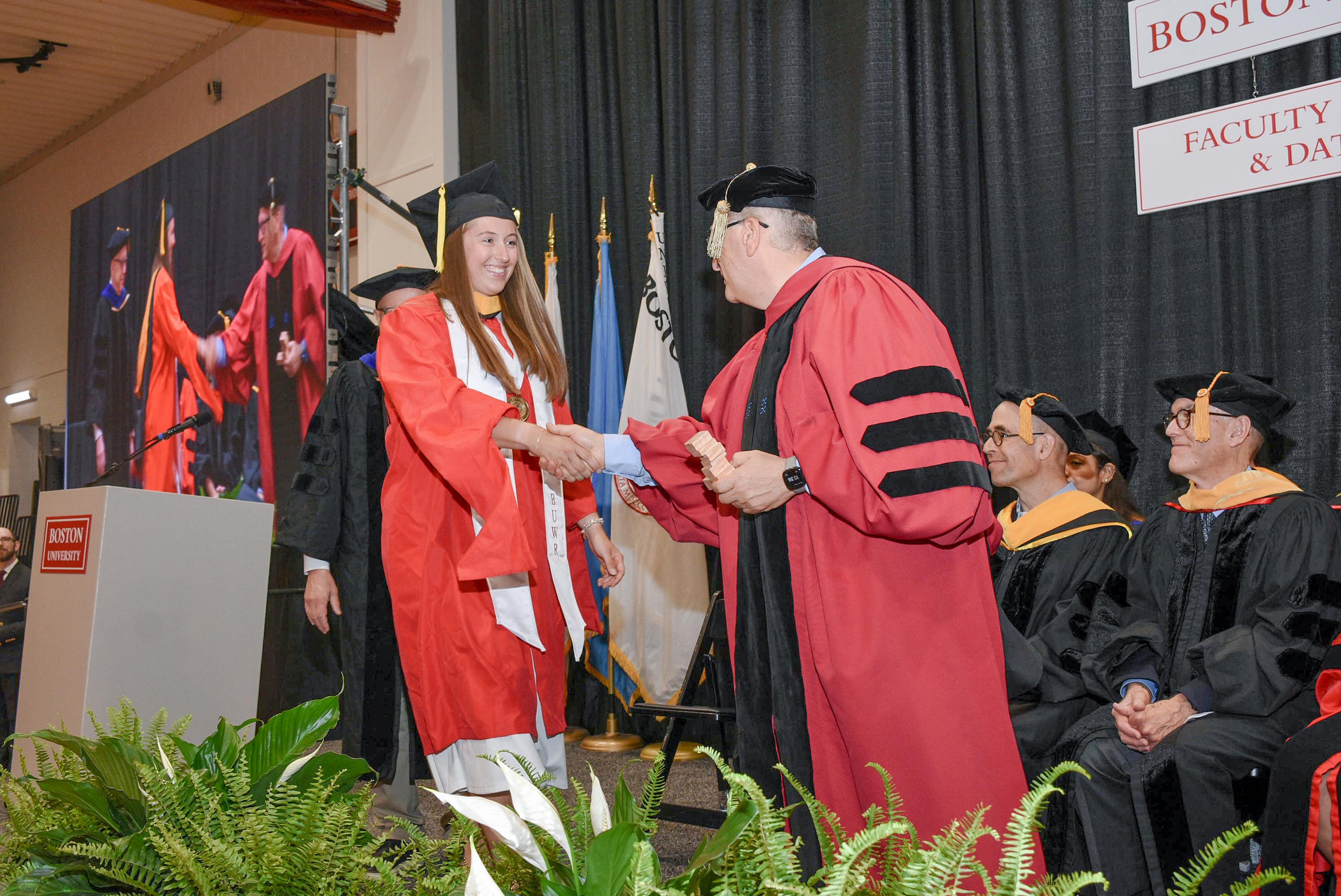
Jacquelyn Turcinovic
The Next Leader: Jacquelyn Turcinovic Receives DeLisi Award for Viral Genomics Data Work.
Your Career ROI
Graduates of the Boston University Bioinformatics PhD program are highly successful, securing jobs in both academia and industry. The global bioinformatics market is projected to accelerate at a 17.4% Compound Annual Growth Rate (CAGR) through 2029, reflecting strong demand for professionals skilled in interpreting biological big data. This demand, and our strength in the field, make our graduates highly sought after for this in-demand field.
- Professional Development: You will cover essential skills such as grant writing, paper writing, and networking, making you a strong candidate for competitive positions.
- Amplify Your Research Voice: Develop your voice. Students actively present their findings during the Student Research Seminars held on campus every other week. You are also empowered to travel the globe to present your findings at major conferences and events.
- Industry Integration: PhD students can secure internships in industry, which provide valuable experience, connections, and can lead to direct job offers upon graduation.
- Alumni Network: You benefit from a vast network of alumni who live and work within the Boston area.
Alumni Employment Outcomes
Graduates of the Boston University PhD in Bioinformatics have gone on to work in leading organizations across biotechnology, pharmaceuticals, data science, and healthcare. Employers include:
- Genentech, Inc. – Computational biology and drug discovery research
- Johnson & Johnson – Bioinformatics and translational data analytics
- Pfizer – Genomics, precision medicine, and computational modeling
- Thermo Fisher Scientific – Bioinformatics tools and molecular diagnostics
- Agios Pharmaceuticals – Cancer metabolism and biomarker discovery
- GreenLight Biosciences, Inc. – RNA-based therapeutics and bioengineering
- Exosome Diagnostics – Molecular diagnostics and biomarker development
- DaVita – Clinical data analytics and healthcare informatics
- New England Biolabs – Genomics, enzyme research, and data science
- Schrödinger – Computational chemistry and molecular modeling
These outcomes reflect the program’s strong interdisciplinary training and the high demand for PhD-level bioinformaticians across academia, industry, and healthcare sectors.
Industry-Leading Faculty

Associate Professor in the Department of Medicine & Faculty of Computing & Data Sciences
Director of the Bioinformatics Program
Co-scientific Director of the Boston University Medical Campus Single Cell Sequencing core
Faculty Spotlight: Joshua D. Campbell, Ph.D.
Learn the science from someone who is actively defining it.
Dr. Campbell is a BU Bioinformatics success story. Having earned his Ph.D. from the program, he now leads cutting-edge research in computational biomedicine, focusing on cancer and lung disease.
His lab tackles complex, high-throughput genomic data to find breakthroughs. He is an expert in developing novel methods—like the Celda framework—to characterize cellular heterogeneity using single-cell RNA sequencing. In collaboration with leading institutions (including Dana-Farber Cancer Institute and The Broad Institute), Dr. Campbell's work directly targets the genomic alterations in cancer, aiming to identify novel therapeutic targets and define strategies for early detection of lung cancer.

Assistant Professor, Boston University Chobanian & Avedisian School of Medicine
Director of Graduate Studies for the BU Bioinformatics Master's program
Faculty Spotlight: Adam T. Labadorf, Ph.D.
Learn from a leader who is actively using bioinformatics to solve the biggest challenges in brain health.
Dr. Labadorf is an active alumnus and a key leader of the MS in Bioinformatics. His lab sits at the critical intersection of neuroscience, genomics, and machine learning, using bioinformatics to understand the molecular secrets of neurodegeneration in human tissue. He has particular expertise in analyzing post-mortem human brain tissue and cerebrospinal fluid transcriptomes.
Dr. Labadorf’s research focuses on finding common pathological mechanisms across devastating conditions like Huntington's, Parkinson's, and Chronic Traumatic Encephalopathy (CTE). His goal is to find commonalities that can lead to novel treatment modalities.

A Community of Innovative Leaders
The pursuit of a Doctorate in Bioinformatics is a collaborative endeavor designed to help you transform from a technical expert into a creative, imaginative leader with a passion for driving the field forward. Sharpen your knowledge and skills, and gain access to a treasure trove of resources and mentors that will help you develop the intellectual spark needed to achieve something great.
You don't just join a program; you join a close-knit community built to foster pioneering work. We believe true scientific breakthroughs emerge when diverse educational backgrounds, unique perspectives, and varying skill sets converge. This supportive environment is designed for sharing insights, learning from different cultures, and challenging conventional thought. The student-led BiOS (Bioinformatics Organized Students) committee actively ensures your voice is heard and builds the intellectual and social bonds necessary for deep collaboration.
Share your expertise, strengthen your professional network, and drive fundamental research forward together.

The faculty of the Bioinformatics Program is unmatched in the breadth and depth of its expertise. Together they act as a solid interdisciplinary network for ambitious students from diverse backgrounds to create new paths of innovative research.
— Itai Yanai, PhD, Professor, Dept. of Biochemistry and Molecular Pharmacology, New York University School of Medicine
Admission Requirements for the Doctorate in Bioinformatics
Prospective students who have completed a bachelor’s degree may apply for admission to the PhD program. The PhD requires a total of 64 credits, consisting of lecture, laboratory, and seminar courses and research credits. While there is a set of required core courses, the precise course of study will be determined in consultation with the student’s academic advisor and will reflect the student’s background and interests.
To be admitted to PhD candidacy, students must demonstrate mastery of the core subject matter (no lower than a “B” in core courses) and complete the oral qualifying examination by the end of the second year.
How to Apply to the PhD in Bioinformatics
- Online application form.
- Three recommendations, preferably from professors.
- Transcripts from all colleges previously attended.
- Personal statement/statement of purpose
- Resume
Please contact Bioinformatics to confirm all materials have been received. For further information on requirements, please see our Frequently Asked Questions page.
See Full Application Instructions
Funding Your PhD in Bioinformatics
All admitted students to the Boston University Bioinformatics PhD program receive a fully supported funding package. This commitment ensures you can focus entirely on advancing your research without undue financial burden, making this Doctorate in Bioinformatics an excellent and financially sustainable option.
Your comprehensive support package is designed for success. It includes full tuition, health insurance, travel funding, and a highly competitive annual stipend, starting at US $45,000. The funding is administered centrally by the Admissions Committee, meaning no separate financial aid application is required for PhD candidates.
Funding & Fellowships
Funding is provided through multiple support mechanisms, including Bioinformatics Program Fellowships, Research Assistantships, Teaching Fellowships, and Graduate Teaching Assistantships. The program’s financial foundation is further bolstered by an institutional training grant from the National Institutes of Health (NIH)—specifically the T32 GM100842 award—which provides first-year fellowships at the time of admission.
Your Impact in Bioinformatics Starts Today
You are ready to stop analyzing and start defining. Apply for the Boston University Bioinformatics PhD program and lead the next generation of scientific knowledge.
Start Application
FAQs for the PhD in Bioinformatics
Q. What is the expected time to degree, and what are the credit requirements?
Q. How is the curriculum customized to fit my specific research focus?
Q. What kind of research resources and collaborations are available for a Doctorate in Bioinformatics?
Q. What kind of career support is provided, and what are the post-graduation outcomes?
Q. Is a Bachelor’s or Master’s degree required for admissions?
For more information please visit our Frequently Asked Questions page.