Lessons from China—Questrom Class Took BU Students on Memorable Business Trip

Greg Stoller (bottom row, second from left) took Questrom students to China over spring break to observe Chinese businesses in action. Photo by Gill Gao
Lessons from China—Questrom Class Took BU Students on Memorable Business Trip
Over spring break, 25 Boston University students joined Questrom’s Greg Stoller to see what Chinese companies could teach them
What did you do on spring break? Some 25 Boston University students trekked around the globe to meet with business executives in China. Greg Stoller, a BU Questrom School of Business master lecturer in strategy and innovation, chaperoned them for his Global Management Experience class, which he has taught for more than 20 years. Each spring, he and his students tour firms in an Asian country.
“This year’s visits ran the gamut from American multinationals to large Chinese publicly traded corporations, local technology start-ups, and global manufacturers,” Stoller says. “Our planning team can’t think of a better way of teaching international business than by bringing the students to meet with companies directly.”
The class is open by application only to any junior or senior, and occasionally, “well-credentialed sophomores,” Stoller says. Spots in the class are filled by Questrom’s Undergraduate Development Center after it reviews applications.
It’s a memorable experience not only for the students, but for the foreign executives as well. “It was so nice having you and the students last week in Shanghai,” one of them wrote to Stoller after their visit. “I was really impressed by your teaching passion and the students’ deep understanding of the Shanghai operation!”
As for the students, they returned with invaluable insights for their careers, as four explained to BU Today. The companies they visited requested not to be named.
Dona Bonnie (Questrom’26)
I visited a large amusement park that serves thousands of guests each day through rides, entertainment, and food. Going into the trip, I expected everything to feel completely different, but one of the first things I noticed, both on the streets of China and in this park, was how familiar it all felt. People joked, families spent time together, and yes, drivers still honked on the road. What stood out, though, was how clean, welcoming, and respectful the environment was, not just because of the employees, but because visitors seemed to take pride in the space as well.

The biggest lesson I took from this experience is that a strong, culturally connected brand can shape how people behave and interact. Every business we observed in China, whether local or international, made a clear effort to reflect Chinese culture and values, creating a sense of shared identity. In the case of this park, that translated into an environment where people felt connected and acted in such a manner. As someone pursuing a career in hospitality, I will carry this lesson forward by focusing on building spaces and experiences that feel meaningful to the people they serve. When a brand truly resonates with its customers, it not only stands out, but also creates a lasting value that is much harder for competitors to replicate.
Ivy Gomes (Questrom’27)
One of the biggest takeaways I had from visiting a private international-standard hospital network is how much healthcare marketing is really about trust, not promotion. The organization offers high-quality, personalized care, especially for patients who want a better experience than what they might get in crowded public hospitals. They do not rely on flashy advertising to attract patients. Instead, their growth comes from word of mouth, strong relationships, and making sure patients feel genuinely cared for and understood. You could feel that trust in the environment itself. For example, there was a bakery and café inside the hospital that was started by a former patient who had recovered and wanted to give back, which made the space feel more human and community-driven rather than purely clinical.
That idea of trust is not just present in healthcare; it is embedded in everyday life in China. We even passed by a vending machine that allowed people to open it fully, take what they needed, and simply pay honestly. That same mindset carries over to how people choose doctors and hospitals. They go where they feel safe and confident, not where they see the most marketing. As someone interested in advocacy, communications, and media, especially in healthcare and policy, this experience made me realize that the kind of work I want to do is not just about getting attention. It is about building credibility and helping people feel informed and supported. That is what makes this lesson so valuable to me. In something as personal as healthcare, trust is not a nice-to-have bonus; it is everything.
Madison Sanchez (Questrom’28)
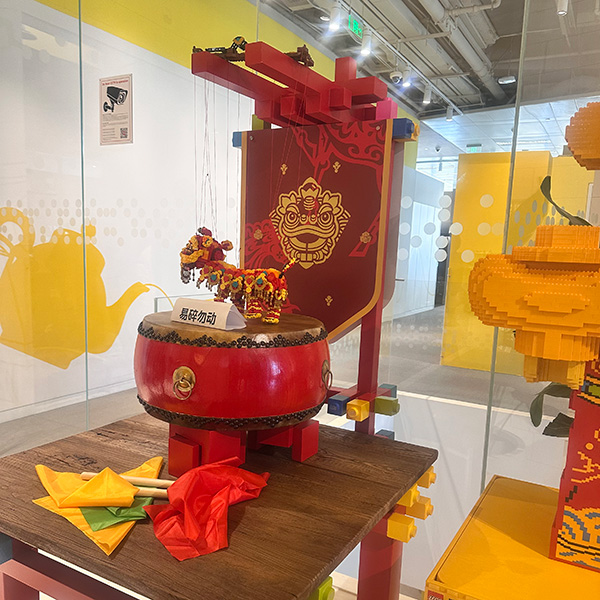
I visited a global toy company best known for its building blocks and creativity-focused products. What stood out most was the company’s intentional approach to adapting its brand to succeed in China. Since construction-based toys are a relatively new concept for many Chinese children, the company did not rely solely on its global reputation. Instead, it focused on localization, by creating culturally relevant products such as Lunar New Year sets, zodiac-themed collections, and models of landmarks like the Shanghai skyline and the Great Wall. These exclusive offerings demonstrate a deep understanding of the local market and a commitment to connecting with customers in meaningful ways.
Beyond its products, the company also positions itself as an educational tool, emphasizing creativity, problem-solving, and early childhood development. It partners with thousands of schools and invests heavily in learning experiences, reinforcing its role as more than just a toy brand. Additionally, a significant ownership stake is held by a foundation dedicated to advancing children’s education globally, highlighting its commitment to social impact.
The biggest lesson I will carry forward is the importance of using business as a force to create value within the communities it serves. The company’s success in China shows that strong brands go beyond expansion by aligning with local culture and needs, investing in their communities, and building trust over time. As I pursue my career, I aim to apply this approach by prioritizing meaningful impact and fostering long-term relationships in every market I serve.
Anna Tretiakova (ENG’26)

One of the most valuable lessons I learned came from a global cleaning technology company that produces everything from household pressure washers to large-scale industrial cleaning systems. At their manufacturing facility close to Shanghai, I saw firsthand how they stay competitive by customizing nearly every aspect of their production process. Instead of relying entirely on standardized equipment, they build their shop floor specifically tailored to make their products. They also strategically decide what to manufacture in-house versus outsourcing, balancing efficiency with control.
The key lesson I took away is the importance of designing flexible, optimized production systems rather than relying on one-size-fits-all solutions. As an engineering student, I had previously programmed a robotic arm in a manufacturing class. Seeing similar technology used at an advanced industrial scale was a full-circle moment that connected my coursework to real-world applications.
This visit helped me better understand the role I want to pursue after graduation. It’s one thing to operate machinery, but another to design the systems behind it: planning factory layouts, optimizing workflows, and improving efficiency. This company showed me how engineering and business strategy come together in manufacturing, and it reinforced my interest in pursuing a career in manufacturing optimization.