Research Program Helps Bridge the Opportunity Gap for Young Engineers
Training and mentorship experience gives first-generation and low-income college students a taste of lab work—but needs new funding to continue
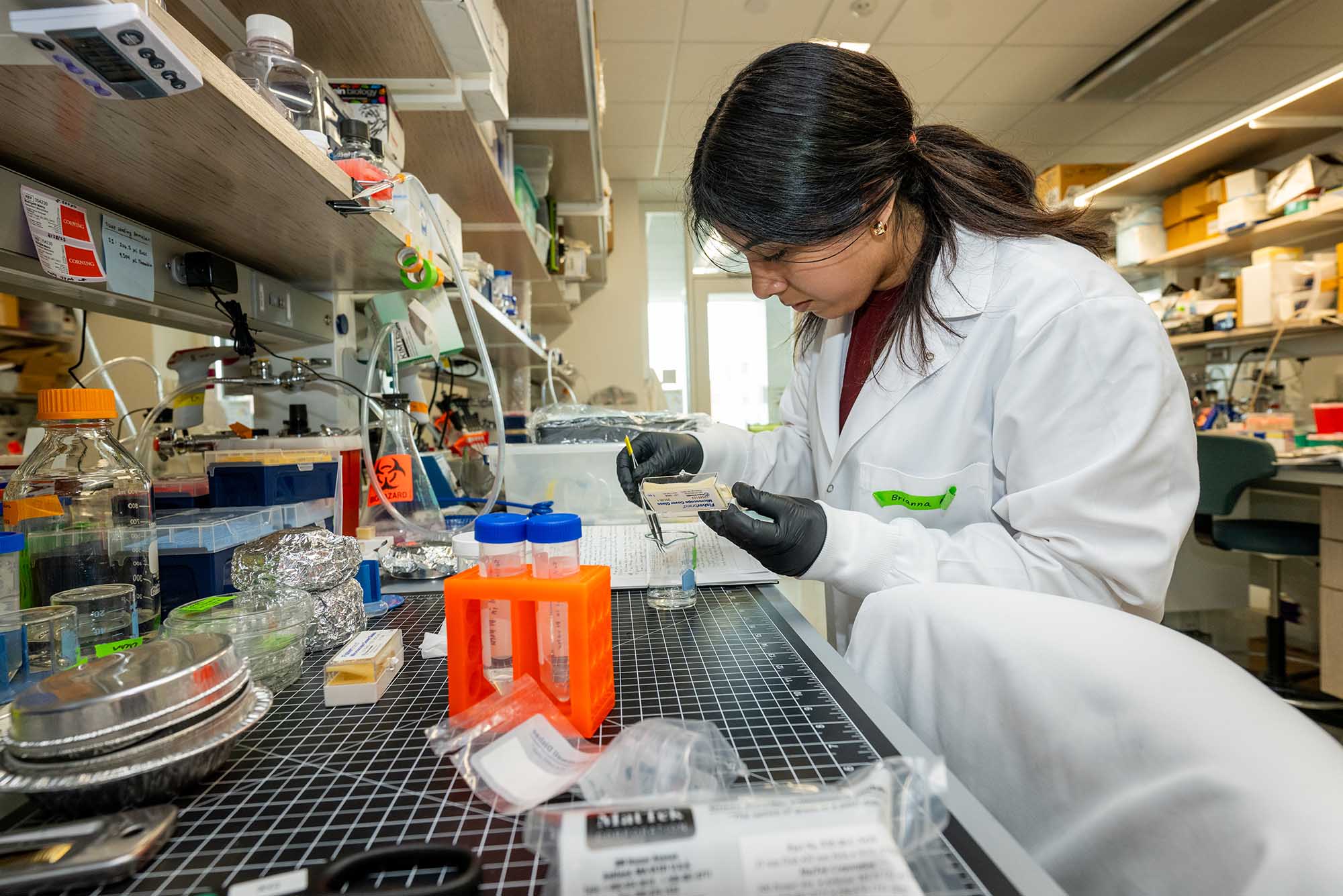
REM-Includes participant Brianna Perales (ENG’28) works on a project in the lab of BU biomedical engineer Christopher Chen.
Research Program Helps Bridge the Opportunity Gap for Young Engineers
Training and mentorship experience gives first-generation and low-income college students a taste of lab work—but needs new funding to continue
Brianna Perales (ENG’28) has always loved hands-on work and problem-solving. Growing up, her family didn’t have the resources to send her to summer science camps. Instead, Perales would make her own toy claw vending machines out of cereal boxes and scrap plastic, finding joy in building something functional. Later, she joined STEM-focused clubs in high school that only furthered her engineering interest and abilities. But after learning her lungs had developed scar tissue from a nasty bout of pneumonia, Perales’ quest for discovery found a new purpose: finding a way to treat—and even regenerate—tissue damage in patients like herself.
When Perales came to Boston University to study electrical and biomedical engineering—the first in her family to go to college—she looked for ways to have an immediate impact.
This past year, Perales applied for a BU College of Engineering–affiliated program, Research Engineering and Mentoring-Includes (REM-Includes), designed to give first-generation and low-income college students their first taste of lab time. It’s run by the BU-led CELL-MET, a National Science Foundation (NSF) Engineering Research Center in Cellular Metamaterials. The center, funded by a 10-year NSF grant and housed at the BU Photonics Center, is a collaboration between partner institutions—BU, Florida International University, and the University of Michigan—that seeks to create breakthroughs in cardiovascular care, particularly in the areas of cardiac tissue engineering and regenerative medicine.
REM-Includes, which comes with a stipend, helps bridge the gap for students like Perales who might not have had as many research opportunities as their peers, says Brenda Hugot, associate director of summer programs and outreach at the Photonics Center. But REM-Includes’ future is uncertain—the strand of funding it relied on recently ended and the team is looking for fresh support.
“The goal of REM-Includes was to introduce students to research early on to help them become more engaged with engineering—to see how it’s applied, and how what they’re studying ultimately translates into medical breakthroughs,” Hugot says. “The program was also designed to build a cohesive learning and friend group so that the participants can support each other throughout their time at BU.”
Research and Skill-Building
During the fall and spring semesters, seven engineering freshmen—six CELL-MET students, plus one sponsored by the Photonics Center—worked up to six hours a week in campus labs. But the heart of the program kicked off this summer.
For six weeks, the students spent weekday mornings on the ninth floor of the Photonics Center building, where they practiced basic engineering skills under the tutelage of Chris Alba (Wheelock’18,’23). A science teacher at Revere High School, just north of Boston, Alba ran sessions on skills like printed circuit board (PCB) fabrication, 3D printing, laser-cutting, and reading research papers. Ethan Hathaway, technical coordinator for Photonics Center summer programs, led sessions on skills like photolithography and making research posters.
“A big benefit of this program is simply exposure,” Alba says. Science education varies wildly from school to school. Alba himself didn’t have deep experience with engineering until he began teaching, he says, and enrolled in BU programs for working teachers to conduct research and learn skills like those covered in REM-Includes. He went on to earn a master’s and a certificate of advanced graduate studies in science education from BU Wheelock College of Education & Human Development, and will pursue an additional master’s in mechanical engineering from ENG next year.
The extra practice gives students an edge, Alba says. “Some students in this program certainly hadn’t been exposed to something like PCB manufacturing—and now they have that skill,” he says. “It’s something they can put on their résumé, and when they’re working in the field, they can say, ‘Hey, I can do this. Let me take the lead on this.’”
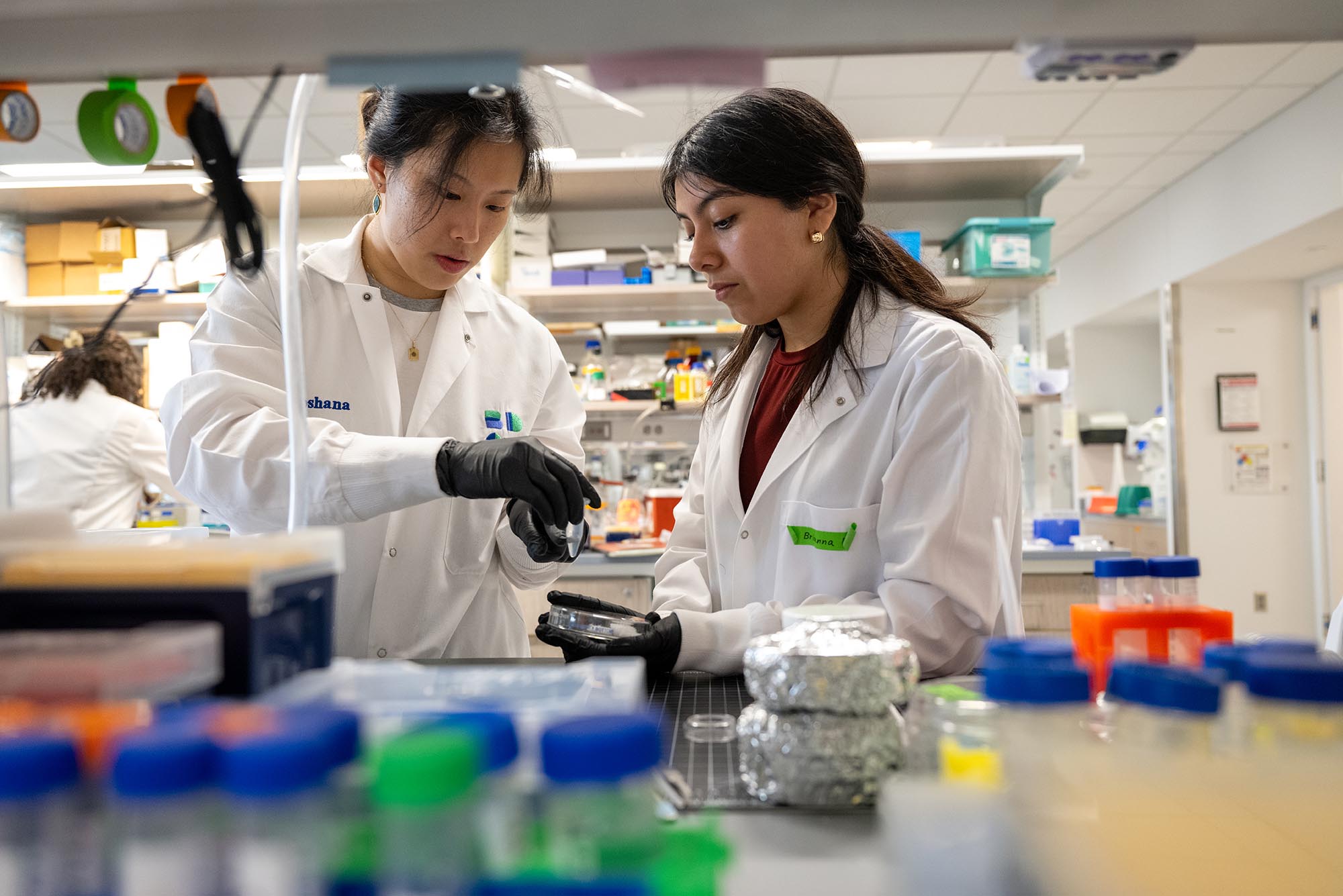
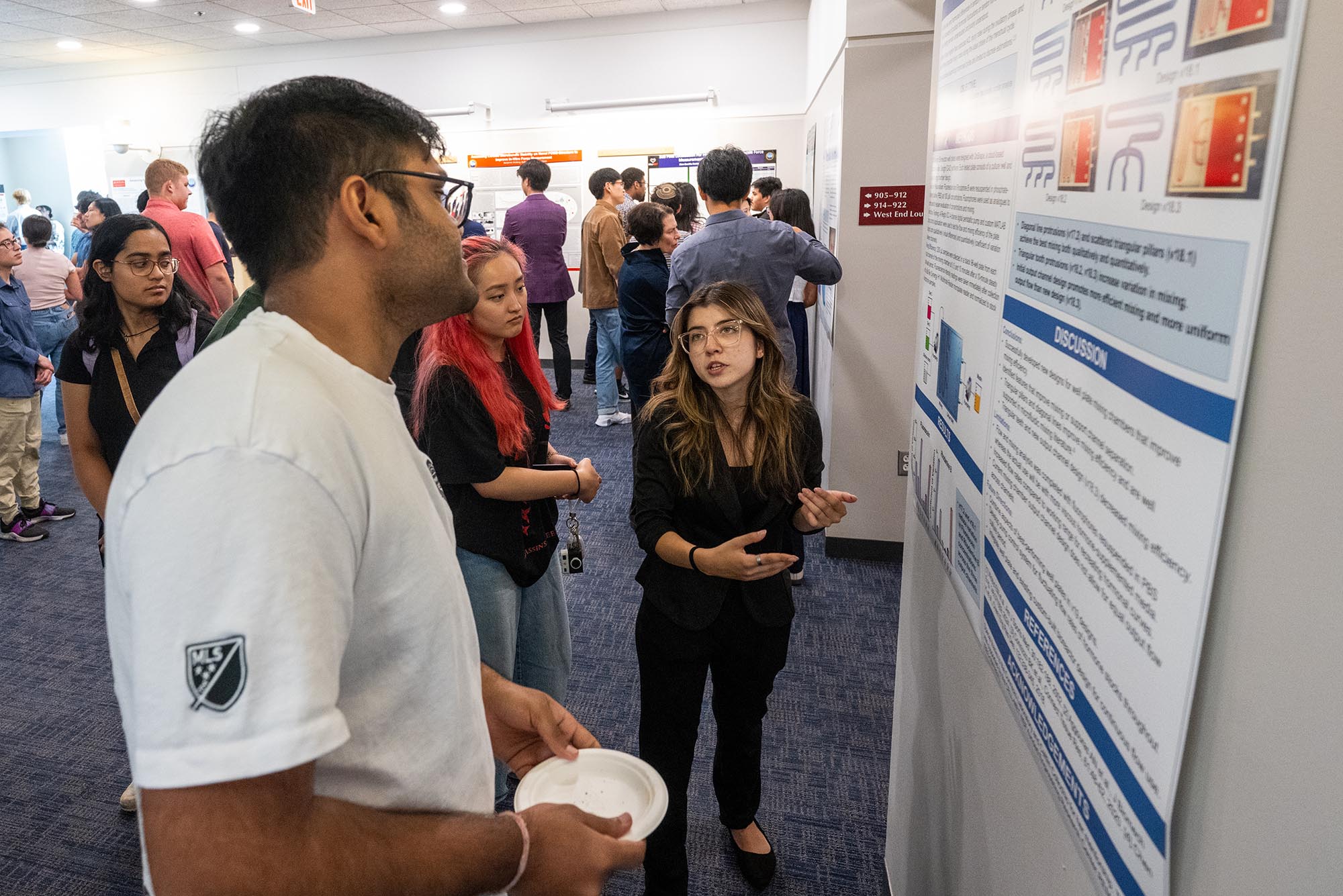
Each student spent their afternoons working on an individual mentored project in a CELL-MET or ENG lab. They presented the results of their work at a Photonics Center poster symposium for summer research programs in August.
One student’s project involved creating a user interface with MATLAB, a programming and numeric computing platform, for his mentor’s research to image blood flow in mice brains with a high-speed camera. Another’s involved finding a better way to administer drugs through skin, using pork belly as a skin stand-in.
Perales chose a project that contributed to CELL-MET efforts to grow cardiac tissue in 2D environments like petri dishes. Among other uses, growing cardiac tissue lets researchers, for example, conduct studies in labs that could lead to better understanding of how heart attacks happen. Perales optimized a method to help heart cells grow in a more organized way.
The design she refined, based on one of her mentor Xining Gao’s projects, “allows for more accurate measurements of the cells’ contractile forces,” Perales explains. “This work contributes to a larger effort to develop a reproducible 2D cardiac tissue platform for reliable high-throughput screening of heart function and potential treatments.”
Creating Pathways in STEM
One of the reasons Perales applied for REM-Includes was to explore tissue engineering and experience what biomedical research looks like in practice. The summer program was especially helpful for gaining an understanding of how research happens, she says. Moving from the morning to afternoon sessions highlighted the importance—and difficulty—of time management in research. And in her mentor’s lab, “I saw firsthand that experiments often have unexpected outcomes, and a large part of the process is figuring out how to navigate them within the bigger picture,” Perales says.
She feels more confident in her abilities after finishing the program.
“I feel my adaptability has improved, both inside and outside the lab, along with becoming better at engaging with existing research to advance my own work,” Perales says. “The experiments I conducted required a high level of precision that helped me strengthen my attention to detail and refine my fine motor skills with lab equipment, ultimately making me more comfortable and confident in the lab.”
Denver Morse (ENG’28, CAS’28), a biomedical engineering major, also chose a tissue-engineering project, printing microscale scaffolds for heart cells to grow on. As someone “enthralled by biofabrication and all things medical,” as she puts it, the program’s ties to CELL-MET research were too good to pass up. Beyond tightening her lab skills, the experience “reinforced the value of persistence in iterative research, highlighted the importance of mentorship and collaboration in driving scientific progress, and deepened my commitment to pursuing impactful, translational research in biomedical engineering,” she says. And, she adds, “This glimpse into research has compelled me to pursue an MD-PhD, as I have fallen in love with working in the lab.”
That’s exactly what the program’s architects intended.
Demand continues to grow for highly skilled STEM jobs, Hugot says, so creating a pipeline for as many people as possible to enter the field has never been more important. Unfortunately, the NSF funding for REM-Includes expired at the end of August; continuing to offer similar research opportunities for undergraduates will require alternative sources of funding.
The type of research conducted in CELL-MET labs “is an exciting pathway” for students to follow, Hugot says. “It’s a good way to make a living in multiple respects; it’s challenging, gratifying work. Everybody should have access to these kinds of opportunities.”
As a science teacher, one of Alba’s personal goals is to increase diversity in STEM fields. Helping the REM-Includes students refine their skills, and catch up to peers with previous research experience, is just one way to do that, he says.
He also hopes the program contributes to solving the great medical challenges of our time. At BU, “there are projects in the works that are meant to help people and save lives,” Alba says. “We need more of that. Hopefully, this program creates researchers who make that happen.”
Comments & Discussion
Boston University moderates comments to facilitate an informed, substantive, civil conversation. Abusive, profane, self-promotional, misleading, incoherent or off-topic comments will be rejected. Moderators are staffed during regular business hours (EST) and can only accept comments written in English. Statistics or facts must include a citation or a link to the citation.