Think Mushrooms Are a Pizza Garnish? You Haven’t Read Spores of Doom
BU’s Aaron Worth compiles weird tales about fungi in new anthology
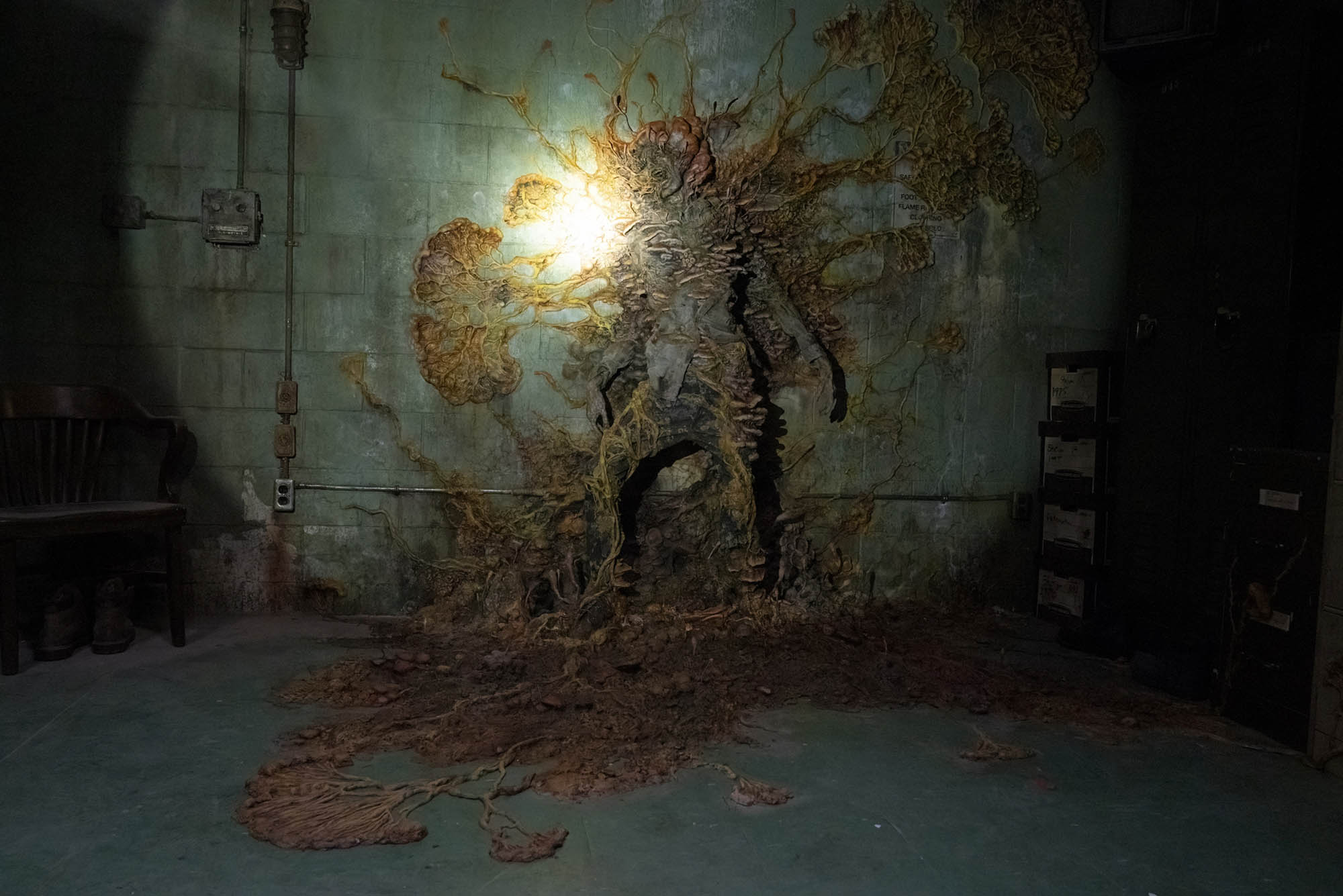
Aaron Worth’s new anthology capitalizes on the vogue for horror stories involving mushrooms and fungi, such as HBO’s The Last of Us. Photo by Warner Bros. Discovery, Inc.
Think Mushrooms Are a Pizza Garnish? You Haven’t Read Spores of Doom
BU’s Aaron Worth compiles weird tales about fungi in new anthology
“Mushrooms seem to be having a moment.” Author Jeff VandeMeer’s 2023 comment wasn’t culinary, but cultural, writes Boston University’s Aaron Worth in the introduction to his latest good-read-for-Halloween, Spores of Doom (British Library, 2025). From numerous novels to HBO’s hit series The Last of Us, “sporror”—horror stories where people are absorbed or otherwise menaced by fungi—have, um, mushroomed in the last decade, says Worth, a College of General Studies associate professor of rhetoric.
The 13 “dank tales of the fungal weird,” as his subtitle describes the collection, demonstrate that writers have long nurtured a fascination with mushrooms. The stories date back as early as 1839 and boast such famous authors as Edgar Allan Poe, H.G. Wells, and H.P. Lovecraft, as well as Worth, whose story “The Mykophagoi” concludes the anthology.
The editor of several British Library spooky anthologies, Worth spoke with BU Today about why we find mushrooms, moulds, toadstools, and their ilk so unnerving.
Q&A
with Aaron Worth
BU Today: Many of us love mushrooms as a food item. What about them scares readers?
Worth: Horror has always exploited fears of alterity—radical “otherness”—and it’s hard to get more “other” than fungi. They aren’t animals, and they aren’t plants. They’re something else—and from our perspective, they often seem to be something, to quote Homer Simpson, “much more else.” They can be seen as transgressing all kinds of conceptual boundaries: between living and dead, male and female, organic and inorganic. In that sense, they are “monstrous” from a categorial perspective, blurring the lines between the terms and distinctions we use to organize things in our minds and in our culture. That can be extremely unsettling.
Yet they’re familiar as well, whether as a meal accompaniment, and fungi more broadly are responsible, of course, for the wine and beer we drink, for medicines and other drugs, and so on, as parasites and lifelong co-travelers, and indeed as not-so-very-distant evolutionary kin. Animals and fungi, we now know, are both more closely related to each other than to plants. Maybe this is where our fear of becoming fungus, as evidenced in such recent films and TV series as The Last of Us, comes from.
It’s hard to get more ‘other’ than fungi. They aren’t animals, and they aren’t plants.
BU Today: When and how did you first stumble on “sporror?”
I think the first writer I encountered whose work featured fungal entities in a prominent way was H.P. Lovecraft, so that would have been way back in high school. Of course, the category of “sporror” didn’t exist yet, but Lovecraft was always lavishing his settings with putrid, unwholesome fungal growths to create an uncanny atmosphere, and even imagined a species of fungus-based life which was supposed to come from Pluto. Other pulp writers from Lovecraft’s day, particularly in the science fiction magazines, wrote about malevolent mushrooms, spores, yeasts, and so on, and as I try to show in the anthology, there are important examples of the fungal weird that date farther back. But he’s probably the most influential single figure in the prehistory of today’s sporror genre.
BU Today: You mention in the book’s introduction that mushrooms are having a cultural moment now, but the stories date back almost two centuries. Have writers’ approaches to this topic changed in that time?
The earliest piece in the collection is Edgar Allan Poe’s famous story “The Fall of the House of Usher.” This is a good example of a Gothic tale featuring fungi for atmospheric and symbolic purposes, but which predates any conscious category of a “fungal weird,” so even though it’s been exhaustively written about by critics over the years, it wasn’t particularly thought of as a “fungal” tale in the past. By contrast, you can look at a pair of contemporary Gothic novels which consciously revisit and rework Poe’s story, Silvia Moreno-Garcia’s Mexican Gothic and T. Kingfisher’s What Moves the Dead, in which the fungal theme is both brought more center stage and used as a vehicle to explore such topics as colonialism, gender, and so on.
Speaking generally, different cultural and historical moments tend to project their own anxieties onto genres and subgenres over time—vampires, for instance, could symbolize the fear of invasion from “The East” in Bram Stoker’s day, and fears of sexually transmitted diseases in the 1980s and 1990s. So mushrooms and other fungi have functioned over time as symbols of invasion, the loss of individual identity—joining a “hive mind”—or contagion and infection, especially in our post-pandemic moment.
BU Today: Which story in the collection scares you the most?
The Robert Aickman story “The Stains” is maybe most unsettling to me, but in a David Lynch way, because his fiction is so ambiguous that you’re never quite sure exactly what happens, which has a goosebumpy effect, on me, at least. For pure grue, Clark Ashton Smith’s “The Vaults of Yoh-Vombis” may take the prize. I also have to admit that my own story in the collection gives me a little chill, because I can picture the fate I imagined for the characters in it, but it’s not for me to say how successful it is in transmitting that feeling to readers.