Design, Build, Drive: Meet Terrier Motorsport
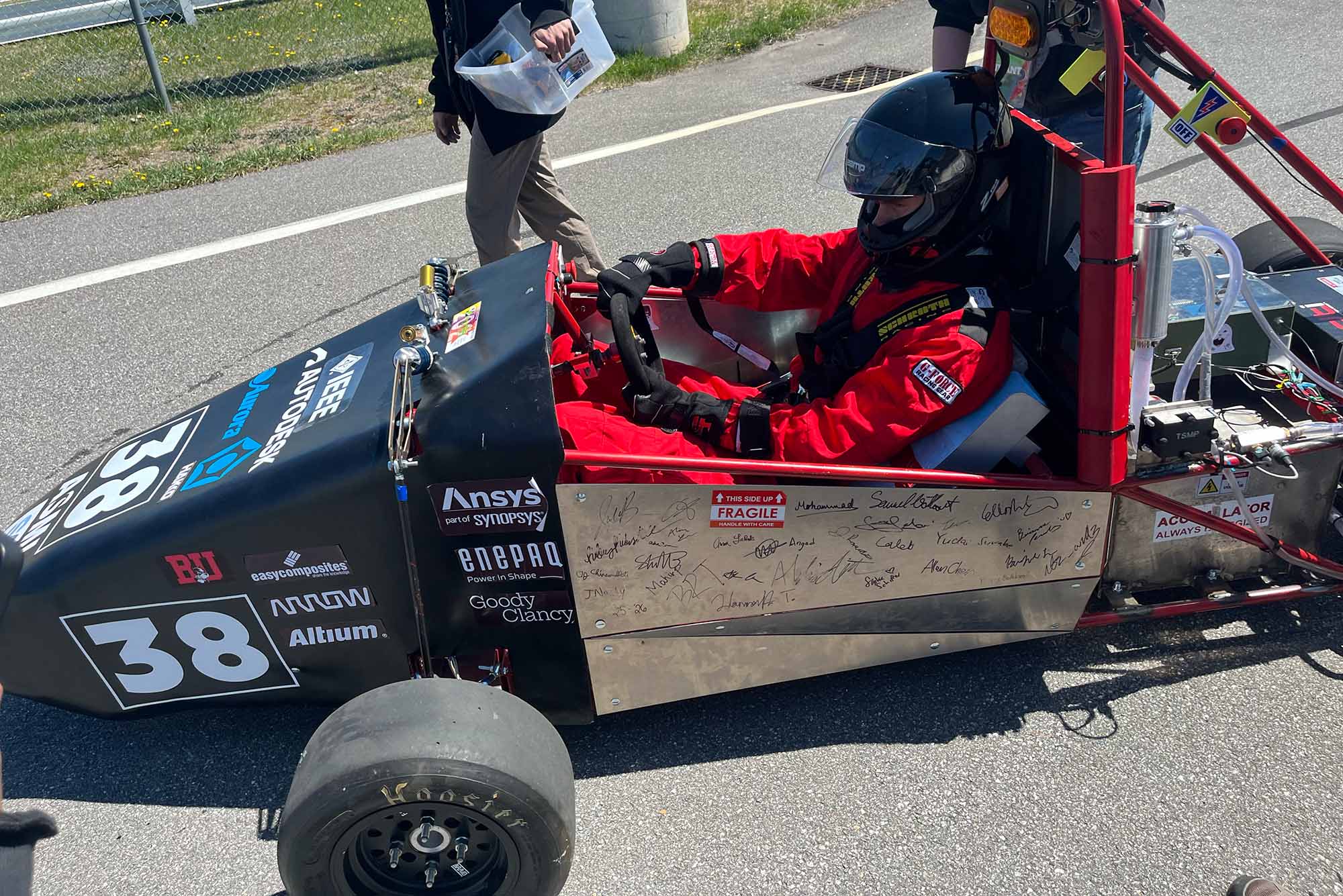
Students took turns driving TM01, their all-electric racecar, around a track for 44 kilometers at collegiate competition Formula Hybrid last spring. Photo courtesy of Terrier Motorsport
Design, Build, Drive: Meet Terrier Motorsport
BU’s student racecar club is building a new and improved electric vehicle
Hundreds of student clubs will gather on Nickerson Field this Saturday, September 5, for Splash, BU’s annual extracurricular fair. There will be multiple performing arts groups, organizations promoting cultures from around the world, and hobbies active and sedentary. It’s safe to say, though, that you’ll find only one club devoted to designing and building an electric racecar. That is, a full-size, working, all-electric automobile capable of zipping around a track for 44 kilometers, or navigating a slalom course.
Terrier Motorsport, formerly known as BU Racing, enters this school year on a tailwind, boasting real competition experience that eluded past iterations of the club. Last spring, for the first time in its decade-plus history, the club qualified at Formula Hybrid, an annual collegiate competition for electric and hybrid vehicles, held at the New Hampshire Motor Speedway. Moreover, several members of the club earned a Design Excellence Award from the BU College of Engineering’s electrical and computer engineering department for the car’s safety system, which they submitted for their senior capstone project.
Not content to coast, this year the club plans to build a whole new car, incorporating a raft of improvements to make it sleeker and more reliable. At Splash, they’ll be recruiting for student engineers to help design and manufacture the new car’s chassis, motor, driver retention system, electrical system, and most everything else.
Terrier Motorsport isn’t just for engineers, though. They’re also looking to fill the myriad management and administrative roles that support the club’s efforts as a whole.
“We’re doing documentation, budgeting, sponsor outreach, event planning, social media,” says Teric Cheung (Questrom’28), Terrier Motorsport’s chief of business and operations. “There’s so much that goes into this. It’s a cross-functional, interdisciplinary team. That’s the benefit of a club like this; we all get exposed to different fields.” Cheung, who added an engineering minor to his business major as a direct result of his exposure to engineering in Terrier Motorsport, reasons that “Obviously, my GPA won’t be a 4.0, but I’m learning so much.”
The club’s workshop is located in a basement off Cummington Mall. That’s where the students assemble the car from parts that, by and large, they manufactured themselves in BU’s Engineering Product Innovation Center (EPIC).
The endeavor combines mechanical engineering with electrical and computer engineering, and students find that the experience reinforces lessons from their engineering coursework. “You learn the theory in class, but then in the club you realize, ‘That actually applies to this part I’m designing,’ or ‘this analysis I’m running,’” says Cheung.
The club suffered a minor setback when they discovered that TM01 was too big to fit in their building’s freight elevator and members had to disassemble the car, take it upstairs in stages, and reassemble it outside.
We call TM01 ‘the Tank,’ which is not necessarily a good nickname for a racecar
“We call TM01 ‘the Tank,’ which is not necessarily a good nickname for a racecar,” says Cheung. “It’s not slow for its size, but it is huge. That’s why one of our goals for this year, for TM02, is to downsize the car, and also improve the quality of our manufacturing. We made some miscalculations last year.”
That didn’t stop the students from getting TM01 to New Hampshire for Formula Hybrid in May. The multi-day event is one of several Formula SAE (or FSAE) competitions held under the auspices of SAE International, formerly known as the Society of Automotive Engineers. (“Formula” refers to a set of rules for open-wheel, single-seat cars of the kind that compete in the international Grand Prix.)
Once at the speedway, the Terriers had to overcome additional hurdles. On the first day, the car failed one of several different technical inspections. (Judges have to be quite strict, considering student safety is at stake.) The Terriers’ electrical team spent a late night fixing the battery box. Upon retaking that test, the car passed, but proceeded to fail the next one. Now it was the mechanical team’s turn to stay up late, repairing the suspension and chassis.
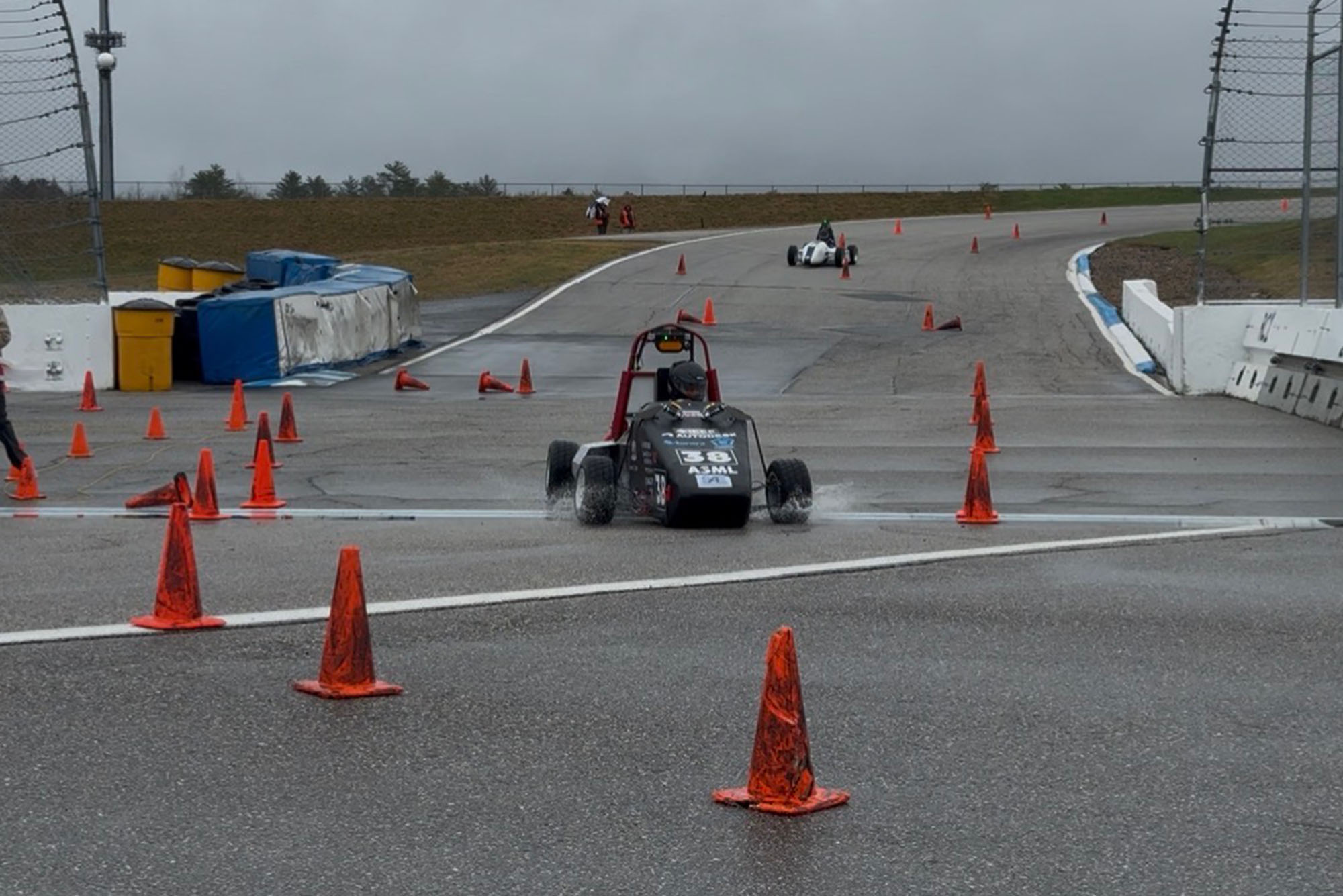
Finally, the car passed all inspections, and the Terriers were free to compete for points in various events, aiming for the best times and performances in autocross (a kind of slalom course), acceleration (a straight 75-meter run), and endurance (making it around a track for 44 kilometers with four driver changes).
In the end, Terrier Motorsport placed 7th overall out of 23 teams and was the top finisher from the Boston area. “It was just a massive outbreak of joy,” says Cheung. “This is what we spent two years building toward.”
Grace Lee (CAS’27), Terrier Motorsport’s secretary, says she observed an impressive strain of maturity in her teammates—and their competitors—throughout what could often be a humbling process. An important aspect of the competition took place not on the racetrack or in the pit stop, but in a conference room, where students gave presentations on their car’s design and the club’s operations. The judges asked probing questions and offered frank feedback on all aspects of this project that the students had toiled over for so long.
“The engineers from BU and all these other college-level teams were open to criticism in a way that’s hard to find in other disciplines, to be honest,” Lee says. Along with that level-headedness, she noted a willingness to help each other out and a genuine interest in respectfully considering ideas that transcended the confines of the competition.

These are the kinds of traits—persistence, collaborative spirit—that potential employers like to see in undergraduates, and indeed, Cheung says that many businesses will sponsor collegiate racecar clubs for that reason: “They want to get a first look at students who have hands-on experience completing an ambitious project.” These skills will translate to sectors far beyond the automotive industry—although Terrier Motorsport alumni have landed jobs within the Formula world, too.
“Overall, the club is a crazy investment in terms of time and effort—it’s essentially like taking an extra class,” says Cheung. “Ultimately, what a lot of alumni say is that the outcome is definitely worth it. I already say it’s worth it.”
Student representatives from Terrier Motorsport will be on Nickerson Field during Splash on Saturday, September 5, from noon to 2:30 pm.