“Let Us Be the Architects of a New World”: Moms in Academia Speak Out to Address Workplace Inequalities
“Let Us Be the Architects of a New World”: Moms in Academia Speak Out to Address Workplace Inequalities
BU researchers and peers from around the world, after decades of talk, lay out a plan for action
As the coronavirus pandemic’s grip on the United States stretched from weeks into months, with huge swaths of the American workforce bound to their homes, studies began trickling out revealing that the impact and burden of quarantine was not equally shared. Women—particularly mothers, and especially mothers of color—were bearing the brunt of the pandemic’s toll, losing their jobs in greater numbers than men, handling the lion’s share of increased housework that quarantine created, and juggling their careers while also taking on the role of teacher to their children struggling to navigate a new remote-school routine.
But many people in America, including female researchers at Boston University and institutions around the world, didn’t need research papers to tell them what they already knew: of course mothers would be impacted the most—it’s how the system is set up, they say.
“We kept [seeing new peer reviewed publications] and reading [about these studies in the news], which showed moms were being badly impacted, and a lot of the lead authors on these papers were men,” says ecosystems ecologist and biogeochemist Robinson Fulweiler, a BU College of Arts & Sciences professor of biology and of earth and environment, who has been an advocate for women in academia even before she became a mom to two children, ages three and one. “The news was reporting these studies as if they were a surprise…but there’s already been a lot of data gathered about this issue. But there have been no solutions. Our level of frustration peaked. We decided we need to make a plan to fix things.”
She found an ally in colleague and fellow marine scientist Sarah Davies, a BU College of Arts & Sciences assistant professor of biology. “We’ve all been to the meetings, the ones where we are all batting around ideas on how to improve things for women and for moms in academia,” Davies says. “But there have been no real solutions.”
Davies uses Twitter to raise awareness of the realities of being a mom in academia. One of her recent posts said: “OK, my older daughter starts hybrid in person learning this week, which means I now get 2 days of no Zoom school (such a friggin gift). This post below got me thinking about how much time I have lost- TOTAL (likely underestimate): 615 hrs. This is with a 50/50 partner!”
While the data are clear that mothers are being disproportionately impacted by COVID-19, many groups could benefit from these strategies. Rather than rebuilding what we once knew, let us be the architects of a new world.
In recent months, Fulweiler and Davies have used the platform to organize a response—1,500 scientists strong—to a now-retracted Nature Communications paper that suggested women in science should seek out male mentors for the best career success. This response was coupled with Fulweiler’s effort to gather data demonstrating strong female mentorship, and ultimately led to a manuscript, with Davies the lead author, describing the need to broaden our value system.
Davies has two children under the age of four—between running a research lab, teaching courses at BU, and caring for a toddler and a baby at home, she says extra bandwidth didn’t exist.
But Davies, Fulweiler, and peers from around the world, also mothers, felt it was time to take action. “We all had no time—but we prioritized this anyway,” Davies says.
They wanted to get together a group of women in academia, representing different stages of a career, from different backgrounds, ranging from postdocs to full professors. “Everyone spoke from a different place about what the problems are,” Davies says.
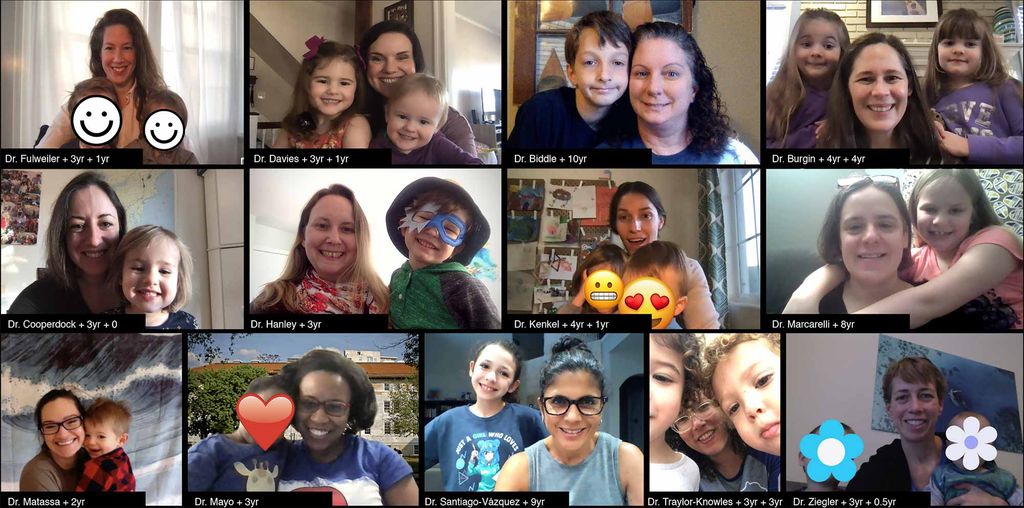
Together, 13 researchers—all moms themselves—authored a manifesto for supporting mothers in academia. They spelled out a roadmap for policies that would support women, and particularly mothers and parents of color, to help level a playing field traditionally dominated by white men.
“While the data are clear that mothers are being disproportionately impacted by COVID-19, many groups could benefit from these strategies. Rather than rebuilding what we once knew, let us be the architects of a new world,” they write.
There are five areas, or “spheres of influence,” the authors say, that could impart a tangible impact on women by implementing some key requirements. “Hopefully, this can be the start of a snowball of change,” Davies says.
Their proposed areas of focus:
1) Mentors
“The number one thing is to culture an environment where everyone feels comfortable, so that the moment when someone says they are pregnant, it’s a supportive setting,” Fulweiler says. She also says it’s important not to make assumptions about someone just because they are pregnant or a new parent: “Ask to what level they want to be involved in a group’s research, don’t assume that they want less involvement.”
Fulweiler says lab heads and mentors should also be fully aware of a university’s policy for new parents, and to fight for change if those policies are lacking.
“My chair was so jazzed when I told her I was pregnant, she was so congratulatory,” Davies says. “It really made me think about what a difference it would have made if I had a different chair who was not as supportive. That could have really changed my feelings about being accepted in the department.”
Fulweiler says that three graduate students in her lab have had babies, and that she made an effort to be positive and supportive throughout those experiences. “I was really excited for them,” she says. “I was someone who never wanted to have kids, but then I got married and I changed my mind. Having seen my students do it, it made me realize it’s possible. They were also very supportive of me. My lab is wonderful.”
2) University administrators
Davies says university administrators and policies can support mothers in academia by reexamining tenure timelines. “Universities have given an automatic one-year extension to tenure-track faculty that take a teaching leave when they have a baby, but I think there should be a choice,” Davies says. “When you think about existing wage gaps between men and women, these extensions don’t really work as intended anyway. I actually didn’t want any ‘baby’ years added to my tenure timeline, but if you take maternity leave, you get a one-year extension.”
She says universities can provide incentives for other faculty members to take on additional responsibilities while a colleague is becoming a new parent or funds to hire someone to temporarily provide relief. “Other faculty in the department could step up in helping,” she says. But these good “departmental citizens” should be rewarded with extra merit or additional pay. “I would do that for someone else,” she says.
Where could universities have the biggest impact? Fulweiler and Davies say it’s daycare. “Subsidized, quality daycare with great daycare providers…daycare that is safe, testing for COVID…. Even if this pandemic wasn’t happening, the biggest issue is still daycare,” Fulweiler says. “Universities should have a sliding scale, so that based on economics, people can get assistance.”
3) Scientific societies
“COVID has shown us you can do conferences virtually,” Fulweiler says. And while that’s not the same experience as attending a conference in person, it does increase the accessibility for parents and new and expectant mothers. “We’re asking that conferences don’t go back to all in-person events.”
She also says she and her coauthors are asking scientific societies to continue to invest in early- and mid-career scientists, recruiting them to join their boards. “When early-career people see somebody like them in that type of position, they realize they can do it,” Fulweiler says. “Boards should be diversified, especially to include moms of color.”
At meetings and conferences, daycare support and lactation rooms should be the norm, Fulweiler adds, remembering one experience that really stands out in her memory. “In 2017, I was cochairing the Coastal Estuarine Research Federation (CERF) meeting, and they had a lactation room, and in it there were granola bars and water and notes that said, ‘You can do it, you’re not going to lactate forever.’ It was so awesome.”
4) Publishers
Publishing scientific papers and studies makes up a huge component of achieving tenure. But Davies says publishers can do more to make publishing opportunities more accessible to women and mothers. “Invite academic mothers to write review articles—we know these articles tend to get well-cited, and the opportunities are often going to high-profile men,” she says.
She says publishers can extend deadlines for revisions and reviews, and expedite or subsidize submissions from women and mothers. Publishers should actively recruit women to their editorial boards, Davies says, because those positions mean a lot for someone’s profile and reputation in academia. Publishers could even add an option to self-identify as a mom during paper submission processes, she says, and they could wave open-access fees for papers led by moms, which would increase the visibility of those studies. “Open-access is cited more, but often a lot more expensive,” she says.
5) Funding agencies
Davies says funding agencies could streamline paperwork and provide multiyear extensions to grants at no cost, acknowledging that many researchers have lost countless hours during the pandemic. “We lost a whole season doing research in the field,” she says. “We also suggest [funders] ask for COVID-19 impact statements, and provide supplemental funding.”
Comments & Discussion
Boston University moderates comments to facilitate an informed, substantive, civil conversation. Abusive, profane, self-promotional, misleading, incoherent or off-topic comments will be rejected. Moderators are staffed during regular business hours (EST) and can only accept comments written in English. Statistics or facts must include a citation or a link to the citation.