news
Sensorium: Stories of Glass and Fragrance
Corning Museum of Glass
September 7, 2024–February 23, 2025
by R.J. Maupin
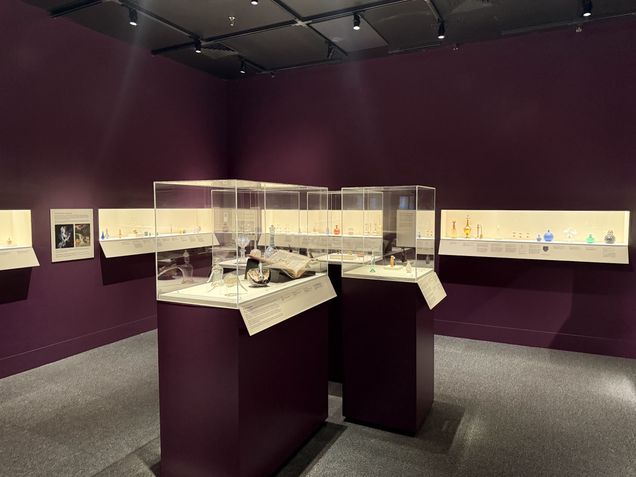
Museum visitors can spend countless hours looking at artwork on display, but other sensory experiences, such as smelling or touching, are largely forbidden. Despite these necessary protocols that protect material culture for future generations, curators can implement creative strategies to facilitate immersive, multisensory exhibitions. Sensorium: Stories of Glass and Fragrance, a 2024–2025 exhibition curated by Julie Bellemare at the Corning Museum of Glass (fig. 1), provides an expansive overview from antiquity to the present day of scent containers that held perfumes, scented waters, medicines, tobacco, spiced oils, and dried flowers. Given that these fragile glass bottles must be protected by vitrines for their safety, the exhibition runs the risk of prohibiting the visitor from engaging the very sense that structures its thematic narrative. Nevertheless, Bellemare cleverly addresses this challenge and offers an encouraging example of how curators can supersede the visual by inviting visitors to “think” with their noses.

Outside of the main gallery is an introductory text and a small interactive station that reminds the viewer to imaginatively consider olfaction in tandem with vision (fig. 2). Under a wall text that asks, “What did money smell like in the 1700s?” viewers are prompted to consider the influence and violence of the European spice trade in Indonesia and Sri Lanka as they sniff spiced oils made from cinnamon, clove, nutmeg, and mace. This method of multisensory engagement seems almost obvious, given its popularity in other recent exhibitions, such as Five Senses of Chinatown at the Museum of Chinese in America and Our Senses: An Immersive Experience at the American Museum of Natural History. However, the danger of this strategy is turning experience into pure spectacle or eschewing a rigorous analysis of the objects. Since Sensorium’s smell station lies outside the main gallery and relates to a carefully selected set of scented oil bottles and potpourri vessels on the adjacent wall (fig. 3), it becomes a thoughtful, generative experience. While the visitor might yearn to smell other relevant materials, it would be challenging to make interactives for each of the works on display. Thus, it was a clever decision to use this station as an ode to a sensorial way of thinking rather than a central facet of the exhibition’s narrative.
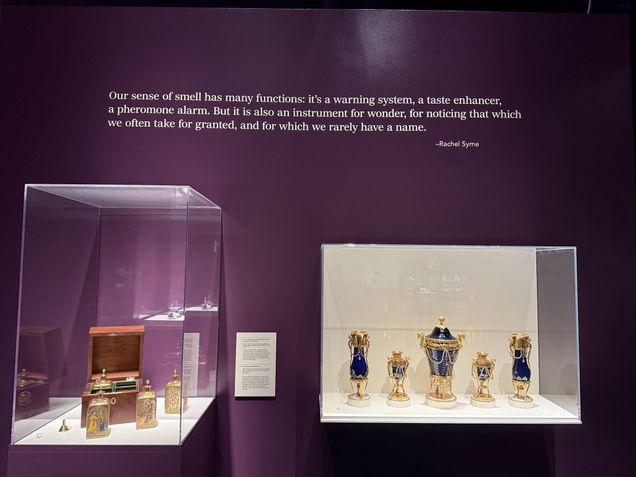
After passing through this introductory section, viewers enter the main gallery, featuring deep purple walls and dramatic lighting that evokes the opulence of the colorful glass vessels within display cases. Three wall didactics chart the evolution of scent bottles, investigating histories of industrialization, luxury, and artistry. Cases in the center of the room diverge from the chronological displays, explaining distillation methods, religious uses, and the utilization of herbs and spices for medicine. This exhibition’s small space does not allow for a comprehensive show, but it does offer a diversity of topics, ranging from the attar industry in India, to the development of synthetic scents, to the nineteenth-century belief in the miasma theory. Viewers, then, can rely on their emotive memories of scent to easily find objects or narratives that spark personal intrigue.
Perhaps the most successful element of this exhibition, considering its institutional context in a renowned glass museum, is the exploration of the connections between scents and the materiality of glass. Physically, the impermeability of glass renders it an ideal container, but its fragility also reflects the preciousness of the expensive materials it is designed to hold. Some objects within the gallery require little contextualization to communicate this idea, such as a set of miniature glass bottles in a gold box, which depicts glassblowers crafting a vessel at a furnace (fig. 4). The maker’s decision to replicate this scene reveals how the box’s craftsman, glassmaker, perfumer, and consumer were consciously bound in an intimate relationship. While the visitor cannot physically handle this object, it is easy to imagine the original seventeenth-century owner touching it, picturing the complex methods used to produce the glass vials, and finding pleasure in its lavish aromas.

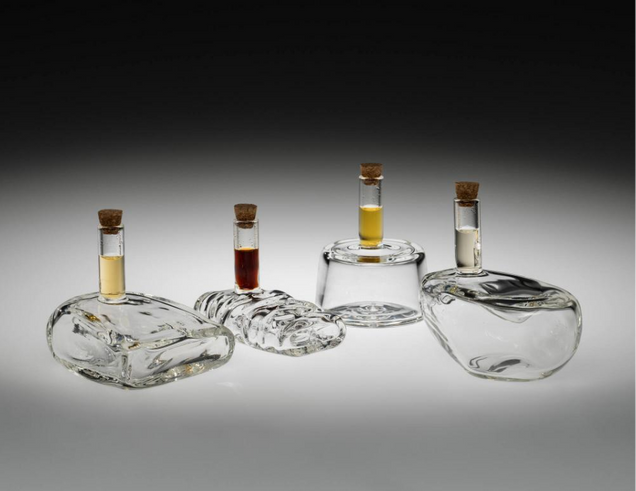
Beyond historical examples, Bellemare’s inclusion of contemporary glassmakers was a wise strategy to compel the viewer to consider smell as a primary way we interact with the material world. Glass artist Katherine Gray’s Paper, Sleeve, Wax, Block (2024) depicts four tools used to blow glass and small vials holding distilled scents of those that are emitted when using the tools in a hot shop (fig. 5). For example, the block is a wooden tool submerged in water that is used to gently shape the glass; as steam rises off the wood, it emits an unmistakable burnt odor. By capturing these smells, Gray refers to the nostalgia of her embodied experiences as a maker. Gray’s piece makes a powerful statement in this context, as visitors to the Corning Museum of Glass have the opportunity to see (and smell) a live demonstration of glass being blown or flameworked in nearby studios. In harmony with the exhibition’s title, Gray’s work—as well as many others that were selected for display—allude to the necessity of thinking beyond the visual and the meaningful stories we can tell when considering other forms of sensory stimuli in our everyday lives.
____________________
R.J. Maupin is a second-year master’s student in Decorative Arts, Design History, and Material Culture at Bard Graduate Center. Her focus is American glass history of the nineteenth and twentieth centuries with particular interests in labor, industrialization, gender, and the performative aspects of craft.
____________________
editor’s introduction
by Rachel Kline and Kaylee Kelley
The discipline of art history has often struggled to reanimate what, for many of us, are three-dimensional objects stripped of their original context within the white walls of the modern museum. In the field of Renaissance art history, Michael Baxandall attempted to revive the temporally specific viewer with his concept of the “period eye,” which he theorized as the ways in which visual experience is culturally relative.1 However, the full range of sensory engagements beyond the visual was still missing from this approach. More recently, in her study of Isabella d’Este’s collection— an exemplar assemblage of art and artifacts curated by one of the most influential female patrons of the Renaissance— Geraldine A. Johnson has expanded on the concept of the “period eye” by considering the embodied experience of a historically specific viewer who “would have engaged works of art with all the senses, rather than by vision alone.”2 She argues that the tactile elements central to many of Isabella’s small-scale sculptural objects would have appealed to the Marchioness and her courtly entourage, thus emphasizing the sensorial phenomenon of art consumption during the Renaissance.
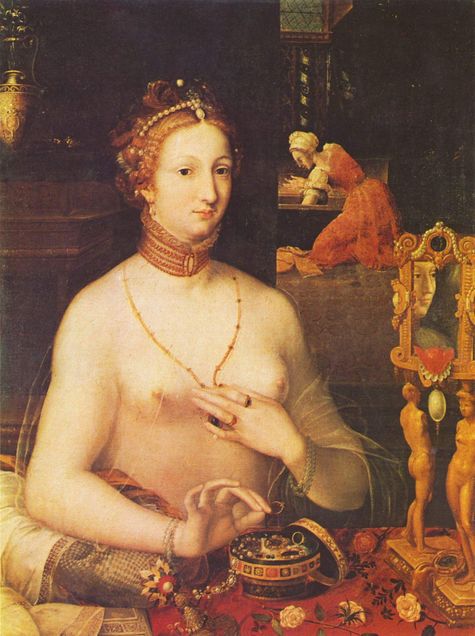
Reimagining the other types of sensory responses an image might evoke challenges the perception that early modern painting becomes static once it has been ripped from its original time and place. Portrait of a Lady at her Toilette (fig. 1) is one such feast for the senses, offering a visual parallel for period engagement with material culture at the court of Fontainebleau. During the sixteenth century, the court of King Henry II of France attracted an international group of court artists and especially Italian painters, who brought with them an interest in the sensual allure of painting. In the developing discourse of Italian painting, images of the nude female body became a metaphor for the beauty of painting itself, which the viewer was invited to experience and even possess in the case of certain elite patrons.
In her analysis of a similar image of a nude woman at her toilette woven into a tapestry, Laura Weigert accounts for the multi-sensory engagement of this iconographic type and demonstrates how “the scene evokes a multiplicity of sensual pleasures that diffuses a single focus on this body.”3 The beholder is encouraged to consider the silken texture of the sitter’s diaphanous negligée and the sound of courtly music playing from the next room in tandem with the surface of the image itself. When ocular-centric modes of viewing are put aside, one is able to conjure the aroma of the fallen rose petals, the cool clink of the string of pearls, and perhaps even smell the drifting scent of incense or the perfume worn by the seated lady. The nude woman’s elongated fingers pinch the gemstone pendant around her neck and delicately hold a jeweled ring; these gestures formally suggest the tactility central to the painting’s appeal. When we intentionally read images through a sensorial lens, we can gain insight into Renaissance life at the court of Fontainebleau. In considering the full range of sensorial stimuli present in a work of art, we are not met with a mirror onto court life but rather an opportunity to imagine the experiences of the period viewer and sitter.
This issue of SEQUITUR expands this line of thinking to consider the allure and agency of works of art through inquiries into the embodied experiences of artists, patrons, beholders, and collectors. Such a reading of Portrait of a Lady at her Toilette exemplifies the generative potential of looking beyond the canvas to consider the multi-sensorial phenomenon of viewing. Materiality, sound, fragrance, and spectacle are evoked by this issue’s authors, culminating in a body of research which reconsiders what might fall under the purview of art historians as scholars primarily concerned with the visual realm.
In this issue, Sunmin Cha explores the profound visual and sensory dimensions of Albert van Ouwater’s The Raising of Lazarus (c. 1460–1475), a rare surviving work by the Haarlem painter. Cha’s analysis reveals how Ouwater’s painting functions as a dual spectacle—while the viewer marvels at the artist’s technical skill and narrative clarity, the figures within the scene themselves witness the miraculous restoration of life likened to the ritual of the Eucharist. Through an examination of an incense burner from the Metropolitan Museum of Art, Madison Clyburn investigates the historical significance of scent in the everyday lives of sixteenth-century Paduans. Clyburn reveals how the stimulating, therapeutic effects of scent shaped the sensory fabric of a city bustling with students, pilgrims, disease, and fragrant imports.
Shifting the focus from sensory engagement to timekeeping, Mya Rose Bailey’s research spotlight offers a poignant examination of how clocks and timepieces at Thomas Jefferson’s Monticello plantation distorted and shaped the lived experiences of enslaved laborers. Bailey demonstrates how the sense of sound shaped the lives of enslaved people, thereby seeking to shed light on the silenced bodies whose experiences are often obscured within the extensive historical archive.
In her visual essay, Elise Racine explores the dynamic interactions between digital and physical realms. With an emphasis on knowledge-sharing through the lens of sensory interaction, her work—inspired by the materiality of traditional book art in tandem with digitally accessed work—aspires to redefine our engagement with knowledge as an embodied, sensory act.
R.J. Maupin’s thoughtful review of Sensorium: Stories of Glass and Fragrance, curated by Julie Bellemare at the Corning Museum of Glass in Upstate New York, underscores the power of scent in shaping historical narratives. Maupin highlights the immersive approach to the exhibit which invites visitors to smell fragrances infused with spices traded by Dutch merchants, while also encouraging reflection on how sensory engagement influences production processes. Angelina Diamante reviews Conjuring the Spirit World: Art, Magic, and Mediums, a comprehensive five-month-long survey of Spiritualism at the Peabody Essex Museum in Salem, Massachusetts. Considered in this review are the twentieth-century performances of magic and seances, and the ways in which reality and spectacle harmonized with the senses to achieve resolution with contemporary audiences.
Together, these contributions offer a rich exploration of the sensory dimensions of art and history, demonstrating how our engagement with the world around us shapes both perception and artistic creation.
____________________
Rachel Kline is a fifth-year PhD candidate studying the art of the Italian Renaissance. Rachel’s research interests include the representation of the female nude in fifteenth-century Italy and the decoration of Florentine marriage chests. Rachel has held positions at the Penn Museum and the Philadelphia Museum of Art.
Kaylee Kelley is a doctoral student focusing on art of the early modern period. Her research centers on Renaissance tapestries created across Italy, Flanders, and England with an emphasis on their literary sources and curation. She has held positions at the Museum of Fine Arts, Boston and the Medici Archive Project.
____________________
1. Michael Baxandall, Painting & Experience in Fifteenth Century Italy (Oxford University Press, 1972), 29–108.
2. Geraldine Johnson, “In the Hand of the Beholder: Isabella d’Este and the Sensual Allure of Sculpture,” in Sense and the Senses in Early Modern Art and Cultural Practice, eds. Alice E. Sanger and Siv Tove Kulbrandstad Walker (Ashgate Press, 2012), 183.
3. Laura Weigert, “Chambres D’amour: Tapestries of Love and the Texturing of Space,” Oxford Art Journal 31, no. 3 (2008): 319.
The Allure of Vision: The Act of Seeing in Albert van Ouwater’s The Raising of Lazarus
by Sunmin Cha
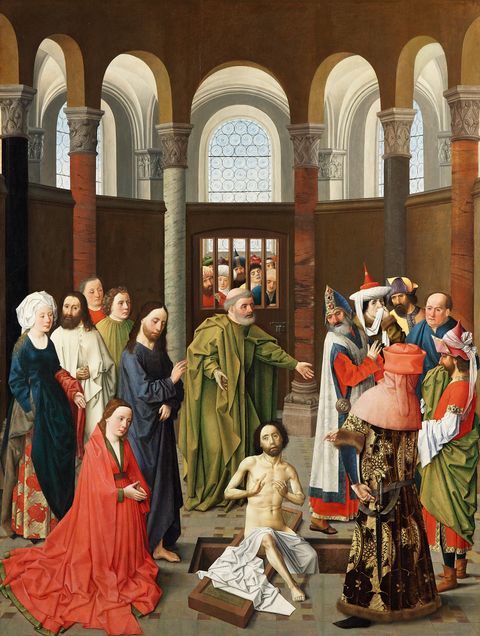
Albert van Ouwater’s The Raising of Lazarus (ca. 1460–1475) is a spectacle in every sense of the word. This rare surviving work by the pioneering Haarlem painter is not only a visual feast for the viewer but also a profound meditation on the act of seeing itself.1 The painting is populated with carefully rendered figures dressed in vibrant, richly detailed attire, their varied poses and expressions drawing the eye across the composition. In the foreground, the viewer encounters the striking figure of Lazarus himself. His pale, lifeless body, now restored to life, is depicted in a vulnerable state of nudity, drawing immediate attention to the miraculous narrative from the Bible. Arriving in Bethany four days after Lazarus had died, Christ met Mary and Martha, Lazarus’s two sisters. After reaffirming the faith of the sisters, Christ called upon the dead man. When he said, “Come forth, Lazarus,” in front of the cave where he had been buried, Lazarus came out with his hands and feet bound in graveclothes.

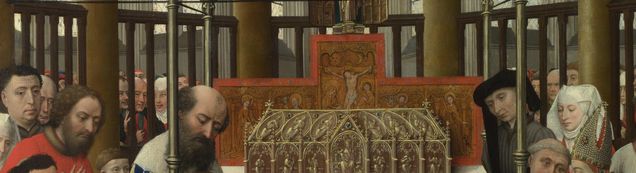
Previous scholarship refers to Rogier van der Weyden’s The Exhumation of St. Hubert (fig. 2) in the National Gallery, London, as the direct model for Ouwater’s panel, explaining his innovative composition as an imitation of the master.2 However, such an interpretation does not fully account for Ouwater’s distinctive approach. In this essay, I argue that Ouwater deliberately rendered Christ’s miraculous act as a visual spectacle. In doing so, he juxtaposed the biblical narrative with the contemporary liturgical spectacle of the Eucharist.
It should be noted that the moment of Lazarus’s resurrection had rarely been depicted in independent panel paintings in the Netherlands during the fourteenth and fifteenth centuries. Traditionally, this theme was confined to illuminated manuscripts, particularly within the Office of the Dead in Books of Hours, where its placement underscored the narrative’s relevance to prayers for the deceased.3 Ouwater’s—or his patron’s—decision to isolate this moment from its traditional narrative context and depict it as an independent panel painting marks a significant shift. It transforms the scene from a private devotional aid in small-size manuscripts into a striking large-scale visual spectacle.
Moreover, Ouwater’s panel strikingly departs from the biblical description as well as the pictorial tradition.4 He moved the event to the choir of a Romanesque church.5 This indoor setting of the scene contradicts the biblical account of the event, which precisely refers to Lazarus’s tomb as a “cave.”6 To the best of my knowledge, Ouwater’s painting is the only fifteenth-century Netherlandish panel to set the Raising of Lazarus within an architectural interior.7 For instance, two Flemish manuscripts, roughly contemporaneous with Albert van Ouwater, depict the resurrection of Lazarus in a distinctly different manner from Ouwater’s panel. One is found in the Très Riches Heures du Duc de Berry which was illuminated by the Limbourg brothers between 1411 and 1416 (fig. 3). Another manuscript, known as the Salting Hours, was made in the workshop of Simon Marmion around 1470 (fig. 4). In both manuscripts, the Raising of Lazarus appears in the opening page preceding the Office of the Dead. While architectural elements are present, the open fields, trees, and expansive sky clearly establish the outdoor setting.8

In Ouwater’s panel, the inner space of the Romanesque church is occupied by the biblical figures. The painter clearly separated the spectators into two contrasting groups. To Lazarus’s right stands Christ, who has raised him from the dead with his hand in blessing. Mary kneels at Christ’s side, facing her brother in prayer. Martha—the second sister of Lazarus—and three disciples complete the group of people gathered around Christ. Each of them is depicted in humble gestures of devotion and reverence. In stark contrast, the figures on Lazarus’s left—lavishly dressed Jews—add an element of opulence and skepticism to the scene. Among them, two individuals vividly cover their noses, recoiling from the stench of the decaying body of Lazarus.9 The visceral response not only heightens the realism of the scene but also evokes a multi-sensorial dimension, inviting viewers to imagine themselves present in this miraculous moment.
In the immediate foreground, the protagonist of the narrative, Lazarus, emerges from his grave in a strictly frontal position, directly facing the viewer.10 In the miniature examples, Lazarus is depicted rising out of the grave in an oblique pose as he gazes at Christ (figs. 3 and 4). This is also visible in a later painting by Geertgen tot Sint Jans (ca. 1465–1495), who was a disciple of Ouwater (fig. 5).11 In these instances, the pictorial emphasis is on Christ, not Lazarus. As Lazarus’s body and gaze guide the beholder’s attention to Christ, they emphasize that the miraculous resurrection of the dead was made through the intervention of God. On the contrary, Ouwater put a greater emphasis on Lazarus. In his painting, Christ is relatively invisible compared to Lazarus whose centrality and frontality immediately capture the beholder’s attention.

The unusual prominence given to Lazarus may allude to the Mass.12 Since the earliest days of Christian theology, Lazarus’s resurrection has been understood as a prefiguration of Christ’s own resurrection and, by extension, the Eucharist. Just as Lazarus emerged from his tomb after four days, Christ rose from the dead. During the Mass, this resurrection was symbolically reenacted each time the priest elevated the host above the altar, emphasizing the transformative power of the sacrament.13 Twelfth-century theologian Simon Tournai likened Lazarus’s resurrection to the miraculous transubstantiation at the Eucharist, emphasizing that both events defied natural order through divine intervention.14
Indeed, the prominent place of Peter in Ouwater’s painting alludes to the priestly role in the sacrament of the Eucharist.15 Behind Lazarus stands Peter, who uses an expressive gesture to point out to the Jews the deep meaning of the miracle that is taking place before their eyes. Ouwater has given Peter an unusual position at the very center of the composition. Not only does he conspicuously occupy the middle of the painting, but his wide-open arms also introduce the resurrected Lazarus to the spectators in the painting and to the viewer outside the painting. His significant role in the resurrection of Lazarus is testified neither in the Bible nor in the preceding images.
Behind him, the remaining part of the building is separated by a wall-like structure. Behind this structure, the crowd trying to witness the event is seen through the grate of the window, and these figures form a dynamic, densely packed group. Their presence suggests the widespread fascination and curiosity surrounding Lazarus’s resurrection. Yet these figures are not merely decorative; they become participants in the drama, as they bear witness to the climactic moment of Lazarus’s resurrection.
Compared to the onlookers in The Exhumation who surround the entire ambulatory behind the screen, they occupy only a small part of Ouwater’s painting (figs. 6 and 7). However, the meticulous depiction of their gestures and faces effectively conveys their desire to witness the miraculous event in front of them. Given the approximately nine people tightly squeezed into a small window-like frame, one can almost feel how they push each other to get a better view of the miracle. For instance, one man raises his chin to look beyond another person in front of him, which shows his intense desire to witness the event. Even though Rogier van der Weyden’s panel is much more crowded, the onlookers behind the choir screen do not show any eagerness to see the event happening before them. Their calm and even aloof attitude strikingly differs from the spectators in The Raising of Lazarus who indeed illustrate the dynamic act of seeing.
Together, the figures of Lazarus and Peter, along with the spectators arranged along the vertical centerline of the painting and set within a Romanesque building, visually evoke the ritual practice of the Eucharist as understood in the late medieval period. As Miri Rubin has argued, at the center of the whole religious system of the Late Middle Ages lay a ritual which turned bread into flesh.16 The Eucharist serves as a means for believers to recall Christ’s past sacrifice while making it present and accessible to them. Through this reenactment of the original sacrifice, the ritual renews and imparts grace.17 However, the participation of the laity was limited to viewing the sacrament, as they rarely consumed the Host on days other than Easter.18 Instead, they regularly attended church to witness the Elevation of the consecrated Host.19

The exceptional level of desire to see the resurrection of Lazarus figured in Ouwater’s painting, in fact, parallels contemporary worshippers’ yearning to participate in and see the Elevation of the Eucharist. The Elevation was essentially a moment of the display. Introduced in the twelfth century, the ritual of raising the Host was designed to visually engage the laity and mark the moment of transubstantiation—especially since most worshippers had little understanding of Latin prayers.20 To enhance its visibility, measures were taken such as suspending a brightly colored cloth behind the altar or using candlelight to silhouette the raised Host.21 In fact, according to a fifteenth-century Augustinian monk, some worshippers even called out to the priest, urging him to raise the Host higher.22 To see the Host was the most important element for late medieval devotees during the celebration of the Mass. This was to see the real presence of Christ.
Albert van Ouwater’s The Raising of Lazarus captures a dual spectacle: the viewer outside the painting marvels at Ouwater’s technical mastery and vivid storytelling, while within the painting, the spectators themselves behold the miracle of life restored by Christ. The late medieval viewer of Ouwater’s painting could identify with the onlookers behind the window, who embody the visual experience during the Mass. Indeed, a man clothed in red, looks directly at the viewer and urges us to join him. In this sense, the real spectators and painted spectators converge in Ouwater’s painting. This multi-layered interplay between seeing and being seen transforms the theme of the Raising of Lazarus into a deeply immersive experience, inviting the audience to reflect on their own role as spectators of the miraculous.
____________________
Sunmin Cha is a PhD candidate at Columbia University focusing on the intersections between religious iconography and artistic production in sixteenth-century Haarlem, with a particular emphasis on the Man of Sorrows. She is currently writing her dissertation which examines how artists like Maarten van Heemskerck, Cornelis van Haarlem, and Hendrick Goltzius responded to the religious and political shifts of the time through their paintings.
____________________
1. The attribution of The Raising of Lazarus to Albert van Ouwater (ca. 1415–1475) is largely based on the description of Karel van Mander: “I have seen a grisaille copy of a large, upright painting done by Albert, portraying the Resurrection of Lazarus. The original had been taken to Spain in a tricky way, without any payment having been made, after the siege and surrender of Haarlem. The figure of Lazarus was beautiful for its time, a remarkable nude painting. An architectural detail in this picture was a temple, of which the columns were rather small. On one side, apostles were shown, on the other, Jews. There were pleasing female figures in the picture, too. In the background some people could be noticed looking through a colonnade of the choir. (Daer was vam hem een paslijck groot stuck in de hooghte, waer van ick heb ghesien een ghedootverwede Copie, en was de verweckinghe van Lasarus: het principael werdt nae d’Haerlemsche belegheringhe en overgangh, met ander fraeyicheyt van Const, van den Spaengiaerden bedrieghlijck sonder betalen ghebracht in Spaengien. Den Lasarus was (nae dien tijt) een seer schoon en uytghenomen suyver naeckt, van goeden welstandt. Daer was een schoon Metselrije van eenen Tempel: doch de Colomnen en t’werck wat cleen wesende, op d’een sijde Apostelen, op d’ander sijde Ioden. Daer waren oock eenige aerdighe Vroukens, achter quamen eenighe, die toesaghen door Choor pilaerkens.)” Carel van Mander et al., The Lives of the illustrious Netherlandish and German painters, from the first edition of the Schilder-boeck (1603-1604): preceded by the lineage, circumstances and place of birth, life and works of Karel van Mander, painter and poet and likewise his death and burial, from the second edition of the Schilder-boeck (1616-1618) (Davaco, 1994). 1: fol. 205 v. The original Dutch is cited from James Snyder, “The Early Haarlem School of Painting: I. Ouwater and the Master of the Tiburtine Sibyl,” The Art Bulletin 42, no. 1 (1960): 42.
2. Stephan Kemperdick, “Albert van Ouwater: The Raising of Lazarus,” Oud Holland 123, no. 3/4 (2010): 241–43. Kemperdick convincingly demonstrates that the motif of the onlookers placed behind a grate in the ambulatory, the brightly lit ambulatory itself, and the open grave placed parallel to the picture plane in a tiled floor are noticeable in both paintings. However, his research likewise focuses on creating lineage between the artists. Based on Ouwater’s familiarity with the van der Weyden panel, he assumes the possible training of Ouwater in the southern Netherlands.
3. Kathryn M. Rudy, “A Pilgrim’s Book of Hours: Stockholm Royal Library A233,” Studies in Iconography 21 (2000): 250. Books of Hours were personal prayer books modeled after the breviaries used by monks and religious communities. Typically, Books of Hours included a variety of prayer sequences or offices, such as the Little Office of the Virgin Mary, the Office of the Holy Cross, and the Office of the Holy Spirit. The Office of the Dead was a specific sequence of prayers intended to be recited for the souls of the deceased, particularly aimed at reducing their time in purgatory. It was often visually introduced by scenes of death and resurrection, such as scenes of Hell, Purgatory, and the Raising of Lazarus.
4. Jacqueline E. Jung, “Seeing Through Screens: The Gothic Choir Enclosure as Frame,” in Thresholds of the Sacred: Architectural, Art Historical, Liturgical, and Theological Perspectives on Religious Screens East and West, ed. Sharon E. J. Gerstel (Dumbarton Oaks Research Library and Collection: Harvard University Press, 2006), 185–88. In her research on the Gothic choir screen, Jung specifically points out that the indoor setting of the painting contradicts the biblical description of the tomb of Lazarus. She compares the wall-like structure in Ouwater’s The Raising of Lazarus with the Gothic choir screen, which does not only conceal the sacred event from the laity but also reveals it to them.
5. Kemperdick, “Albert van Ouwater,” 235. Carved reliefs on the Romanesque capitals of the ambulatory depict scenes from the Old Testament—the Flight of Hagar and Ismael, the Sacrifice of Isaac, Moses Before the Burning Bush, and God Giving the Tablets of the Law to Moses. Snyder argues that Ouwater placed the event in the choir of a Romanesque church to show that the Old Testament period is ended by the age of the Messiah. Snyder, “The Early Haarlem School of Painting: I,” 39–55.
6. “Then Jesus, again greatly disturbed, came to the tomb. It was a cave, and a stone was lying against it. Jesus said, ‘Take away the stone.’ Martha, the sister of the dead man, said to him, ‘Lord, already there is a stench because he has been dead four days.’” (John 11: 38–39).
7. Although I have not encountered any other depictions of the Raising of Lazarus set within an architectural interior from any period or region, given the vast scope of surviving visual material, I remain cautious about stating categorically that Ouwater’s panel is entirely unique in this regard.
8. In the miniatures, the architectural elements play only ancillary roles compared to the Romanesque building in Ouwater’s panel that encompasses the entire biblical scene. The destroyed Romanesque building in The Raising of Lazarus from the Très Riches Heures du Duc de Berry implies the coming of Christ and the transition from Judaism to Christianity. Simon Marmion also depicted architectural detail in the background which looks like the wall of a city or the exterior of a building.
9. This does not imply that the negative depiction of the Jews is the original invention of Ouwater. In fact, the hostile depiction of Jews and negative connotations were highly prevalent in the religious images of northern Europe. However, they usually appear in the Passion cycle, especially as the tormentors of Christ. The scholarly discussion on Jews in premodern European society and their visualization is extensive. See Moshe Lazar, “The Lamb and the Scapegoat: The Dehumanization of the Jews in Medieval Propaganda Imagery,” in Anti-Semitism in Times of Crisis, eds. Sander L. Gilman and Steven T. Katz (New York University Press, 1991), 38–80; Ruth Mellinkoff, Outcasts: Signs of Otherness in Northern European Art of the Late Middle Ages, 2 vols. (University of California Press, 1993); Heinz Schreckenberg, The Jews in Christian Art: An Illustrated History, trans. John Bowden (Continuum, 1996); and Debra Higgs Strickland, Saracens, Demons, & Jews: Making Monsters in Medieval Art (Princeton University Press, 2003).
10. His frontal view strikingly contrasts with the almost horizontal body of St. Hubert in Rogier van der Weyden’s painting, an alleged source for Ouwater. Without any mediating help, Lazarus stands up. The rigid frontal body of Lazarus and vertical direction recall the body and movement of Christ in his own resurrection.
11. Henry Martin Luttikhuizen, “Late Medieval Piety and Geertgen Tot Sint Jan’s ‘Altarpiece for the Haarlem Jansheren’” (PhD diss., University of Virginia, 1997), 192.
12. As the resurrection of Lazarus prefigures that of Christ, the tomb in Ouwater’s painting also reminds the viewer of Christ’s sarcophagus. Given that the altar was commonly interpreted as Christ’s allegorical tomb since the Carolingian period, the parallel placement of the tomb is significant. Godefridus J. C. Snoek, Medieval Piety from Relics to the Eucharist: A Process of Mutual Interaction (E.J. Brill, 1995), 186–202.
13. Luttikhuizen, “Late Medieval Piety,” 192.
14. Benedicta Ward, Miracles and the Medieval Mind: Theory, Record, and Event, 1000–1215 (University of Pennsylvania Press, 1987), 15.
15. Even though he does not carry his attributes, Peter’s physiognomy is recognizable. By the fifteenth century, St. Peter was commonly portrayed with a distinctive bald patch on the crown of his head. Since the ninth century, only priests were permitted to handle the host, which led to the widespread practice of the priest placing it directly into the worshipper’s mouth. This reinforced the priest’s role as a mediator between the divine and the laity. Luttikhuizen, “Late Medieval Piety,” 196.
16. Miri Rubin, Corpus Christi: The Eucharist in Late Medieval Culture (Cambridge University Press, 1991), 1.
17. Luttikhuizen, “Late Medieval Piety,” 194–5.
18. Rubin, Corpus Christi, 64. The laity seems to have avoided communion at least in part due to concerns about placing Christ in their unworthy bodies. They worried about whether they could have sexual intercourse upon receiving the sacraments without stripping Christ of his virginity and wondered what would happen to Christ if they became ill.
19. Luttikhuizen, “Late Medieval Piety,” 198.
20. Robert W. Scribner, Religion and Culture in Germany (1400-1800) (Brill, 2001), 90. A gesture of elevation came to mark the moment of consecration to offer its meaning to the audience, the real presence of Christ. As medieval theologians agreed that the transubstantiation occurred after the priest’s consecration of the Host with the words, the Elevation after consecration signifies Christ’s corporeal presence at the Mass.
21. Rubin, Corpus Christi, 54–63.
22. Caroline Walker Bynum, Holy Feast and Holy Fast: The Religious Significance of Food to Medieval Women (University of California Press, 1987), 55. The Augustinian monk, Gottschalk Hollen, vividly attested to such enthusiasm as “they come when they hear [the] bell, entering to see elevation, and when it is over they leave running and fleeing, as if they have seen the devil.”
Notes About Contributors
Rachel Kline is a fifth-year PhD candidate studying the art of the Italian Renaissance. Rachel’s research interests include the representation of the female nude in fifteenth-century Italy and the decoration of Florentine marriage chests. Rachel has held positions at the Penn Museum and the Philadelphia Museum of Art.
Kaylee Kelley is a doctoral student focusing on art of the early modern period. Her research centers on Renaissance tapestries created across Italy, Flanders, and England with an emphasis on their literary sources and curation. She has held positions at the Museum of Fine Arts, Boston and the Medici Archive Project.
Sunmin Cha is a PhD candidate at Columbia University focusing on the intersections between religious iconography and artistic production in sixteenth-century Haarlem, with a particular emphasis on the Man of Sorrows. She is currently writing her dissertation which examines how artists like Maarten van Heemskerck, Cornelis van Haarlem, and Hendrick Goltzius responded to the religious and political shifts of the time through their paintings.
Madison Clyburn is an Art History PhD Candidate at McGill University. Her work focuses on medicinal perfumes and the material culture of women’s wellness in late medieval and early modern Italy. She has written for The Recipes Project, Ornamentum magazine, and the SSHRC-funded project Hidden Hands in Colonial Natural Histories.
Mya Rose Bailey (they/she) is an Afro-Caribbean scholar interested in multisensory anthropology, temporality, and memory in Black history and culture. They hold a BA in Art History from SUNY New Paltz and are currently completing their MA in Decorative Arts, Design History, and Material Culture from Bard Graduate Center.
Elise Racine is a Washington, DC-based multidisciplinary activist, emerging artist, and PhD candidate at the University of Oxford. Using arts-based methodologies, her research examines the socio-ethical implications of emerging technologies, like artificial intelligence. Recent exhibitions include: The Bigger Picture (Beta Festival 2024, Ireland) and Unearthing (Sims Contemporary, NYC).
R.J. Maupin is a second-year master’s student in Decorative Arts, Design History, and Material Culture at Bard Graduate Center. Her focus is American glass history of the nineteenth and twentieth centuries with particular interests in labor, industrialization, gender, and the performative aspects of craft.
Angelina Diamante is an MA candidate at Sotheby’s Institute of Art (Valedictorian, with distinction) and a specialist in Italian Renaissance and Baroque European painting and sculpture. Recently, her research has considered art and its intersection with the esoteric and occult, evincing motifs such as classical paganism and the Gothic.
Notes About Contributors
Catherine Lennartz is a PhD student in the History of Art and Architecture at Boston University. Her research explores the intersection of exhibitions and memorials, memory-focused art, and remembrance, especially as they relate to human rights violations and Indigenous issues.
William Chaudoin holds a BA in Italian from Vassar College and an MA in Art History from the George Washington University, where his research focused on the early modern period in southern Italy. His scholarship explores the ways art and architecture served as mediums of devotion and social influence.
Gillian Yee (they/them) is a second-year PhD student at Temple University specializing in global contemporary art history from 1980 to the present. Their goal as a scholar is to explore the realm of queerness, transness, and “non-normative” identities within art practices, thereby circumventing a traditional canonical understanding of the discipline.
Hamin Kim (she/her) is a PhD student at Boston University whose research centers on modernization and globalization in Korean art from the 20th century onwards, with particular emphasis on Korea’s cultural exchange with Japan and the United States and the history of performance in Korea.
Sayak Mitra (b. 1984, West Bengal) is an Indian artist working across traditional and contemporary new media art. His work addresses power, displacement, social injustice, and class issues through paintings, photographs, and installations. He graduated with a B.Tech from WBUT (2008) and an MFA in Painting from Boston University (2024). Sayak co-founded Artist-collective Ocular in 2006 and has exhibited globally, winning awards like the Hugh and Marjorie Petersen Award for Public Art and the Atul Bose Award for Painting.
Elaigha Vilaysane received her BA in Chinese Language and Literature and Art History from the George Washington University in May 2023. She has recently completed her master’s degree at SOAS, University of London in History of Art and Archaeology of East Asia with a concentration in Chinese studies.
Kendall Murphy is a first year master’s student at Tufts University. She has held a variety of roles that allowed her to connect the public with new art, including working for the Minneapolis St. Paul International Film Festival. She is interested in site-specific contemporary art and curation.
David Wojnarowicz, Peter Hujar, and (Other) Worlds Past a “Pre-Invented Existence”
by Gillian Yee
When Peter Hujar died from AIDS-related complications on November 26th, 1987, David Wojnarowicz’s first inclination was to photograph his mentor and former lover’s body in excruciating detail. In the chapter “Living Close to the Knives,” from his memoir Close to the Knives, he recounts his experience with Hujar’s death: the rapid decline in his physical and mental health, his angry outbursts as he sought last-ditch attempts for treatment, and Wojnarowicz’s attempts to talk to him as he coasted in and out of consciousness on his hospital bed. This chapter further describes Hujar’s last living moments in painstaking detail. Following the twitching of his eyelids, the final slow, steady intake of breath, and an all-encompassing stillness of his body, Wojnarowicz’s ensuing impulses managed to surprise even himself:
… I barely cried. When everyone left the room I closed the door and pulled the super-8 camera out of my bag and did a sweep of his bed: his open eye, his open mouth, that beautiful hand with the hint of gauze at the wrist that held the i.v. needle, the color of his hand like marble, the full sense of the flesh of it. Then the still camera: portraits of his amazing feet, his head, that open eye again—I kept trying to get the light I saw in that eye—and then the door flew open and a nun rushed in babbling about how he’d accepted the church and I look at this guy on the bed with his outstretched arm and I think: but he’s beyond that.1
In a whirlwind of quickly intensifying emotions, Wojnarowicz’s impulse was to visually capture this intimate encounter with death that would heavily influence the rest of his artistic practice. Although the 23 resulting photographs taken in these moments allude to his lifelong occupation with human consciousness and mortality, they also permitted him to reside in an in-between space where both life and death coexist, and where Wojnarowicz was unrestricted by society’s expectations to grieve properly.
Living during the height of the HIV/AIDS crisis, Wojnarowicz resented the idea of “properly” dealing with these experiences of tremendous loss. This meant grieving quietly and out of sight, thus following a Euro-American tendency to deny, ignore, and avoid death and its resultant indicators. Many of the works he would create in the following years would directly respond to the deaths that resulted from the overt, widespread neglect and maltreatment of populations most affected by HIV/AIDS. Wojnarowicz’s photographs of Hujar show how this exploration into the “essence of death” acts also as an exploration into existence beyond the grasp of the “pre-invented,” which he describes as: “A place where by virtue of having been born centuries late one is denied access to earth or space, choice or movement. The bought-up world; the owned world. The world of coded sounds: the world of language, the world of lies.”2 The pre-invented existence is therefore one that, in its ascription of white cisgender heterosexuality as the norm, commonly restricts life and marginalizes individuals based on race, class, gender, and sexuality in its promises of false histories and futures.
In using death and the corpse as the subject for his work, Wojnarowicz utilizes that which is typically considered abject as visual provocation for unraveling the boundaries between interior and exterior, self and other. In questioning the processes of subjectification—the defining of the ever-transitory, networked, indeterminate, and ephemeral self—this work offers an alternative ontological viewpoint regarding human existence, refusing to be bound by commonplace definitions of what being human is and how one should exist.3 That is, death and life are not two ends of a binary where cross-contamination (the “infection” of life with death) signifies abjected Otherness but are intertwined in a never-ending dance of feelings, sensations, intensities, and memories.

Both in their galleries and online collections, the Whitney Museum of American Art commonly displays three of these photographs as a triptych (fig. 1). Each black and white print shows its respective body part in complete isolation from the rest of Hujar’s figure; there is nothing else within the frame to focus our gaze on aside from the rumpled fabrics of his hospital gown and the bed linens below him. By isolating and centering the body parts almost perfectly within each frame, Wojnarowicz’s intimate shots of the (dead) body force the viewer to focus on details that might have gone unnoticed if he had captured the complete form. With the shot of Hujar’s head, for example, one’s gaze may catch at the places where shadows dance underneath his unkempt beard or the dip of his clavicle. In this same photograph, his vacant, unfocused stare interrupts a viewer’s gaze and discomforts them; it looms out from underneath half-lidded eyes, cast far beyond the picture plane. In their invitation for contemplation and close looking, the parts of the body presented in each photograph almost take on a life of their own, eliciting different sensations in their viewers and pointing to the reality that although we idealize our identities as whole concepts, they are often naturally incomplete and without borders. Wojnarowicz’s practice of separating the body into pieces through the camera lens, then, enforces the multiplicity of the human form, bypassing common perceptions of identity and knowledge as each piece holds distinct meaning and value for the photographer.
As Tomasz Sikora asserts in his analysis of Wojnarowicz’s work, death and mortality play a vital part in the artist’s oeuvre by producing an array of sensory and affective responses not commonly associated with the lifeless body, called “queer life-worlds.”4 Refusing to gloss over what we consider bad experiences that produce negative feelings, Sikora argues that Wojnarowicz used photography and the subject of the lifeless body in tandem to propose these experiences as an avenue toward extending our existence past our corporeal forms. As such, his work subverts the expectation of death as a bad experience; in its place is an embrace of “the cosmic dance of photons and images and bodies and sensations,” where a focus on lived experiences with new ways of feeling, living, and being affected give way to possible life-worlds that are alternative to pre-codified attachments in a necropolitical state.5
Hujar’s body is an exploration into these worlds through Wojnarowicz’s take on the essence of death: “the fears and joys of it the flight it contains … just all the thoughts and sensations this death this event produces in bystanders more spirituality than any words we can manufacture.”6 Undeterred by a reductive life/death dichotomy, Wojnarowicz utilizes these photographs to emphasize the ability to connect within a larger matrix of human existence. The close-up shots of his body—perhaps replicating a gaze that carefully and lovingly regards another’s body one final time—contribute towards a sense of absolute veneration, grieving the loss of one of the most influential men in Wojnarowicz’s life and capturing, in simple shots, all the wonderful memories and joy this body brought him over the years. It is a radical gesture of love and intimacy, an expression of life and death simultaneously, and a transformation of death from an all-encompassing endless void to a liminal state of being that allows temporary freedom from what he calls a pre-invented existence.
Wojnarowicz’s response to Hujar’s death is immediate artistic action, turning towards the reception and production of aesthetic sensations instead of rendering the dead body a passive, powerless object. As he lands his photographic gaze on different parts of Hujar, he releases the parts from the organic unity of the body, as if they’ve “become their own little persons” with their own subjectivities, histories, and sensations.7 In each shot, Wojnarowicz lays bare his relationship to this body so informed by love, intimacy, respect, and raw connection that it goes far past what should be conceivably possible in a pre-invented world of self-regulation and carefully codified rules. The photographs of Hujar’s body thus unravel the boundary between “I” and “Other” rather than reinforcing it, sharing contemplative, quiet, life-changing moments suspended in time, as if they represent the artist’s eyes traveling over Hujar’s corpse for the first time. They seek to capture the amalgamation of beauty, joy, and acceptance within a subject commonly associated with ugliness, trauma, and rejection.
As self-regulatory subjects within a pre-invented existence, we reject death as the supposed antithesis of life and avoid signifiers of death (i.e., aging and disease) because they threaten to violate a life/death binary. In contrast, the mournful quality of Wojnarowicz’s photographs is, as Marietta Radomska states in their discussion of queer death studies, an example of “practices that transgress the effects of white humanist melancholia and establish a relational ethics apt for unlocking congealed power matrices, and opening towards alternative futurities.”8 These images of the corpse become a conduit for alternative ways of being, inhabiting a liminal space where one isn’t cast into the outer bounds of society due to attributes of race, gender, sexuality, and able-bodiedness.9 Such an alternative is apparent in these quiet moments after Hujar’s last breath, when Wojnarowicz is alone with his body and captures all the things he finds beautiful and captivating. There is, in these alternatives, a certain freedom from a pre-invented existence that can only be seen and witnessed in death.
____________________
Gillian Yee (they/them) is a second-year PhD student at Temple University specializing in global contemporary art history from 1980 to the present. Their goal as a scholar is to explore the realm of queerness, transness, and “non-normative” identities within art practices, thereby circumventing a traditional canonical understanding of the discipline.
____________________
1. David Wojnarowicz, Close to the Knives: A Memoir of Disintegration (Open Road Integrated Media, 2014), 111-12. Super-8 cameras are typically for recording video, but in this instance Wojnarowicz only used one for photography.
2. Wojnarowicz, Close to the Knives, 96.
3. Maggie Hennefeld and Nicholas Sammond. Abjection Incorporated (Duke University Press, 2020), 19.
4. Tomasz Sikora, “Queer Life-Worlds and the Art of David Wojnarowicz,” Journal of Gender Studies 29, no. 1 (December 15, 2019): 76-87, https://doi.org/10.1080/09589236.2019.1692194.
5. Sikora, “Queer Life-Worlds,” 82.
6. Wojnarowicz, Close to the Knives, 111-12.
7. Wojnarowicz, Close to the Knives, 82.
8. Marietta Radomska, Tara Mehrabi, and Nina Lykke, “Queer Death Studies: Death, Dying and Mourning from a Queerfeminist Perspective,” Australian Feminist Studies 35, no. 104 (April 2, 2020): 92, https://doi.org/10.1080/08164649.2020.1811952.
9. Wojnarowicz, Close to the Knives, 118.
Dalí: Disruption and Devotion
Museum of Fine Arts, Boston
July 6–December 1, 2024
by Kendall Murphy
The Disintegration of the Persistence of Memory (1952-54) by Salvador Dalí welcomes visitors into Dalí: Disruption and Devotion at the Museum of Fine Arts, Boston (MFA). This painting is an apt work to begin the exhibition, as it prepares the viewer to engage with Dalí’s legacy and to make connections to artwork of the past. Dalí: Disruption and Devotion places a selection of European art from the MFA’s collection in conversation with a number of his significant works to highlight how the artist drew from art history in his practice, while remaining a “disruptor” of the art world.1 The historic European works benefit from this arrangement as much as Dalí’s canvases do because the exhibition fosters a current of surrealism throughout the collection, inviting the viewer to explore all of the art with an eye for the fantastic and enigmatic.
At the start of the exhibition, visitors encounter works including The Temptation of Saint Anthony (about 1650) (fig. 1) by David Teniers the Younger, which features ghoulish creatures such as a bat-like figure and skull-faced monster. The theme of the surreal is sparked by the fantastical creatures invented by Teniers and other earlier artists to represent themes such as temptation, lust, and terror.

Additionally, the exhibition design fosters a dreamlike atmosphere. The deep purple walls are angled to create dark corners that evoke a sense of privacy or secrecy. Its thoughtful design enhances visitors’ ability to search for the otherworldly in artwork outside of the surrealist canon. The exhibition introduces the viewer to surrealism through a quotation from Dalí, saying “Surrealism is not a movement. It is a latent state of mind perceivable through powers of dream and nightmare.”2 If surrealism is a state of mind, then perhaps artists like Teniers could have tapped into a realm of surrealist fantasy as well.
One of the highlights of the exhibition is Francisco Goya’s Los Caprichos (1799), a series of prints that ridicules the flaws of Spanish society. Dalí’s reinterpretation of Los Caprichos hangs directly across from Goya’s prints, so the viewer immediately notices the bold colors and eccentric details he adds, such as an enigmatic yellow bundle on the woman’s lap in Hypnagogic Rope by Raymond Lull Attached (1973-77). Dalí adds no embellishment to the donkey-man in Goya’s De que mal morira? (Of what ill will he die?) (1799) suggesting that Goya’s surreal character fits into Dalí’s bizarre world. Also, Dalí’s Velázquez’s Painting the Infanta Marguerita with the Lights and Shadows of His Own Glory (1958) hangs adjacent to Infanta Maria Teresa (1653) (fig. 2), which is from the workshop of Diego Velázquez. This comparison allows the viewer to experience a reference point for Dalí’s work up-close and to appreciate the psychological intensity that Velázquez’s associates capture in Infanta Maria Teresa.

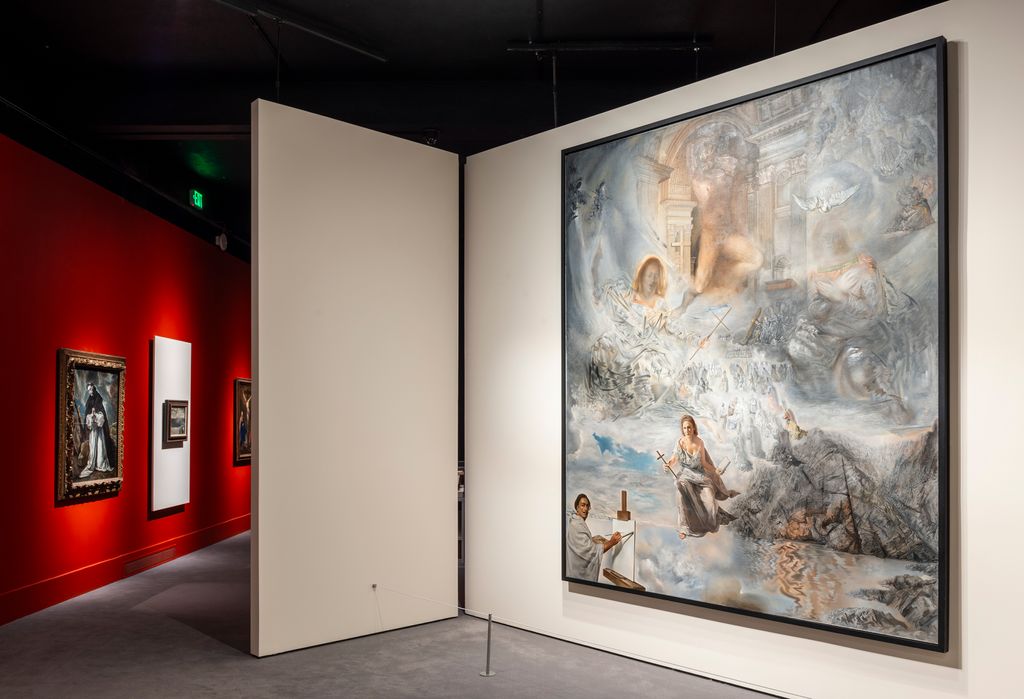
The exhibition’s second half delves into Dalí’s biography and the theme of “devotion,” particularly his conversion to Catholicism later in life. Although this is an important topic to explore, the exhibition does not fully address the contradictions inherent in Dalí’s shift towards a traditional faith as he continued his avant-garde explorations of sexual desire and taboo. This period also coincides with Dalí’s reactionary outlook, including his support for the fascist dictator Francisco Franco.3 His monumental painting The Ecumenical Council (1960) (fig. 3), celebrating the coronation of Pope John XXIII, reflects this newfound conservatism. A more comprehensive exploration highlighting Dalí’s conservative positions alongside this work would enhance the themes of disruption and devotion.4
The final artworks presented deal with time and mortality, including Dalí’s Old Age, Adolescence, Infancy (The Three Ages) (1940) (fig. 4). This painting exemplifies his use of “double images,” created through his paranoiac-critical method, which he describes as a “delirium of interpretation.”5 The image label for this work concludes the exhibition by reinforcing the fact that Dalí continued to “acknowledge the artists of past centuries.”6 While the exhibition highlights how Dalí mined past art for inspiration, it overlooks the vibrant community of surrealists, dadaists, and avant-garde artists he engaged with. Citing influences from artists like Yves Tanguy and Max Ernst could have enriched the narrative of Dalí’s sources of inspiration.7
Dalí’s complex works remain thought-provoking, and viewing them alongside his potential inspirations is intriguing. However, the exhibition does not provide a novel understanding of Dalí, skirting the paradoxical nature of his later devotion to Catholicism. Ultimately, visitors leave with an incomplete picture of the artist, as shifting and elusive as the faces in Old Age, Adolescence, Infancy (The Three Ages).

____________________
Kendall Murphy is a first year master’s student at Tufts University. She has held a variety of roles that allowed her to connect the public with new art, including working for the Minneapolis St. Paul International Film Festival. She is interested in site-specific contemporary art and curation.
____________________
1. Dalí: Disruption and Devotion, introductory wall text, Museum of Fine Arts, Boston.
2. Dalí: Disruption and Devotion, Fantasy and Nightmare wall text, Museum of Fine Arts, Boston.
3. Dawn Ades, Dalí and Surrealism (Harper & Row, 1982), 114-17.
4. Ades, Dalí and Surrealism, 114-17.
5. Ades, Dalí and Surrealism, 119. Dalí characterized his paranoiac-critical method as a way to perceive many different forms within one composition by going into a state of delirium. He claimed that this “irrational knowledge” led him to create the shifting arrangements that produce multiple images within his artwork.
6. Dalí: Disruption and Devotion, Old Age, Adolescence, Infancy (The Three Ages) wall label, Museum of Fine Arts, Boston.
7. Ades, Dalí and Surrealism, 45.
Echoes of Shamanism: Reimagining Tradition and Chance in South Korea
by Hamin Kim
As part of its New Year’s event, Hyundai Artlab commissioned artist Maia Ruth Lee to create a set of symbols predicting fortunes for 2024. This virtual project, titled Glyphoscope 2024, invited participants to select three cards from a set of twenty, each resembling ancient hieroglyphs (fig. 1). The experience, similar to drawing tarot cards, presented a brief interpretive text and a series of keywords that were drawn both from the selected glyphs as well as the initials of the participant’s name, offering a personalized set of affirmations to carry into the New Year. The interactive nature of this project, which combines algorithmic patterns with chance elements, reflects the enduring desire to find clarity amid the uncertainties of the future. Practices like fortune-telling, which are carried out with varying degrees of sincerity, remain deeply ingrained in contemporary society. We continually “test” our luck in various ways, from opening fortune cookies to seeking advice from clairvoyants.

Notions of chance and future prediction have often been dismissed as magical, unscientific, and illogical. Traditional faith systems that embrace such values have been in perpetual tension with the scientific worldview that emerged during the Age of Enlightenment. Especially in many countries that experienced colonization, this tension led to the suppression or transformation of indigenous traditions in favor of modernized (and often Westernized) visions of the future. South Korea followed a similar trajectory. Despite the influence of Confucianism during the Joseon Dynasty (13–19th centuries), and the introduction of Christianity in the late 19th century, shamanism, the primordial religion of Korea derived from Siberia and Northeast Asia, remained deeply embedded in the base of the country’s cultural terrain.1 Even during the period of rapid modernization during the 1960s to 1980s, when the authoritative South Korean government promoted uniformity and the Western standard of development while simultaneously stifling individual creativity, people continued to turn to shamans in times of crisis or uncertainty, relying on the power of luck to avoid misfortune.2
Shamanism saw a resurgence in the early 21st century in the arts as South Korea gradually globalized after the end of the Cold War in 1989 and established a democratic government shortly after. Authoritative values in the past gave way to diversity and cultural heterogeneity, and the contemporary art world moved towards a “global pattern of flow and resistances” rather than the dichotomous view of center versus periphery.3 Artists started to take notice of the potential of shamanism as an apt alternative to a strictly rational, scientific worldview. Their reexaminations found a more fluid, empathetic approach to considering human nature. This new understanding of shamanism was a central theme in the 2014 Seoul MediaCity Biennale, titled Ghosts, Spies, and Grandmothers. The Biennale’s director, Park Chan-kyong, focused on marginalized yet potent entities in society. He explained his decision to juxtapose three seemingly disparate figures:
Spies seen in the movies look attractive, but “spies” (gancheob) in the news are terrifying.4 One should worship god in ancestral ceremonies but stay far away from the ghosts you encounter during the night. Grandmothers should be respected, but in reality, they are expelled outside the huge wave of praise for the young. You notice them sometimes, but they are generally difficult to spot; or one does not wish to see them, or should not see them. They are skilled in silence and possess top-level information. Hence they cry out, confess, disclose or testify. They easily become paradoxical beings according to the situation.5
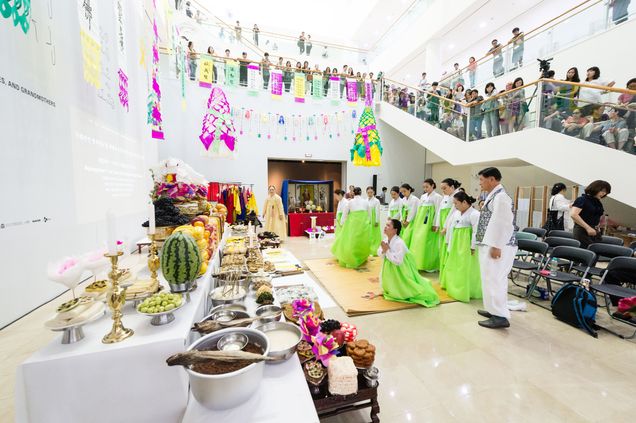
The convergence of the three symbolic figures—ghost, spy, and grandmother—underscores Asia’s ongoing effort to transcend forcefully inserted Westernized influences and reclaim its original heritage by positing a “modernity against modernity.”6 Park’s theme was not incidental; it was the culmination of his own documentary, Manshin: Ten Thousand Spirits (2013), which unraveled the complex and ambivalent emotions surrounding shamanism in Korea through the life of Kim Keum-hwa, the country’s most renowned manshin (shaman). The predominantly female demographic of Korean shamans ties to the figure of the “Grandmother,” who venerates shamanistic deities or “Ghosts,” and who has witnessed the tumultuous 20th-century history in Korea, where many formative and socio-political events were often centered around “Spies.”
Shamanism experienced another resurgence during the 2020 Covid pandemic. In 2021, the Ilmin Museum of Art opened their exhibition entitled Fortune Telling, which provided an outlet for exploring and processing collective anxieties in a time marked by uncertainty. The exhibition drew on shamanistic practices as well as traditional East Asian philosophies, including the concept of yin and yang, and the five elements (wood, fire, earth, metal, and water), which comprised the fundamental categories in Chinese cosmology to understand the universe. The harmony and balance of these forces were thought to govern the natural world and human life. This exhibition exemplified how what was once seen as occult has been recontextualized in contemporary art as a way to bring comfort to the audience. As part of the show, a shaman with an art educational background produced a museum audio guide and artists invited participants to engage in saju readings (fortune-telling based on one’s birth date) as part of a performance.
The exhibition space was divided into two sections, “fate” and “counseling,” suggesting that for the curators, these concepts are interrelated: fate serves as the foundation of existence, while counseling offers therapeutic guidance in navigating fate and finding inner peace. Indeed, the exhibition is also living proof that what was once viewed as an occult practice of communicating with otherworldly entities became more accessible with the popularization of diluted forms such as saju, tarot readings, and face readings—practices that were considered safer and relatively more scientific—grounded in statistical reasoning rather than ghostly communications. Fortune Telling offered visitors a way to reflect on the emotional and psychological challenges of the pandemic, bridging ancient philosophies with contemporary concerns (fig. 3). This renewed interest in shamanism and traditional cosmology highlights how people seek comfort and meaning from deeply rooted cultural practices, especially during times of crisis.


Although shamans remain somewhat intimidating figures due to their perceived possession by spirits, artist Haegue Yang offers a more sympathetic interpretation. She notes that “today’s shamanism has been tainted by a culture of unscientific superstition or prayers for personal prosperity. In the past, shamanistic rituals (guts) were performed for communal well-being—to bring rain, end droughts, or ensure the safe return of those who had left their homes.”7 Her ongoing project, Mesmerizing Mesh (2021–), folds and cuts pieces of traditional Korean paper, evoking symmetrical ritual paper props used by shamans (figs. 5-6). The mass of works explores shamans as intermediaries between the divine and humanity, although the artist laments that shamans themselves often remain marginalized.8


However, Yang also poignantly points out that the preservation of tradition may have political connotations, particularly in parts of Europe, where it is sometimes used to justify exclusion and anti-immigration sentiments.9 Nonetheless, many non-Western countries, especially in the Global South, share similar sentiments toward shamanism as those illustrated above in the case of South Korea, including an ambivalence toward rooting their historical narratives that were once superimposed by imperialism and capitalism. The quest to reconnect with their roots remains ongoing.
Understanding shamanism and its reception in the contemporary world is far from straightforward. It is a complex and multi-layered process, entangled with the legacies of imperialism, questions of legitimacy and self-doubt, and the unpredictable nature of future prediction. Despite this complexity, the exhibitions and participating artists highlight the potency of shamanism as a transgressive and healing force embedded in the lives of many. By looking into works on both institutional and individual levels, Korean contemporary art in the context of shamanism deals with defying logical explanations and offering a path for those seeking meaning in an increasingly uncertain world.
____________________
Hamin Kim (she/her) is a PhD student at Boston University whose research centers on modernization and globalization in Korean art from the 20th century onwards, with particular emphasis on Korea’s cultural exchange with Japan and the United States and the history of performance in Korea.
____________________
1. The survival of Korean Shamanism amidst the influx of Christianity is detailed in Oak, Sung-Deuk, “Healing and Exorcism: Christian Encounters with Shamanism in Early Modern Korea.” Asian Ethnology 69, no. 1 (2010): 95-128.
2. Although sporadically, artists continued to investigate shamanism in their practices during the 20th century. The most salient efforts were made in the Minjung (People’s) arts movement during the 1980s but also through individual efforts including the photographer Lee Gapchul’s Confliction and Reaction series (1990-2002) as well as Lee Seungtaek’s Wind series (1967- ) etc.
3. Arjun Appadurai, Modernity at Large: Cultural Dimensions of Globalization (University of Minnesota Press, 1996), 46-47.
4. In the original Korean statement, Park differentiates between Western “spies” and “spies (gancheobs).” The former evoke Hollywood’s James Bond archetype—sleek and glamorous—while the latter refer specifically to North Korean operatives who infiltrate South Korean society to steal sensitive information. These North Korean spies are often portrayed as petty and unrefined, embodying a dirtier, more sinister image.
5. Park Chan-kyong, “Why ‘Ghosts, Spies, and Grandmothers’?”, Accessed September 23, 2024, http://archive.mediacityseoul.kr/2014/en/introduction/2014theme/ghost-spy-grandmother/.
6. This is not to suggest that all Western influences introduced in Asia were imposed by force. However, the remnants of colonialism, as opposed to voluntary cultural exchanges, have left more profound impacts on later generations. My aim is to highlight the involuntary aspects of Western influence rather than to dismiss Western influence in Asia as wholly negative. Additionally, the phrase “modernity against modernity” is derived from the original Korean title of the Seoul MediaCity Biennale.
7. Unless otherwise indicated, translations are the author’s. Jaeyeon Cho, “Double Souls, Dialectic of the Truth: SMK – Statens Museum for Kunst Haegue Yang solo exhibition, Double Soul,” Art in Culture [translated from Korean], April 2022, 166-67.
8. “Beyond Paganism and Shamanism: Haegue Yang in Conversation with Kirsty Bell on Mesmerizing Mesh”, July 2, 2022, Haegue Yang, accessed on September 2, 2024, http://www.heikejung.de/list_of%20texts/KirstyBellHaegueYangMM.pdf.
9. “Haegue Yang: Handles, Haegue Yang Interview,” W Magazine [translated from Korean] (November 4, 2019), https://www.wkorea.com/2019/11/04/%EB%A7%9D%EA%B0%81%EC%9D%98-%EC%86%90%EC%9E%A1%EC%9D%B4/ (accessed on September 20, 2024).
From the Tomb to the Museum Plinth: Chinese Burial Objects on Display in the Victoria and Albert Museum and the Metropolitan Museum of Art
by Elaigha Vilaysane
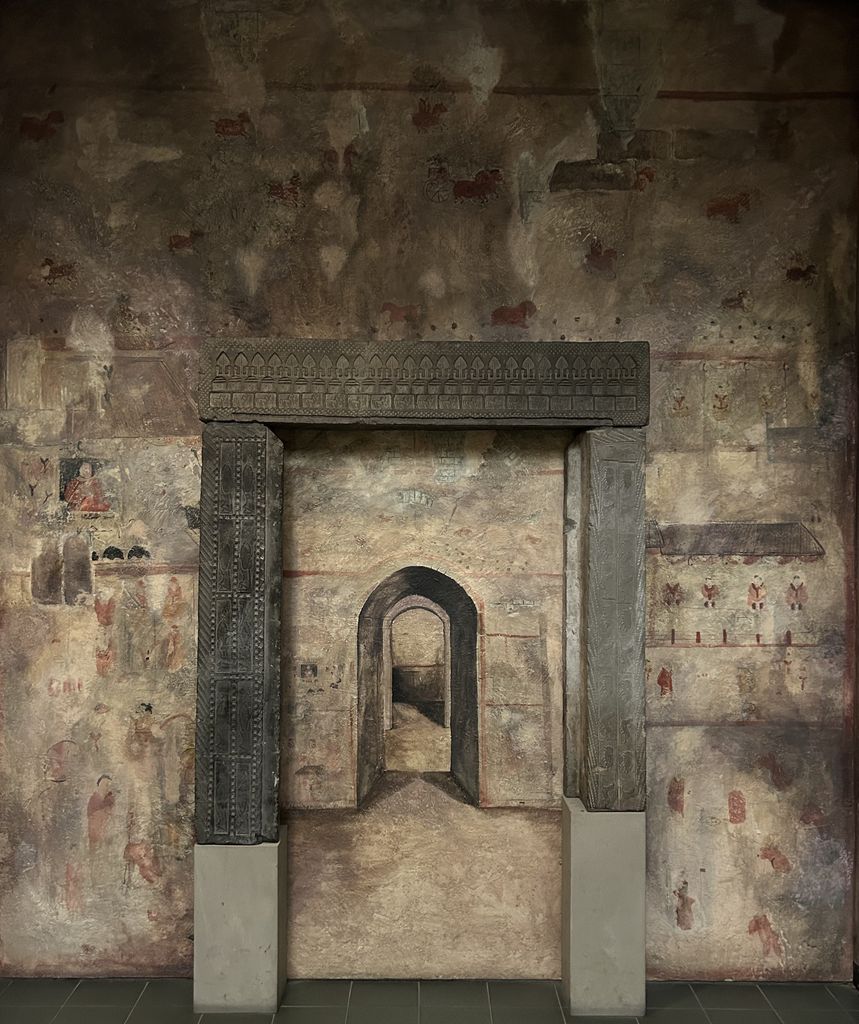
In his 2009 journal article entitled “Enlivening the Soul in Chinese Tombs,” Chinese art historian Wu Hung contends that most European and American museums do not display Chinese funerary objects in their ritual and architectural context.1 As a result, the decontextualized display of these artifacts limits an understanding of their original function.2 Museums in the West already subject Chinese objects to a binary of display, either within the pre-existing framework of Western art or classified as anthropological or ethnological objects.3 For Chinese burial objects, this binary becomes further exacerbated as their identity is defined as “art” or “artifact” when they are divorced from their original archaeological contexts.4
My Master’s dissertation in the History of Art and Archaeology of East Asia examines how Chinese burial objects are displayed in two Western universal survey museums’ galleries: the Charlotte C. Weber Gallery at the Metropolitan Museum of Art in New York City (Met) and the T.T. Tsui Gallery at the Victoria and Albert Museum in London (V&A). These universal survey museums are characterized by their globally diverse collections spanning a geographically broad range of art history.5 To my knowledge, no existing research compares these two galleries. I critique these galleries in their roles as cross-cultural communicators. The efficacy of the galleries is determined by whether the displayed Chinese burial objects’ purpose and function is clearly conveyed to visitors, and if these objects are contextualized within dynastic Chinese history and culture through the semiotics of the space—such as object descriptions and accompanying wall texts—as well as within the space itself, including the architecture and other visual informants impacting their display.
Religious and philosophical dynastic Chinese beliefs informed the practice of utilizing burial objects to activate the tomb into a spiritual space for the deceased’s soul as a “microcosmic representation of the universe.”6 These burial objects, known as mingqi are “[…] portable tomb furnishings, mainly objects and figurines, that are specifically designed and produced for the dead.”7 Mingqi are largely what both the Met and the V&A display in their respective Chinese “burial” galleries.
The interpretation of sacred objects, like mingqi, is notably impacted by how they are displayed within a museum. Art historian Gretchen T. Buggeln identifies a trifold dynamic of the display of sacred objects in museums as a relationship between the viewer, who is informed by both the museum's interior and exterior architecture, and the object’s innate characteristics.8 Buggeln expands upon the influence of the museum’s architecture on the visitor experience by quoting museologist Carol Duncan, “[Museums] contain numerous spaces that call for ritual behavior, ‘corridors scaled for processions, halls implying large, communal gatherings, and interior sanctuaries designed for awesome and potent effigies.’”9 In addition, there exists a subconscious museum etiquette requiring visitors to keep low volume levels and to slowly circumambulate the gallery, which both exemplify ritual-like behavior.10 The influence of spatiality on the museum visitor’s understanding of sacred objects through “spatial semiotics [that] reinforce the devotional context,”11 such as the glass case or plinths, emphasizes the sacredness of these objects by distancing the viewer through a physical barrier.12
In displaying sacred objects, curators are tasked with representing intangible religious beliefs. Religious studies scholar Chris Arthur has addressed the general skepticism of how much one can depend on the gallery to provide a comprehensive overview of specific religious beliefs and practices through the display of their respective religious objects. Yet he is hopeful that an object’s description, albeit short in nature, can provide the visitor with a starting point for understanding.13 Although the original sacred environment can never be fully recreated, the museum remains responsible for presenting their collection of sacred objects within an atmosphere of respect.14 This is important to consider in forming our understanding of Chinese burial objects on display and especially the museum’s efforts to communicate their original sacred significance to the deceased.
Given the nature of its collection, my dissertation concludes that because the Charlotte C. Weber Gallery at the Metropolitan Museum of Art mostly contains ceramic mingqi from the Han and Tang Dynasties, the gallery is curated into a linear, chronological mode of display identifying and highlighting the progression of mingqi as burial art. Alternatively, the diversity of the Victoria and Albert Museum’s collection (spanning from the Neolithic era to the Ming Dynasty) allows its “burial” section of the T.T. Tsui Gallery to communicate with five other thematic sections of the gallery: Temple and Worship, Living, Eating and Drinking, Ruling, and Collecting. Thus, the T.T. Tsui Gallery presents mingqi as artifacts. By cohesively contextualizing the function of Chinese funerary objects in Chinese life and culture, the curation of the T.T. Tsui Gallery encourages the viewer’s visualization of the spiritual space, hence a more effective method for visitors to learn about the importance and function of Chinese funerary objects.
____________________
Elaigha Vilaysane received her BA in Chinese Language and Literature and Art History from the George Washington University in May 2023. She has recently completed her master’s degree at SOAS, University of London in History of Art and Archaeology of East Asia with a concentration in Chinese studies.
____________________
1. Wu Hung, “Enlivening the Soul in Chinese Tombs,” RES: Anthropology and Aesthetics, no 55/56 (Spring – Autumn, 2009): 41, https://www.jstor.org/stable/25608834.
2. Wu, “Enlivening the Soul in Chinese Tombs,” 41.
3. Steven Conn, “Where is the East? Asian Objects in American Museums, from Nathan Dunn to Charles Freer,” Winterthur Portfolio 35, no 2/3 (Summer – Autumn, 2000): 157-58, https://www.jstor.org/stable/1215363.
4. Ronald L. Grimes, “Sacred objects in museum spaces,” Studies in Religion/Sciences Religieuses 21, no. 4 (1992): 422-23.
5. Carol Duncan and Alan Wallach, “Chapter 3: The Universal Survey Museum,” in Museum Studies: An anthology of contexts, ed. Bettina Messias Carbonell (Blackwell Publishing Ltd., 2004), 54.
6. Wu, “Enlivening the Soul in Chinese Tombs,” 22.
7. Wu Hung, “Materiality,” In The Art of the Yellow Springs (University of Chicago Press, 2010), 87.
8. Gretchen T. Buggeln, “Museum space and the experience of the sacred,” Material Religion 8, no. 1 (2012): 45, https://doi.org/10.2752/175183412X13286288797854.
9. Buggeln, “Museum space and the experience of the sacred,” 37.
10. Buggeln, “Museum space and the experience of the sacred,” 37.
11. Louise Tythacott, “Curating the Sacred: Exhibiting Buddhism at the World Museum Liverpool,” Buddhist Studies Review 34, no. 1 (2017): 116, http://www.doi.10.1558/bsrv.29020.
12. Tythacott, “Curating the Sacred: Exhibiting Buddhism at the World Museum Liverpool,” 123.
13. Chris Arthur, “Exhibiting the Sacred,” in Godly Things: Museums, Objects, and Religion, ed. Crispin Paine (Leicester University Press, 2000), 5-6.
14. Tythacott, "Curating the Sacred: Exhibiting Buddhism at the World Museum Liverpool," 130.
Jijnasa (desire to know)
by Sayak Mitra
The crisscrossing threads of my identity as both a Bengali Indian and a conditional resident of the USA unfurl and entangle conventional forms of artistic knowledge. Through my paintings and installations, I assemble fragments of my life—past and present, seen and unseen—to describe the breadth of my multicultural experiences and the worlds in which I live.
I am interested in the Vedantic Nyãya-derived concept of DṚG DṚŚYA VIVEKA (the Seer and the Seen), which emphasizes philosophic inquiry and temporal unearthliness. Growing up in the suburbs of Calcutta and spending time in our rural desher bari (native country home) surrounded by mustard, potato, and jute fields, my earliest memories as a practicing artist involve building pandals (temporary ritual structures) and participating in household puja (sacred ceremonies of worship).
I live with a keen awareness of the origins and implications of materials. In my approach to the concept of dematerialization in art, I propose to expand the concept of auto-ethnographic embodiment by exploring the history of my materials, cultural interpretation, and subjective association, instead of rejecting the materiality of objects. To shape the visual reading of my material, I borrow tools from deconstructionism and semiotics that allow me to persuade dematerialization beyond its materiality and objecthood.
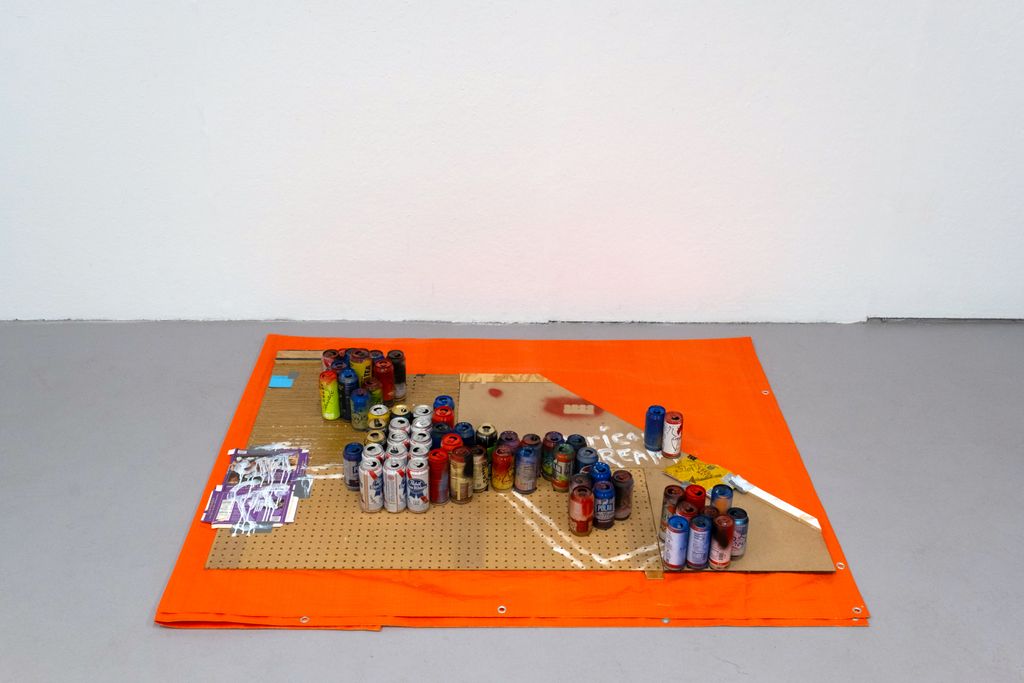
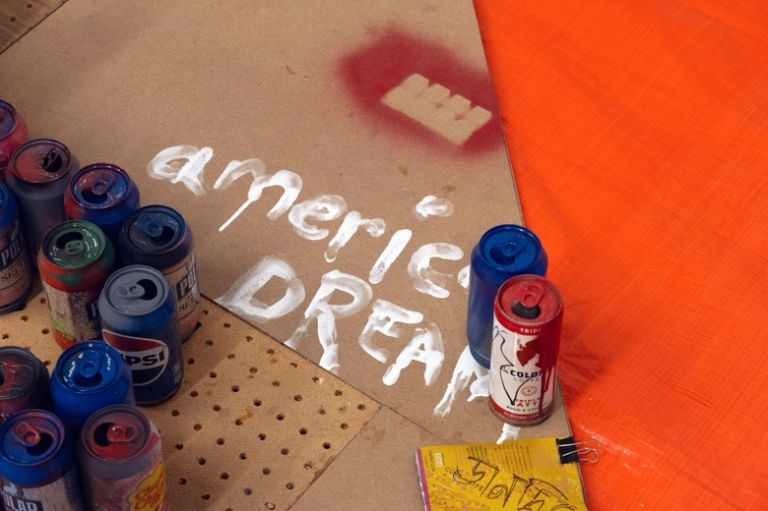
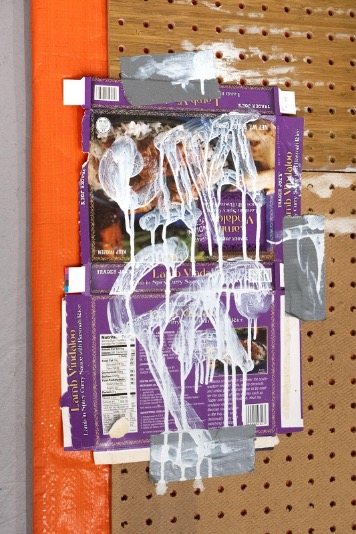
Figures 1-3. Sayak Mitra. Dhulagargh Industrial Park (2024). Acrylic, graphite, duct tape, food package, recyclable aluminum and steel cans, pegboard, wood, and tarp. Approximately 67 x 45 x 8 in. (170.2 x 114.3 x 20.3 cm). Images courtesy of the artist.
Examples of this approach are Dhulagargh Industrial Park (figs. 1-3) and Shakshi Chhilo Siddharth. Two primary materials, tarp and burlap, are used respectively for these two works. In Dhulagargh Industrial Park, mediums operate as mental images evoked by heterogeneous recyclable cans, upcycled fabrics, reclaimed materials, pigments, found objects, store-bought items such as home-improvement tools, urban development signs, etc. In West Bengal, the tarp has many purposes, including being used to dry parboiled rice and jackfruit seeds. I replaced seeds and rice with recycled cans, food packages, and makeshift signs. Parboiled rice is partially boiled and dried before milling and polishing, giving it a life before it is cooked for consumption. Similarly, after consuming green jackfruit, villagers collect, clean, and dry the jackfruit seeds for trade in the marketplace. Energy drinks, soda, beer cans, and frozen packed foods represent the working class in our society. The form of the cans echoes the stacks of kerosene barrels that are hauled around Calcutta on makeshift wagons (fig. 4).
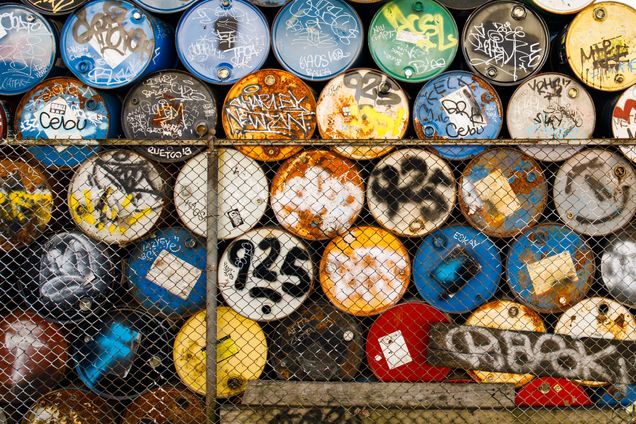
In Dhulagargh Industrial Park, I play with the idea of the planogram and jnana yoga to design a coded metaphor for a global market. Jnana yoga is a disciplined practice of knowledge: it allows us to observe any phenomena beyond its literal significance. On the other hand, a planogram is a diagrammatic system that helps retail stores maximize their sales and feed the supply-demand requirements of capitalism. I used wood, pegboard on orange tarp, and a section of shelf to represent the myth of a grandiose global market (fig. 2). Merchandise tags from manufacturers that claim “fair-labor-standard-certified” reassure customers, while factory workers endure inhumane treatment to meet consumer demands. Products imported from overseas obscure the workers’ conditions, creating a system that shields customers from moral accountability and enables over-shopping. The shape of pegboards is an extractive, semi-fictional, cartographic representation of Dhulagarh Industrial Park in the Howrah district of West Bengal.
During the rise of the gig economy of the early 1970s, small-scale factories were established in newly built industrial complexes. During this time, employers were not responsible for providing basic labor support and exploitative companies were not held accountable. The irony of the post-colonial myth of India’s progress, juxtaposed with the extractive economy it inherited, has been glorified under the shadow of the “American Dream.” The phrase “American Dream” appears in parallel with the Indian protest slogan “Khabo Ki?” (“What can we eat?”) on a Trader Joe’s frozen Lamb Vindaloo package, reflecting the culinary culture of diasporic Indians (figs. 2-3). As it has become synonymous with remittances to Central and South Asia, the vindaloo dish evokes the bittersweet colonial legacy of Portuguese rule.


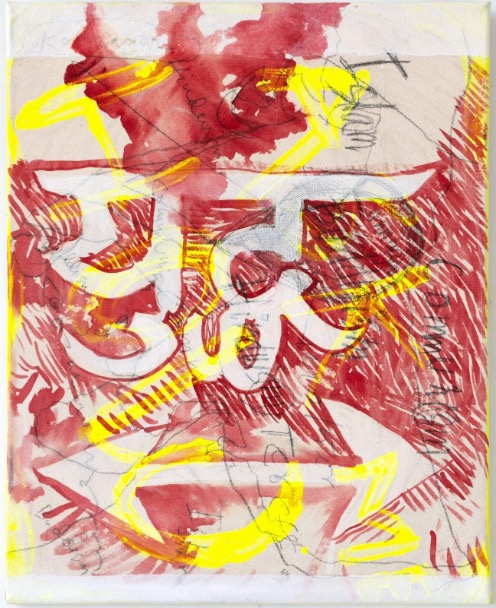
Figures 5-7. Sayak Mitra. Shakshi Chhilo Siddharth (2023). Graphite, acrylic, egg tempera, cardboard, aluminum signs, recyclable food packages, found woods, used gloves, burlap roll, stretched canvas, and reclaimed materials. Approximately 65 x 96 x 8 in. (165.1 x 243.8 x 20.3 cm). Images courtesy of the artist.
Shakshi Chhilo Siddharth showcases the socio-economic tension and societal hierarchy that operate as an aesthetic dialogue between several parameters: i.e. the customer of the local grocery, ambitious émigrés and refugees, collapse and vitality, disorder and systemization (figs. 5-7). This work was made in response to the architecture of the third floor of 808 Commonwealth Ave., a car factory turned into private art school studios in Boston. The main structure is made from a found divider wall and transformed into four wooden shelves leaning on the wall as we often see in diasporic grocery stores. The items on the shelf are carefully selected store-bought goods, drawings, and paintings. I propose a conversation between the plasticity of our “globalized idea,” and the stipulation of accessibility for many civilians who were not born in the affluent West or who have not benefited from the colonial extractive economy: between “JUST DO IT” and “DO NOT ENTER” (fig. 6). Half of the shelf is covered by burlap: in West Bengal, burlap is often repurposed into doormats, cushions, and curtains, giving discarded potato sacks a new life. This practice of deliberate repurposing reinforces cultural identity and underscores the metabolism of materials.
My practice ultimately aims to demonstrate how multiculturalism is an illusory neo-liberal concept that represents sovereignty rather than collective liberation. I’m interested in thinking about how the contemporary industrial complex bears and bares histories of colonial factories, and how my practice links ideas of empirical evidence with the myth of globalization. I see the world as a fragmented ensemble, and that fragmentation is excruciating. I seek to establish continuity through my research, paintings, and installations (figs. 8-14).


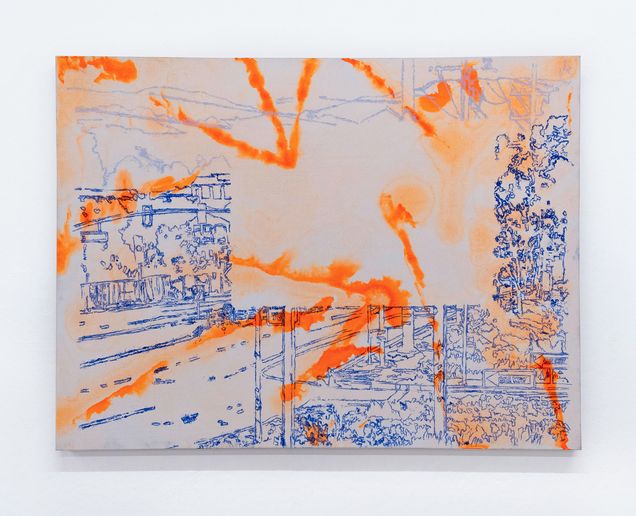
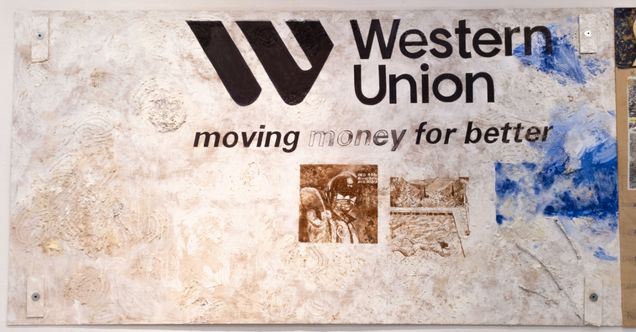

Figures 8-14. Sayak Mitra. Mindful Objective Investigation of Rationalist Narrative in the Gig Economy (2024); A Window At Industrial Park (2024); Ganashatru (2023); Untitled (2023); Untitled (2023); The flow of the Ganges (left panel of the triptych) (2023); International Mother Language Day (2022). Multimedia. Variable dimensions. Images courtesy of the artist.
____________________
Sayak Mitra (b. 1984, West Bengal) is an Indian artist working across traditional and contemporary new media art. His work addresses power, displacement, social injustice, and class issues through paintings, photographs, and installations. He graduated with a B.Tech from WBUT (2008) and an MFA in Painting from Boston University (2024). Sayak co-founded Artist-collective Ocular in 2006 and has exhibited globally, winning awards like the Hugh and Marjorie Petersen Award for Public Art and the Atul Bose Award for Painting.
____________________