Cage Card Notification System
Purpose and Scope
The purpose of this system is to identify different cage cards used within the vivarium. These cards are used to communicate the intended use and care of individual cages between BUASC and lab staff while being housed in BUASC facilities.
Card Types
General

Primary Cage Card (White)
Primary Cage Card</span hidden>
White in color with unique number and barcode for tracking. The BUASC will issue completed cage cards once the animals are ordered and received by a vendor. Lab specific cage cards can be found in each lab’s animal holding room and can be used when the researcher or BUASC establishes a new cage of animals by weaning or separation. This card has two perforated strips on the top; one for activation of card and second for deactivation of card. All cages must have a primary cage card with the following information and conform to BUASC format:
- PI Name
- Financial Account
- Protocol (PROTO) number
- User’s name
- Phone number
- Species
- Sex/Age/Weight
- Strain
- DOB
- Vendor/IHB
- Arrival date (if applicable)


Transfer/Transport Card (Teal)
Transfer/Transport Card (Teal)
Teal in color, this card is used to designate cages moving to another room/building within BU, transferring to another protocol and/or another PI, or transporting out to another institution. This card must be placed by the research staff for any transfers/transports within BUASC maintained colonies. All transfers/transports must first be approved by BUASC by submission request in AOPs. Physical movement of cages between rooms and/or changing of protocols on cards without permission is prohibited. BUASC staff will complete all transfers/transports once request is approved. When completing a transfer/transport, BUASC will update cage cards accordingly to reflect change.

Learn more about the transfer process and filling out Transfer/Transport Cards
Problem Notification Card (Green)
Problem Notification Card (Green)
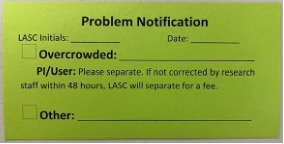
Green in color, this card is used to flag any non-emergency concern (i.e. overcrowded cage, wean due, missing information on cage card, etc.). Noteworthy: this card does not include non-emergency health concerns (see Vet Services card). The lab must rectify noted problems within reasonable timeline with the exception of overcrowded cages. The lab is allowed up to 48 hours to correct an overcrowded cage unless an emergency arises (double litters, fighting animals, etc.). It is the responsibility of the lab to maintain colony breeding and weaning. BUASC assistance in aforementioned cases are chargeable services. In emergency events, BUASC will separate animals immediately upon finding. The veterinarian will be consulted for permission to supply standard chow and water for any cages that have been observed to have very little (2-3 pellets) or no special food or water.

Vet Service Card (Red)
Vet Service Card (Red)
Red in color, this card is used to indicate that an animal within the cage has an active health concern. When a health concern is noted, the animal(s) are under the care of Veterinary Services. Presence of this card on the cage means the lab should also have received communications via Health Concern email. This card is used in conjunction with a health case monitoring form for BUASC to document each case on a daily/weekly/monthly schedule.


Single Housed Card (Beige)
Single Housed Card (Beige)
Beige in color, this card is placed by ASC staff when single housed animals are noted. At the next cage change, additional enrichment will be given to any cages that are not marked for enrichment restriction. The mice will receive extra enrichment during cage change until the animal is euthanized or paired (follow male group housing policy).


New Animal Arrival Card (Purple)
New Animal Arrival Card (Purple)
Purple in color, this card is used to flag newly arrived animals to the facility from BU approved animal vendors. This card is placed by BUASC staff upon housing the animals and will stay on during their acclimation period. BUASC will monitor these cages closely during this time and remove the card approximately 1 week later.

Surgery
Post-Surgical Cards (Blue)
Post Surgical Cards (Blue)
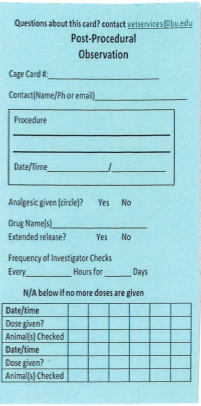
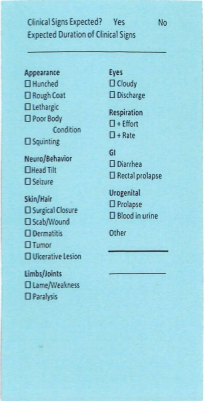
This card is used for lab staff to communicate to BUASC staff when any animal manipulations were completed within the cage. This card is to be filled out in it is entirely. This card also allows the BUASC staff to look for any abnormal post-procedure behavior once returned to the housing room. A post-procedure monitoring form for rodents should be filled out after a surgical procedure by the researcher to document observations.
Special Circumstances
Chemical Containment Label (Yellow, Orange, Red)
Chemical Containment Label (Yellow, Orange, Red)
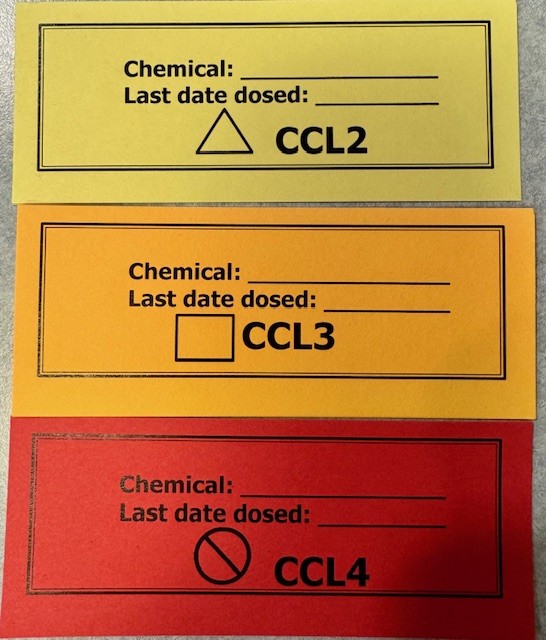
Varying in color, these cards are used to identify animals in cages that have been administered chemical agents. They are categorized (CCL 2–4) from low to high hazard and require specific safety controls. Each card must list the chemical name and the last date of dose. The card is to remain on the cage until the chemicals’ half-lives have been reached.
Learn more about Chemical Containment Levels (CCL) for Animal Administration here in our policies library: https://www.bu.edu/research/forms-policies/containment-levels-for-chemical-administration-in-animals/

Protocol On-Hold Notification (Orange)
Protocol On-Hold Notification (Orange)
This card is placed at the cage level by BUASC when informed by the IACUC that a protocol is on HOLD (reason for this varies and questions should be directed to IACUC). The animals are placed on a BUASC holding protocol and the lab is restricted from any manipulation or handling (including but not limited to weaning, setting up breeding pairs, collecting weights, etc.) of these animals while the protocol is on Hold. Once cleared by IACUC to remove from holding, BUASC will remove the cards.

Special Care Cards (Yellow)
Special Care Cards
Yellow in color, these cards are used to indicate any special care within the cage that differs from normal husbandry. This includes special food/water, fasting, special bedding, extra enrichment, etc. It should be noted whether the lab or BUASC staff will provide care of special requirements when applicable. The researcher should contact BUASC manager to find out what special items the BUASC can do. Please note that BUASC completion of special instructions may incur a charge to the lab for the service. The entirety of the card should be filled out, especially a contact number for the individual making the request.


Restriction Cards: Food & Water
Restriction Cards: Food & Water
White in color, this card is used to indicate food or water restriction within the cage. Researchers may independently initiate and end restriction to cages according to their experimental needs. Restriction must be approved on the protocol before beginning. This card should be filled out in its entirety. Researchers with actively restricted cages must maintain documentation of daily feedings or watering. Researchers may request ASC support for feeding or watering (e.g., weekends or holidays). These requests should be submitted to the facilities operation manager at least one business day prior to the scheduled service. Note: a charge will incur for services provided.
The determination of the minimum caloric requirement or minimum fluid required to maintain the health of each animal is required prior to starting food or fluid restriction studies. Learn more about Food and Fluid Regulation and Restriction (IACUC) here.
Learn more about Special Care Requests.

Breeding

New Litter Card (Hot Pink)
New Litter Card (Hot Pink)
Pink in color, this card is placed by the BUASC staff when the observation of a new litter is present in the cage. This card can be placed by the research staff if they spot the litter first. It contains the birth date (DOB) and wean date of the new litter. The wean date is 21 days from the date of birth. Mice and rats can deliver litters every 21 days. If 2 litters (otherwise known as double litters) are present in a cage, the older pups must be immediately separated out (overcrowding; referred to as emergency wean) unless otherwise approved on the IACUC protocol or by vet services due to a health concern evaluation. It is the responsibility of the lab staff to keep track of the breeding colony and weaning events to help reduce charges to their lab. Any cage not weaned out within 48 hours of the weaning date will be weaned by the BUASC for a fee (as noted in the special service log). In addition, any double litters found by BUASC will be separated and also constitutes as a chargeable service.


Breeder Card (Pink)
Breeder Card (Pink)
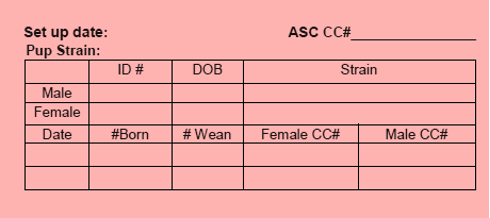
Pink in color, this card is placed by research staff when setting up new mating pairs. The card contains information on parent strain, DOB, and ID if any. The litter production is also tracked on the card by ASC if we initiate any separation of the litter.
Learn more about breeding animals and filling out Breeder Cards