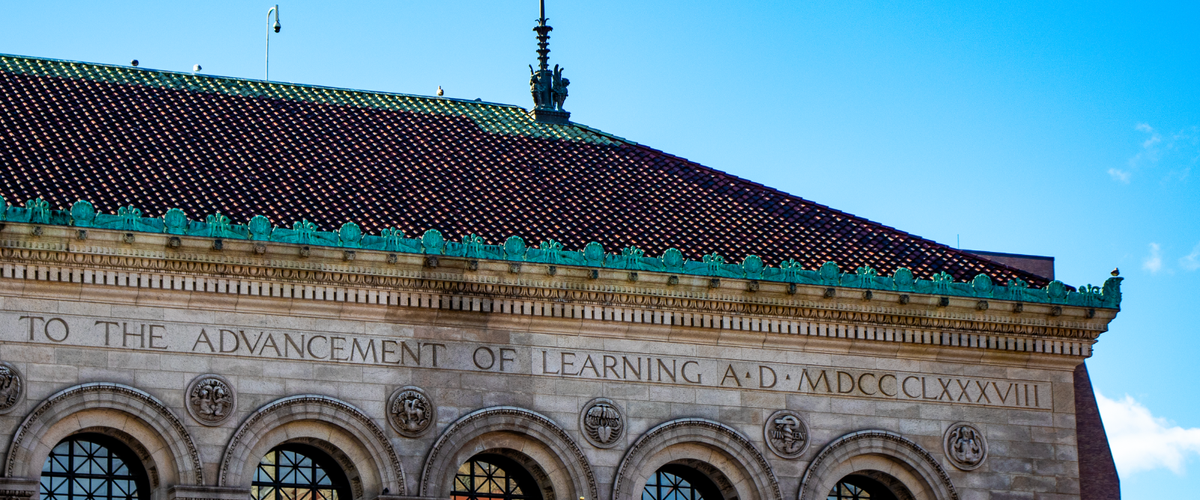

We are excited to share that Reuben Danyali (CAS/KHC ’28) is the inaugural Norman B. Leventhal Map & Education Center Summer Research Intern at the Boston Public Library! Reuben will contribute to geospatial research and data analysis of historic housing patterns, evictions, and property ownership in Boston and across Massachusetts to support a new public-facing exhibition by the Leventhal Center in 2027.
The Norman B. Leventhal Map & Education Center, established in 2004, is a nonprofit organization established as a public-private partnership between the Boston Public Library and philanthropist Norman Leventhal. Its mission is to use the collection of 200,000 maps and 5,000 atlases for the enjoyment and education of all through exhibitions, educational programs, and a website that includes more than 10,000 digitized maps at collections.leventhalmap.org. The map collection is global in scope, dating from the 15th century to the present, with particular strengths in maps and atlases from New England, the American Revolutionary War period, nautical charts, and world urban centers.
Reuben is a rising junior studying Environmental Analysis and Policy and Economics. He is originally from Baltimore, MD, where he gained a passion for urban design and environmental justice. His main academic interests include ecological restoration and planning policy. He does research at BU as a team lead for the Campus Climate Lab at the Institute for Global Sustainability and a GIS developer with the PLACES Lab. He enjoys backpacking and rock climbing, metal music, and historical nonfiction.
We asked Reuben several questions below about his interests, motivations, and hopes for his internship at the Leventhal Center this summer!
What made you want to apply for this internship?
I wanted to apply for this internship because I think the Leventhal Center does something no other geography research institution or group does: centering public education as the guiding outcome of their research. In a professional sense, I am very interested in geospatial analysis and geographical information systems, but I think this is a rare opportunity to work with those tools for a goal that is explicitly and uniformly public-oriented. I really relish the opportunity to do work that will teach people more about the place they call home and could inform policy to improve this city.
Tell us about your interest in cities.
I like to think of cities as “force multipliers” in the area of policy, especially because they concentrate resources, people, and services. I’ve always been interested in cities and the policies and people who build them because I see our cities as instruments of social justice and community welfare. I think we are living in an era in the US where the value of cities, in this sense, is underutilized, especially given our historic obsession with suburban development. We are living in an ever-more urban world with growing complexities in meeting key needs such as housing, the environment, and dignified work. The path forward for improving people’s material conditions must therefore include a visionary and transformative application of policy in creating cities that bridge the gap between our current challenges and these needs, and I hope to be a small part of that work.
How did you first become interested in housing and research using geospatial data?
While I’ve been interested in housing and maps since high school, my first professional exposure to housing research and GIS came through a freshman-year class, Housing Policy: An Economic Perspective, taught by Economics Professor Adam Guren. I think this was a really good way to be introduced to both topics because it neatly combined theory and application, which really underscored the value of geographic analysis as a tool for approaching housing policy.
What are you most looking forward to this summer?
This summer, I’m most interested in the opportunity to work with highly complex, detailed housing data, down to the sub-parcel scale of individual units. Working at the Leventhal Center is hopefully going to expose me to a scale of historical data on housing that I haven’t yet had the opportunity to work with, and while I expect to confront new challenges in this area, I’m excited by the possibilities that such a massive and rich data catalog will allow for analysis. I also look forward to contributing to public materials for upcoming exhibitions at the center, as I’m very interested in the educational work they do.