
This post is part of our #BUandBoston series, highlighting the work and research of BU students, faculty, and staff throughout the City of Boston and the Greater Boston region. Interested in having your Boston-related work featured? Tag us on Instagram or Twitter (@BUonCities) using the #BUandBoston or send us an email at ioc@bu.edu.
By Sasa Ramos (CAS ‘27)
The Urbanism Club at Boston University is an emerging community of urban enthusiasts dedicated to enhancing urban life throughout Boston. Through peer-led discussions and community events, students engage with urban topics related to Boston, including housing and transportation. The club invites students to present local issues of their choice, sparking conversation between urbanists across all disciplines. Established in 2024, the Urbanism Club at Boston University has since thrived as a community of future civic leaders.

Co-President Jerry Zhou (CGS ‘24, CAS ‘26), a senior studying Sociology and Architectural Studies, has played a key role in shaping the Urbanism Club since its founding. Jerry connected with An Pham (CAS/KHC ‘24, Economics and Mathematics) over their shared passion for urbanism while taking the Global Urban Studies course with Professor Loretta Lees. Laying the foundation for BU’s first urbanism club, Jerry and An gathered a group of eight urbanists in May 2024. Following An’s graduation, Jerry took over the club’s planning and operations alongside Levi Chen (CAS ‘27, Architectural Studies). Becoming an official student organization this year has allowed the Urbanism Club to expand its outreach, with the majority of its members being underclassmen.
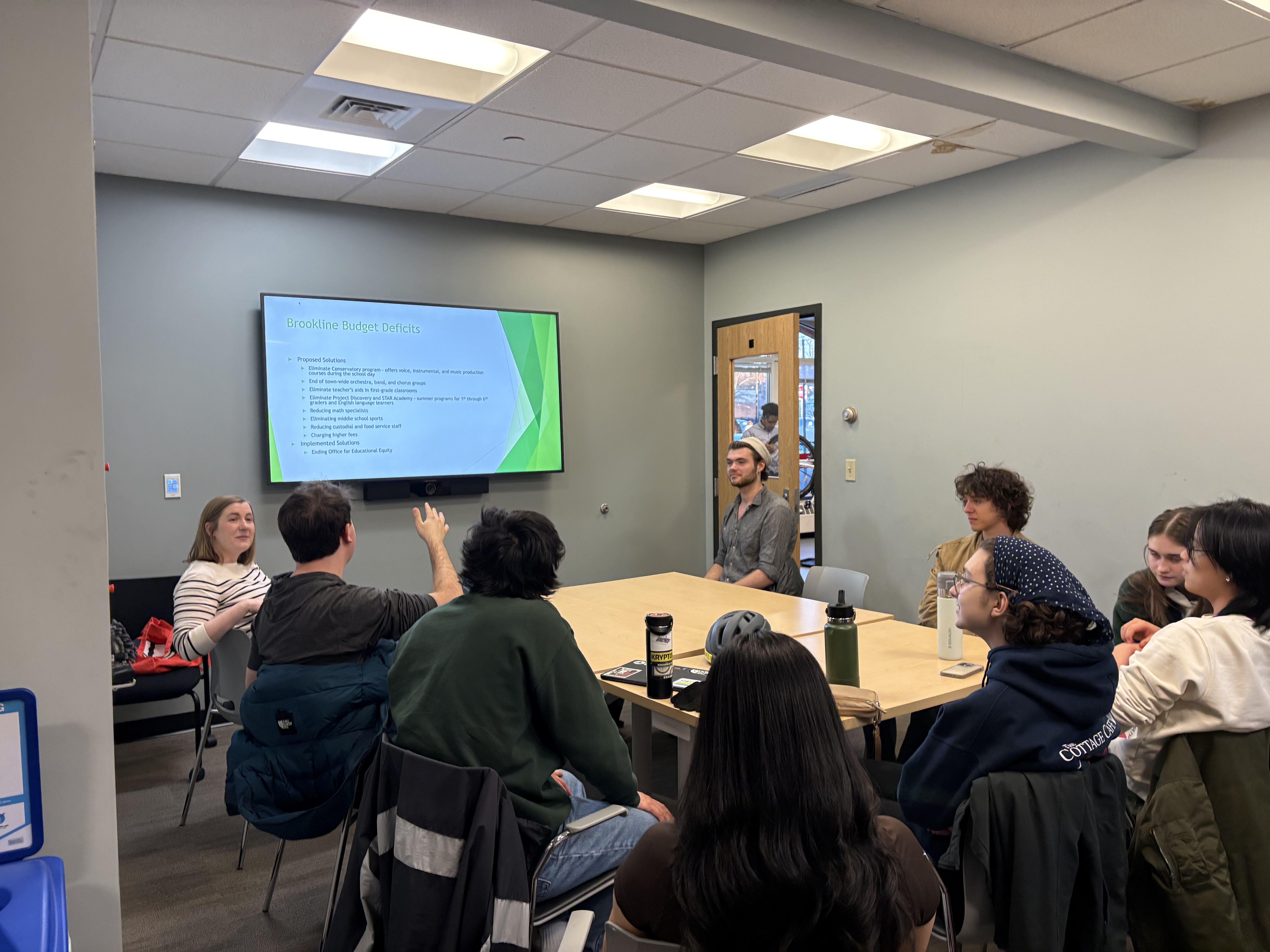
Club members discuss solutions to the Brookline budget deficit during a general meeting.
Photo courtesy of Jerry Zhou
Through peer education, the Urbanism Club empowers fellow students to become advocates in their local community. On a bustling, urban campus integrated within the city of Boston, Jerry expressed an urgent need for safer streets: “Comm Ave is our campus; our campus is only as good as Comm Ave is.” On October 7, 2025, Jerry published an op-ed in the Daily Free Press, inspired by conversations with fellow students around the demand for bike safety on campus. His ideal campus features accessible infrastructure that centers on the needs of pedestrians, bikers, and wheelchair users. Proposing the inclusion of a protected bike lane in front of Warren Towers as part of its existing renovation plan, he points out how this dialogue serves as a powerful tool for collaboration between the BU community and the City of Boston: “Both of these parties need to be working together to advance some sort of vision of Comm Ave on BU’s campus that puts the students at BU first.”
Beyond engaging students on campus, the Urbanism Club fosters relationships with city officials—the people with the power to influence policy. In March 2025, club members shared their input on accessible design in Kenmore Square as part of the Fenway Transportation Action Plan, discussing their ideas with City Councilor Sharon Durkan. The club recently welcomed back Councilor Durkan, who biked from City Hall to speak with students about the benefits of bike-friendly infrastructure. “A lot of people are just very siloed,” Jerry observed. “A student organization like the Urbanism Club should serve to bridge the gap between BU students and the broader community and encourage them to engage with the city that they live in.”
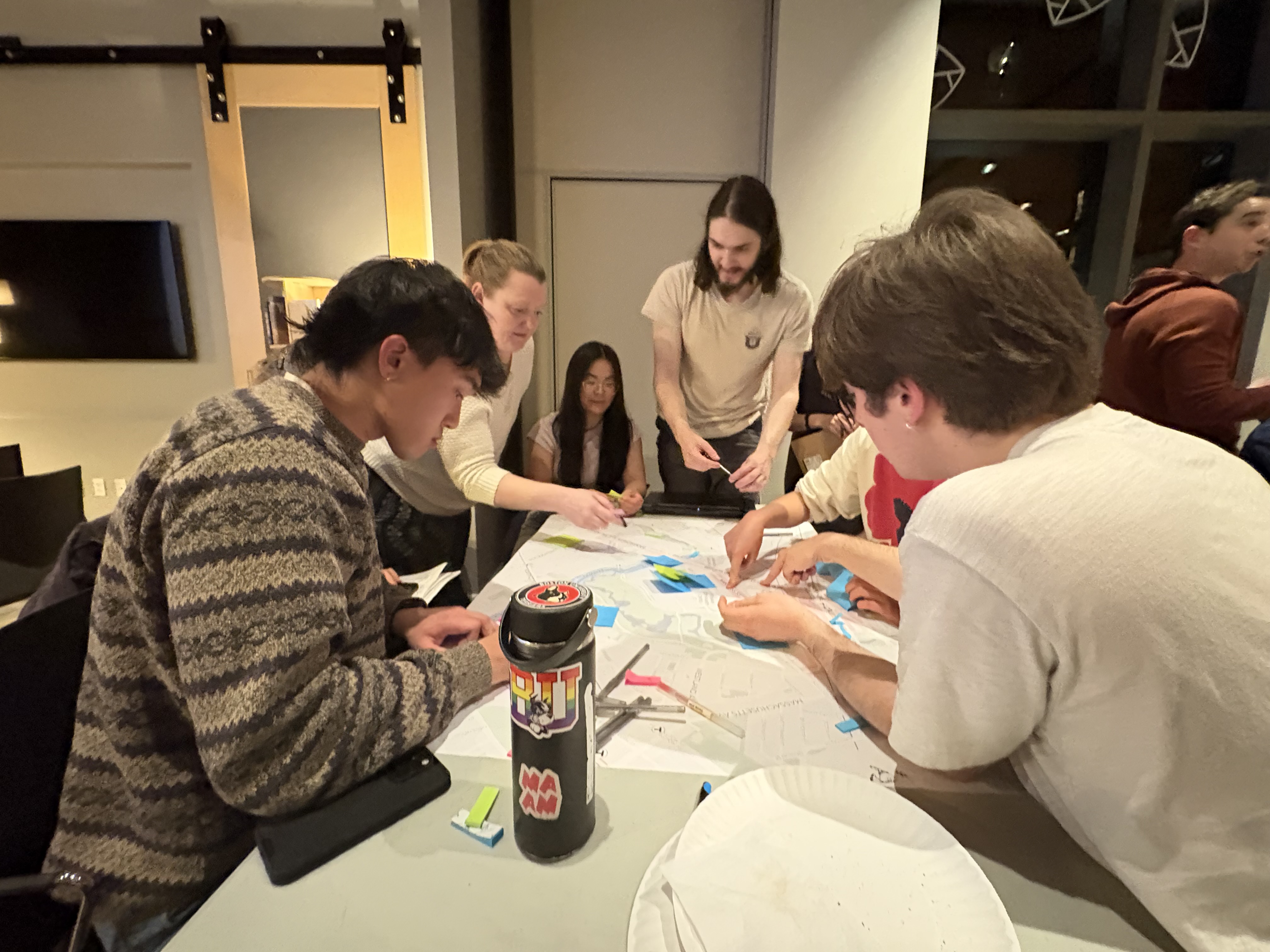
A student organization like the Urbanism Club should serve to bridge the gap between BU students and the broader community and encourage them to engage with the city that they live in.
Reflecting on his journey as an urbanist from Pennsylvania to a full-time student in Boston, Jerry urges others to build meaningful connections outside of the “BU bubble” and take advantage of the boundless opportunities the city has to offer: “If we had more students doing that, I think that the city would be a better place for not just students but everyone.” Moreover, Jerry credits the advocacy of past student organizations, which have laid the groundwork for the Urbanism Club’s focus on community education. BU Bikes, a former student group focused on bicycling, successfully implemented protected bike lanes along West Campus. The Urbanism Club carries on its legacy by empowering individuals with the knowledge to shape and enhance the built environment.
Promoting civic engagement through dialogue, the Urbanism Club serves as a multidisciplinary space bringing together urbanists from all walks of life. The club plans to restructure its general meetings, striking a balance between both educational and social events. Club members are responsive to current events, expanding their scope beyond transportation issues to cover housing justice and food insecurity. In light of the recent federal shutdown delaying the Supplemental Nutrition Assistance Program (SNAP), the Urbanism Club discussed the legacy of redlining on food deserts, emphasizing the power of community action to address urban inequalities.
Looking towards the future, Jerry sees sustained community engagement as the key to achieving tangible change: “It’s the spirit of educating people about advocacy and encouraging people to get involved in their communities. I hope that spirit stays alive.”
