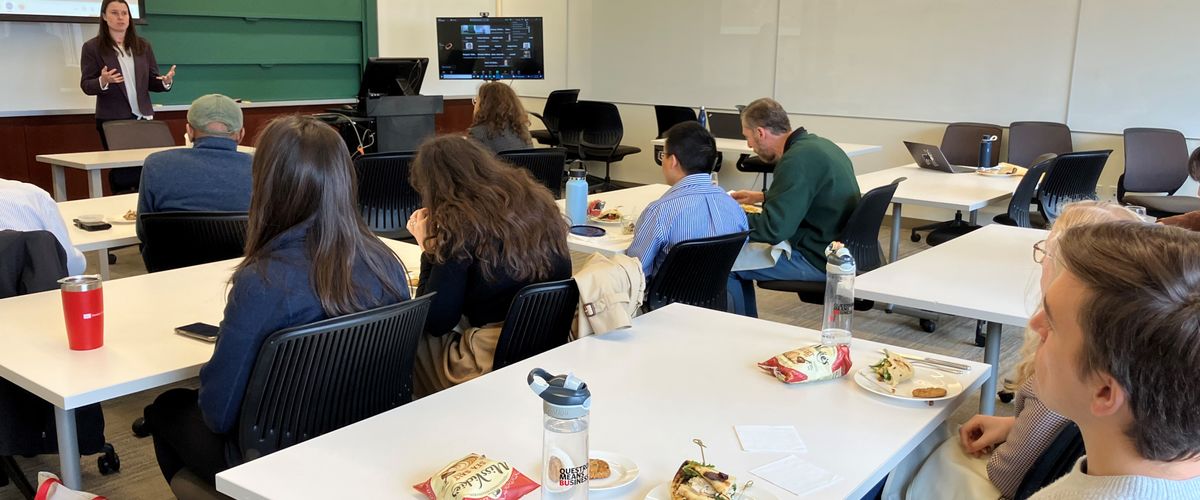
IMAP seeks to foster collaboration on its research projects both across academic departments, and between academics and industry professionals. One way we encourage these interactions is via our monthly lunch seminars. Those who join, either in-person or online, should not expect to simply watch anonymously, but rather engage in the discussion and meet others interested in similar topics.
What: A monthly lunchtime presentation and discussion of IMAP-relevant research
Who: Academics and industry professionals
Why: To promote interdisciplinary exchange of ideas around ESG challenges and ensure academic research is informed by and relevant to industry
Where: In-person on the BU campus and via Zoom
We hope industry affiliates in the Boston area will join us in-person.
2025-2026 Lunch Seminar Dates
- September 25, 2025
- November 20, 2025
- December 11, 2025
- January 29, 2026
- February 12, 2026
- March 19, 2026
- April 16, 2026
Upcoming Seminars
March 19, 2026 – Greenhushing: Unintended Consequences of Conditionally Mandatory Disclosures
Regulators intend for conditionally mandatory disclosures to balance compliance costs with investors’ desires for greater information about firms’ activities, operations, and risks. We explore the consequences of conditionally mandatory disclosures by studying managers’ responses to the SEC’s recent Climate Disclosure Rule. Included with this rule was the requirement to disclose scenario analyses around how the firm assessed the firm-level financial consequences of climate change, but only if prepared internally. Using a 2x2x2 between-participant experiment, we find that under a conditionally mandatory disclosure regime, managers choose to prepare climate-risk disclosures less frequently versus a voluntary disclosure regime. The presence of a safe harbor and previous preparation of a scenario analysis also are positively associated with the decision to prepare a new scenario analysis. Our findings suggest that conditionally mandatory disclosures may incentivize managers to end the underlying activity to avoid disclosure.
Jesse Chan, Assistant Professor in Accounting at Questrom School of Business, will present.
Register here:
April 16, 2026 – The CELT Project: Data & Stories for a Clean Energy Transition in Massachusetts
This talk will give an overview of the Clean Energy and Environment Legacy Transition Initiative (CELT), a collaboration between the BU Institute for Global Sustainability (IGS) and the UMass Lowell RIST Institute for Sustainability and Energy to accelerate decarbonization in the 351 cities and towns in Massachusetts. Funded by the Massachusetts Department of Energy Resources, CELT supports a municipal and state fellows’ program, data for decisions, and statewide collaborations to support clean energy projects. This talk will introduce the CELT Atlas and Explorer, two public data tools focused on providing community level maps and information about energy infrastructure, sustainability grants, housing and population, and energy affordability across the state. We will also share case studies of sustainability projects cities and towns are tackling in order to meet 2050 NetZero state goals.
Patricia Fabian and Cutler Cleveland, both IGS Faculty Associate Directors will present.
Register here:
Past Seminars
February 12, 2026 – Do Investors Price the Brussels Effect? Regulatory Risk and Sustainability in U.S. Markets
This talk will explore whether U.S. equity markets respond when EU regulations spill over into global markets through the “Brussels Effect.” Using the case of European sustainability reporting rules under the Corporate Sustainability Reporting Directive, I examine how investors price in regulatory risk: U.S. firms with European operations experienced negative stock market reactions around key regulatory milestones. These reactions are linked to higher discount rates, reflected in greater volatility and shifts in option pricing. Of note, the effects are present both for firms directly covered by the rules and for those indirectly exposed, and they are strongest for high-emissions firms. Overall, the discussion will suggest that the Brussels Effect—as an expression of the EU´s extraterritorial regulatory ambition—creates tangible regulatory risk for U.S. firms.
Tati Fontana, PhD candidate in Accounting at BU Questrom School of Business will present.
Watch this presentation:
January 29, 2026 – Environmental Regulation, Pollution, and Economic Outcomes in Capital Markets
Environmental Regulation, Pollution, and Economic Outcomes in Capital Markets
Watch this presentation:
November 20, 2025 – Measuring Impact to Unlock Capital for Energy Access
Measuring Impact to Unlock Capital for Energy Access
Watch this presentation:
September 25, 2025 – The Relevance to Investors of Greenhouse Gas Methane Emissions
The Relevance to Investors of Greenhouse Gas Methane Emissions
Watch this presentation:
See the PowerPoint here: Relevance to Investors of Greenhouse Gas Methane Emissions
June 12, 2025 – Should Anesthetics with Enormous Global Warming Potentials be Banned? Dealing with Competing Moral and Technical Points of View
Should Anesthetics with Enormous Global Warming Potentials be Banned? Dealing with Competing Moral and Technical Points of View
See the PowerPoint here: Should Anesthetics with Enormous Global Warming Potentials be Banned?
April 17, 2025 – The Puzzle of Sustainable Investment
The Puzzle of Sustainable Investment
Watch this presentation:
February 13, 2025 – Geospatial Finance: Foundations for Sustainable Investment and Environmental Insight
Geospatial Finance: Foundations for Sustainable Investment and Environmental Insight
Watch this presentation:
January 30, 2025 – Energy Investment Tax Credits & Environmental Outcomes: Evidence from Electric Utilities
Energy Investment Tax Credits
Watch this presentation:
December 12, 2024 – Making ESG Research More Trustworthy
Making ESG Research More Trustworthy
Watch this presentation:
November 21, 2024 – Climate Solutions, Transition Risk, and Stock Returns
Climate Solutions, Transition Risk, and Stock Returns
Watch this presentation:
September 26, 2024 – The Emperor’s New Climate Scenarios
The Emperor's New Climate Scenarios
Watch this presentation:
June 13, 2024 – Mitigation of Shipping CO2 Emissions
Mitigation of Shipping CO2 Emissions
Watch this presentation:
You can also watch an animated 3-minute video about this talk here:
April 4, 2024 – Common Environmental Scoring of Fossil Fuels for Foreign Trade and Investment Decisions
Common Environmental Scoring of Fossil Fuels for Foreign Trade and Investment Decisions
Watch this presentation:
March 21, 2024 – Pharmaceutical Industry Reporting on Access
Pharmaceutical Industry Reporting on Access
Watch this presentation:
February 2024 – Do or Do Not, There is No Try
Do or Do Not, There is No Try: Managing and Mitigating Sociopolitical Firm Risk Events
January 2024 – Who does not care loses
Who does not care loses: Ethical governance and the bottom line
Watch this presentation:
December 2023 – What do shareholders want?
What do shareholders want firms to maximize - profits or profits + ESG objectives?
November 2023 – Direct and Spillover Effects of U.S. State-Level Climate Change Regulations
What are the effects of state-level greenhouse gas regulations?
September 2023 – Predicting the success of utility climate targets
Can we predict if a utility will meet its climate targets?
Watch this presentation:
June 2023 – The 51 Percent Project & Finance Professionals
How should we be communicating about climate change?
Watch this presentation:
April 2023 – ESG Risk Disclosures: The Predictive Ability of SASB Recommendations versus Industry Best Practice
What is the predictive ability of ESG risk disclosures?
Watch this presentation:
March 2023- Business Risks due to Biodiversity Loss in Indonesia
Which Indonesian palm oil plantations are associated with loss of tropical biodiversity?
Watch this presentation:
February 2023 – Disinformation and native advertising about climate change: Identifying ESG claims
How corporations are employing the power of native advertising
Watch this presentation:
January 2023- Corporate Carbon Risk in Utilities
What is the risk associated with corporate carbon targets?
Watch this presentation:
December 2022- Using ESG Research
Can we trust empirical research on ESG?
November 2022- When Green Investors Are Green Consumers
Why does the impact of green investing on polluting firms’ costs of capital appear to be limited?
Watch this presentation: