The Graduate Student Summer Fellows program at the Institute for Global Sustainability (IGS) offers graduate students from across BU the opportunity for capacity building, mentoring, and interdisciplinary analysis to support their independent research projects in planetary health and human well-being, the governance and politics of sustainability transitions, and energy systems of the future.
The program encourages:
Diverse methodological approaches that span robust data analysis and rigorous mixed methods
An emphasis on social justice and equity
Translation of research into policy impact, industry engagement, and social action
2026 Summer Fellows
“Comparing Heat Decarbonization Scenarios for the City of Boston: Analyzing Impacts on Energy Demand, Cost, and Energy Justice,” Grace Betts (PhD student, Environmental Health, School of Public Health)
“Exposure to High Ambient Temperatures and Risk of Hypertensive Disorders of Pregnancy,” Sharon Casey (PhD student, Epidemiology, School of Public Health)
“Delivering Climate Justice to Global South: From Climate Adaptation Aid to Loss & Damage Compensation,” Sheida Hooshmandi (PhD student, Earth & Environment, Graduate School of Arts & Sciences)
“Smart and Sustainable Buildings through Data-Efficient Reinforcement Learning,” Xinyi Hu (PhD student, Computing & Data Sciences, Faculty of Computing & Data Sciences)
“Energy Poverty, Household Biomass Fuel Use, and Respiratory Health in Ethiopia: Implications for Planetary Health and Sustainable Energy Transitions,” Feven Lencha (MPH candidate, Epidemiology and Biostatistics with a focus on Global Health, School of Public Health)
“Crop-Specific Flood Damage and Recovery Mapping for Equitable Climate Resilience,” Dorsa Mohammadi (PhD student, Earth & Environment, Graduate School of Arts & Sciences)
“Characterizing Ultrafast Photophysics of β-Carotene under Strong Light-Matter Coupling,” Seongje Park (PhD student, Chemistry, Graduate School of Arts & Sciences)
“Investigating Thermal Transport in Metal–Organic Framework – Polymer Composites to Improve Direct Air Capture of Carbon Dioxide Efficiency,” Alexander Rocca (MS student, Mechanical Engineering, College of Engineering)
“The ESG Engagement Gap: When Political Pressure Reshapes the Talk but Not the Walk,” Jena Santi (PhD student, Accounting, Questrom School of Business)
“Spectrum Fairness: A New Game-Theoretic Framework for Active-Passive Dynamic Spectrum Sharing,” Jiguang Yu (PhD student, Systems Engineering, College of Engineering)
“Power Optimization in Large Language Model Inference Serving,” Lizzy Yue (PhD student, Computer Engineering, College of Engineering)
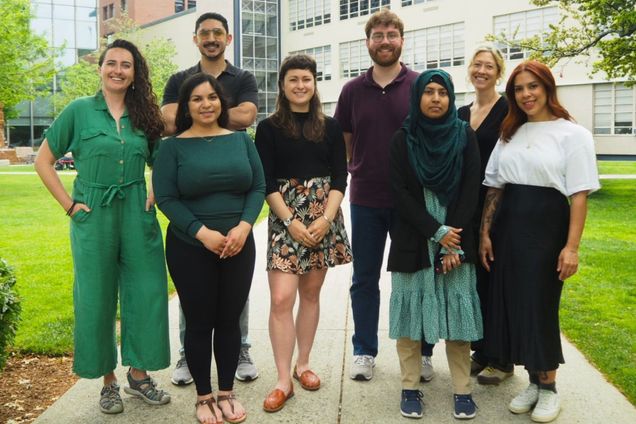
Back row (left to right): Sophia Tigges, Melissa Martin, Mohammadamin Hajikhodaverdian, Bamidele Aroboto, and Yikai Zhang; Front (left to right): Breanna van Loenen, Naa Korkoi Tackie, Tati Fontana
The 2025 cohort of fellows represented seven departments and four schools and colleges across the University.
Advancing Energy-Efficient High Entropy Alloy Synthesis Through Machine Learning and Multi-Scale Simulations Bamidele Aroboto (PhD student, Mechanical Engineering, College of Engineering)
Research: Integrating data science, machine learning, and materials science to design next-generation energy materials with an emphasis on high-entropy alloys, leading to more sustainable manufacturing practices.
U.S. Capital Market Consequences of the Brussels Effect: Evidence from Sustainability Reporting Tati Fontana (PhD candidate, Accounting, Questrom School of Business)
Research: Examining U.S. investor reaction to the extraterritorial European regulatory risk in the context of the sustainability transition.
Energy Efficient Monolithic 3D Transformer Accelerator Mohammadamin Hajikhodaverdian (PhD student, Electrical & Computer Engineering, College of Engineering)
Research Goal: Using a novel hardware architecture to enhance the computational efficiency of energy-intensive, large-language AI models, making them more sustainable.
Analyzing the Role of Climate Emotions in Shaping Engagement Patterns on Reddit Naa Korkoi Tackie (PhD student, Emerging Media Studies, College of Communication)
Research: Understanding the key emotions that characterize climate discussions and how these emotions reflect on the volume of engagement with Reddit posts and comments, in support of improved climate communication.
Assessing Urban Heat Island Intensity on Building Energy Demand, Grid Congestion, and Negative Health Outcomes Melissa Martin (PhD student, Earth & Environment, College of Arts & Sciences)
Research: Rethinking building energy demand modeling to study the impact of heat islands on public health and investigate how cooling interventions could increase energy demand and cause power system congestion.
Saltmarsh Microplastics: Quantifying Accumulation and Inferring Depositional Pathways in the Great Marsh and Boston Harbor, MA Sophia Tigges (PhD candidate, Earth & Environment, College of Arts & Sciences)
Research: Examining the resilience of coastal ecosystems to sequester harmful microplastics trapped in salt marsh soils as rising sea levels threaten these habitats.
Quantification and Spatiotemporal Modeling of VOCs from Satellite Measurements Breanna van Loenen (MS student, Remote Sensing and Geospatial Science, College of Arts & Sciences)
Research: Investigating the public health impacts of the oil and gas industry using remote sensing data to monitor hazardous, hard-to-detect volatile organic compound (VOC) emissions from fossil fuel infrastructure.
Optimizing Electric Vehicle Charging Infrastructure on University Campuses: A Queueing-Theoretic Analysis of Capacity and Congestion Yikai Zhang (PhD student, Business Administration, Questrom School of Business)
Research: Analyzing electric vehicle charging infrastructure data such as arrival rates, service times, and station capacity to quantify congestion patterns and utilization levels, helping to optimize network expansion.
2024 Summer Fellows
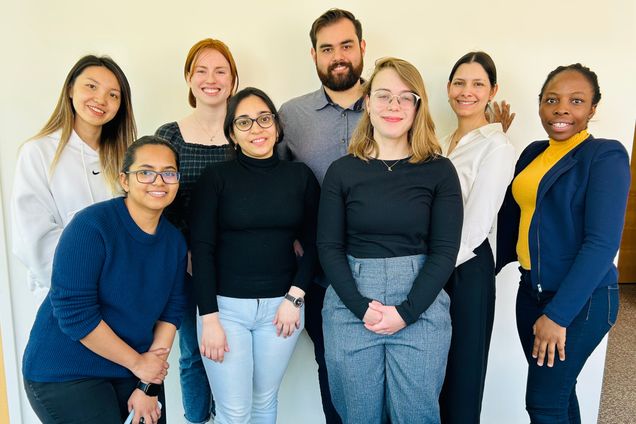
From left to right: Mira Kelly-Fair, Emily Ghosh, Adham Badawy (back), Erin Polka, Brian Sousa, Farbin Fayza, M. Pilar Botana Martinez (back), Dalilah Paulino de Castro Campos
The 2024 student fellows conducted sustainability research spanning economics, politics, and engineering. Learn about their research and explore their profiles below.
Cultivating Resilience: Wastewatersheds as Beacons of Climate Adaptation in Agriculture, Adham Badawy (Earth & Environment, Graduate School of Arts and Sciences)
Research: How treated wastewater reuse can be utilized as a climate adaptation measure for agriculture. This fellowship is supported by the Impact Measurement & Allocation Program to help investors mitigate against the climate risks associated with water scarcity.
Rethinking How We Measure Indoor Heat Burden for People Living in Heat Islands, Pilar Botana Martinez (Environmental Health, School of Public Health)
Research: The value of novel approaches to characterizing the burden of heat exposure for vulnerable populations in ways that are relevant to health and wellbeing.
Assessing the Exposure of Socially Vulnerable Populations to Water Scarcity in Southern Europe: A Case Study of Portugal, Dalilah Paulino de Castro Campos (Earth & Environment, Graduate School of Arts and Sciences)
Research: How socially vulnerable populations are disproportionately exposed to water scarcity in Southern Europe.
Assessing the Carbon Sustainability of Photonic Computing for Artificial Intelligence Systems, Farbin Fayza (Electrical & Computer Engineering, College of Engineering)
Research: The carbon sustainability of photonics-based computing systems, which are used in data centers and autonomous vehicles for running artificial intelligence applications.
GDC-Infiltrated Solid Oxide Electrolysis Cells for Hydrogen Production and Grid-Scale Energy Storage, Emily Ghosh (Materials Science and Engineering, College of Engineering)
Research: The longevity of solid oxide electrolysis cells (SOECs) in clean hydrogen production to minimize environmental impact from energy consumption.
Empowering Belizean Communities: Science-Based Solutions for Coastal Ecosystems, Mira Kelly-Fair (Earth & Environment, Graduate School of Arts and Sciences)
Research: Ecosystem services to improve protection and restoration of mangrove forests in Belize.
Visualizing Modeled Spatial Patterns of Residential Heating Consumption and Efficiency in Massachusetts, Erin Polka (Environmental Health, School of Public Health)
Research: The spatial dynamics of residential energy patterns across Massachusetts and how energy consumption and efficiency differ across the state.
Cost Benefit Analysis of Greenhouse Gas Reduction Technologies and the Associated Health and Water Impacts in the United States, Brian Sousa (Environmental Health, School of Public Health)
Research: The infrastructure costs, emission reductions, health impacts, and water consumption of various renewable energy and carbon capture technologies in the United States. This fellowship is supported by the Impact Measurement & Allocation Program to enhance IMAP’s Corporate Carbon Risk project.
2023 Summer Fellows
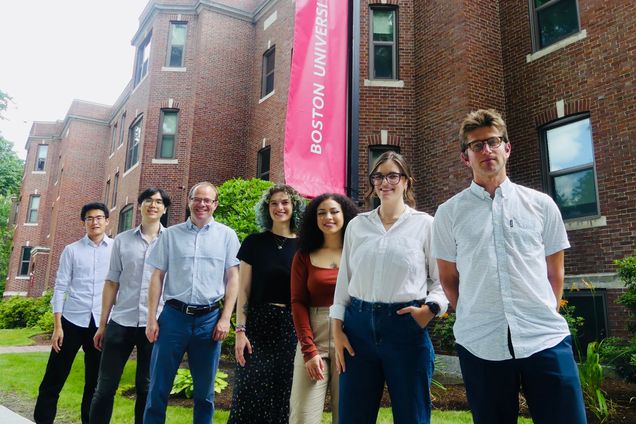
From left to right (back): Xiaofei Qin, Jillian Mulligan, Aaron Khan, Claudia Diezmartínez, Bright Olunusi; (front): Sakshi Sharma, Vedika Srivastava, Lucía Vilallonga
The 2023 cohort of student fellows engaged in research on various sustainability topics, including climate and energy justice with the mentorship of National Renewable Energy Laboratory (NREL) staff.
Developing a web-based tool to support energy justice in Massachusetts — Vedika Srivastava (Computer Science, Graduate School of Arts & Sciences)
Investigating machine learning methods for improving numerical rainfall prediction in tropical climates — Lucía Vilallonga (Mathematics & Statistics, Graduate School of Arts & Sciences)
Working on a sensor designed to spatially resolve local concentrations of ions in operating batteries, supporting smarter, safer batteries — Aaron Khan (Materials Science & Engineering, College of Engineering)
Focusing on how cities across the United States are financing climate action and incorporating climate justice into their municipal budgets — Claudia Diezmartínez (Earth & Environment, Graduate School of Arts & Sciences)
Studying the electrochemistry and microstructure of solid oxide fuel cells to increase their efficiency as a renewable energy resource — Jillian Mulligan (Materials Science & Engineering, College of Engineering)
Assessing the likelihood of electric utility companies in the US achieving their carbon reduction targets — Sakshi Sharma (Computer Science, Graduate School of Arts & Sciences)
2022 Summer Fellows
From left to right: Liaoyuan Zhan, Jing Trerayapiwat, Benjamin Sovacool (IGS Director), Cori Barnes, Sasha Gilmore, Stephanie Strickland, Allan Rego
IGS’s inaugural class of summer student fellows conducted independent, interdisciplinary research across a broad spectrum of sustainability topics related to planetary health, energy systems, and climate governance:
Exploring sustainability and equity in Boston’s bicycle infrastructure — Cori Barnes (Earth & Environment, Graduate School of Arts & Sciences)
Marginalized community impacts and sustainability initiatives regarding climate heat extremes in Boston — Sasha Gilmore (Earth & Environment, Graduate School of Arts & Sciences)
Investigating the feasibility of distributed energy storage and generation technology as a supporting infrastructure in the Azores’ transition to renewable energy — Allan Rego, (Mechanical Engineering, College of Engineering)
How climate change messaging impacts viewership, perception, and intention to act among sustainability-oriented media consumers — Stephanie Strickland (Media Studies, College of Communication)
New materials screening for calcium looping sorbent at room temperature using photochemical decomposition — Jing Trerayapiwat (Chemistry, Graduate School of Arts & Sciences)
Incorporating the idea of social preferences into the existing “carbon reduction willingness to pay” model — Liaoyuan Zhang (Economics, Graduate School of Arts & Sciences)