News
Betsy DeVos Proposes New Rules for How Colleges Handle Sexual Harassment Claims
BU will examine the changes closely to ensure a safe learning environment
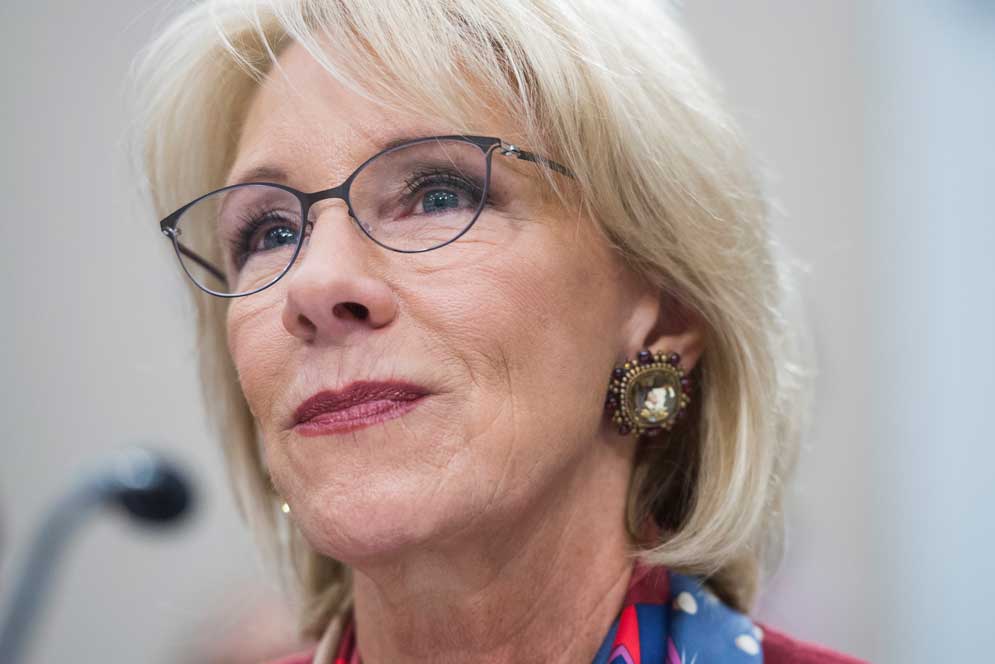
On Friday, US Education Secretary Betsy DeVos proposed significant changes to federal rules for the handling of sexual harassment and sexual assault complaints by universities. Photo by Tom Williams/AP Images.
Betsy DeVos, US Secretary of Education, proposed controversial federal rule changes Friday that would require significant alterations in the way colleges and universities handle complaints of sexual harassment and sexual assault.
The change that garnered the most attention was a requirement that a hearing be held where representatives of accusers and of their alleged victims were present and could cross-examine the other party.
Another significant change is that colleges would be required to investigate only those allegations that occur on campus or in areas the school oversees, and only if an allegation was properly reported to specific officials. The current rules stipulate that colleges must investigate all student complaints, whether they occur on campus or off and no matter how the school learned about them.
The proposals from DeVos would also tighten the definition of sexual harassment.
BU officials say they need to study the proposals and evaluate their effects before responding. The University’s priority is always to “provide students with a learning environment that is safe from sexual harassment and misconduct,” says Jennifer Grodsky, BU’s vice president for federal relations, and the proposals need to be evaluated in that light.
A 60-day public comment period now follows before final rules are enacted by the Department of Education, likely in early 2019, Grodsky says. The University could comment directly or through a trade organization. Find the full text of the proposals here.
“Throughout this process, my focus was, is, and always will be on ensuring that every student can learn in a safe and nurturing environment,” DeVos said in a statement. “That starts with having clear policies and fair processes that every student can rely on. Every survivor of sexual violence must be taken seriously, and every student accused of sexual misconduct must know that guilt is not predetermined. We can, and must, condemn sexual violence and punish those who perpetrate it, while ensuring a fair grievance process. Those are not mutually exclusive ideas. They are the very essence of how Americans understand justice to function.”
Keys changes in the proposed rules include:
- Colleges and universities would be required to hold a live hearing, including cross-examination. That questioning could be conducted only through the parties’ advisors (usually counsel), however, and personal confrontation between the complainant and respondent would not be permitted. Currently BU uses staff from the Judicial Affairs office to provide findings of fact, the so-called “investigator-only” model, which would no longer be permitted.
- New definitions of sexual harassment include: “Unwelcome conduct on the basis of sex that is so severe, pervasive and objectively offensive that it effectively denies a person equal access to the school’s education program or activity.” Currently the rules use Obama-era standards of unwelcome conduct of a sexual nature.
- Requiring schools to choose one standard for deciding all cases, either a simple “preponderance of the evidence,” as used at BU currently, or the higher standard of “clear and convincing evidence.” Schools would be required to decide all cases by the same standard.
The changes appear intended to counteract Obama-era rules that are described by Trump administration officials as too vague, as well as to increase due process protections for the accused.
“It is our goal with this proposed rule to ensure that Title IX grievance proceedings become more transparent, consistent, and reliable in their processes and outcomes,” DeVos said. “Far too many students have been forced to go to court to ensure their rights are protected because the Department has not set out legally binding rules that hold schools accountable for responding to allegations of sexual harassment in a supportive, fair manner.”
The public is invited to comment on the proposed update to Title IX rules. Students, faculty, and staff wishing to voice their opinion to the US Department of Education can do so here.
Author, Joel Brown can be reached at jbnbpt@bu.edu.
BU Trustee Richard Cohen’s Challenge Bolsters Need-Based Undergrad Financial Aid
Gift will match dollar for dollar all new or increased donations, up to $1 million

“BU is a place of incredible opportunity,” says BU trustee Richard D. Cohen (CGS’67, Questrom’69). “This sort of education shouldn’t be limited to those who have the economic means.” Photo by Dave Green.
Boston University trustee Richard D. Cohen (CGS’67, Questrom’69) is stepping up once again in support of scholarships—and once again, he is challenging others to join him.
Starting today, Cohen will match, dollar for dollar, all new or increased gifts made for need-based undergraduate financial aid, up to a total of $1 million. Donors who take the Cohen Challenge will help the University in its ongoing quest to make undergraduate education affordable for all students and their families, regardless of their means—and those donors will see the impact of their gift doubled.
“BU is a place of incredible opportunity,” says Cohen, founder and president of New York City–based real estate investment firm Capital Properties. “Students who come here have access to hundreds of fields of study, nearly any kind of extracurricular or service activity, research, athletics, you name it. It’s a place to find your path—I know it was for me. This sort of education shouldn’t be limited to those who have the economic means.”
To qualify for the Cohen Challenge, any donor can give to BU’s general scholarship fund, which supports undergraduates across campus, or to a specific school or college scholarship fund. And all gifts count toward the $1.5 billion goal of the ongoing Campaign for Boston University, which will conclude in September 2019.
This isn’t the first time Cohen has led by example. In 2010, he sponsored a similar—and successful—$1 million scholarship challenge. Since joining the Board of Trustees in 2006, he has steadily supported financial aid, and in 2017, he made a targeted donation with low-income families in mind. Today, the Richard Cohen Scholarship is targeted to eligible Pell Grant recipients, allowing for increased economic diversity within the University’s traditional undergraduate population. Thanks to Cohen’s giving, support from other donors, and investments by the University, nearly one in five US undergraduates at BU is eligible for a Pell Grant, a proportion that places the school among the highest in its university peer group.
“Once again, Richard is showing tremendous leadership through his generosity,” says Robert A. Brown, BU president. “His giving has already moved the financial aid needle, and yet he understands, as we do, that scholarships remain an urgent priority. Every year, our students are arriving with stronger academic credentials. We are working to be an institution where cost is not an absolute barrier if a young person is accomplished enough to gain admission.”
Cohen’s challenge applies to current-use scholarship funds, which can be spent right away to meet financial need. Those donors who endow undergraduate scholarship funds of $100,000 or more are eligible for a different match, through BU’s Century Challenge.
In his role as founder and president of Capital Properties, Cohen, who has also endowed a professorship at the Questrom School of Business, has guided the company’s expansion into a full-service real estate investment company, with in-house commercial and residential management and development divisions. Since founding the company, he has acquired, managed, or developed more than 18,000 condominiums and apartment units and over eight million square feet of office space in more than a dozen major US markets.
Author, Julia Serazio can be reached at serazio@bu.edu.
National Academies Holds Anti-Harassment Forum
BU IN DC
Federal advisory committees give extramural researchers the opportunity to engage with agency officials, shape federal funding priorities, and learn how government works. Several BU faculty who are members of these committees recently attended the following meetings:
Daniel Segrè of the College of Arts & Sciences and the College of Engineering: Department of Energy Office of Science’s Biological and Environmental Research Advisory Committee on October 18 and 19.
Joshua Semeter of the College of Engineering: National Science Foundation (NSF) Advisory Committee on Geosciences on October 17 and 18.
College of Engineering Dean Kenneth R. Lutchen: NSF's Directorate for Engineering Advisory Committee meeting on October 24 and 25.
Anthony Janetos of the Pardee Center for the Study of the Longer-Range Future: NSF’s Advisory Committee for Environmental Research and Education meeting on October 24 and 25.
If you are interested in serving on a federal advisory committee, BU Federal Relations can assist in identifying the right opportunity.
NATIONAL ACADEMIES HOLDS ANTI-HARASSMENT FORUM
The National Academies for Sciences, Engineering, and Medicine hosted "Together We Can Do Better: A Convening of Leaders in Academia to Prevent Sexual Harassment" on November 9. Participants, including Vice President and Associate Provost for Research Gloria Waters and Vice President for Federal Relations Jennifer Grodsky, discussed research on the prevalence of harassment in academia, its pernicious impact, and how to address it. Officials from the National Science Foundation, National Institutes of Health, and the National Aeronautics and Space Administration (NASA) presented their existing and forthcoming changes to grant award terms and conditions that will require universities to be more proactive in reporting and addressing harassment.
BUZZ BITS...
- The U.S. Department of Homeland Security (DHS) unveiled plans to reorganize DHS science and technology operations in order to more rapidly transition research into applications that respond to emerging threats.
- President Donald J. Trump intends to appoint five new and two existing members to serve on the National Science Board, the governing board of the National Science Foundation.
- The U.S. Department of Justice recently announced a new initiative to protect against economic espionage by the Chinese government, including increased scrutiny for research labs and universities.
GRANTS NEWS YOU CAN USE
The National Science Foundation (NSF) has released two solicitations related to one of the agency's "10 Big Ideas" for future scientific investment, Understanding the Rules of Life:
- The Understanding the Rules of Life: Epigenetics program will invest up to $18 million to support between six and 12 awards for multidisciplinary research, education, and workforce training in the field of epigenetics. Proposals are due by February 1, 2019.
- The Understanding the Rules of Life: Building a Synthetic Cell program will invest up to $10 million for four to six transformative proposals that bring together multidisciplinary expertise to work towards “designing, fabricating, and validating synthetic cells that express specified phenotypes.” Preliminary proposals are due to NSF by December 28, and full proposals will be solicited by invitation only.
Not Politics as Usual
 NOTABLE ALUMNI
Not Politics as Usual
BU alumnae were among the historic wave of women, minority, and LGBTQ candidates who upended the 2018 midterm election. Get to know them
 FACULTY EXPERTS
A Better Way to Predict Election Outcomes
BU Professors Dino Christenson and Mark Crovella have developed a faster, cheaper alternative to election polling by analyzing web browsing data. See how they do it
 RESEARCH HIGHLIGHT
How Does HIV Exposure Impact Uninfected Babies?
With funding from the National Institutes of Health, the BU School of Public Health is comparing the health of HIV-exposed babies in Zambia with the health of babies born to mothers without HIV. Find out how
IN CASE YOU MISSED IT...
Congresswoman Katherine Clark and Senators Elizabeth Warren and Ed Markey celebrated the 70th anniversary of the landmark Framingham Heart Study, run by Boston University... The BU Global Development Policy Center and the World Resources Institute released a joint report on the climate implications of China's Belt & Road Initiative... Still savoring the Boston Red Sox World Series championship? Learn about their previous World Series appearances at Boston's other baseball treasure, located at BU, via The New York Times... Congratulations to Monica Wang of the BU School of Public Health, one of the Greater Boston Chamber of Commerce's ten outstanding young leaders in 2018... Sarah Sherman-Stokes of the School of Law explains the impact of the immigration court backlog in Massachusetts to WBUR.
Midterm Elections: Divided Congress is Coming
BU IN DC
President Robert A. Brown attended the fall meeting of the Association of American Universities on October 21 and 22. Vice President and Associate Provost for Global Programs Willis Wang gave a presentation at the meeting.
David Boas of the College of Engineering hosted a National Science Foundation workshop on neurophotonics on October 22 and 23.
James Bessen of the School of Law testified before the Federal Trade Commission on innovation and intellectual property policy on October 24.
Kevin Outterson of the School of Law addressed the World Antimicrobial Resistance Congress on October 25 and 26.
Azer Bestavros and Mayank Varia of the Rafik B. Hariri Institute for Computation and Computational Science & Engineering met with officials at the U.S. Department of Education regarding privacy preserving analytical technologies on November 5.
MIDTERM ELECTIONS: DIVIDED CONGRESS IS COMING
Democrats succeeded in capturing the majority of seats in the U.S. House of Representatives in Tuesday's midterm elections — giving them control of the chamber for the first time since 2010 — while Republicans increased their control over the U.S. Senate. Here's what research universities can expect:
- Budget: Democrats have called on the White House to negotiate a new two-year budget agreement to lift the current discretionary funding caps and avoid major cuts to federal programs.
- Research: The House Science, Space, and Technology Committee will be led by Rep. Eddie Bernice Johnson (D-TX), who plans to focus on topics such as climate change and broadening participation in science. Several Republican advocates for science and the humanities lost their elections, so a new group of champions will need to be cultivated.
- Education: The expected chairs of the House and Senate education committees have both identified the renewal of the Higher Education Act as a priority, but it is unclear if the two parties can reach agreement. House Democrats will increase their oversight of the U.S. Department of Education, holding more fact-finding hearings.
MIDTERM ELECTIONS: THE BU CONNECTIONS
After Tuesday's election, Boston City Councilor Ayanna Pressley becomes Boston University's Congresswoman-elect and the Massachusetts delegation's first African American congresswoman. Representative Richard Neal (D-Springfield) will ascend to the chairmanship of the House's tax-writing committee, while Rep. Jim McGovern (D-Worcester) will lead the House Rules Committee. Alumnae of the University fared well in the election: Pressley, who attended the College of General Studies, and New York Congresswoman-elect Alexandria-Ocasio-Cortez (CAS ‘11) will join Florida Congresswoman Lois Frankel (CAS ‘70) in the House. The outcome of Gina Ortiz Jones's (CAS ‘03, GRS ‘03) Congressional race in Texas is currently too close to call.
EVENTS NEWS YOU CAN USE
Registration is now open for the tenth annual Advanced Research Projects Agency-Energy (ARPA-E) Energy Innovation Summit, scheduled for July 8 - 10, 2019, in Denver, Colorado. It is the first of the agency's innovation summits to be held outside of the Washington, D.C., area. The event is both a conference and a technology exhibition, presenting an opportunity for the academic, industry, and government sectors to showcase and learn about transformative energy technologies. Investigators who wish to strengthen or initiate relationships with ARPA-E program officers or participate in the technology showcase can sign up online.
Midterm Election Results Bode Well for Healthcare, Environment
BU experts weigh in on what’s ahead
 Will the new Congress heed public need? BU experts are hopeful after Tuesday’s midterm results. Photo by Drew Stephens.
The reasoned debates and shouted arguments at candidate forums and dinner tables are over. American voters decided Tuesday to give Democrats a majority in the House, with at least 27 new seats, hobbling Donald Trump’s presidency (most Republican candidates had rallied to the president). The electorate left the Senate in GOP hands, adding four new seats to what had been a one-seat majority.
A historically high turnout (final numbers won’t be available for a while) sent a record number of women (over 100) to Congress, including the first Massachusetts congresswoman of color, Tennessee’s first female senator, the first two Muslim representatives (from Michigan and Minnesota), and the first two Native American women representatives (Kansas and New Mexico).
What do the results portend for the concerns of everyday Americans over the next two years? Below, BU experts with an array of areas of expertise offer their takes.
Sandro Galea, School of Public Health Robert A. Knox Professor and dean

Health won last night. From guns to opioids to healthcare, the issues that shape health were at the core of the midterm campaign.
The remarkable turnout we saw shows the power of these issues to unify people and mobilize them in pursuit of a healthier country. It also reflects dramatic shifts in our national conversation. More and more, we now talk about issues like gun violence, climate change, and economic inequality as health issues. Perhaps the most visible sign of the emergence of health as a core electoral issue has been the widespread acceptance of single-payer healthcare in the United States. Once seen as a prohibitively radical step, the push for single payer was at the heart of many a winning campaign Tuesday.
The diversity of the election—both among voters and candidates—was another positive sign for health. When groups are marginalized—or worse, targeted for poor treatment by those in power—their health suffers. The strong showing of women, racial and ethnic minorities, and LGBTQ people was a note of good news for groups that have too often suffered under this administration. Indeed, this surge in civic engagement was perhaps the central health gain of the midterms. Health is politics and political engagement is a sine qua non of creating a world where all can live healthily.
This makes our work in a university all the more important. By generating knowledge and influencing the public debate, we can inform shifts in our national conversation and the social movements that emerge from them. These movements are what, in turn, drives electoral change, to build a politics that promotes health, rather than one that undermines it. The election was an encouraging step in this direction.
Nathan Phillips, College of Arts & Sciences professor of earth and environment
 The results can’t be called an unqualified victory for environment and climate, but advocates gained crucial purchase to push for clean air and water and a habitable planet for all.
A Democratic House majority will benefit science, environment, and climate. For over a decade, the influential House Committee on Science, Technology and Space had chairs who doubt the science of climate change. The new House majority will not have that obstacle. Climate and clean energy research will be less stifled going forward.
Across the nation, scores of newly elected officials pledged to not accept funding from the fossil fuel industry, including BU’s own alumna Alexandria Ocasio-Cortez (CAS’11) (New York), and in Massachusetts, the commonwealth’s first African American congresswoman, Ayanna Pressley, and new state representatives Nika Elugardo and Thomas Vitolo (ENG’11). The pledge turns out to be a robust indicator of policy positions on climate: Pressley’s Democratic primary opponent, who didn’t sign the pledge, was a ranking member of the House subcommittee on pipelines, took fossil fuel money, and was silent on expansion of fossil fuel infrastructure. Pressley, among yesterday’s winners from a pool of 1,269 pledge signers nationally, comes into office unencumbered by such entanglements.
While many climate progressives elected yesterday are Democrats, the politics are not simply partisan. Last summer, Massachusetts state Senate Republicans advanced excellent omnibus clean energy legislation that the House Democratic leadership undermined. House Speaker Bob DeLeo (D-Winthrop), who led the House effort to slow clean energy legislation, was rebuked by a winning (albeit nonbinding) Winthrop ballot measure, wherein 61 percent of voters instructed him to advance climate legislation, while Republican Senator Patrick O’Connor (Weymouth), a proponent of clean energy and a staunch opponent of a proposed Weymouth fossil fuel plant, won reelection.
DeLeo and reelected Governor Charlie Baker represent the biggest bipartisan obstacle to climate action. Under the influence of the utility and pipeline lobbies, it is likely that a barrage of new proposals to expand fossil fuel pipeline infrastructure throughout the commonwealth will continue with their support. The strategy for climate advocates will be as much to say yes to clean energy legislation as to say no to dirty energy projects. The battle for clean and against dirty energy makes the late US House Speaker Tip O’Neill’s aphorism “All politics is local” never more true than for the foreseeable future in communities from Weymouth to Lawrence.
Virginia Sapiro, CAS professor of political science
 First things first: among people who chose to vote, their party identification was the most important determinant of how they voted. About 95 percent of Democrats voted D, and 94 percent of Republicans voted R, according to CNN exit polls. But more Democrats voted. And Independents—30 percent of those who voted—split for Democrats 54 percent to 42 percent. As always, if we know about turnout patterns and partisanship, we know a lot about what happened.
Beyond that, African Americans went overwhelmingly D (women somewhat more than men, as usual). Latinos voted predominantly D (women more than men), and among white people, while men split 60 percent for Republicans, women were evenly divided.
If we look further into white people’s voting patterns, we see a pretty big education divide, with college-educated folks voting D by 53 percent and white people without degrees voting R by 61 percent. (College education does not divide the voting choices of people who are not white in the same way.) But the interaction of race, education, and gender is very important: while white college-educated men voted R 51-47 percent, white college-educated women voted D 59-39 percent. And while white people without college degrees gave Republicans the majority of their votes, there was a clear gender divide: white women without college degrees voted R 56-42 percent, while white men without college degrees voted R 66-32 percent. Although younger people didn’t vote nearly in the same proportions as older people and although their turnout was up slightly, they did vote Democratic more than their elders did.
These are preliminary findings from exit polls. We will be able to say more of value once the high-quality data being collected can be analyzed in rigorous ways according to scientific standards. But the importance of partisanship and turnout in determining electoral outcomes will not be diminished.
There will now be at least 100 women in the House, beating the previous record of 84, closing in on 23 percent. This wasn’t a coincidence, and it didn’t happen just because Democratic women rose up in anger. Organizations across the country worked diligently to recruit and train women for office, including many highly skilled and accomplished women who hadn’t before given serious thought to running for office. This will make a big difference.
Thomas Fiedler (COM’71), College of Communication dean
 There are many things about the 2018 midterm elections that render it worthy of historic note, among them the reemergence of a Democratic majority in the House (and all that it will portend for President Trump in the next two years); the success of so many female candidates, making this the second “Year of the Woman” in our recent history (the first being in 1992); the engagement of many more under-35 voters than historically turn out for midterm contests, and the strong showings of two African American candidates in the Florida and Georgia gubernatorial races.
But if asked to pick one aspect of this election that will distinguish it from those that came before, I would have to say that it is its unwavering focus on a single issue at every level of the ballot. That issue: Donald Trump. Midterm elections tend to be corrective of the preceding presidential election, which is why it is so rare that the incumbent president’s party holds or gains seats. That was true on Tuesday. And most midterm elections tend to turn on two issues: pocketbook or war. So what is distinctive about 2018 is that in a time of strong prosperity and relative peace, a majority of voters went to the polls because of their anger at, or support for, the president. It was a true referendum.
Thomas Whalen, College of General Studies associate professor of social sciences
 “Tip” O’Neill once famously said, “All politics is local.” I think last night’s midterm results belie that assertion. Whether you were running for governor in Maine or fighting it out for a hotly contested Senate seat in Texas, your campaign more likely than not turned on how you felt about the man with the wild hair and funny New York accent residing at 1600 Pennsylvania Avenue.
If ever there has been a recent leader who has so thoroughly dominated the political discourse and proceedings in our country, one would be hard-pressed to top President Donald J. Trump. He was the alpha and omega of the 2018 midterm campaign season. Hot-button issues concerning taxes, family healthcare, income inequality, LGBTQ rights, and gun violence all took a back seat to the personality quirks of our narcissistic commander in chief. If you liked him, you pulled the lever for the Republican on the ballot. If not, then you more likely went Democratic blue. It was as simple as that. Trump single-handedly managed to make the entire election cycle about himself.
I don’t think that kind of personality-driven referendum has occurred in a modern midterm cycle since Franklin Delano Roosevelt—a man said to have had a first-class temperament, but second-rate intellect—was president during the Great Depression and World War II.
But unlike FDR, who tried to appeal to the better angels of voters’ nature with his soaring rhetoric and folksy fireside chats, Trump has chosen the Sturm und Drang of race-baiting and political division to get his message across. He has no interest in bringing Americans together because, quite frankly, that would be bad politics. He would rather show us controversial campaign ads about how the Democrats and their allies are allegedly trying to sneak cutthroats onto our soil through invading migrant caravans from Central America.
It’s all been so very tawdry and ugly. Voters everywhere deserve better.
Authors, BU Today staff.
A Better Way to Predict Election Outcomes
Two CAS profs use web browsing data for fast, drill-down analyses
Photo by GoodLifeStudio/iStock.
As the predictions for the 2016 presidential election remind us, polling the electorate is an imperfect science. Most polls claimed that Hillary Clinton would be our next president—it seemed a foregone conclusion—and most polls were wrong, although many forecasts for the popular vote were very close—off by less than one percentage point. Election polling has always been inexact. It has also been time-consuming, expensive, and lacking the ability to measure the influence of short-lived events, like a candidate’s speech, or to read the electorate of small geographic areas.
Now, two Boston University professors believe they have found an alternative, one that is not only similarly accurate, but has the potential to be faster and less expensive, can target areas as small as towns, and can measure the people’s response to specific issues and events. The methodology, which correlates web browsing patterns with public opinion from polls, was developed by two College of Arts & Sciences faculty: Mark Crovella, a professor of computer science, and Dino Christenson, an associate professor of political science.
They worked with Giovanni Comarela from the University of Vicosa (formerly a BU PhD student under Crovella), Ramakrishnan Durairajan at the University of Oregon, and Paul Barford at the University of Wisconsin, Madison. Barford, who also works for ComScore, Inc., a kind of Nielsen ratings of the internet, negotiated an arrangement with comScore, which provided the researchers with the web browsing histories of more than 100,000 US residents over the 56-day period preceding the 2016 election.
All the data the researchers used was specifically authorized and released for this kind of research by the users who generated the data. The researchers’ analysis of that data—two terabytes worth containing 70 million websites—showed exactly when and where voters made decisions that led to the election of Donald Trump.

Dino Christenson plans to build a web API that could be used by academic researchers to gauge public opinion. Photo by Cydney Scott
It also suggested that contrary to popular and expert opinion, a last-minute dip in support for Hillary Clinton was not precipitated by a letter to Congress from FBI director James Comey that revealed that the FBI had found a new batch of relevant emails on Hillary Clinton’s server. Crovella and Christenson’s analysis clearly indicated that support for Clinton began to decline on October 25, 2016, three days before the letter was sent. That doesn’t mean, says Christenson, that the letter had no impact on support for the Democratic candidate. “The previous slippage could have just been a coincidence,” he says. “It may have been a small dip that would have rebounded had it not been for the letter…but the findings certainly cast doubt on the Comey letter as the first mover.”
For Crovella and Christenson, the importance of that finding is its proof that their methodology can measure the influence of single, brief events, such as a particular campaign stop, or a Supreme Court decision, or a scandalous news report—a valuable potential for candidates and pollsters.
“Let’s say a candidate flies in to a city, makes a speech, and flies out,” says Crovella. “How much of an effect does that have? A typical political poll is too coarse an instrument to measure that. A poll, even one that’s well done, takes three or four days to get a large enough response to be statistically significant. You can’t measure something that had an effect that lasted two days. That’s washed out of the measurement process.”
Similarly, says Crovella, the large numbers needed to give a traditional poll statistical significance prevent it from drilling down on small populations. “Because there are a lot of people participating in our data, we can look at political leanings of different populations on an early, localized geographical basis,” says Crovella. “We can do this in a fairly fine-grained way in space and time, because we’ve got records of their browsing behavior, their websites, on a minute-by-minute, hour-by-hour, day-by-day basis.”
Crovella and Christenson also say that their method can gauge big-picture support more accurately than current polling methods do. Their research, “Assessing Candidate Preference through Web Browsing History,” by Giovanni Comarela, Ramakrishnan Durairajan, Paul Barford, Dino Christenson, and Mark Crovella, is published in Proceedings of ACM KDD 2018, London, UK.
Ultimately, says Crovella, the polling system needs two things: “It needs the records of web browsing, and it needs some kind of initial poll to calibrate the machine-learning component to learn what it’s looking for.”
Calibration was the hard part, as well as the reason that massive computing power was brought to bear. How exactly does one translate website visits into reliable indicators of political leanings? Some websites are clearly biased toward one candidate or party, but many are not. And a visit to a particular site may not necessarily mean that the visitor shares the site’s opinion.
Step one was finding a credible way to determine “ground truth,” a term that describes criteria based on real-world evidence that is used to train a machine-learning algorithm. Crovella worked backwards, starting, somewhat ironically, with the results of traditional opinion polls.

Mark Crovella says his methodology can quickly measure the public’s response to specific events, such as campaign rallies. Photo by Cydney Scott
“Let’s say you have a poll from September 1, and it shows that on this day 60 percent of the people in Michigan are leaning toward the Democratic party. You use that to train a machine-learning algorithm to look at all of the individuals in your data set and decide which of them must make up that 60 percent. Then you have an idea of what a Democratic voter looks like in terms of their website visits. You carry that forward, looking at subsequent visits and asking how the data set is changing. This method was not previously well-developed, and we had to find a new way to apply it to data that was as large as what we were studying.”
Crovella and Christenson point out that now that they have developed their approach with data that was donated, they are developing methods to accomplish the same ends that operate on encrypted data. This will improve user privacy, because no computer (other than the user’s own computer) will be able to see a user’s web browsing data.
Unsurprisingly, Crovella and Christenson’s initial analysis taught them a few things about their methodology, as well as the sentiments of voters. They learned, for example, which browsing habits were the best indicators of political leanings. “We found that referrals from social media are very informative,” says Crovella. “We found that if you simply type a search into a browser and click on that link, it’s not as likely to tell us something about your political leanings. But if you follow a link that was referred to you by a friend, it is likely that that’s indicative of your political leanings.”
What’s next? Crovella and Christenson plan to build a web function that will make their technology and methodology available to other social scientists and public opinion researchers. Crovella says they would like to build a system that social scientists can use to answer questions “like if someone goes to Chicago and gives a speech, how much does it move the needle and how long does it stay moved?”
“I would like to have a web API where any academic researcher could go on any day to query public opinion,” says Christenson. “One could type in their outcome of interest as well as the geographic area of the country and period of time, and in return get estimates of the related public opinion dynamics in real time. The applications are potentially quite broad. You could look at the public’s position on candidates, representatives, policy issues, even local events, like campaign stops or school board elections, assuming there is an underlying partisan or ideological dimension, and you wouldn’t have to spend tens of thousands of dollars on a poll or even have a poll in the field for the time period or region of interest.”
Perhaps because he is a longtime observer of political polls and a trained survey researcher, Christenson is sympathetic to the shortcomings of traditional polls.
“There is going to be error whenever you try to generalize,” he says. “And when there’s an electorate that’s as divided as the United States, it’s not surprising that polls would be off, especially by small margins in locales where we don’t have a great deal of data collection.” Still, he suggests, public opinion is too important to be marked by the limitations and costs of polls, at least if there is a way to improve upon them. And now there just might be.
Framingham Heart Study 70th Anniversary Ceremony
70th Anniversary Ceremony: October 26, 2018
The Framingham Heart Study is a project of Boston University & the National Heart, Lung, & Blood Institute.

Speakers included:
Reverend Dr. Debbie Clark, Edwards Church UCC, Framingham, Mass.
John P. Galvani, President, Friends of Framingham Heart Study
Brian Kit MD, MPH, Program Officer, NHLBI
Karen Antman, MD, Provost Boston University Medical Campus; Dean, BUSM
U.S. Congresswoman Katherine Clark, Fifth District, Mass.
Mayor Yvonne M. Spicer, Mayor, Framingham, Mass.
Daniel Levy, MD, FACC, Director, Framingham Heart Study; Branch Chief, NHLBI
Dr. Vasan Ramachandran, Principal Investigator and Director Framingham Heart Study; Professor, Boston University School of Medicine
BU to Join Second AAU Campus Sexual Misconduct Student Survey
With 33 institutions participating, it’s expected to be among largest sampling ever
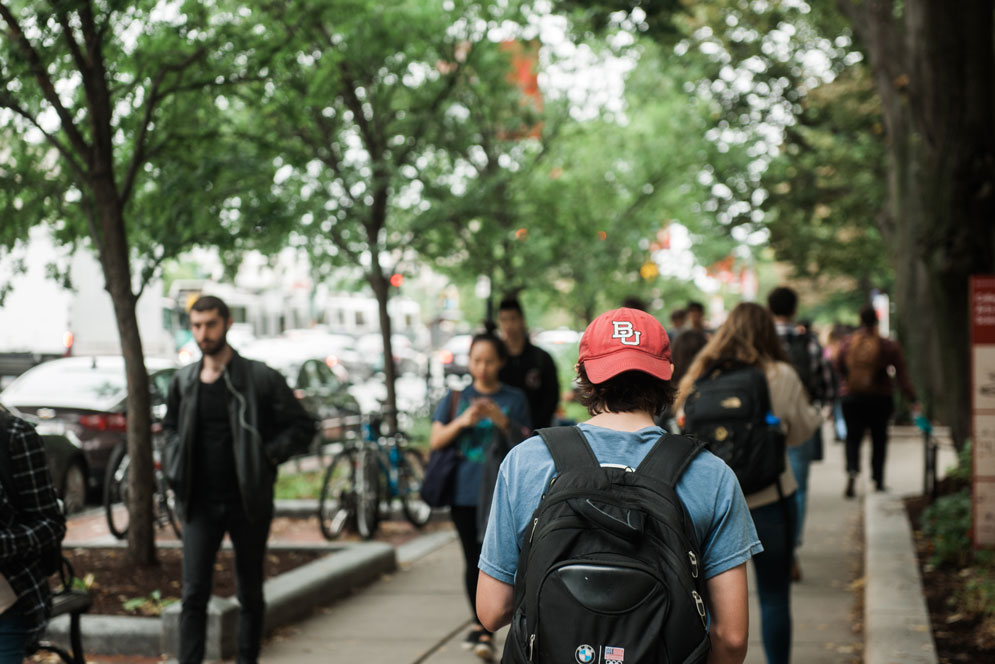 By participating in an Association of American Universities survey about campus sexual assault and misconduct, BU will be able to compare itself to other schools. Photo by Janice Checchio.
Amid the national uproar over #MeToo and Brett Kavanaugh’s Supreme Court appointment, BU has announced that it will join 32 other universities in asking students about sexual misconduct and assault on campus.
The online survey will be conducted during spring semester by the Association of American Universities (AAU) and is expected to be among the largest such sampling ever, with participating universities having just under one million undergraduate, graduate, and professional students. It will probe misconduct by all members of a university community—faculty, students, and staff.
The AAU and Boston University did separate sexual misconduct surveys four years ago. Besides BU, 31 other AAU members and one nonmember (Georgetown) will participate in the upcoming survey.
The University decided not to do its own survey this time, because “having access to directly comparative data with our AAU peers will be worthwhile,” says Jean Morrison, University provost. “It will give us recent and updated insight into the issues that people in the BU community are feeling around sexual assault. It’s important that we continue to seek information about the sense of the community around this issue.”
The AAU says its survey will ask questions about the characteristics and frequency of assault and misconduct on campus.
“We’ll send out a link so that people can do the survey online,” says Kenneth Elmore (Wheelock’87), BU associate provost and dean of students. That will be done in February, he says.
Given the current attention to sexual assault and misconduct, “it is fantastic that students in the country, and society, raise this issue,” Elmore says. The survey will help “to give us a sense of the direction we might be heading as a community.”
Mary Sue Coleman, president of the AAU, says the survey’s goal is student safety: “AAU universities are committed to protecting students, and we believe this survey will contribute to the growing body of research on this topic to better inform campus policies and procedures.”
While the survey will ask sensitive questions, the AAU will include a consent statement for respondents and a trigger warning that some questions will be of an explicit nature. The survey also will include links to resources, both on campus and off, for students upset by any questions.
Experts on several AAU member campuses suggested at least four-year intervals between surveys to allow schools ample time to analyze the data and address problems revealed by the survey, the AAU says.
The organization will release aggregate results of participants’ surveys, while leaving it up to individual schools to decide whether to release their own results. BU did release its data four years ago and will do so again, Elmore says.
The University’s first survey, in 2015, found that while 90 percent of Terrier respondents felt safe on campus, almost 25 percent of female students said they had been sexually assaulted in some form as students. About 75 percent of respondents said they believed University administrators care about their welfare.
That first survey informed the programming at the University’s Sexual Assault Response & Prevention Center. It also helped publicize University measures to prevent abuse and misconduct and to address it when it happens.
Among those measures are a College of Arts & Sciences elective for first-year students on healthy consent and communication; support groups, including for victims of assault and students who’ve been in an abusive relationship; weekly reviews of assault cases by the University’s Title IX coordinator (the gender discrimination watchdog), Judicial Affairs, and the Dean of Students office; and the use of Advocate, a judicial database software tool that collects student conduct statistics and data from the annual Clery report of campus crimes, for sharing among BU offices.
Most universities in the 62-member AAU that are not participating in next spring’s survey either are doing their own survey or are part of a state university system that is conducting surveys, according to the AAU. The AAU survey will be conducted and analyzed by Westat, a Maryland-based social service research firm that services federal, state, and local governments, businesses, and foundations.
Author, Rich Barlow can be reached at barlowr@bu.edu.
BU Law Professor James Bessen Addresses the Federal Trade Commission
Hearings on Competition and Consumer Protection in the 21st Century
 Federal Trade Commission (FTC) event at Constitution Center in Washington, DC from October 23 - 24, 2018. Learn More!
James Bessen serves as Executive Director of the Technology & Policy Research Initiative and a Lecturer in Law at Boston University School of Law. He was previously a Fellow at Harvard University’s Berkman Center for Internet & Society. He has also been a successful innovator and CEO of a software company.