News
Trump Plans Campus Free Speech Executive Order
BU IN DC
Shoumita Dasgupta of the School of Medicine met with Congressional offices as part of the Federation of American Societies for Experimental Biology Capitol Hill Day on March 7.
TRUMP PLANS CAMPUS FREE SPEECH EXECUTIVE ORDER
President Donald J. Trump announced Saturday he plans to issue an executive order that would prohibit colleges from receiving federal research funds if they do not support free speech. In an address to the Conservative Political Action Conference, the President stated, "If [universities] want our dollars, and we give them by the billions, they’ve got to allow people to speak." The White House did not provide details on the proposal, which may be subject to legal challenges, but observers believe it would mirror a plan laid out by scholars at the American Enterprise Institute (AEI) last year.
BUZZ BITS...
- Dr. Scott Gottlieb, head of the U.S. Food and Drug Administration, announced on Wednesday he would resign next month.
- Dr. Neil A. Jacobs has been named the new acting head of the National Oceanic and Atmospheric Administration (NOAA). The previous acting administrator, Dr. Tim Gallaudet, will remain as NOAA's assistant secretary of commerce for oceans and atmosphere. The U.S. Senate has not acted on the nomination of Barry Myers (LAW '70) as permanent NOAA administrator.
- Retired U.S. Air Force Major General Mark A. Brown was named chief operating officer of Federal Student Aid at the U.S. Department of Education on Monday.
EVENT NEWS YOU CAN USE
BU Research will host the next installment of its "Research on Tap" series on Wednesday, March 20, at 4 p.m. "High Tech and High Touch: Digital Innovations from BU’s Mobile and Electronic Health-ARC" will be curated by Belinda Borrelli from the Goldman School of Dental Medicine, Lisa Quintiliani from the School of Medicine, and Tibor Palfai from the College of Arts & Sciences. Scholars from across the University will deliver microtalks on their mobile health research, followed by a networking reception where investigators can interact with potential research collaborators.
A Day in the Life of BU’s Engineering Product Innovation Center
Students, faculty, staff get a chance to design and build their own ideas at EPIC
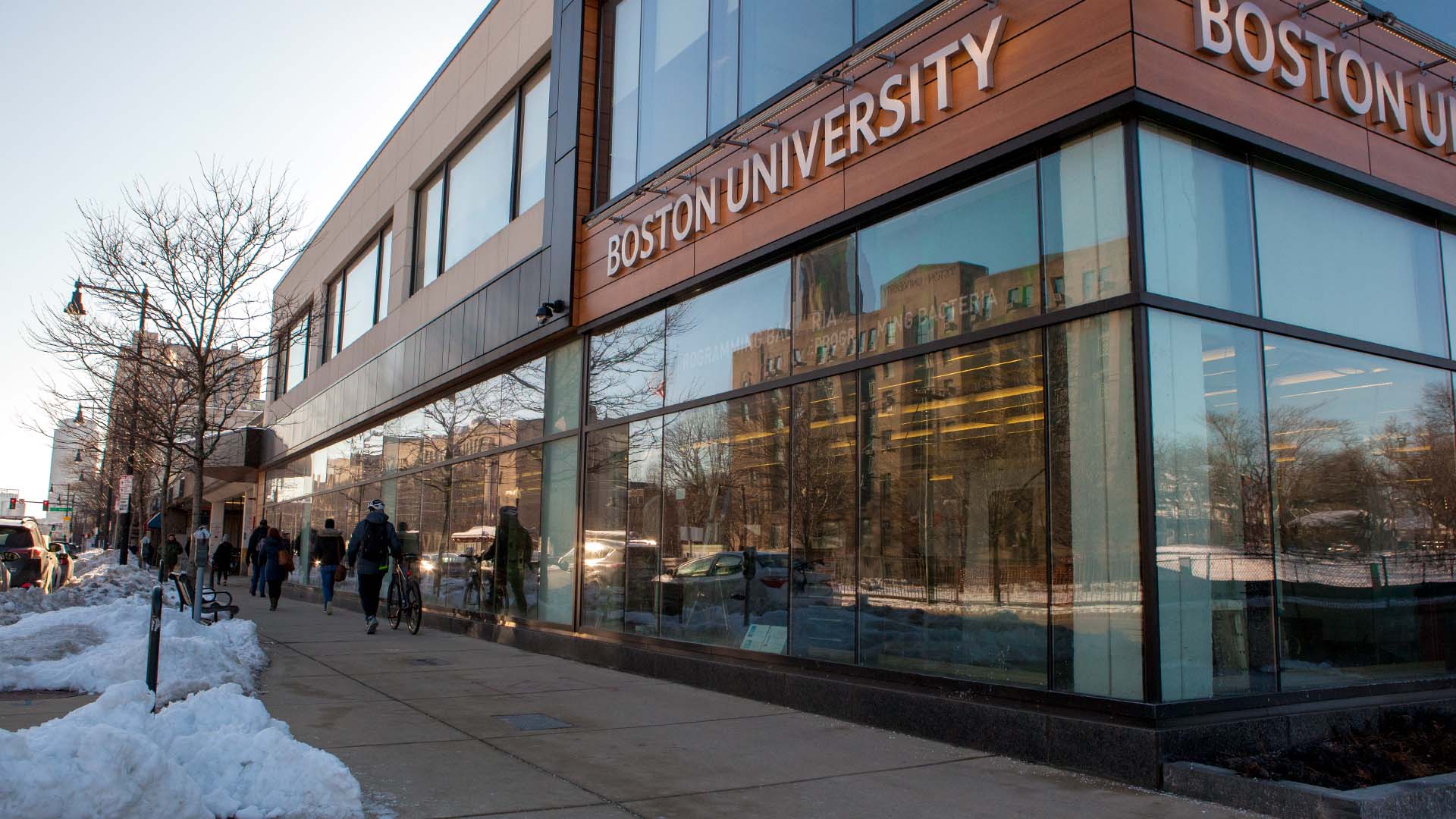 When it opened in January 2014, BU’s Engineering Product Innovation Center—better known as EPIC—was hailed as an opportunity to not only transform BU’s engineering programs, but to provide a hub for all members of the BU community, regardless of major, interested in product innovation.
Walk past the building’s sleek glass exterior at 750 Comm Ave, and from morning to night you’ll see students inside the 15,000-square-foot facility working with 3D printers, supply chain management software, robotics, laser printing, and a computer-aided design (CAD) studio to design and build their ideas. The cutting-edge facility, which draws approximately 600 undergrad and grad students each semester, offers training on most everything vital to product innovation, from design and prototyping to manufacturing and life-cycle management. It’s a constant whir of activity, seven days a week, as you can see in our video.
Anyone interested in working at the center must first take an online safety test. After passing the test, you can use EPIC in several ways: enrolling in one of the center’s many design and manufacturing classes, signing up to join one of the clubs that meet there regularly, or bringing in your own personal project (you have only to bring a sketch with you) and EPIC’s versatile and helpful staff will help you build it.
In this video: Watch as students design and create their own ideas at BU’s Engineering Product Innovation Center, using such tools as a lathe, a CNC mill 3D printers, and collaborative industrial robots.
For more information about EPIC, contact lab supervisor Joe Estano at jestano@bu.edu.
Videographer, Bill Politis can be reached at bpolitis@bu.edu.
Professor Named to 2020 Dietary Guidelines Committee
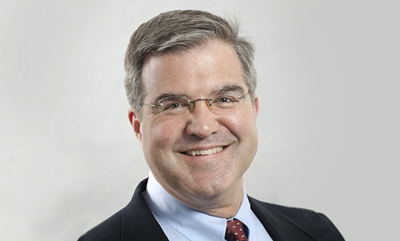 Timothy Naimi, professor of community health sciences, has been appointed to serve on the 2020 Dietary Guidelines Advisory Committee.
Comprised of 20 nutrition and health experts across the country, the independent advisory committee reviews scientific evidence on topics and questions identified by the United States Departments of Agriculture (USDA) and Health and Human Services (HHS), to help inform the development of the 2020–2025 Dietary Guidelines for Americans.
Naimi, who is also a professor at the School of Medicine and a physician and researcher at Boston Medical Center, says he is honored to serve on the committee.
“It is important for the public to understand the best health information about food and beverages, and I’m pleased to be invited to serve on this committee,” Naimi says.
The dietary guidelines serve as a basis for federal nutrition programs and policies, offering food-related recommendations to promote health and help prevent chronic diseases, such as cardiovascular disease and type 2 diabetes. The guidelines are published every five years to reflect the latest research findings on nutrition and health.
The 2020 advisory committee will begin their work at a public meeting that will be announced in the coming weeks. Once the committee completes its scientific review, it will submit a report to USDA Secretary Sonny Perdue and HHS Secretary Alex Acosta for consultation as the departments develop the official guidelines. For the first time, members of the public will be able to attend several committee meetings to submit questions and feedback. Their input will accompany the advisory committee’s report, and will also help inform the final guidelines.
Also for the first time, the advisory committee will adopt a life-stage approach to its review process, by incorporating dietary recommendations for infants, toddlers, and pregnant women. For each stage of life, the committee will evaluate overall dietary patterns of food and beverage consumption, as well as current intake of food groups and nutrients, nutrients that are of public health concern, and the prevalence of nutrition-related chronic health conditions. It will look closely into the health effects of added sugars, sugar-sweetened beverages, alcohol, certain dietary fats, and seafood.
No matter where people seek information about nutrition and health, Naimi says he hopes the updated dietary guidelines will educate and motivate people to make sensible choices about their food and drink consumption.
“My hope is that people will pay attention to the guidelines, or that the guidelines will inform the information sources that people regularly interface with,” Naimi says. “Even if messages about nutrition are being filtered through other sites, I think the dietary guidelines serve as an important informational foundation for various outlets.”
Author: Jillian McKoy
NIH Issues Forceful Statement on Harassment
BU IN DC
Jeffrey Murphy of Alumni Relations spoke about developing a strong professional network at a workshop for Washington-area alumni on February 27.
NIH ISSUES FORCEFUL STATEMENT ON HARASSMENT
Addressing victims of sexual harassment in the academic community, senior leaders at the National Institutes of Health (NIH) issued a statement Thursday saying, "We are concerned that NIH has been part of the problem. We are determined to become part of the solution." The agency disclosed the number of researchers it has investigated for "sexual harassment-related concerns," reiterated that grantees are required to inform the agency when key personnel on an NIH grant award have been removed due to harassment allegations, and announced a new email address for reporting harassment concerns to NIH. An NIH working group on "Changing the Culture to End Sexual Harassment" is expected to recommend further NIH action this summer.
HEARING FOCUSES ON CHINA'S IMPACT ON U.S. EDUCATION
On Thursday, the Senate Permanent Subcommittee on Investigations held a hearing on China's impact on the U.S. education system. Senators released a bipartisan report stating that 70% of schools that received more than $250,000 for a China-sponsored Confucius Institute failed to properly report the foreign gift to the U.S. Department of Education (ED). While Subcommittee Chairman Rob Portman (R-OH) said he wants "China to be a strategic partner as well as a strategic competitor," he urged ED to update its guidance on foreign gift reporting and asked the State Department to increase its review of visas associated with Institute personnel.
GRANTS NEWS YOU CAN USE
The Army Research Office and National Security Agency released a broad agency announcement for the fiscal year 2019 Department of Defense (DOD) Advanced Computing Initiative, which seeks to strengthen DOD’s intellectual capital in computing systems research. DOD is seeking innovative proposals to address four research thrusts: Novel Methods of Computing, Hardware and Software Systems Components, Exploration of System Concepts, and Algorithms and Architectures. Interested applicants are required to submit a two-page concept paper by March 25, and will be notified by April 25 whether they have been selected to submit a full proposal or a short-term proposal for a smaller award.
Advancing Discovery Science for Public Health Impact
NHLBI Director Gary Gibbons Visits BU on February 27, 2019
Video (above) from Wednesday, February 27, 2019.
Keefer Auditorium - School of Medicine
Boston University Medical Campus
72 East Concord Street
Boston, MA 02118
For seven decades, research supported by the National Heart, Lung, and Blood Institute has led to broad-based interventions that have improved morbidity, mortality, and quality of life for individuals with cardiovascular, pulmonary, and blood diseases and disorders. Despite substantial improvements in prevention and treatment, health disparities in both the burden and outcome of disease exist. In this forum, NHLBI Director Gary H. Gibbons explored the institute’s scientific vision for the 21st century. He also examined the unprecedented opportunities in basic discovery science, genomics, precision medicine, data science, and implementation science to transform clinical practice and potentially preempt and prevent chronic disease, enhancing health and health equity in all populations.
Cohosted with Boston University School of Medicine
Speaker
 Gary H. Gibbons, Director, National Heart, Lung, and Blood Institute, National Institutes of Health
Gary H. Gibbons is director of the National Heart, Lung, and Blood Institute at the National Institutes of Health, where he oversees the third-largest institute at the NIH, with an annual budget of approximately $3 billion and a staff of nearly 2,100 federal employees, contractors, and volunteers. NHLBI provides global leadership for research, training, and education programs to promote the prevention and treatment of heart, lung, and blood diseases and to enhance the health of all individuals so that they can live longer and more fulfilling lives.
Since being named director of the NHLBI, Gibbons has enhanced the institute’s investment in fundamental discovery science, steadily increasing the pay line and number of awards for established and early stage investigators. His commitment to nurturing the next generation of scientists is manifest in expanded funding for career development and loan repayment awards as well as initiatives to facilitate the transition to independent research awards.
Gibbons provides leadership to advance several NIH initiatives and has made many scientific contributions in the fields of vascular biology, genomic medicine, and the pathogenesis of vascular diseases. His research focuses on investigating the relationships between clinical phenotypes, behavior, molecular interactions, and social determinants on gene expression and their contribution to cardiovascular disease. Gibbons has received several patents for innovations derived from his research in the fields of vascular biology and the pathogenesis of vascular diseases.
Gibbons earned his undergraduate degree from Princeton University and graduated magna cum laude from Harvard Medical School. He completed his residency and cardiology fellowship at the Harvard-affiliated Brigham and Women’s Hospital in Boston. Gibbons was a member of the faculty at Stanford University from 1990 to 1996, and at Harvard Medical School from 1996 to 1999. He joined the Morehouse School of Medicine in 1999, where he served as the founding director of the Cardiovascular Research Institute, chairperson of the Department of Physiology, and professor of physiology and medicine at the Morehouse School of Medicine. Gibbons served as a member of the National Heart, Lung, and Blood Advisory Council from 2009 to 2012.
Throughout his career, Gibbons has received numerous honors, including election to the Institute of Medicine of the National Academies of Sciences; selection as a Robert Wood Johnson Foundation Minority Faculty Development Awardee; selection as a Pew Foundation Biomedical Scholar; and recognition as an Established Investigator of the American Heart Association.
The Top Cybersecurity Threats to Watch

FACULTY EXPERT
The Top Cybersecurity Threats to Watch
BU computer engineer Ari Trachtenberg explains what the United States should do to protect our data privacy. Protect your data
 RESEARCH HIGHLIGHT
Is Greening the Earth a Good Thing?
With support from NASA, BU researchers find that China and India are leading the way in increased plant and tree cover -- but with mixed results. Take a look
 NOTABLE ALUMNI
Helping At-Risk Students Become Entrepreneurs
BU alumna Ayele Shakur (Questrom '87) is the CEO of BUILD, a national program that helps students in struggling high schools get a hands-on education in finance, marketing, and running a business. Read her story
IN CASE YOU MISSED IT...
BU hosted City of Boston Day on February 16th, welcoming Boston residents with complimentary admission to six BU Athletics games... The Boston Globe features a start-up launched by Sharon Goldberg of the BU College of Arts & Sciences that aims to make cryptocurrency less risky... Reuters highlights a BU School of Public Health study on the correlation between youth suicide rates and gun ownership... WBUR will host a free community day on February 28th... Joan Salge Blake of the BU Sargent College of Health & Rehabilitation Sciences tells The Boston Globe how to eat healthier in the workplace.
Education Committee Announces Higher Ed Plans
BU IN DC
Shulamit Kahn of the Questrom School of Business, Nathan Phillips of the College of Arts & Sciences, and Wynter Duncanson and Muhammad Zaman of the College of Engineering spoke at the American Association for the Advancement of Science Annual Meeting between February 14 and 17.
EDUCATION COMMITTEE ANNOUNCES HIGHER ED PLANS
On Thursday, the leaders of the House Education and Labor Committee jointly announced plans to hold five bipartisan hearings on higher education, with a goal of reauthorizing the Higher Education Act during the current session of Congress. The hearings will focus on: college cost, accountability, college completion, innovation, and community colleges and minority-serving institutions. Stakeholders are also invited to share research and evidence with the committee. Education committee leaders in the U.S. Senate have also expressed interest in renewing the higher education law, but reaching bipartisan consensus across both chambers may prove difficult.
BUZZ BITS...
- The National Science Foundation (NSF) announced Dr. Joanne Tornow as the next director of the Biological Science directorate. Dr. Tornow has worked at NSF in a number of capacities since 1999, including once serving as the acting director of the the Social, Behavioral and Economic Sciences directorate.
- More than 50 scientific organizations have launched a Consortium on Sexual Harassment in STEMM to address ethical and professional conduct and culture within the sciences, engineering, and medicine.
- The National Institute on Aging at the National Institutes of Health announced its first concept clearances in 2019, giving insight into the research topics likely to become funding opportunity announcements in the months ahead.
GRANTS NEWS YOU CAN USE
Are you looking for federal funding mechanisms to support graduate students? Lewis-Burke Associates has updated its catalog of federal scholarship, fellowship, and internship programs geared towards graduate students. The programs are sorted by agency, and include both individual student grants and opportunities for universities to support a group of students.
Congress Passes Spending Deal to Avoid Shutdown
BU IN DC
Joyce Wong of the College of Engineering accepted the American Association for the Advancement of Science STEM Equity Achievement Change Bronze award on behalf of the University on February 13. Provost Jean Morrison, Vice President and Associate Provost for Research Gloria Waters, College of Engineering Dean Kenneth Lutchen, Associate Provost for Graduate Affairs Daniel Kleinman, Associate General Counsel Rebecca Ginzburg, Lawrence Ziegler of the College of Arts & Sciences, and College of Engineering graduate student Cristian Morales joined her at the ceremony.
Azer Bestavros, Andrei Lapets, and Mayank Varia of the Rafik B. Hariri Institute for Computing and Computational Science & Engineering discussed privacy-preserving analytical technologies with Congressional staff and federal statistical agency officials on February 13.
Rena Conti of the Institute for Health System Innovation and Policy spoke at the Paying for Cures conference on February 12.
CONGRESS PASSES SPENDING DEAL TO AVOID SHUTDOWN
Yesterday, Congress passed legislation to fund the government agencies that had previously been affected by a month-long partial government shutdown. President Donald J. Trump has stated he intends to sign the measure, which he will need to do today in order to avert another shutdown. Under the bill, these research agencies will receive funding increases for the remainder of fiscal year 2019, which began on October 1, 2018:
- National Science Foundation: $8.08 billion, a 4% increase from its current level
- NASA Science: $6.91 billion, an 11% increase from its current level
- National Endowment for the Humanities: $155 million, a 1.4% increase from its current level
Other federal agencies, including the National Institutes of Health and the U.S. Department of Education, already received their fiscal year 2019 spending allocations in September.
BUZZ BITS...
- The President signed an executive order on artificial intelligence on Monday. Among other provisions, it recommends federal agencies consider artificial intelligence a priority for research and development.
- The National Institutes of Health announced the charge and membership of its Advisory Committee to the Director Working Group on Changing the Culture to End Sexual Harassment.
- In response to a Senate Finance Committee inquiry, the Office of the Inspector General (OIG) for the U.S. Department of Health and Human Services said the National Institutes of Health had asked the OIG to investigate several researchers for failing to properly disclose foreign affiliations.
EVENTS NEWS YOU CAN USE
Join BU Research on February 27th for "The American City: Promoting Inclusion or Sowing Division?," the next installment of the popular Research on Tap series. Graham Wilson and Katharine Lusk of the Initiative on Cities will curate the session, which will feature microtalks from scholars at the University who are devoted to the study of urban populations, policies, and leadership. They will share their latest comparative research on the benefits and consequences of housing, health, public safety, education, and inclusion policies and priorities. A wine and cheese reception will follow.
BU Policies Protecting Free Speech to Get Fresh Look
As rhetoric nationwide intensifies, President Brown requests reviews and reports by fall
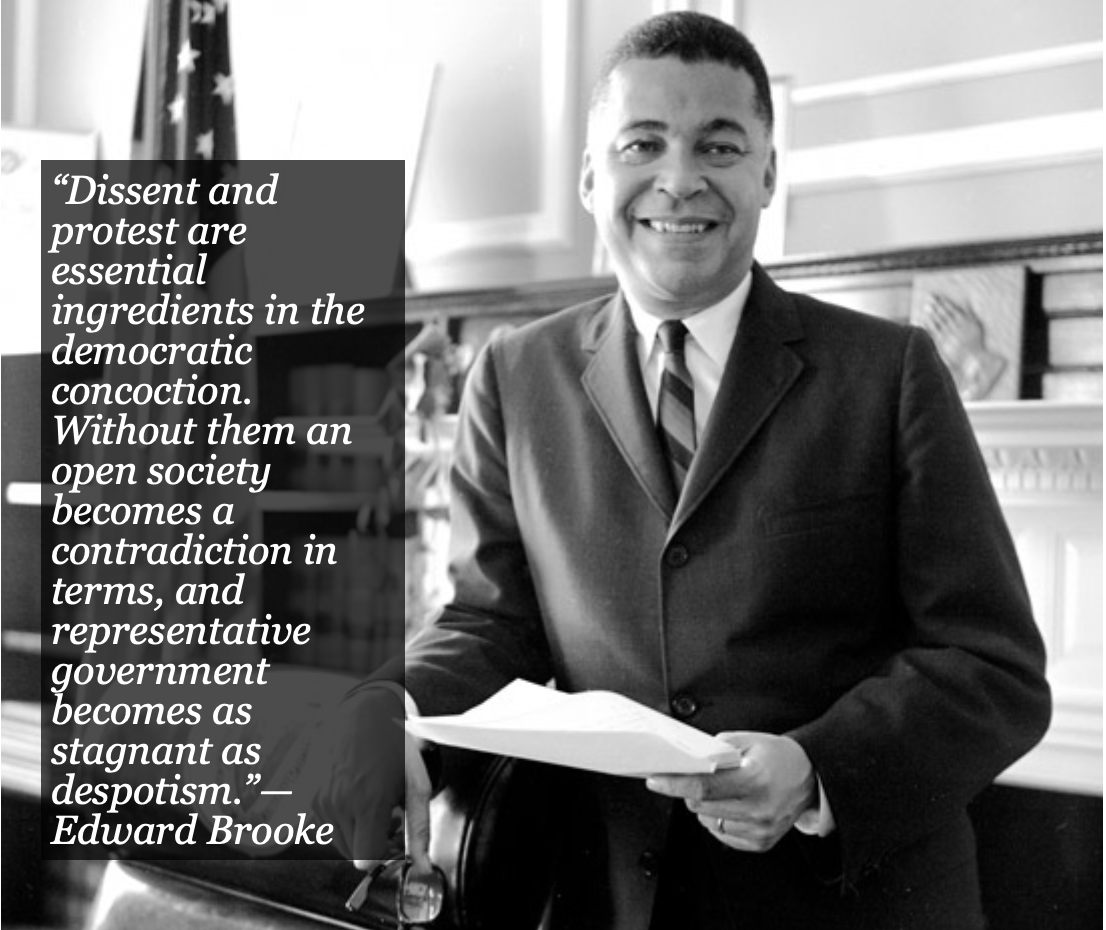
In 1966, Edward Brooke (LAW’48,’50, Hon.’68) became the first African American popularly elected to the US Senate. Photo by BU Photography.
Almost one-fifth of American undergraduates endorse violence to silence a campus speaker “known for making offensive and hurtful statements,” a 2017 survey found. Some have practiced what they preach.
A melee at Middlebury College in 2017 sent a professor to the hospital after she and scholar Charles Murray, who has argued that there are IQ differences between races, had been shouted off a stage and tried to weave their way through a gauntlet of protesters. The professor had participated in Murray’s talk to critically interrogate him about his views.
Mindful of the contentious political landscape on campuses and off, and sensing a potential threat to freedom of expression, Robert A. Brown, BU president, is creating two committees to review and possibly revise the University’s protocols protecting speech.
“Freedom of expression is a foundational guiding principle for an enduring democracy; it is both a check on power and a means to foster robust discourse,” Brown wrote in an email going out campus-wide. “American higher education has benefited profoundly from strong constitutional protections that have provided our campuses with unmatched scope for intellectual inquiry and an environment where ideas can be tested and sharpened in an atmosphere of serious but collegial debate.”
A Free Speech Policy Committee will draft a statement “that describes and affirms the University’s commitment to free speech,” Brown wrote. Jean Morrison, University provost, and Erika Geetter, vice president, general counsel, and secretary of the BU Board of Trustees, will chair the committee. Simultaneously, a Free Speech Operations Committee, chaired by associate general counsel Rebecca Ginzburg (School of Law’04) and Kenneth Elmore (Wheelock’87), associate provost and dean of students, will explore revisions to existing policies.
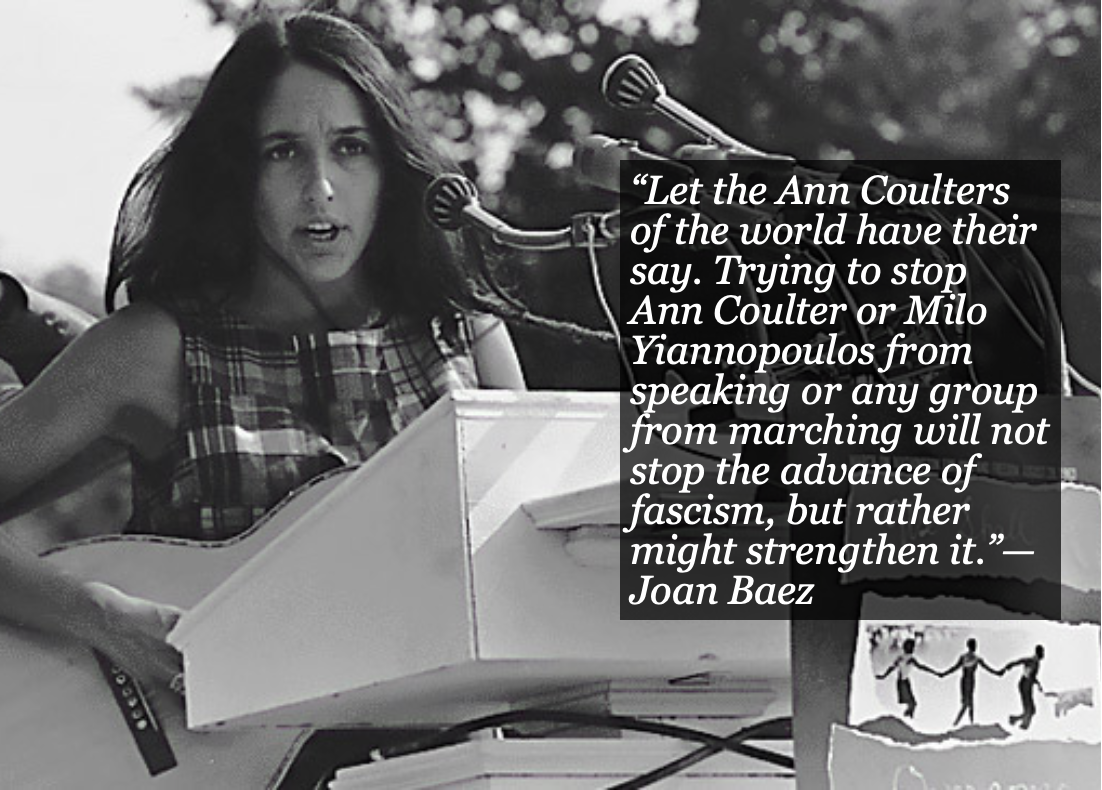
Joan Baez playing at the March on Washington in August 1963.
The committees will work through the early fall, when they’ll submit reports for approval by the University Council (professors and administrators who recommend action on academic matters) and the Administrative Council (which considers administrative policies).
But in polarized times, Brown wrote in his email: “The commitment to free speech is tested. As we observe events both on campuses and in the broader society, I believe it is reasonable to suggest we are in such a time.”
Morrison adds that BU has “a variety of independent operational policies” regarding expression, including in the BU Lifebook. Under “Tolerance and Religion,” the publication says the University “encourages the free exchange of beliefs and ideas and the reexamination of one’s values and commitments. With this freedom, however, comes the responsibility to respect the rights of others, including the right not to be harassed or pressured to join a religious group or take part in its activities.”
“But,” says Morrison, “we are overdue for a comprehensive, University-wide conversation about free speech and its manifestation in daily life on our campuses.”
One reason: that troubling student survey was not the lone example of First Amendment–challenged students and administrators making headlines. Last year, feminism critic Christina Hoff Sommers’ speech at Oregon’s Lewis & Clark Law School was repeatedly interrupted by protesters.
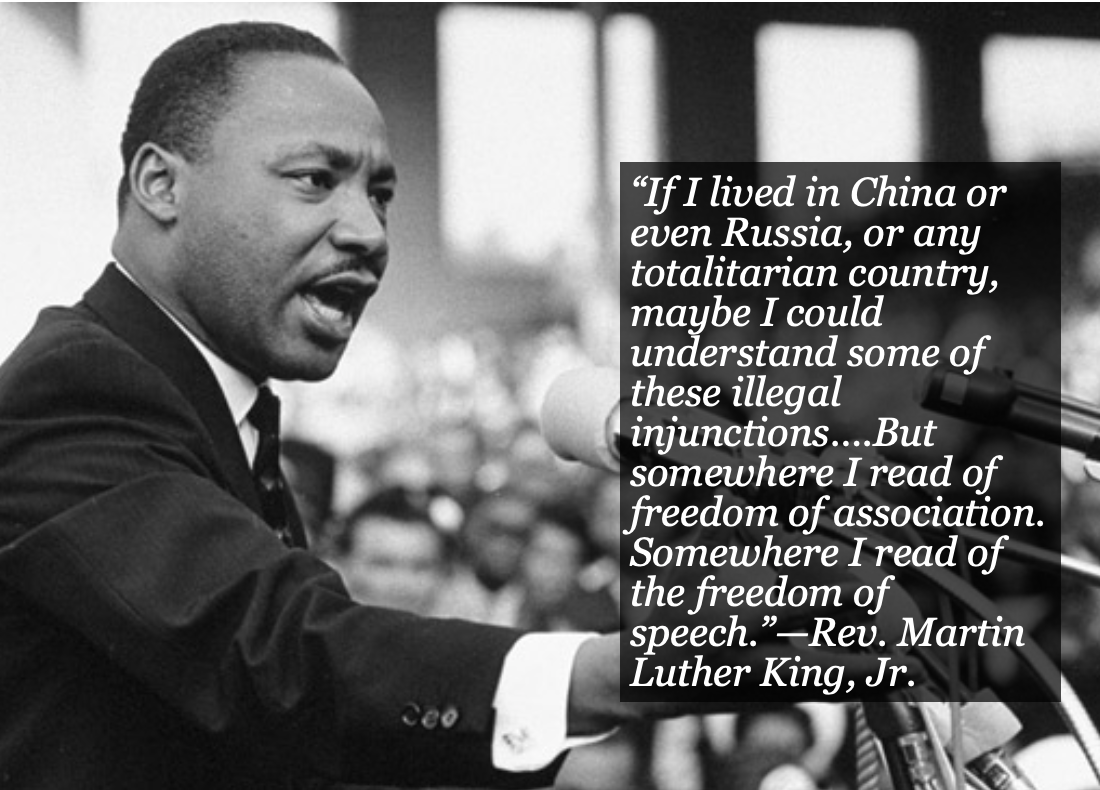
Rev. Martin Luther King, Jr. (GRS’55, Hon.’59) giving a speech during the 1963 March on Washington.
Meanwhile, events off campus have cost some professors their jobs, as when New Jersey’s Essex County College fired an adjunct who had ridiculed, on Tucker Carlson’s Fox News TV show, whites objecting to a Memorial Day event for African Americans only. The University of Tampa fired a professor who called Hurricane Harvey “instant karma” for Republican-voting Texans.
Today’s battles over speech recall another contentious time: just over half a century ago, when BU’s most celebrated alumnus raised his voice in defense of freedom of expression.
In 1968, on the night before his murder, Martin Luther King, Jr. (GRS’55, Hon.’59) decried court injunctions on the Memphis sanitation strike he was in the city to support: “If I lived in China or even Russia, or any totalitarian country, maybe I could understand some of these illegal injunctions….But somewhere I read of freedom of association. Somewhere I read of the freedom of speech.”
As for violence being used to squelch those freedoms of civil rights protesters, King, who’d been assaulted numerous times for his activism, said, “We aren’t going to let dogs or water hoses turn us around.”
Author, Rich Barlow can be reached at barlowr@bu.edu.
Controversial Civil Rights Activist Angela Davis Draws Big Crowd to BU Talk
“Through black history we learn the best of the history of the United States of America,” she tells packed house
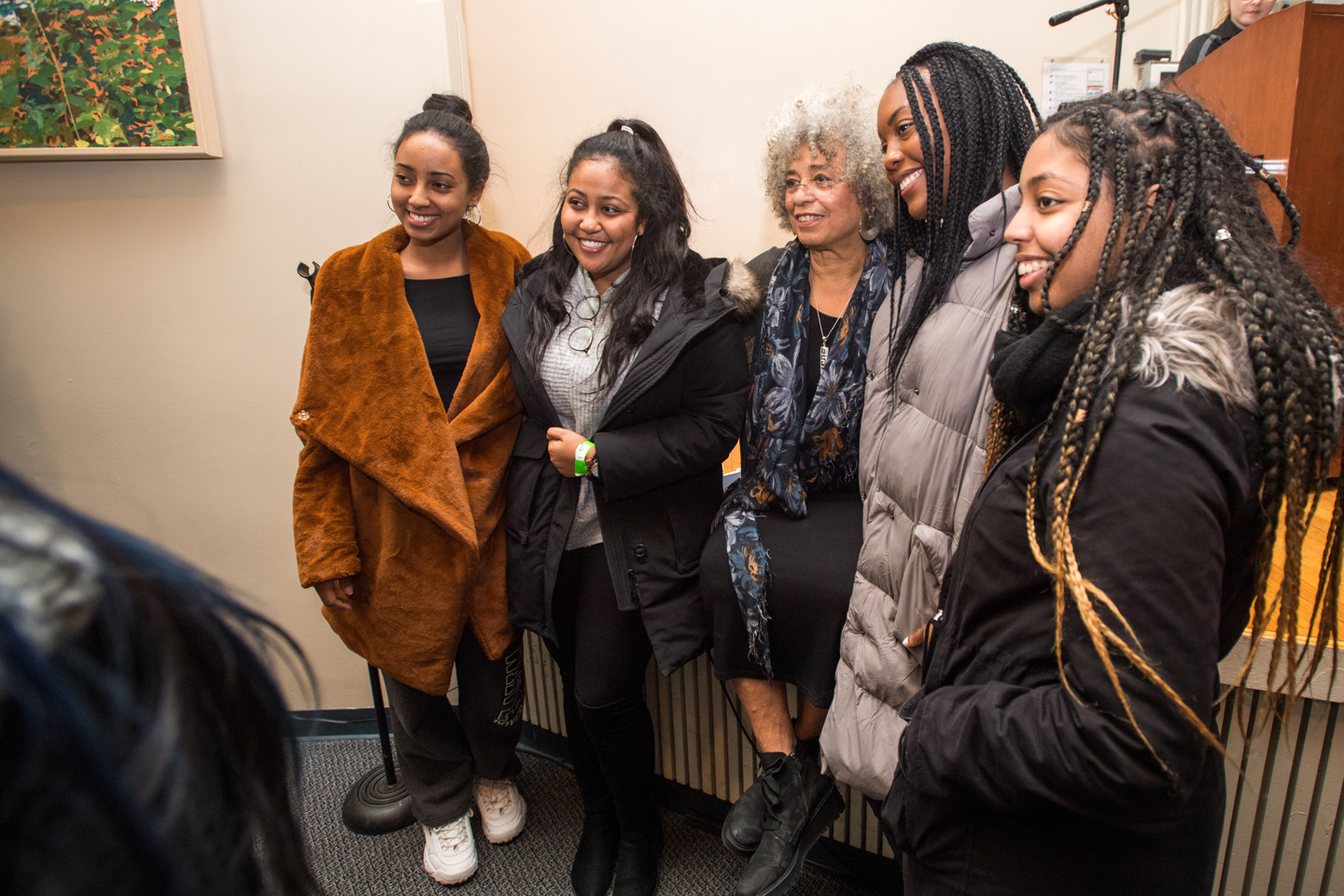
Angela Davis, activist, academic and author took time to chat with students and pose for photos with them, including Feven Solomon (CAS'21), from left, Kalkidan Tewodros (Questrom'21), Davis, Grace Mecha (SAR'21), and Zanta Ephrem (SAR'21) after speaking to a full crowd in Jacob Sleeper Auditorium February 9, 2019. The event, entitled Angela Davis: Violence Against Women and Its Ongoing Challenge to Racism! was made possible by The Boston University Undergraduate Sociology Association.
Controversial feminist icon, civil rights leader, scholar, teacher, and author Angela Davis stood in front of a packed Jacob Sleeper Auditorium Saturday night, sipping ginger tea in a blue thermal mug she’d brought herself, because, she said apologetically, she had a cold.
The title of 75-year-old Davis’ hour-long talk was broad—Violence against Women and Its Ongoing Challenge to Racism—and she had much she wanted to share with an audience of some 600 students, faculty, and staff. But her main message was a hopeful one—that people, and movements, are connected over decades, even centuries, of history, and that change can happen, but it takes time and you have to be patient. “Through black history,” Davis said, “we learn the best of the history of the United States of America, because that history is an unbroken struggle for freedom.”
She was charming, erudite, self-deprecating, and funny. She did not ignore having been a polarizing figure over the years, and even brought up the recent roller-coaster events in her hometown of Birmingham, Ala.: the Birmingham Civil Rights Institute selected her for a human rights award, then rescinded the award amid protests over her support of a boycott of Israel, only to reverse itself—amid a new outcry, this time in support of Davis—and announce she would be given the award after all.
It was hardly her first brush with controversy. In her many books and lectures around the world, Davis has been outspoken on issues from race relations to poverty to gender violence. She was on the FBI’s 10 Most Wanted List in the early 1970s, was fired from her position as a professor at UCLA, was accused of being a communist organizer, and spent more than a year in jail.

The audience laughed when, flashing a big smile, Davis said, “I keep asking myself, why do I end up at the center of all these controversies? I’m actually happy this happened. It gives us a new opportunity to understand the ways in which the different forms of violence connect, the relationship between racism and anti-Semitism and Islamophobia and it allows us to combine our scholarship and our activism with our collective imagination and our passion.”

Davis, who has won many accolades and stirred controversy over the course of her nearly half century of activism, urged her audience to imagine a world without violence. “Racist violence—we do not have to assume it’s a future inevitability,” she said.
Throughout her talk, she connected the aftermath of slavery to the often overlooked early activism against sexual violence of Rosa Parks and other black women of her generation, to the Montgomery bus boycott led by black leaders like Martin Luther King, Jr. (Graduate School of Arts & Sciences’55, Hon.’59), to the fight against mass incarceration, and to the Black Lives Matter and #MeToo movements.
Davis, whose scholarly papers were acquired last year by Harvard University’s Schlesinger Library on the History of Women in America, said that “over decades and decades and centuries, black people have refused to give up. And that hope in the black struggle represents the hope for democracy in this country and the world.”
The audience gave her one of many rounds of resounding applause.
She acknowledged that “we live in a violence-saturated society,” with gender violence, economic violence, racist violence, and school violence all “linked to institutional and ideological structures.” And yet, she said, “I want you to imagine a world without violence. We need to find ways to talk about violence that doesn’t affirm their permanence, because they can be ended.”
She talked about the importance of seeing the universality of the lives of people of color. “Oftentimes the slogan ‘Black Lives Matter’ is interpreted as only black lives matter,” she said. “So why is it that so many people counter by saying all lives matter. You say black lives matter, they say no, all lives matter.
“But the whole point,” she said, raising her voice, “is that if ever black lives were to truly matter, then all lives would really matter.”
The audience applauded again. Among the crowd, freshman Kathryn Pollack-Hinds sat transfixed. “She was a household name in my family when I was growing up,” Pollack-Hinds said before Davis took the podium.
Many students of color were in the crowd, among them a number of young women who said they had grown up hearing Davis’ name spoken with something like awe, and that they had long admired her.
Introducing Davis, Saida Grundy, a College of Arts & Sciences assistant professor of sociology and of African American studies, said among Davis’ earliest memories of her childhood, in a segregated Birmingham, were the sound of bombs exploding in the home of a black family across the street (the family had dared to move to the edge of a white neighborhood). Grundy said, quoting Davis, that later there was the bombing of the 16th Street Baptist Church (carried out by the Ku Klux Klan), which killed four black girls. One of the girls lived next door to the Davis family. Angela Davis was a close friend of another of the girls and her sister was close friends with three of them. Her mother had taught all of them in her classroom.
“The bombings of Birmingham would ricochet the surviving children out into the world,” Grundy said, noting that one of those surviving children was her mother, Ann Beard Grundy, who was with her in the Sleeper audience. “Our speaker today is the living evidence that those daughters of violence emerged as mothers of the movement.”
Davis “has set the standard for scholar activism,” she said, and her work “has spanned decades of feminist thought, political philosophy, Marxist theory and practice, divestment from apartheid and occupation, contemporary social movements, queer liberation, and prison abolition.”
During the Q&A after Davis’ talk, a young woman asked if Davis thought macro problems like racism and healthcare and economic inequities could ever be solved.

After her talk, Davis spoke with many of the students who had come to hear her, like senior Casey Guillard.
“Sometimes we have to pause and say that things don’t have to be the way they are—and to imagine a different time, when education is free,” Davis said. “Healthcare should be free for everyone…. It’s about the monopolization of the wealth that is produced on this planet. So, yeah, that means we have a long struggle ahead of us.”
Angela Davis: Violence against Women and Its Ongoing Challenge to Racism was organized by CAS sociology senior Claire Lawry and junior Zahra Thani, with support from the Undergraduate Sociology Association, and was cosponsored by several BU schools and departments.
Author, Sara Rimer can be reached at srimer@bu.edu.