News
You’re Invited: A Conversation with Rep. Lois Frankel (D-FL)
 BU IN DC
You're Invited: A Conversation with Rep. Lois Frankel (D-FL)
Join the BU Alumni Association to hear Lois Frankel, BU alumna and U.S. Representative, discuss her three decades in politics on Oct. 23rd on Capitol Hill. RSVP today
 FACULTY EXPERTS
The Transformers
From protecting the human brain to ending racial disparities in the law, meet seven BU researchers who are revolutionizing the human experience. Be transformed
 NOTABLE ALUMNI
Make Way for Sculptures... and Headlines
BU alumna Nancy Schön (DGE’48), the artist behind the iconic Make Way for Ducklings sculptures in the Boston Public Garden, made news this summer.
Find out why
IN CASE YOU MISSED IT...
RSVP for the Technology Ethics Center's Deepfake Conference on October 18th featuring Danielle Citron of the BU School of Law... BU Global Programs is working with the U.S. State Department to deliver English courses for U.N. peacekeepers in Nepal... BU School of Law Dean Angela Onwuachi-Willig explains how "Law and Order" rationalizes racial bias in the justice system in The Boston Globe... Julie Klinger of the BU Pardee School of Global Studies discusses rare earth supply chains in The Hill.
Senate Committee Supports NSF, NEH, NASA
BU IN DC
Thomas Webster of the School of Public Health spoke at a National Academies workshop on PFAS chemicals on September 26.
Hardin Coleman of the Wheelock College of Education & Human Developmentdelivered the keynote address at the Council for the Accreditation of Educator Preparation (CAEP) annual meeting from September 25 through 27.
SENATE COMMITTEE SUPPORTS NSF, NEH, NASA
The Senate Appropriations Committee approved two spending bills that would increase the budget of both the National Science Foundation (NSF) and the National Endowment for the Humanities (NEH) in fiscal year 2020. The committee-passed bill would provide a three percent increase for the NSF and slightly more than a one percent increase for the NEH; the measure would continue to fund the Science Mission Directorate at NASA at its current level. The U.S. House of Representatives previously recommended higher research budgets for all three entities. The two chambers will need to reach agreement on spending prior to November 21, when the continuing resolution that is keeping the government operating at current funding levels expires.
BUZZ BITS...
- The National Science Foundation (NSF) announced last week that it selected Dr. Margaret Martonosi as the next leader of the NSF Computer and Information Science and Engineering Directorate. Dr. Martonosi, a computer scientist at Princeton University, will begin her new role in February 2020.
- NSF's Social, Behavioral, and Economic Sciences (SBE) Directorate released a Dear Colleague letter detailing changes to longstanding NSF SBE programs. The "repositioned program portfolios and processes" will take effect in January 2020.
- A federal watchdog found that a majority of institutions that receive National Institutes of Health funding do not have sufficient safeguards in place to protect federally-funded research from foreign espionage.
EVENTS NEWS YOU CAN USE
BU Research has two upcoming events for faculty and staff:
- Learn how to incorporate data analysis about books, articles, and other publications in your research at a SciVal workhshop on October 10. SciVal is one of the leading sources of bibliometric data for academic institutions, and is free for the BU community.
- The first of two town halls on international research collaboration will be held on October 16. Representatives from BU Sponsored Programs, Office of the General Counsel, and more will outline the evolving regulatory landscape for international research partnerships and the current requirements for research proposals, reporting, disclosures, and agreements.
A Note to Our Readers: Due to the Congressional District Work Period, Beltway BUzz will not publish next week.
BU Advocates for International Scholars
BU IN DC
Michael Dietze of the College of Arts & Sciences spoke at a meeting of the National Science Foundation Directorate for the Biological Sciences Advisory Committee on September 20.
Diane Baldwin and Ryan Russell of Sponsored Programs attended the Federal Demonstration Partnership annual meeting from September 22 through 24.
Roscoe Giles of the College of Engineering discussed exascale computing at the U.S. Department of Energy's Advanced Scientific Computing Advisory Committee meeting on September 23.
School of Social Work Dean Jorge Delva attended a Capitol Hill briefing cohosted by the Center for Innovation in Social Work & Health on the social determinants of health on September 25.
BU ADVOCATES FOR INTERNATIONAL SCHOLARS
Boston University joined 43 private colleges and universities in Massachusetts in sending a letter to the state's Congressional delegation outlining concerns over recent immigration policy changes. The letter highlights the unpredictable visa process and delays in approval for Optional Practical Training (OPT), and the detrimental impact on international students and scholars in the Commonwealth. The University also joined hundred of colleges in sending a letter urging Congress to pass legislation to protect students in the Deferred Action for Childhood Arrivals (DACA) program for undocumented immigrants brought to the United States as children.
KENNEDY ENTERS MASS. SENATE RACE
On Saturday, U.S. Representative Joseph Kennedy (D-Brookline) announced he will challenge incumbent Senator Edward Markey (D-MA) for his seat in the U.S. Senate in 2020. Kennedy has championed LGBTQ rights and mental health issues during his four terms in the U.S. House of Representatives. Markey has served in Congress since the 1970's, starting in the House before joining the Senate in 2013. He is best known for his advocacy on climate change and consumer rights. Kennedy's departure from his 4th Congressional District seat will set off a crowded race to succeed him in the House.
EVENTS NEWS YOU CAN USE
Looking for better ways to communicate your research to the public? Back by popular demand, BU Research and Public Relations are again hosting Brad Phillips, founder of Throughline, for an expanded half-day interactive media training and messaging workshop for faculty. This training will help you gain new skills and empower you to effectively speak about your work and research to media, funders, policy makers, and even on social media.The workshop takes place on October 2 from 1 to 5 pm at the Hillel House.
BU School of Social Work Co-hosted a Congressional Briefing
You’re invited to attend:
Integrating Social Determinants of Health into Future Health Care Policy
Hosted by Rep. Karen Bass and the Congressional Social Work Caucus
Thursday, September 26, 2019
2:00pm – 3:30pm
B208 Longworth House Office Building
Evidence has shown that health outcomes are greatly affected by housing, transportation, nutrition, education, and other socioeconomic factors. Our nation’s health policies need to do more to address the social needs of individuals and communities. Failure to address these social determinants of health leads to disparities in health outcomes for vulnerable populations. But how can we leverage federal health programs and social needs care to ensure a healthier future for all? Our panel of experts will explore the history and context of the issue, examine what is currently happening at the federal level, and provide new ideas for future policy solutions.
Panelists
- RADM Sylvia Trent-Adams, Principal Deputy Assistant Secretary for Health, Office of the Assistant Secretary for Health, U.S. Department of Health and Human Services (Invited)
- Robyn Golden, Co-Director, Center for Health and Social Care Integration, and Associate Vice President, Population Health and Aging, Rush University Medical Center
- Laudan Aron, Senior Fellow, Center on Labor, Human Services, and Population, The Urban Institute
Please RSVP by visiting this link.
Sponsoring Organizations


This is a public and widely-attended event.
BU’s URBAN Enables PhD Students to Study People’s Health and the Earth’s
Program offers a unique marriage of disciplines
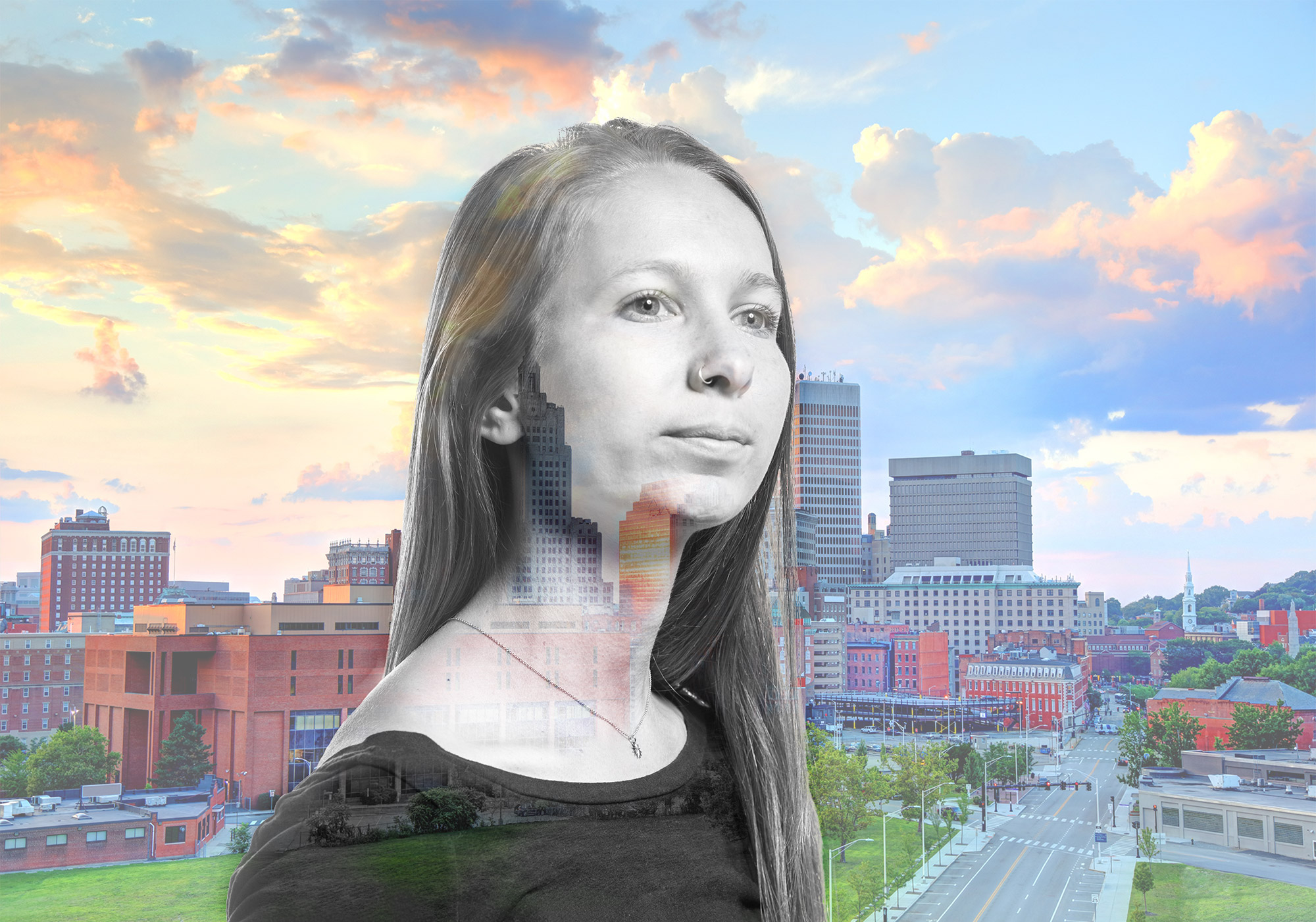 Paige Brochu (SPH’18,’22) gathered data to map a proposed urban forest for Providence, R.I. Portrait by Jackie Ricciardi. Photo of Providence, R.I. by Denis Tangney Jr./iStock.
Planting a tree in your yard can increase your property value, while helping to fight climate change (trees absorb carbon dioxide, a greenhouse gas). But rising property values also make urban neighborhoods unaffordable for low-income residents. And trees can boost pollen counts—just ask anyone who suffers from allergies.
That tree-planting, as American as Johnny Appleseed, has downsides is probably a news flash to most. But PhD student Paige Brochu (SPH’18,’22) learned it over the summer during an internship that her BU professors say blends two sciences, uniquely, in American higher ed. One is environmental health, the study of environment’s effects on human health, which is the subject of her doctoral work; the other is biogeoscience, the study of interactions between life processes and geological ones, including how land cover and rising mercury affect air and water.
Interning with the Nature Conservancy, one of the world’s leading environmental nonprofits, this summer, Brochu advised the city of Providence, R.I., about creating an urban forest plan, collecting data about similar efforts from Cleveland to Melbourne. She got the gig, with its one-two interdisciplinary punch, courtesy of BU’s three-year-old URBAN Program, which also involves a year of coursework.
URBAN is open to BU PhD students studying biogeoscience, environmental health, and statistics. The program plans to educate 60 PhD students over its life (five years guaranteed, with a sixth likely), courtesy of a $3 million grant from the National Science Foundation (NSF). This summer’s interns were involved in a range of projects, including planting trees in Arlington, Mass., and tracking wildlife health in the Adirondacks. The goal of the program is to prepare doctoral students for careers in academia, government agencies, NGOs, and the private sector by combining broad training across science along with management, policy, communication, and governance.

“I think it’s insane why other schools aren’t doing this,” Brochu says. “Biogeosciences and environmental health—we’re trying to answer a lot of the same problems.” Jonathan Levy, a School of Public Health professor of environmental health, summarizes the overlap: biogeoscientists are “trying to understand how people affect the environment,” while “we want to understand how the environment affects people.”
Levy is one of three URBAN faculty directors, overseeing the coursework and internships. The latter, which this year received financial support from the Office of the Provost, equips students for tackling urban environmental problems such as “air pollution, heat island effects, cities that are warmer, planting more trees,” says another codirector, 2015 Metcalf Award winner Pamela Templer, a College of Arts & Sciences professor of biology and head of BU’s Biogeoscience Program.
You might think the real-world application of saving the planet would be universally embraced by scientists. It’s not. Levy says that even in his eminently solutions-oriented field of public health, “if you say, ‘I’m doing applied research’…sometimes that’s viewed in a pejorative way, like you’re not doing serious science.” URBAN’s rebuttal is that “you can do cutting-edge, novel, important science as a student…andyou can do work that matters and makes a difference.”
URBAN student Lucila Bloemendaal’s childhood pointed her to her policy interest.
“I grew up in New Orleans and Houston, and we’ve been hit by floods and hurricanes there” that scientists believe climate change has worsened, says Bloemendaal (GRS’23), who is working on a PhD in earth and environment.

In her summer internship, she analyzed soil and water contamination data from commercial sites owned by clients of consulting firm Environmental Resources Management. The work involved “delving more into the environmental health side of things. These contaminants affect human health,” says biogeoscientist Bloemendaal. She’s grateful for URBAN’s environmental health aspect “because it’s all connected. We cannot ignore humans or the environment when looking at physical systems, and vice versa…. I want to help cities adapt and work with emerging issues that will become increasingly worse with climate change, such as flooding from sea level rise.”
URBAN also exposes its students to communicating science to nonscientists in the public and in the internship-sponsoring organizations. Other BU programs and universities teach this, but URBAN leans in on it. “With the traditional science degree, which is still the majority of science students—they may get a three-hour seminar on science communication. This is taking it truly to another level,” says Lucy Hutyra, a CAS associate professor of earth and environment and URBAN’s third codirector.
One example: spurred by URBAN, Bloemendaal enlisted in the American Geophysical Union’s science communication and advocacy program.
URBAN was born from disappointment. The NSF initially rejected a request for a grant focused purely on biogeoscience with a been-there, done-that rationale, since BU already had the biogeoscience program Templer leads. “I’m so glad that happened, because it was a kick in the pants to say…what do we not have?” she recalls.
What BU and everyone else didn’t have was a program marrying that discipline with environmental health. Templer says that before collaborating on URBAN with Levy, she “didn’t interact with any of these folks over there on the Medical Campus, and now we’re all connecting.”
Author, Rich Barlow is a senior writer at BU Today and Bostonia magazine. Perhaps the only native of Trenton, N.J., who will volunteer his birthplace without police interrogation, he graduated from Dartmouth College, spent 20 years as a small-town newspaper reporter, and is a former Boston Globe religion columnist, book reviewer, and occasional op-ed contributor. View his profile
MA Colleges Are Concerned About Immigration Policies
 ADVOCACY RESOURCE
MA Colleges Are Concerned About Immigration Policies
Boston University and 42 other Massachusetts colleges warn Congress that immigration policy changes hurt the Commonwealth's international students and campuses. Read our concerns
 FACULTY EXPERT
Deepfake Videos Could Undermine the 2020 Election
BU School of Law Professor Danielle Citron, a leading scholar on internet privacy, urges presidential candidates to have an eight-point emergency plan to counter deepfakes. Is this real?

RESEARCH HIGHLIGHT
Could Your Race Influence Where an Ambulance Takes You?
With funding from the National Institutes of Health, BU School of Medicine researchers found surprising data about where patients are transported by emergency medical services. Find out more
IN CASE YOU MISSED IT...
Aviva Lee-Parritz of the BU School of Medicine explains how the medical community is striving to address racial bias in maternal care in The Boston Globe... Michael Siegel of the BU School of Public Health weighs in on retailers' attempts to ban guns in stores for CNN... Rena Conti of the BU Questrom School of Business raises concerns about the Federal Drug Administration's use of the Orphan Drug Act for opioid use disorder treatments in Health Affairs... Gavin Benke of the BU College of Arts & Sciences talks about the business community's opportunity to be pro-consumer in The Washington Post... Japonica Brown-Saracino discusses how to identify a city's "sexual identity culture" in The New York Times.
White House Explains Research Security Concerns
BU IN DC
Michael Siegel of the School of Public Health addressed the Vapor Technology Association's national meeting on September 16.
Julie Wickstrom of Financial Assistance discussed federal student aid with Congressional staff during the Higher Education Loan Coalition’s fall meeting on September 16 and 17.
WHITE HOUSE EXPLAINS RESEARCH SECURITY CONCERNS
White House Office of Science and Technology Policy Director Kelvin Droegemeier issued a letter to American researchers on Monday outlining the Trump Administration's plans to address concerns over foreign influence in the research enterprise. Droegemeier explained that the recently formed Joint Committee on the Research Environment (JCORE) will focus on: collecting examples of foreign research exploitation across the research enterprise, coordinating disclosure requirements among federal research agencies, providing a list of best practices to address scientific security, and developing strategies for minimizing and managing malign foreign influence. Members of JCORE plan to visit universities across the country this year in order to hear directly from the research community.
BUZZ BITS...
- The House Select Committee on the Climate Crisis recently released a Request for Information seeking public input on policies to address climate change, specifically in the areas of innovation, decarbonization, agriculture, non-CO2 greenhouse gases, carbon removal, and resilience and adaptation. The Committee will use the responses it receives by November 22 to inform its legislative recommendations to Congress next year.
- The National Institute of Child Health and Human Development (NICHD) released its 2020 strategic plan on Wednesday. The plan identifies health disparities, infectious disease, disease prevention, nutrition, and global health as cross-cutting topics to integrate into NICHD's scientific research.
- The House Education and Labor Committee held a hearing yesterday examining the difficulties loan borrowers have faced navigating the Public Service Loan Forgiveness program. Members of Congress alternately criticized the U.S. Department of Education, loan servicers, and the policymakers who created the program.
EVENTS NEWS YOU CAN USE
Throughout the country, people are talking about sexual harassment—and academia is no exception. Join the Office of Research and Federal Relations for a conversation with two of the leaders behind the landmark report "Sexual Harassment of Women: Climate, Culture, and Consequences in Academic Sciences, Engineering, and Medicine," issued last year by the National Academies of Sciences, Engineering, and Medicine. Come learn about the report's findings and the next steps in the movement to end gender-based harassment in higher education on Thursday, September 26th at 3 p.m. in the Kilachand Center.
Senate Committee Funds Defense, Energy Research
BU IN DC
Danielle Citron of the School of Law spoke on an American Enterprise Institute panel on internet liability law on September 6.
Jonathan Woodson, director of the Institute for Health System Innovation & Policy, discussed the military health system at a Health Affairs event on September 12.
Pamela Parker of Development and Alumni Relations met with a group of alumni from the Pardee School of Global Studies on September 12.
SENATE COMMITTEE FUNDS DEFENSE, ENERGY RESEARCH
The Senate Appropriations Committee approved a spending bill on Thursday that would provide funding for defense and energy research in fiscal year 2020. The bill recommends $7.22 billion for the U.S. Department of Energy's Office of Science, a $633 million increase over current levels. It also proposes a $307.8 million increase over the Trump Administration's suggested funding level for basic research at the Department of Defense. Although the U.S. House of Representatives has already approved its defense and energy spending bills, it is unlikely the two chambers will reach agreement on spending matters prior to the October 1 start of the fiscal year. Therefore, a continuing resolution to keep federal agencies open will likely be needed.
BUZZ BITS...
- The U.S. Department of Energy announced the creation of a new Artificial Intelligence (AI) and Technology Office to coordinate all AI and machine learning research activities across the agency.
- The House Financial Services Committee held a hearing to examine government oversight of federal student loans. Witnesses criticized the Trump Administration's supervision of student loan servicers.
- The National Institutes of Health (NIH) announced that Dr. Susan Gregurick will serve as its next associate director for data science. Dr. Gregurick is a computational biologist who has been with NIH since 2013.
EVENTS NEWS YOU CAN USE
BU Research is bringing back its popular Research on Tap series, which invites BU faculty to share their expertise through a curated series of microtalks. Dr. Andy Henderson of the School of Medicine will host "Working on an HIV Cure" on Tuesday, September 24th from 4 to 6 pm in the Kilachand Center. Investigators will discuss their research on HIV infection and pathogenesis. After the presentations, participants can meet potential research collaborators during a wine and cheese reception.
BU Advances in U.S. News & World Report National Universities Rankings
University also among most innovative schools, magazine says

BU advanced in the U.S. News rankings of the country’s best national universities and is also one of the most innovative. Photo by Adele Bertschy (Sargent’20).
BU advanced two spots, to number 40, in the latest U.S. News & World Report rankings of National Universities, released Monday.
The University shares that spot with five peer institutions, two of them—Brandeis and Northeastern—also in Massachusetts. The other three are Case Western Reserve University, the College of William & Mary, and Tulane University.
BU also moved up one notch in the magazine’s ranking of Most Innovative Schools, tying at number 27 with the University of Pennsylvania, Rice University, and UCLA. These are institutions that in the opinion of presidents, provosts, and admissions deans surveyed by U.S. News “are making the most innovative improvements in terms of curriculum, faculty, students, campus life, technology, or facilities,” the magazine says.
“We are thrilled to see our progress reflected in this year’s numbers,” says Jean Morrison, University provost and chief academic officer. “The climate among global research institutions grows more competitive each year, and how BU measures up is a reflection of our daily ability to evolve, innovate, and reinvent, to reach across disciplinary boundaries and produce practical new solutions to societal challenges.
“This year’s rankings,” she says, “are at once a testament to the advances we continue to make as a community and to our talented faculty, who each day bring out the very best in our students and researchers. They are also a motivator for us to continue improving and driving forward.”
The magazine ranked 388 national universities, defined as institutions offering a “full range of undergraduate majors” as well as master’s and doctoral programs. Many, including BU, are research institutions. U.S. News says its rankings are based on factors such as expert opinion about each university from presidents, provosts, and admissions deans; quality of instruction, including student-faculty ratios and faculty with the highest degrees in their fields; student quality; financial resources; alumni giving; graduation rates, including among low-income students; and first-year student retention.
Princeton and Harvard clocked in at first and second place, respectively, for best National Universities, with a three-way tie for third: Columbia, MIT, and Yale.
“BU created one of the first study abroad programs, and currently sponsors more than 90 international programs,” U.S. News writes, while praising such “highly ranked graduate schools” as the School of Law, the Questrom School of Business, the School of Medicine, the College of Engineering, and Wheelock College of Education & Human Development. MED “is the nation’s first combined cancer research and teaching laboratory,” the magazine writes. Topping the U.S. News Most Innovative list are Arizona State, at number one, Georgia State, at two, and MIT listed third.
Author, Rich Barlow is a senior writer at BU Today and Bostonia magazine. Perhaps the only native of Trenton, N.J., who will volunteer his birthplace without police interrogation, he graduated from Dartmouth College, spent 20 years as a small-town newspaper reporter, and is a former Boston Globe religion columnist, book reviewer, and occasional op-ed contributor. View his profile.
Introducing Affordable BU
 ON THE CHARLES RIVER
Introducing Affordable BU
Boston University will meet the full financial need of all domestic students, starting in fall 2020, with a planned investment of more than $290 million annually. Get introduced

STUDENT LIFE
BU's Online MBA To Launch in 2020
BU Questrom School of Business will team with edX to offer the online education provider's first Master of Business Administration degree to students worldwide. Glimpse the future
 RESEARCH HIGHLIGHT
Optimists Live Longer
With funding from the National Institutes of Health, BU and Harvard scientists find that optimism could boost our chances of living 85 years or more by over 50 percent.
Be optimistic
IN CASE YOU MISSED IT...
Danielle Citron of the BU School of Law discussed internet liability and Section 230 at the American Enterprise Institute on September 6... Cara Stepp of BU Sargent College and Steve Ramirez of BU College of Arts & Sciences received the Presidential Early Career Award for Scientists and Engineers... Michael Siegelof BU School of Public Health explains how specific types of gun laws reduce mass shootings in The Washington Post... Jack Beerman of the BU School of Law weighs in on lawsuits against white supremacists on NPR.