The Search for Ancient Ice
Understanding what happened to the climate millions of years ago may tell us a lot about what will happen next
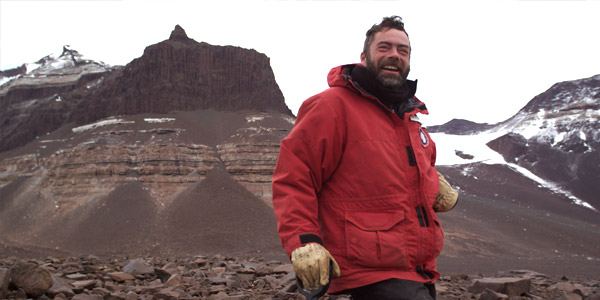 Antarctica researcher studies past climate change to learn about the future.
High in the Transantarctic Mountains, the McMurdo Dry Valleys are the largest part of Antarctica not covered with ice. Instead, a seemingly endless carpet of boulders and rocks flows into networks of steep cliffs and valleys—some over a mile deep, recalling the canyons of the American Southwest, but unimaginably more vast. Almost nothing lives there. There are no people around for hundreds of miles. This is Earth’s most ancient landscape, frozen in time for millions of years.
For more than a quarter-century, David Marchant, a Boston University professor of earth and environment and head of the BU Antarctic Research Group, has been exploring the Transantarctic Mountains, methodically piecing together the story of the landscape and past climate change and what it has to tell us about the future of our warming planet. As a graduate student in geology years ago, Marchant would spend up to 100 days at a stretch in the Dry Valleys, living in an unheated tent during what passes for summer in Antarctica, learning to read the landscape by walking and asking himself questions: How did that boulder get there? What about the sandstone? What do those cracks in the rocks mean—what caused them?
Since then, Marchant has led research expeditions into the Transantarctic Mountains nearly every year. He has made major discoveries that have upended long-standing scientific views about the age, environment, and climate of the region. Seeing things that earlier geologists had missed, he is widely regarded as a pioneering leader in the field of Antarctic geomorphology, a science that strives to add the “why” to how a landscape looks. As passionate about teaching as he is about research, Marchant is now training the next generation of geomorphologists, imparting to his students his knowledge of how to understand the origin and evolution of this landscape.