Interview with Visiting Scholar Ayla Bonfiglio
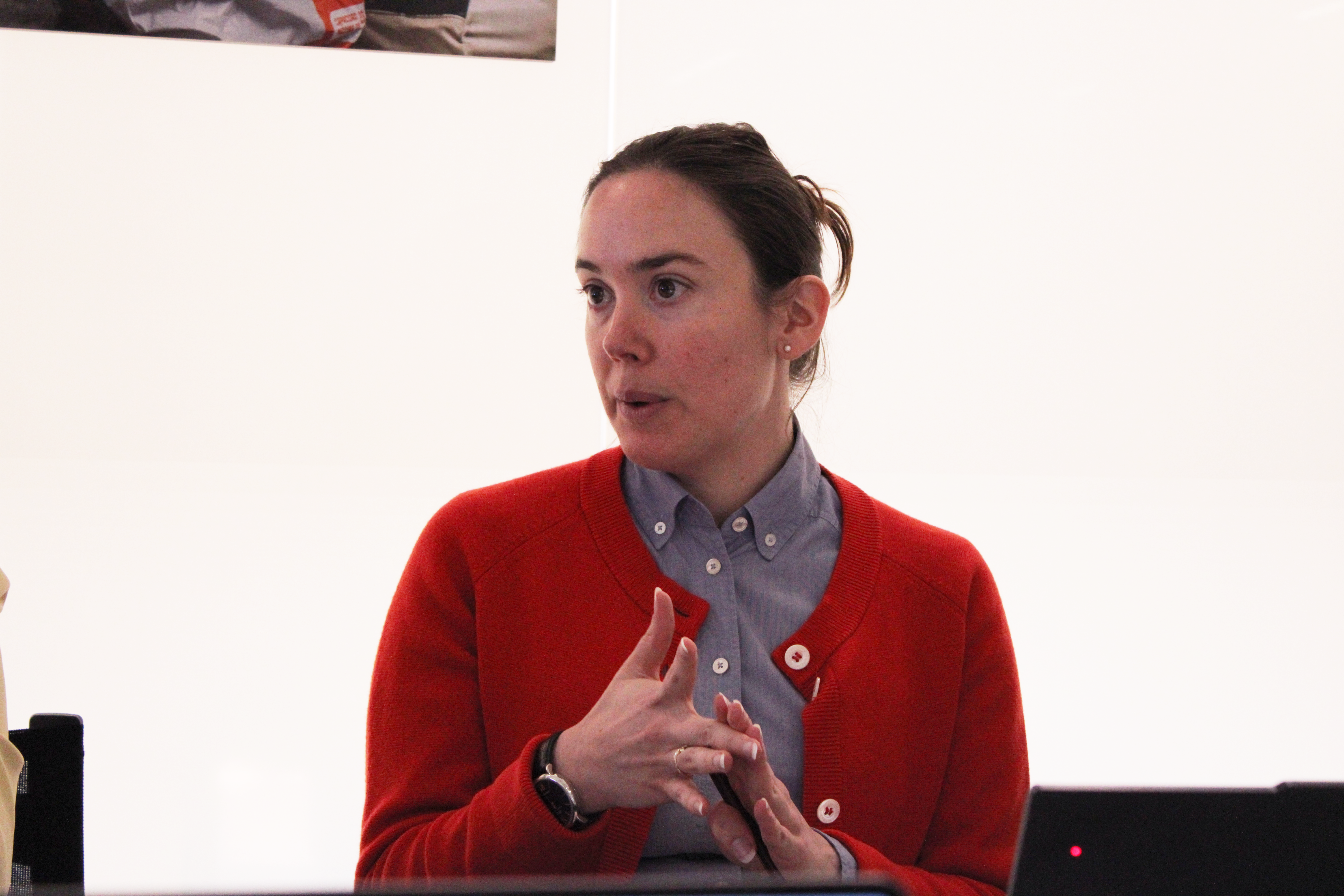 Last week, CFD welcomed Ayla Bonfiglio, Head of Mixed Migration Centre Eastern and Southern Africa / Egypt & Yemen, for a visit to our center where she lead a seminar on climate mobility patterns in East Africa.
The Newsletter Team sat down with Dr. Bonfiglio for a brief interview about her research and work. The transcript of our interview is below.
CFD Team: What first sparked your interest in migration and displacement, and what led you to pursue this work?
When I started my undergraduate studies at Columbia University, I knew hardly anything about migration and displacement. In my third year, I had the opportunity to spend a semester abroad in Uganda through the School for International Training. At the time, and even now, Uganda was the largest refugee-hosting country on the continent and was an often-cited example for progressive refugee hosting policies which supported refugees’ self-reliance. The program directly engaged with this context, bringing us to several refugee settlements and prompting us to think critically about the politics of forced displacement and international development. At just 20 years old, visiting the settlements had a profound impact. I was completely taken by how our modern state system could create such dire and protracted situations for people forced to flee their countries. Moreover, the humanitarian sector designed to respond to their needs was under-resourced at the same time that it was implementing programming that inhibited long-term progress.
I was fortunate to receive a research grant that allowed me to prolong my time in Uganda and ultimately write a thesis on the determinants of self-reliance for refugees in settlements versus urban contents, which was awarded the Charles Beard prize. This would not have been possible had I not had such a wonderful family hosting me in Uganda – the Turyamureebas. They gave me a home and the confidence to go out every day and interview people about their displacement experiences. Since then, I have remained in this field. I have always been motivated by the desire to carry out research that has the potential to impact refugee and migration programming and policy, so when the opportunity arose to work at the Danish Refugee Council’s Mixed Migration Centre, it felt like the perfect fit.
CFD Team: How have your experiences working across countries and with different organizations shaped the way you approach migration research?
This is a tough question, and I want to avoid clichés in my answer, but I am not sure I will! Having worked across countries in North, East, and Southern Africa, the most important lesson I have learned for approaching research is how critical it is to collaborate with local partners and to listen to a wide variety of migration and displacement stakeholders and refugees and migrants themselves. These discussions are important to understand what is already known and where information gaps lie, what is taken for granted, and where people want to see change. In this field, it is imperative to carry out research that seeks to have a meaningful impact on policy and programming.
The other thing I would highlight is how important flexibility is in migration research. Rarely do you have the full picture of the population you are studying from which to design a representative sampling frame. Often, the context is insecure and limits your access to certain sites. And many a time, people do not want to tell their stories to researchers who give nothing in return and can ask insensitive or even harmful questions. I therefore think it is important to develop robust research designs, but to have contingencies and be willing to adapt to the very real challenges and realities you encounter once you start doing the work.
CFD Team: Could you tell us a little about your role at the Mixed Migration Centre and what your work looks like day to day?
As the Regional Head of the Mixed Migration Centre’s Eastern and Southern Africa, Egypt and Yemen office, I get to work with a team of brilliant researchers in Nairobi who run our various research projects, overseeing and implementing data collection, analysis, the writing up of results, and dissemination. My portfolio might sound like a large geography – and it is – but it allows my team and me to work on all the major migration routes intersecting with East Africa. Such a vast geography also makes the job extremely interesting!
For me, a productive day would involve brainstorming with colleagues about new research ideas or emerging themes in a new dataset, reviewing our latest draft publication, and talking to our humanitarian and development partners or migration policy-makers about initial findings or insights from the ground that deserve greater attention and study. A lot of my focus goes to talking to a wide range of actors about the implications of our research for policy and programming and to ensuring that we secure financing for our research. I also have to keep a close watch when my team members are carrying out data collection in difficult locations, to ensure everyone’s safety and security is accounted for.
CFD Team: What do you think is important for people to understand about the different ways individuals and communities respond to climate-related events?
When I first began working on climate mobility in 2010 at the International Migration Institute, climate mobility was a politically contentious issue. In a decade-and-a-half since, while more people recognize the impact of climate change on movement and while more people become directly impacted, it remains contested. As a result, in my view, research on the topic is still not supported at the level it should be.
There are a number of important things people should know about how individuals and communities respond to climate-related events. First, and probably something aimed at the broader public, is that mobility or displacement related to climate disasters and environmental change is neither a theoretical notion, nor a distant future. In the Horn of Africa, particularly in Somalia, Ethiopia, and Kenya, the links between a climate disaster like flooding or drought and migration are relatively clear and happen on a largescale each year. At the Mixed Migration Centre, we have collected more than 5,000 surveys on the various ways in which this happens and have published all of our findings on our website.
Second, in our research, we have seen households exhibit a range of migration strategies to climate disasters. This includes supporting select members to move longer distances to other countries, in hopes of earning higher incomes abroad and spreading risk, while others move nearby in an attempt to maintain some of the household’s existing agricultural or pastoral livelihood strategies, while others still remain in disaster-affected communities of origin. Policies and programs for affected communities don’t always appreciate this diversity, and it is key that they don’t unintentionally undermine a household’s own positive coping strategies.
Third, cities – particularly intermediary cities – are often not viewed as key responders to issues of climate mobility, as we tend to think of climate disasters as confined to rural spaces, and think of national governments as primary actors. Our research has shown that cities are both receivers of people affected by climate disasters and suffer from disasters themselves and experience considerable intra-urban displacement. They are often the front-line assistance providers when you consider the education, health, and documentation services needed by new residents.
Lastly, it is often the most vulnerable people who are unable to move in the face of climate disasters. Sometimes, they are too sick, too old, or too young to move, or have other conditions or disabilities that prevent their movement. Some cannot move because they are caregivers to those who cannot undertake migration journeys, or do not want to risk losing their claims to land and other assets if they move. Few people do not move after a disaster strikes because they do not want to. The challenge is that these groups are often overlooked by humanitarian actors, who focus their attention on displacement sites rather than sites of origin.
CFD Team: Looking ahead, what questions or areas of migration and displacement are you most excited to explore next?
There are a lot of new and important directions in migration and displacement research, particularly in light of all the methodologic advancement taking place. For the next three years at MMC, a large stream of our work will focus on studying return and reintegration experiences. What makes this interesting is that we will be comparing different types of return, from refugee repatriations, to voluntary returns, to deportations. In addition, we shall be following up with the same individuals over the three years to understand how their reintegration processes have evolved and to explore the potential impact of their initial migration and subsequent return journeys as well as their different levels of assistance on these processes. This is important because a lot of returns research is not comparative, nor is it longitudinal, which has limited our in-depth understanding of return and reintegration.
More and more, I am also reflecting on how we carry out our research and where and how we should be employing participatory research methods and/or serving as research facilitators and partners, rather than implementors. We have an exciting project in Kenya where we are working with 10-15 queer refugee-led or community-led organizations, to help them build their own data collection tools and data management systems. The aim is to help them develop their own community-driven data and research products, to support their evidence-based advocacy and program design. Early next year, the system will be up and running and we are looking forward to the results!