Creatives in Practice: Marc Schepens
The Boston University School of Visual Arts Director recently had his work displayed at the David Shelton Gallery in Houston, Texas

CREATIVES IN PRACTICE: MARC SCHEPENS
The Boston University School of Visual Arts Director recently had his work displayed at the David Shelton Gallery in Houston, Texas
One thing that gravitates the next generation of artists to Boston University College of Fine Arts? Knowing that their professors, advisors, and mentors are also working artists, gaining real-world experience and bringing that back into the classroom through their curriculum, lessons, and talks. In CFA’s Creatives in Practice series, your favorite CFA faculty and staff members share the work they’re doing off campus, locally, nationally, and globally.
This past summer, Boston University School of Visual Arts Director Marc Schepens exhibited his work at the group exhibition 42 at the David Shelton Gallery in Houston, Texas. Curated by Jeremy DePrez and Dana Frankfort, the exhibition explored abstraction not as a style, but as a way of thinking that organizes information, tests relationships, and shapes meaning.
Schepens’ exhibited work Untitled (April 3, 2024) is part of an ongoing family of paintings begun in 2018–19. For Schepens, the paintings serve as markers of his presence. “Each canvas is titled with the day it was completed, operating as a literal, existential journal that declares: I was here on this day, observing the world around me,” says Schepens. “This systematic tracking of time speaks to art’s phenomenological and perceptual powers, a durational encounter between my body, the canvas, and the passage of time itself.”
In CFA’s Creatives in Practice, Schepens shares more about his practice; how his roles as artist, professor, and administrator intertwine; and what he would tell a student starting a career in visual arts.

Q&A WITH MARC SCHEPENS
CFA: Marc, can you tell us more about your work that was on view at the David Shelton Gallery?
Schepens: Untitled (April 3, 2024), oil and pencil on linen, 60 x 60” is informed by the perpetual recreation of the ocean’s surface—the constant, rhythmic interplay of motion, reflection, and the refraction of light off the Massachusetts coast where I live.
These daily atmospheric shifts are translated onto linen through a process of hand-patterned, vertical and horizontal broken lines, producing a humming, vibratory effect reminiscent of flowing water. Yet, while rooted in the ocean’s rhythm, the work resists direct representation. Instead, it brings a meditative sensibility focused on marking time, where hours are counted and accumulated, line by line and stroke by stroke.
Walk us through your process. How does a painting typically develop from its initial idea to its finished form?
While the landscape, and more specifically, the ocean, plays a primary role in my work, the paintings are not made from observation. Instead, my practice is process-based. Drawing is at the core of this process. I generate formal ideas around composition, color, and design through drawings done in wet and dry media. It is an iterative process, where I posit questions about approaches and watch them play out both quickly and slowly depending on medium and scale.
Ultimately, each thing I make- whether it be a drawing or painting- asks a series of new questions (i.e., What happens if this is done in this color? What happens if I flip it on its side? What happens if I reverse the design? etc.), and those questions are answered in the next pieces I make. Therefore, each work is a step in the process that begets another series of questions, allowing me to make more work. It is like an ongoing game of telephone… I am not sure where and when it started, and no idea where it will end.


How does your real-world experience as a practicing artist connect to your role as Director and faculty member of BU School of Visual Arts?
In my current role as Director, I teach far less than I used to, but teaching has forced me to outwardly articulate and test my positions on artistic practice. Stating these beliefs in the classroom at both the foundational and graduate levels creates a sense of vulnerability, compelling me to constantly examine whether I genuinely believe the ideas I share. This self-consciousness transforms the classroom into a dynamic, two-way street where students can question my framework just as I challenge theirs. Ultimately, this raw exchange strips away the notion of authority, allowing us to collaboratively refine our understanding of art and learn alongside one another.
What’s inspiring you lately?
Recently I have been interested in certain types of Neolithic and early Bronze Age pottery like Grooved Ware, Unstan Ware, and Linear Pottery. I relate to the designs and process-oriented approach to developing the visual language.
I am also fascinated by the way the patterns could read as abstract decoration, or be translations of the landscape, or be interpreted as other languages of mimesis like skeuomorphism. This ambiguity speaks to my work, where I hope that abstraction, representation, decoration, and the act of record-keeping converse—complementing and undermining one another.

“An artist’s primary focus should be building a self-sustaining, generative practice rather than chasing the success of individual works. A practice driven by continuous curiosity and inquiry naturally yields new formal and conceptual questions, sustaining an artist over a lifetime.”
-Marc Schepens
What advice would you give your students about building a sustainable career in the arts?
An artist’s primary focus should be building a self-sustaining, generative practice rather than chasing the success of individual works. A practice driven by continuous curiosity and inquiry naturally yields new formal and conceptual questions, sustaining an artist over a lifetime. For me—and rooted in how I was taught—that foundation starts with drawing, weaponized as a central engine for creative research and inquiry, regardless of the respective fields we silo towards as artists.
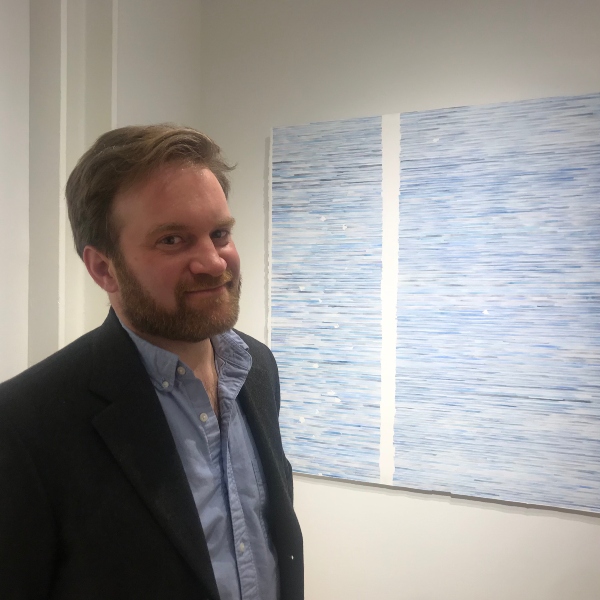
Connect with Marc.
As Director of BU School of Visual Arts, Marc leads the SVA internship class and co-runs a partnership program with Boston Medical Center, leading art discussions with third-year medical students during their psychiatry rotation to strengthen visual acuity and group observation at the Museum of Fine Arts, Boston, called Meds at the MFA. Prior to serving as Director, Marc taught painting and drawing at the foundation level and graduate level.
Follow Marc on Instagram or reach out to him directly at schepens@bu.edu.
About Mentioned Programs
BU’s Painting program promotes the medium of painting in its varied manifestations as a fundamental form of artistic expression. Instruction, practice, and awareness of historical and contemporary context are brought together to enable students to think critically and imaginatively, and to express their ideas with skill and conviction. BFA and MFA degrees offered.
This Series

Also in
Creatives in Practice
-
July 17, 2026
Creatives in Practice: Jim Fagan
-
June 15, 2026
Creatives in Practice: Dan DiPiero
-
May 14, 2026
Creatives in Practice: Lucy Kim