

Category: Spring 2017
In Memoriam
Beloved teacher, famed soprano, Opera Institute founder Phyllis Curtin dies at 94
By Susan Seligson
Banner image: Phyllis Curtin singing with the Mitchell-Ruff Duo, pianist Dwike Mitchell and bassist and French horn player Willie Ruff, in 1984. Curtin was CFA dean at the time. Photo by Boston University Photography
By all accounts, Phyllis Curtin, one of opera’s most graceful and versatile sopranos, was not a diva, always putting the music first. Following a celebrated career on stage, Curtin was dean of Boston University’s College of Fine Arts from 1983 to 1991 and founded the School of Music Opera Institute in 1987. After she retired, she continued to offer master classes at CFA until a few years ago, and for more than half a century she was also a beloved voice teacher at the Tanglewood Music Center. Curtin died June 5, 2016, at her home in Great Barrington, Mass., at age 94.
“The world has truly lost a remarkable person,” says Lynne Allen, CFA dean ad interim and a professor of art. “Curtin’s exceptional talent and presence made her a star, but more than that, she was an intelligent, bright, charismatic lady who led this college as dean. It’s amazing how one person can leave such an indelible mark on the lives of colleagues, students, and audiences. Phyllis was beloved and Boston University mourns the passing of our dear friend.”
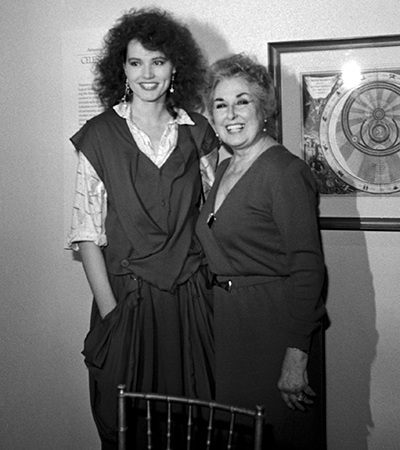
Oscar-winning actor Geena Davis (Hon.’99) (left), who attended CFA, with Curtin, then dean of the College, at a scholarship press conference and luncheon in 1985. Photo by Boston University Photography
A major figure with the New York City Opera in the 1950s and 1960s, Curtin sang roles in operas by Verdi, Wagner, and Richard Strauss, in addition to performing all of Mozart’s major heroines. But she was an ardent supporter of modern composers as well and championed work by noted 20th-century composers such as Benjamin Britten and Darius Milhaud. As New York Times chief classical music critic Anthony Tommasini (’82) noted in a 1998 Times piece, Curtin achieved widespread success and respect, “but never quite the recognition she deserves.”
A New York Times obituary hails Curtin as a consummate professional known for “the purity of her voice, the sensitivity of her musical phrasing, and the crystalline perfection of her diction.”
As a teacher, she instilled in her scores of students and protégés, who included Dawn Upshaw and former CFA faculty member Simon Estes, a reverence for the music and confidence in their instrument. “Don’t worry about the audience,” Curtin was quoted in a 2013 article in the Berkshire Eagle as telling one student. “If you think about the audience, of course you’ll get nervous. Sing it to the universe!”
“To know Phyllis Curtin was to love her,” says Shiela Kibbe, School of Music director ad interim and an associate professor of music. “Her radiant embrace of music and musicians was generous and contagious, and the School of Music at CFA will ever be grateful for her fierce advocacy, her passionate teaching, and her constant example of professionalism in both artistry and demeanor.”
“Phyllis Curtin is unique among famed American artists for a career that was equally distinguished as a homegrown opera star at a time when the European brand was favored, for her teaching—first and for over 45 years at the Tanglewood Music Center, then at Yale, and here at BU—and for her premieres and passionate advocacy of new works,” says longtime friend Phyllis Hoffman (’61,’67), a CFA professor and chair of the voice department and former director of the School of Music and of the BU Tanglewood Institute.
“As dean, she put our School on the map not only via her celebrity status,” Hoffman says, “but especially for her artistic ideals, inspirational teaching, eloquent advocacy for the arts, and her ability to put into words the indescribable in regard to music, performance, and artistry. She perhaps is most remembered as the founder of the Opera Institute, but her legacy is alive and enduring for her myriad achievements during her deanship.”
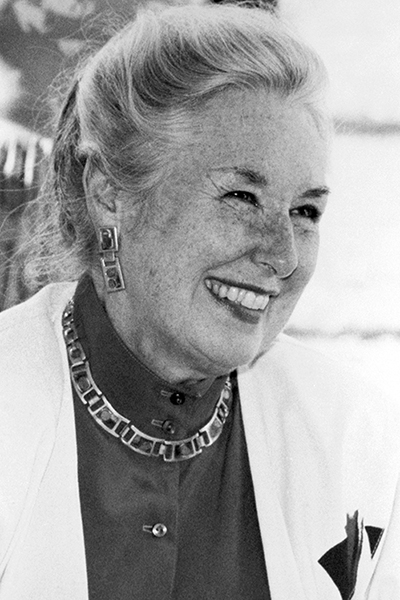
Phyllis Curtin, then dean of CFA, at Tanglewood in 1990. Photo by Kalman Zabarsky
A native of Clarksburg, W.Va., Curtin earned a bachelor’s degree in political science from Wellesley College in 1943. While there she studied singing and went on to pursue graduate studies in vocal performance at the New England Conservatory of Music. Among her early teachers was soprano Olga Averino.
Curtin made her opera debut in 1946 as Tatyana in Pyotr Ilyich Tchaikovsky’s Eugene Onegin with the New England Opera Theater. In 1954, she rose to become a principal soprano at New York City Opera, where she remained until 1960. Her many leading roles included Fraulein Burstner, Frau Grubach, and Leni in the US premiere of Gottfried von Einem’s The Trial, Alice Ford in Verdi’s Falstaff, Antonia in Offenbach’s The Tales of Hoffman, Katharina in Vittorio Giannini’s The Taming of the Shrew, Rosalinde in Die Fledermaus by Johann Strauss II, Violetta in Verdi’s La Traviata, and the title role in Richard Strauss’ Salome. She also performed in the world premiere of two operas by Carlisle Floyd: as Catherine Earnshaw in Wuthering Heights, and in 1955 the title role in Susannah, which would become her most famous.
Critics cite Curtin’s association with 20th-century music as a reason she never achieved the mainstream recognition given her contemporaries Beverly Sills, Joan Sutherland, and Maria Callas. “Where we make our big mistake is thinking that all opera is Tosca and that everything else is something beyond the pale,” Curtin told the Times in 1961. “A new musical show on Broadway gets plenty of attention, but some sort of ridiculous barrier has been set up between the musical and the opera.”
After leaving New York City Opera, Curtin performed with Royal Opera House, London, the NBC Opera Company, the American Opera Society, the Cincinnati Opera, the Glyndebourne Festival Opera, the Tanglewood Music Festival, and the Metropolitan Opera, among others. She taught at Yale University as well as at BU.
Curtin is survived by a daughter, Claudia d’Alessandro, and three grandchildren.
Donations in Curtin’s memory may be made to the Phyllis Curtin Opera Fund at Boston University College of Fine Arts, care of the Office of Development, 855 Commonwealth Ave., Boston, MA 02215, or online here.
A version of this article originally appeared in BU Today.
Leading Questions
Our mission at CFA is to ensure that we are arming students with the skills and expertise they need to be successful as artists. So, we’re asking our faculty, administration, students, and alums for input on how to address the changing role of the arts in society and assess the value of an arts education. The individuals featured throughout this issue of Esprit answer some of our most pressing questions.
Baron Vaughn (’03), actor and comedian
Q. What’s the biggest misconception about artists in your field?
A. That we’re all sad—that we’re more damaged than the average person. I think we’re the same amount of damaged. We’re just more aware of our damage, which can be a cross to bear.
Hannah Lawson (’17), violinist and teacher in Saudi Arabia
Q. If you could give your undergraduate self one piece of advice, what would it be?
A. Take time off to travel. There is no other way to truly find out who and where you want to be one day.
Daria Lugina (’19, CAS’19), painter
Q. Describe in one sentence the impact art has on the world, politics, society, technology, health care, learning.
A. Art is a constant reminder that every person on this planet is just as alive and important as we are.
Russell Houser (’18), commander and conductor of the US Army’s I Corps Band
Q. What one piece of technology is essential to your work?
A. A digital recorder so I can re-hear and study an ensemble’s sound and review and study the practical work of student conductors, and of my work on the podium.

Richard Raiselis, associate professor of art
Q. If you could create your art in any time period, which would you choose, and why?
A. Now. Artists are free to do just about anything they can imagine. Coincidentally, the colors available to artists, both as paints and as screen light, are pretty much unlimited today.
Kaylee Dougherty (’11), ocularist and anaplastologist
Q. Which lesson from CFA has guided you in your career?
A. I’ve always remembered this analogy Batu Siharulidze, professor of art, sculpture, made when he was frustrated with a drawing I was doing: “You were making a great sauce”—I wish I could say it in his accent—“and you put in the tomatoes and some salt and some garlic. And then you put in the sugar, and you ruined it.” The point was that you’ve got to know when something is done.
Marching to His Own Beat
As the conductor of a military band, Russell Houser leads soldier musicians on musical missions
By Lara Ehrlich | Banner photo by Victoria Wang
Music and the military run in Russell Houser’s family; his older brother was a soldier, and his father—who is blind—instilled in him an appreciation for melodies. “I grew up with a sonic orientation to the world,” says Houser (’18), the commander and conductor of the US Army’s I Corps Band. “As soon as I picked up the trumpet at age 10, I was hooked. It was the greatest thing in the world to be able to make sound.”
Houser, who is pursuing his doctor of musical arts in music education through CFA's online program, tells Esprit how he puts his sonic skills to use leading 50 musicians in more than 600 missions a year. The events range from retirements and changes of command, to parades and receptions, to school presentations and community events like the Seattle Marathon.
Lara Ehrlich: Walk us through a day in your life.
Russell Houser: There is no typical day in this job. A textbook perfect day would be physical training in the morning, a bit of downtime, and then accountability formations to ensure that everyone knows what we’re doing for the day, and then rehearsals and missions.
How many musicians are in the US Army’s I Corps Band, and what type of music do you play?
The band that I’m currently assigned to has about 50 musicians. Within that group, there is a ceremonial band, two brass quintets, a rock band, and a jazz combo. The ceremonial band plays events like retirements, parades, and changes of command, and the brass quintets perform similar events for smaller venues. The jazz combo performs for ceremonies on occasion, but it’s more for military receptions, to create a positive, engaging mood. The rock band is great for public relations outreach to schools and for bigger public events, like the Seattle Marathon.
How do the soldiers get involved in the band?
Each soldier joins for their own reasons, but most come to the band with significant performing experience and training. To display the disparity, I had two soldiers in the band who have completed their doctorate for music performance, as well as soldiers who have not done much more than high school.
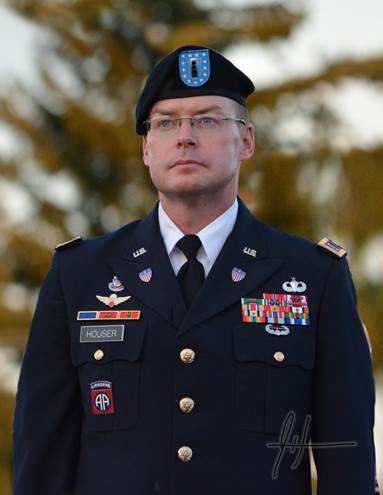
As the commander and conductor of the US Army’s I Corps Band, Russell Houser leads 50 musicians in more than 600 missions a year, from retirements and changes of command, to parades and receptions, to school presentations and community events like the Seattle Marathon. Photo by Jessica Hall
You joined the military after the army band performed at your high school. What was it about the band that inspired you to join the military?
You're asking me to remember what I was thinking 30 years ago as an 18-year-old! My brother had gone into the army out of high school, so I had admiration for him and his decision. I also wanted to get out of the little town I grew up in and see more of the world.
Were you interested in music before you joined the military?
My dad is totally blind and has been all my life, so I grew up with a sonic orientation to the world. As soon as I picked up the trumpet at age 10, I was hooked. It was the greatest thing in the world to be able to make sound. I don’t think I chose it—I think it chose me.
My dad could tell wonderful stories. Where that comes to serve me in this job is that when I see or listen to a piece of music, narratives almost instantly pop into my mind. It’s helpful to find what the music is saying to me, and when teaching conductors, to ferret out what they think the music is telling them.
How might you share what the music is saying to you?
Right now, we’re doing a piece of instrumental music based on “O Come, All Ye Faithful” that starts out with a fanfare trumpet duet, and then goes into a French horn quartet, followed by the timpani. Immediately what jumped to mind is a set of escalators. You’re riding down the escalator playing the trumpet, and then you meet your friend who’s playing the French horn, and there’s a handoff. At the bottom of the escalator is the timpani. That’s how I try to get that sense of connection in the piece to the performer or a conductor.
How does music support army operations and morale?
We play at many ceremonies. I think some of the most meaningful ones have been for when soldiers come home from deployment. When they start walking off the plane—at any hour—the band is there breaking out the welcome home music. We are a sonic backdrop to those events.
We will play at organizational events, such as retirements, and we'll play “Auld Lang Syne” and “Old Soldiers Never Die” as last tributes.
Finally, and probably most importantly, we’ll play at funerals to say good-bye to service members one final time. Those few notes are gut-wrenching. There's a poignancy that cannot be done by anyone else. It gets harder as I get older just because I’ve become more aware of how precious life really is. I’m almost at a loss for words.
What led you to CFA’s online doctorate of musical arts in music education program?
With this job, I’ve moved every two and a half to three years. I began the program in Afghanistan, and then I moved to North Carolina; to El Paso, Texas; and then Virginia Beach, Virginia—and then Tacoma, Washington. My dissertation advisor and I meet every other week on Skype, and I’ll hopefully be finished in late 2017 or early 2018. It’s probably longer than the typical student in a brick and mortar institution, but I couldn’t have done it any other way.
Tell us about your dissertation on identity construction of LGBT music educators on the podium.
For me, a dissertation has to be personal, professional, and academic. It originally began with personal observations about the challenges in the history of wind bands and the historical writings that show non-favorable or non-equal treatment of people who were different—specifically LGBT people. But where things get interesting is when you put somebody who has been occasionally not looked upon favorably in a leadership position like a conductor. That’s where tensions, to me, are evident.
Our goal on the podium is to be as efficient as possible with the limitations and gifts that you bring inherently to the table. Your job is to liberate the best sounds possible from your organization, and do that in a loving and tender way.
Lullabies that Inspire Hope
Musicians help at-risk mothers write lullabies for their babies
By Susan Seligson | Photos by Asher+Oak Photography
When Shana, a young Congolese immigrant living in Lynn, Massachusetts, was 26 weeks pregnant, her baby stopped moving.
Though doctors at nearby North Shore Medical Center (NSMC)/Salem Hospital said the baby’s heart was beating, they were sufficiently concerned to transfer Shana to Massachusetts General Hospital (MGH), where doctors performed an emergency C-section.
Baby Adriana weighed 1 pound 12 ounces at birth and was hospitalized for two months, first at MGH and then at NSMC. The uncertainty was frightening for Shana, but she found solace in music. Erin Peterson, a caseworker at Boston Medical Center, where Shana had planned to give birth, introduced her to the Lullaby Project, through which several CFA alums helped her craft a song for her baby girl.

Violinist Maya French (’15,’18), co-executive director and artistic director of Palaver Strings, leads the Boston branch of the Lullaby Project, a national outreach program that helps at-risk mothers create songs—and lasting memories—for their babies.
Members of the Boston-based chamber group Palaver Strings, known for using their talents for social awareness, have poured their hearts into the Lullaby Project, a national outreach program that helps mothers facing poverty, incarceration, or homelessness create songs—and lasting memories—for their babies.
Led by violinist Maya French (’15,’18), Palaver co-executive director and artistic director, and Elizabeth “Lizzie” Moore (’14), a violist and songwriter, Palaver Strings has been working for two years with schools and nonprofits in neighborhoods throughout greater Boston. They based their branch of the Lullaby Project at Boston Medical Center (BMC), where they had an opportunity to work with Moisès Fernández Via, director of Arts | Lab, a unique collaboration among CFA, Boston Medical Center, and BU Medical Campus that injects the arts into a clinical setting.
A familiar figure on campus, Fernández Via ('11) has forged artistic partnerships—through the Arts | Lab—at BMC for the last four years, with programs that had CFA students playing lobby concerts in the Menino Pavilion, providing impromptu solo serenades to patients recovering on BMC’s wards, and reading poetry to cancer patients as they received chemotherapy infusions.
“Palaver Strings has been part of the Medical Campus since the very first day of the Arts | Lab,” Fernández Via says. “I have seen them grow from a casual chamber group to a consolidated string ensemble, embodying the core mission of our task at BMC: turning individual ability into collective opportunities.” The Lullaby Project, he says, “belongs to a category of the Arts | Lab project called 'Audienceless.' Here, we test our capacity to include others in what we do.”
Fernández Via was moved to participate in the project because, as he put it, a lullaby is more than a song. “A lullaby is a musical fossil, a powerful narrative that encapsulates in a song all the complexities of parenthood: nurture, vulnerability, doubt, uncertainty, hope, resilience, tenderness,” he says. “Inviting young parents at-risk to write personalized lullabies seems to me a powerful opportunity: a chance to awaken their innate wisdom, so that it guides them through the vastness of parenthood.”
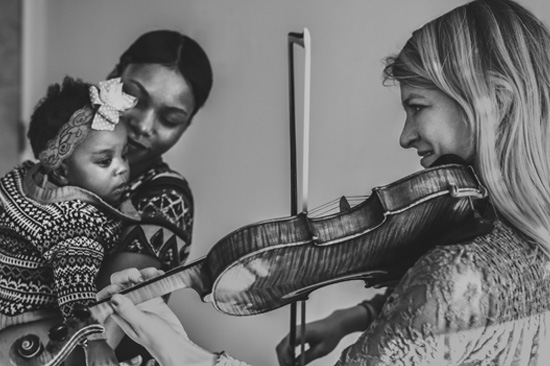
Shana (left), a Congolese immigrant, worked with CFA alums in the chamber group Palaver Strings—led by violinist Maya French (’15,’18) (right)—to write a lullaby for her baby girl.
Fernández Via recruited three participants through caseworkers at BMC. The musicians worked with Shana, then 20, while her baby was in the neonatal unit at NSMC/Salem Hospital. The second participant, Erina, learned she was pregnant at age 40, soon after she arrived from the Democratic Republic of Congo (DRC). Marle, a Congolese who befriended Erina in an ESL class while both lived at a Dorchester shelter for new immigrants, went to the BMC session with Erina for moral support and decided to participate in the project. She wrote a lullaby for her mother, who stayed in the DRC.
French and Moore surveyed the participants, asking about their backgrounds and concerns. For example, they asked, When your child is 18, how will you explain the project and why you participated? What do you do to create calm in your child’s daily life?
Two musicians worked with each woman to develop a custom lullaby. Matthew Brady, who attended BU, from the Boston-based band Milk, served as producer, recorder, and percussionist. Palaver cellist Nikolai Renedo, co-artistic director and community engagement coordinator, was Spanish translator. Fernández Via translated Marle’s interviews from French to English during the songwriting process.
“We had the moms write a letter to their baby, and used that as a starting point,” French says. With the help of the letter and evaluation, the musicians pieced together the women’s stories, passions, and concerns for their children to develop a tune unique to each. Shana, who had a toddler at home while caring for her newborn in the neonatal unit, says she uses music and poetry to cope with life’s hardships.
“I like poems, so I wrote one that they helped me put to a melody,” says Shana, whose tune is inspired by the music of American gospel singer Kirk Franklin. “My poem was about how what I went through was scary at first but it ends good.”
“Once you have words and ideas, you begin thinking about the shape of those words,” says Moore. “Sounds have shape, too, so from the lyrics it’s easier to create the tune, beginning with some chords. And often they’ll tell us a favorite song or songs that make them feel comfortable,” so the musicians can use those as a guide. Shana, for example, wanted the song to be upbeat and played a tune she likes on her phone. “She was trying to portray that this baby was a miracle,” French says.
The pair was surprised by how each lullaby had strong, distinct influences. Erina, though Congolese, is a Spanish speaker who had lived in Cuba and created the ballad “Bienvenido Al Mundo” with Spanish lyrics and a Spanish lilt to express her worries about her child’s future.
Marle, who is learning English, wrote her lullaby “Femme De Courage” to her mother in the DRC, in their native French. “Her whole family is in the Congo, including her children,” French says. “She is here hoping to provide more opportunity for her kids, and wanted to write an ode to her mother for her love and support.”
Shana's Song
I was told you wouldn’t make it, the pain I couldn’t take it… Miracles come, miracles come, miracles come in small packages. I got down on my knees and prayed, asked my God to make a way, a way to take out pain and stress, and replace it with joy and happiness.
Shana’s song, “Mommy’s Miracle Baby,” written in English, is American R&B, chosen for her love of the upbeat sound.
The all-day process, in a BMC conference room, was followed by a recording session at Fernández Via’s apartment. Often the songs created through the Lullaby Project are recorded by professional singers, “but we want to encourage the women to sing their own songs,” French says. “These were their lullabies, and as long as they felt comfortable we felt they should have ownership, so when they play it for the baby, the baby hears his mother’s voice. We wanted them to be at the center of it.”
At first the women “were a little nervous, but we tried to keep it really relaxed,” French says. “It was such a new experience for them.” The musicians—instrumentation included upright bass, cello, viola, keyboards, guitars, and some background vocals—performed within the mothers’ vocal comfort zones so they could sing the lullabies easily and naturally. “It’s really for the women and their babies,” says French.
Despite her shyness, Shana sang her lullaby in front of an audience at an April 2016 Arts | Lab event, a stunning moment for her and for the musicians, who remain in touch with her. Her song acknowledges a debt to God for her baby’s survival.
Shana was nervous about singing in front of people, “but I wasn’t scared,” she says. “I sang in a church choir in my country.” The 30 people gathered in the BMC lobby were swept away by her song, says French. She sang solo. She had dressed up for the event and had posted about it with pride on Facebook. “She’d practiced the song a lot,” French says. “I cried when she sang.”
To help new mothers craft songs that their children are likely to sing to their own babies one day “was one of the most amazing creativity experiences,” says French. “We really bonded with them.” The mothers said they, too, hoped the songs would be passed along to future generations, “hopefully in a better place,” and in a better situation, with their kids having what they need in life, French says. Shana sings her lullaby to Adriana, who is “fine now.” Her words, set to music, “should give other mothers hope.”
The Science of Color
CFA class teaches color scientists how color fools our eyes
By Julie Butters | Banner image by Alison Staffin
How many colors do you see in the above image?
You may have guessed four: one for each of the four squares. But the answer is three. The two small squares are the same color; they only appear different because of their contrasting backgrounds.
The artwork, created by Alison Staffin (CAS’17) for a CFA studio class, reveals what a trickster color can be. It can change its appearance by “stealing” from the hues around it. The way our brain interprets color depends on context; as a result, the small squares appear to be different hues of gray.
(Not seeing the illusion? Distance can enhance the effect: try stepping away from your computer or device to view the artwork. Still no luck? Screen display settings, or differences in how color can appear across browsers, could be altering the true colors of the original image.)
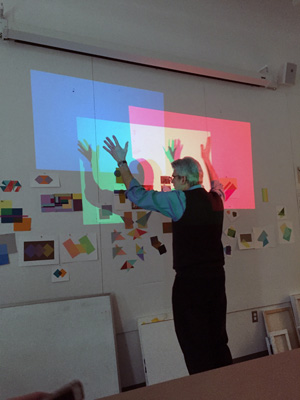
Professor Richard Raiselis shows students how mixing red, green, and blue light creates white. Photo by Morgan Bush
At CFA, students learn how to master this elusive element of art by studying color “problems,” experimenting with different combinations to create artistic sleights of hand. They discover that color isn’t so much about what viewers see as about what they think they see.
“Color class prepares us to be fooled, and to enjoy the swindle, to use [artist Josef] Albers’ word,” says Richard Raiselis, the associate professor of art who teaches the course. But the goal of learning about how colors affect each other, how context impacts perception, and how to quantify subtle differences in colors’ shades, isn’t just to perform impressive tricks—it’s to cultivate superior artistry.
To use color effectively—whether to grab attention in an ad, set mood with stage lighting, or create the appearance of depth in a painting—artists need to be as familiar with colors as magicians with cards in a deck, and manipulate them with the same dexterity.
Color Scientists at Work
Raiselis brought the class to CFA in the 1990s. Like many art instructors, he based it on what was likely the first such course in America, taught by German-born artist Josef Albers at Black Mountain College in North Carolina, and later at Yale University. Albers, who had studied and taught at Germany’s famous Bauhaus art school in the 1920s and early 1930s, was part of a mid-20th-century shift in art that rejected the depiction of real things or people in favor of focusing on color itself—and its power to create illusions.
“Color class prepares us to be fooled, and to enjoy the swindle, to use [artist Josef] Albers’ word.”
—Associate Professor Richard Raiselis
From the time he was a toddler, Raiselis was interested in art, but his parents encouraged him to choose what they considered a more practical career. He studied biology at Yale in the early 1970s, with an idea of continuing to medical school. But in his second term, while writing a paper about color vision in insects for a zoology class, “It was obvious that the art part of me was still alive,” he says. The next year, he took a color class under Richard Lytle, Albers’ former assistant in instruction, and switched his major to art. He was captivated by the beauty of the silk-screened Color-aid paper, the process of trial and error in completing color assignments, and the stimulating challenge posed by the seemingly simple task of cutting and pasting paper swatches. After graduation, he taught a color class at the City University of New York in Jamaica, New York, and the University of Michigan School of Art before arriving at BU.
Raiselis’ class, which meets in a studio on the fifth floor of 808 Comm Ave, is structured as a series of progressively difficult assignments derived from Albers’ 1963 book, Interaction of Color. It’s also peppered with museum visits and lectures by Raiselis on topics such as artists’ use of color throughout history. The class is open to all BU students, which allows for an exchange of perspectives and knowledge. For instance, Morgan Bush (CAS’16), who majored in psychology and minored in visual arts, says she “had something to contribute when we were talking about how the brain processes color.”
Sidebar
Color Illusion: Additive Light
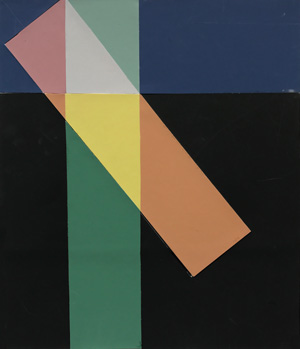
Students in CFA’s color class complete assignments that make optical illusions and show how colors affect each other.
For the assignment to the left, Alison Staffin (CAS’17) used paper to re-create lighting effects produced by overlapping slide projections. The project demonstrates additive light, in which mixing colored light creates lighter hues than those being mixed.
Raiselis introduces the class’ central concept—that color is relative—on day one, by asking students to line up two sheets of blue and red silk-screened Color-aid paper and stare at their boundary. The color of each paper acquires a neon brightness along the horizontal join, and the remaining portions of the papers seem to grow duller by comparison.
“Colors steal from each other what they already have,” explains Raiselis. “Blue wants to steal lightness and blueness from this red. Red wants to steal redness and darkness from this blue. You could call it simultaneous contrast. One exaggerates the differences of the other, just as positioning a tall person next to a short person exaggerates their differences.”
Each class assignment is treated as a problem for students to solve: for example, as in the artwork at the top of this page, how to make one color look like two (other assignments might include making two different colors seem the same or making three colors look like two). Raiselis shares examples of the color illusion they’re going to create—such as artwork by Albers himself—and weighs in as students work, but lets them discover “empirically, through trial and error,” how to create the desired effect. Students use various combinations of the 314 colors in their personal pack of Color-aid paper; in some assignments, they have the option of using stripes, squares, or rectangles. Although there’s no one solution to a problem, there are a lot of ways things can go wrong. As anyone who’s attempted to match socks in a dimly lit room knows, light affects how colors look. Students can unintentionally ruin their artwork by removing it from the natural sunlight of the north-facing studio to tinker under fluorescent dorm lights.
Sidebar
Color Illusion: Good Vibrations
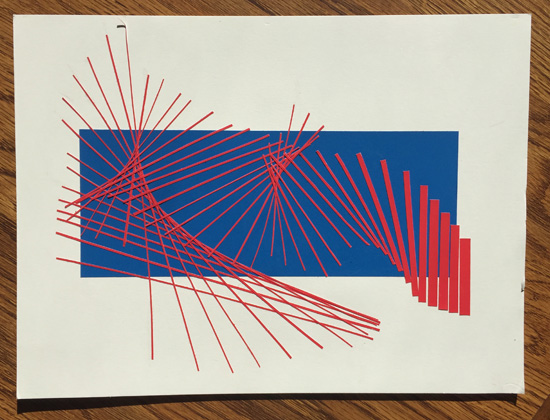
For the project above, students were told to use stripes of any thickness, color, and composition to create a vibration effect. This is achieved, says the artist, Alison Staffin (CAS’17), by choosing different hues with similar degrees of lightness or darkness and by using thin stripes as opposed to large swatches.
Students discover that “some colors are better actors than others,” Raiselis says. Take the artwork by Staffin: a neutral color works well for the small squares, because its muted nature makes them more susceptible to being influenced by surrounding colors. “It is impossible to see a single color in an isolated system without it being affected by anything else,” says Staffin. “You don’t see color for what it is, ever.”
Brain Teasers
The scientific explanation for why our eyes are fooled by this kind of illusion has to do with how the brain interprets color. “Your perception of the world is not based on what the actual visual world is,” says Jeff Gavornik, a College of Arts & Sciences assistant professor of biology. “It’s based on your brain’s attempt to make sense of that.”
“It is impossible to see a single color in an isolated system without it being affected by anything else. You don’t see color for what it is, ever.” —Alison Staffin (CAS’17)
The eye, he says, tells the brain what color it’s seeing in relation to adjacent colors—in terms of contrast and boundaries. When we look at a piece of white copy paper, our cornea and lens project that image onto the back of our retina. “What your brain responds to, what your retina responds to, are the retinal cells that lie across the edge of the paper in that image, where there’s high contrast,” says Gavornik. The brain effectively fills in the spaces between the edges to interpret the entire page as white. When we look at Staffin’s image, our eye can’t directly compare the color of the two small squares; it can only tell the brain about the color of each square relative to the color surrounding it.
Color class is a favorite with students, not only because it’s full of surprises, but because it elevates their craft. Tanner Gauvin ('18) says he’s become “more experimental” and “more knowledgeable of the colors that I’m using—picking and choosing when I really want to grab the viewer with a certain pairing of colors, and when I want the viewer to be relieved by a really subtle shift of colors.” Dina Martinelli (’15,’16), an art teacher at Jaworek Elementary School in Marlborough, Massachusetts, says what she’s learned about how dissimilar colors enhance each other has added stronger contrast and the illusion of depth to her collage work. And Staffin, a biology major who now studies graphic design, says she’ll use her color knowledge to control what elements in an infographic stand out to the viewer first.
Even Raiselis is still learning a thing or two. “I think there are color relationships in my paintings that didn’t exist [in my work] a couple of years ago,” he says—and although he’s been teaching color for decades, it still gives him a thrill. “To see people’s eyes open [to what color can do] is pretty exciting. For me it’s magical, and there’s always something we can learn.”
A New Stage for CFA
The lights go up on the Joan and Edgar Booth Theatre
By Esprit staff
Actors throughout the world make do with makeshift stages in cinemas, bars, and town halls. Even the greatest stars of screen and stage may spend a lifetime treading borrowed boards. As part of a major overhaul of its spaces for the arts, Boston University is bringing a new theatre complex to the heart of its Charles River Campus—and in late 2017, students will step onto a stage built just for them.
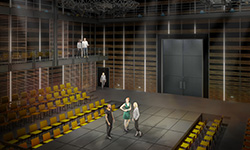
Joan and Edgar Booth Theatre
21,000
square feet
250
seats
9
motorized trusses for lighting, scenic elements, and more
1
motorized catwalk
Photo courtesy of Elkus Manfredi Architects
The project is funded in part by a naming gift of $10 million from leading global financier and self-described sports zealot Steve Zide. Zide, a Boston University trustee, says the gift is a fitting and poetic tribute to his theatre-loving wife, Janet Zide, and his in-laws, who brought the joy of stage performance into his life and the lives of the Zides’ four children.
Rising from a former parking lot at the edge of 808 Comm Ave in what will eventually be an arts campus within West Campus, the theatre will bear the names of Janet Zide’s parents as the Joan and Edgar Booth Theatre. Edgar Booth passed away recently, but Zide’s mother-in-law, Joan Booth, remains an active patron of the arts and a Broadway aficionado, says Zide (LAW’86).
“It’s not an area that I would normally have thought of, but it struck me as the perfect thing to honor Jan’s parents and to give back in a way that’s meaningful to Jan and to me,” says Zide, senior advisor of private equity at the New York offices of international private equity and investment capital firm Bain Capital. He believes that exposure to the arts is an essential part of the mission of all great universities and in the development of full and productive members of society.
“BU is ascendant in so many disciplines since President Brown became part of the community, and we really feel that performing arts are a critical piece of a great urban university,” Zide says. “We wanted to make sure that students interested in performing arts have the opportunity to pursue their passion, the way, for example, medical, law, and business students have the facilities to pursue theirs.”
President Robert A. Brown says he believes that the arts should be part of every student’s experience at Boston University. “When we open the Joan and Edgar Booth Theatre, we will have at the heart of our campus a state-of-the-art theatre as the centerpiece for the role that the students and faculty of the School of Theatre play in fulfilling this goal,” says Brown. “We are deeply grateful to the very generous gift from Steve and Jan Zide—honoring Jan’s parents—that made it possible for us to make this project a reality.”
Designed by the Boston architectural firm Elkus Manfredi, the 75,000-square-foot theatre complex will include the 250-seat Joan and Edgar Booth Theatre, production and costume shops, design labs, classrooms, and a landscaped plaza. When the complex opens, it will be the first time in decades that CFA performance and production students have been housed in the same dedicated location. The theatre will be the centerpiece, funded in part by monies from the 2016 sale of the BU Theatre, the longtime home of the Huntington Theatre Company.
Lynne Allen, CFA dean ad interim, says the gift from the Zides highlights how important theatre and the arts are to our culture. “The naming of the theatre is an incredible gift to the College of Fine Arts community,” Allen says. “It is also a gift to every BU student and faculty and staff member. The theatre will be accessible and central to every BU student’s life.”

The lobby will encourage the community to own the space. Photo courtesy of Elkus Manfredi Architects
In recognizing the generosity of Zide’s gift, Allen hopes it inspires others to support the new space. “This is an incredible moment in time for the School of Theatre, College of Fine Arts, and Boston University. The energy of this new chapter is palpable and alumni support is essential as we finish this space. I encourage our alumni to contribute to this campaign, support the endeavor, and join us in celebrating the space when it opens.”
Jim Petosa, director of the School of Theatre, hopes that a unified home for CFA’s performances and students at the heart of the Charles River Campus will spark cross-disciplinary collaborations and encourage more students, staff, and faculty to attend performances.
“What was most exciting about our project was participating in the design of a new purpose-built 21st-century cultural facility from the ground up,” says Petosa, who was part of a faculty team that collaborated with the architects. “We arrived at this extraordinary space that provides a performance venue that encourages innovation, teaching spaces that are appealing and a joy to inhabit, studio spaces that give students a wonderful environment in which to work, and production shop spaces that are fully dedicated to the productions we undertake.”
For Zide, the theatre is not just a way of showing his appreciation for his wife’s family. It’s a way of showing his appreciation for all of those who have invested in the future of the University. “We all benefit from those who came before us who took the time and interest to make investments and commitments in the future,” he says. “We wanted to be part of that same cycle, and we’ve been very fortunate to have the ability to invest in the BU community and current and future students.”
Opening our doors—and walls
A new studio for graphic design and a renovated façade for 855 Comm Ave

Graphic Design Studio
13,000
square feet
50
new workstations
2
open studios and new classrooms
Photo by Janice Checchio
Another program is already enjoying life in its exclusive, specially designed headquarters. Before moving into a 13,000-square-foot studio in summer 2016, graphic design faculty sometimes had to borrow classrooms—even making a temporary home in a former pizza restaurant. The newly opened graphic design studio at 808 Comm Ave has modular workstations, flexible presentation areas, classrooms, faculty offices, and stunning views of the Charles River. “We can take control of our environment and set it up the way we need to, to foster the kind of work we want to make,” says Kristen Coogan, an associate professor of graphic design. “Depending on what the project is, what the discourse is, we can design our space and be thoughtful and engaged practitioners.” The program’s enrollment numbers are at an all-time high and, thanks to the studio, the College expects to expand further.
CFA is not just opening doors to more students; it’s opening its walls. Nearly a century ago, when 855 Comm Ave was a Noyes Buick dealership, its façade was marked by towering arched windows. The arches were bricked up decades ago, but thanks to the support of generous donors, the windows are coming back, exposing galleries and theatre classrooms to the street.
“The biggest deficit of the current façade is that nobody knows what goes on in CFA unless they walk in the door—and let’s face it, if they don’t have a reason to, they don’t come in,” says Allen. “Opening the windows will allow the world to see activity, to see art in the gallery vitrines, to see students inside, and to have open access doorways that are inviting.”
The changes will “improve the look and feel of CFA along upper Commonwealth Avenue,” says Jane Pappalardo (’65). “To restore the openness that was once there and to create a destination for performance for students, alumni, and Boston arts lovers, is the most thrilling accomplishment for this esteemed University.” Jane's gift with her husband Neil Pappalardo, as well as gifts from Nina Tassler (’79, Hon.'16) and Gerald Levine (’79), and Andrew (Par’14) and Julie Stanton (Par’14) will help make the renovation possible.

Façade
Free-standing walls
or vitrines, will be set back from the windows to create mini galleries for displaying art.
Windows
looking in on theatre classrooms can be darkened to create private rehearsal spaces.
Photo courtesy of Wilson Butler
Allen calls the projects a “facelift to the outside world” and says they—along with the $15 million construction of School of Music practice rooms in 2008 and 2009—demonstrate the University’s commitment to the College of Fine Arts. She hopes that encourages more donors to step forward to support the arts, and these projects in particular.
“The renovations and purpose-built structures send a message from the upper administration that the arts are important at BU, and BU is willing to support them,” she says. “In a major research university, which has a focus on STEM study and research, this is an example of how BU values all aspects of a creative life and believes it should be part of every student’s experience. We at CFA take that as a license to expand and explore beyond our own walls.”
SUPPORT CFA PROJECTS HERE. TO SUPPORT ACTIVITIES IN THE JOAN AND EDGAR BOOTH THEATRE AND DESIGN & PRODUCTION COMPLEX, CONTACT CHRIS MARRION, ASSISTANT DEAN, AT (617) 353-3345 OR CMARRION@BU.EDU.
The Arts Importer
Violinist brings orchestral music to the Middle East
By Jessica Ullian | Photos by Sam Wilson
In 2014, violinist Hannah Lawson accompanied her husband to the Eastern Province of Saudi Arabia looking for adventure—and became her community’s go-to source for arts, culture, and after-school entertainment. Private lessons for eager expatriate students led to a job opening at an international school, where most of the students are foreign nationals living in company compounds. There, Lawson created the region’s first school string orchestra.
“About half of our students grew up here or were born here, and their education only consisted of general music, so they’re coming to orchestra with no biases, no gender standards—the girls are playing double bass,” says Lawson (’17), who is earning her master’s in music education through CFA’s online program. “As soon as the school year starts, I play the Jaws theme for them, and you can see their eyes open up. They’re so excited about something new.”
Lawson describes herself and her husband, Ian Celing, as “typical Midwestern” types who initially accepted Celing’s job offer with an oil company in Saudi Arabia so they could travel and pay off their student loans (the country has no expatriate income tax). They moved to Ras Tanura, a compound for foreign employees on the Persian Gulf. Lawson hadn’t anticipated how much free time she would have, and how few opportunities existed to fill it.
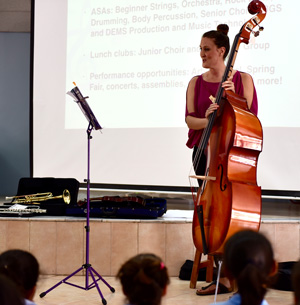
Hannah Lawson ('17) is an orchestra director for Saudi Arabia's British Grammar School of Dhahran, where she has created a curriculum for 800 students from 43 countries.
“We don’t have bars and movie theaters here, and it’s hard for people to communicate between compounds—it’s a lot of word of mouth, kind of like before the age of internet,” she says. The region’s extreme heat—not to mention the need to wear an abaya for trips outside her compound—made finding new activities, or exploring the nearby cities, a challenge.
The only violinist for miles, Lawson began giving private string lessons within her compound and searched online for jobs. She found an opening at the Dhahran British Grammar School, an hour from her compound. The job interview marked the first time she’d left the house without her husband—women typically only travel with male family members—and she had to take a taxi for the trip, since women aren’t permitted to hold driver’s licenses.
“Outside there was this huge, gloomy-looking gate, and then you enter and it’s this gorgeous green lush land,” Lawson says. “When they asked about my background during the interview, I said that I was an orchestra director, and they said, ‘That’s wonderful! We’ve always wanted one of those!’”
“When they asked about my background during the interview, I said that I was an orchestra director, and they said, ‘That’s wonderful! We’ve always wanted one of those!’”—Hannah Lawson (’17)
Lawson quickly found that the school’s needs dovetailed with her master’s work: she was afforded near-total freedom to create a curriculum for nearly 800 students ages 3 to 17, with the stipulation that it had to be structured so another instructor could come in and continue the work when Lawson eventually leaves the country. The students, who come from 43 countries, were lured by her violin renditions of pop tunes, and signed on enthusiastically. There was one potential setback: the school didn’t have adequate instruments for a string orchestra.
Lawson’s private students had been purchasing instruments online, but that wasn’t practical for an order of 20 violins, 15 violas, and 4 cellos. Lawson and her colleagues discovered that the three local music shops were owned by the same person, so Lawson contacted him and explained her predicament. “He was so excited to help us,” she says, and promptly connected her with a retailer in the United Kingdom. The items took five months to arrive, but now the school has everything it needs, including backup instruments and extra strings.
The experience with the shop owner is emblematic of Lawson’s life in Saudi Arabia: “a completely wonderful, polite, and friendly experience,” she says.
Lawson’s husband is on a month-to-month contract, so the couple is free to return to the US any time. They’re in no hurry. Lawson’s students are busy with everything from composing in the computer lab to after-school body percussion clubs. The school held its first all-campus arts festival in November 2016, and held the first all-school performance, which included string orchestra, in December 2016, where the students performed an arrangement of a Coca-Cola holiday advertisement. And while they occasionally miss life in the United States—“sometimes I just want to go to Target by myself,” she says, “and wear a tank top”—Lawson says her teaching experience in Saudi Arabia is unlike any other she’d find in the world. “We’re in this small school in the Middle East, and have one of the coolest programs around.”
Baron Vaughn Uses Comedy to Dig Deep
Baron Vaughn of Grace and Frankie uses comedy to dig deep
By Corinne Steinbrenner
Banner image: In March 2016, actor and comedian Baron Vaughn (’03) performed at SXSW Comedy during the 2016 SXSW Music, Film + Interactive Festival at The North Door in Austin, Texas. Jealex Photo/Getty Images Entertainment/Getty Images
Baron Vaughn’s list of current projects is as long as it is impressive. Vaughn (’03), an acting major, plays Frankie's adopted son, Nwabudike "Bud" Bergstein in the hit Netflix series Grace and Frankie. He’s also producing and hosting the Comedy Central show, The New Negroes. This year’s revival of the cult classic Mystery Science Theater 3000 features his writing and voice acting. Fatherless, Vaughn’s documentary about meeting his father for the first time at age 35, recently aired on the Fusion Channel. His second comedy album, Blaxistential Crisis, is available on iTunes.
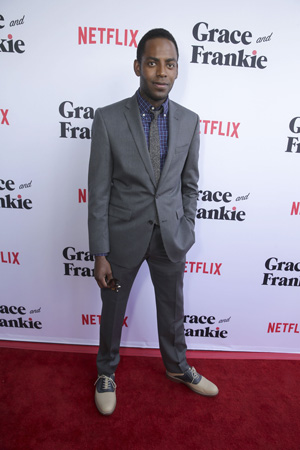
Among many other projects, Baron Vaughn (’03) appears in the hit Netflix series Grace and Frankie, produces and hosts The New Negroes on Comedy Central, and released two comedy albums. Eric Charbonneau/Invision for Netflix/AP Images
While the variety of these undertakings reflects Vaughn’s wide-ranging skills, the projects are united by his sharp-witted humor. Even the documentary, with its ostensibly sober subject matter, elicits more laughter than tears.
“Humor is the number-one way that I process things,” says Vaughn. “There are a lot of people who are funny who use humor as a deflection device, but I use it as a drill to go deeper into things.”
Vaughn gravitated to stand-up comedy at an early age. The monologue he delivered at his first acting audition—which earned him entrance to Las Vegas’ magnet arts high school—was structured like a stand-up routine. “It was something about how I was at an age where I was too old for some things but too young for other things,” Vaughn recalls. “It set up a thesis, and then all the things that supported it were essentially jokes. I guess that’s why I was attracted to it.”
Vaughn first performed his own stand-up material as a college student in Boston, appearing on open mic night at Dick Doherty’s Beantown Comedy Club. “It was a two-person bringer,” he says: in order to be allowed on stage, he had to bring along two people willing to pay the show’s $7 cover. “All of my friends were college students, so that was very difficult to organize,” he says. “It was basically, ‘I can either see Baron tonight or eat a sandwich. Hmm. Decision made. One burger, please.’”
After graduating from CFA, Vaughn moved to New York to pursue acting and comedy, both of which he loves, but for different reasons. While acting offers the joy of collaborating with fellow actors, stand-up affords him full control of his subject matter and its delivery. “I get to take people on a ride,” he says of stand-up.
“Humor is the number-one way that I process things. There are a lot of people who are funny who use humor as a deflection device, but I use it as a drill to go deeper into things.”—Baron Vaughn (’03)
Vaughn honed his stand-up skills performing hour-long comedy shows at colleges throughout the country. His stage presence and jokes about familiar subjects—parents, dating, cable TV—made him a popular act from Vassar to UConn to Appalachian State.
“Colleges were my bread and butter for four or five years,” Vaughn says, “and then as I got older, I started talking more about life—like rent and bills and trying to actually be in a relationship—stuff that college students couldn’t really relate to. They wanted more high-energy stuff that was silly, which I do, but now I wrap that around a perspective.”
Today Vaughn lives in Los Angeles and travels the country to appear at comedy clubs and festivals. His latest comedy album showcases his love of puns and his theatrical style. He breaks into song mid-sentence. He chirps like the crickets who’ve invaded his apartment. He meows “The Imperial March.” Vaughn calls himself a kitchen-sink comedian, “meaning that I throw everything at you, including the kitchen sink,” he says. “I use everything that’s at my disposal in my act. I use the fact that I can do characters, act, do different voices and accents, do interesting things with my body, do sound effects.”

In the hit Netflix series Grace and Frankie, Vaughn (right) plays Nwabudike "Bud" Bergstein, adopted son of Frankie and her former husband, Sol (Sam Waterston, left). Melissa Moseley/Netflix
The sillier segments of the album balance out more serious bits about defaulting on his student loans and developing a life-threatening allergy to dairy. He told a version of the allergy joke during a recent Comedy Central appearance: “I’m actually going to stop calling my allergies that because it’s a wimpy name for something that might kill you out of nowhere. So I’m now going to call my allergies my police.”
Vaughn says he tackles thorny subjects like racism, gun violence, and his own intimacy issues because he’s interested in the “whys of humanity” and the whys of himself. “Essentially, all stand-up comedy is, 'Why do people do things?',” he says.
When he drills into a particular human behavior to discover its core, what he finds there often leaves him shaking his head, he says, and thinking, “That is silly.” In that absurdity, he finds comedy.
By exploring serious subjects on stage, Vaughn hopes to give audience members permission to delve deeper themselves. “It’s not that I want to tell people what to think,” he says, “as much as I want to tell people it’s okay to think, and it’s okay to apply those thoughts to your life, and ask questions, and to say what you feel, and express your fears.” And it’s okay to laugh at yourself in the process.
The Art of Creating Artificial Eyes and Facial Prosthetics
Sculptor puts her skills to use making artificial eyes and facial prostheses
By Corinne Steinbrenner | Photos by Mark Fleming
Kaylee Dougherty presses a sculpting spatula to the clay, smoothing the contours of her morning’s work. She pours a mixture of resin and artificial stone around the clay to form a mold; when it’s set, she’ll fill the mold with pigmented silicone to create an astonishingly lifelike final product.
While most sculptors intend for their work to be seen and admired, Dougherty (’11), an associate at Boston Ocular Prosthetics, Inc., hopes that this piece will go unnoticed.
Dougherty is training to become a certified ocularist and recently received her certification as a clinical anaplastologist. As an ocularist, she creates artificial eyes for patients born without eyes, or for those who have lost them to accident or disease. As an anaplastologist, she sculpts facial prostheses for an array of patients—a man who lost his nose to skin cancer, a girl born with an underdeveloped ear, a woman whose eye was destroyed in a car accident.
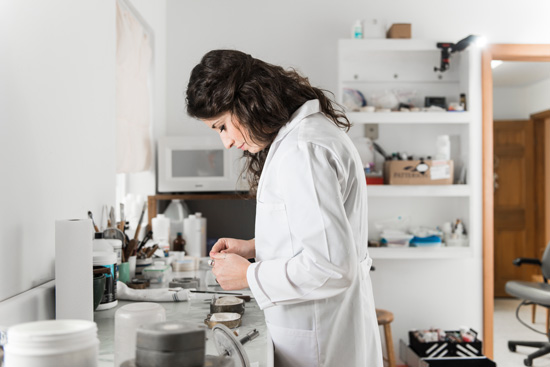
An associate at Boston Ocular Prosthetics, Inc., Kaylee Dougherty ('11) creates artificial eyes and sculpts facial prostheses. Every piece is custom and matched to her patients' natural features.
“Everything is custom,” Dougherty says. “Each piece we do is hand sculpted, is hand painted or hand pigmented.” The goal is to match the prosthesis so precisely to her patient’s natural features that her artwork is mistaken for reality.
Dougherty works alongside her employer and mentor, Ottie Thomas-Smith. Both trained sculptors, they fabricate artificial eyes using dental-grade acrylic, adding red silk thread to replicate veins and mixing pure pigment to create custom eye colors. For facial prostheses, they work primarily in silicone, which they tint with dry pigment to match a patient’s skin tone.
Dougherty and Thomas-Smith spend most of their time in Boston Ocular Prosthetics’ main office and fabricating lab in Jackson, Maine, a tiny town southwest of Bangor that provides a peaceful setting for focusing on their work. They also make regular visits to satellite offices in the Boston area, where they meet with patients to take impressions, perform fittings, and provide maintenance. Ocularistry patients make regular appointments just as they would with their dentist. “We like to see our patients once or twice a year,” Dougherty says. “We clean [the eye] and polish it and check it to make sure there’s nothing that needs adjustment.”
All of Dougherty’s patients come through a physician’s referral, and their prostheses are covered by medical insurance because they are necessary, Dougherty says. “They aren’t just cosmetic.”
Kaylee Dougherty (’11) takes us into her fabricating lab. Dougherty was drawn to anaplastology because the field matched her interests: working with her hands, working with people, and making a positive difference in the world. Video by Jason Kimball
A prosthetic ear helps direct sound waves into the auditory canal. A prosthetic nose filters and moisturizes incoming air. An artificial eye keeps the eyelid in position and helps tears drain properly. When a child is missing an eye, the eye socket can cease to grow, causing the child’s face to develop asymmetrically. Wearing an increasingly larger prosthetic eye can stimulate growth of the socket, encouraging normal maturity of facial bones and tissues.
“Everything we make has a purpose beyond just making this person look normal again,” Dougherty says. “Of course, I can [also] put an ear piercing in for a teenage girl. It’s not going to hurt, so we might as well go for it.”
Finding Her Calling
Dougherty chose sculpture as her undergraduate major at Boston University because “I wanted to do sculpture when I was seven years old,” she says. “It’s all I’ve ever wanted to do.
“I love the physical aspect of sculpting—the act of it,” she continues. “But I didn’t ever see myself having a studio somewhere and trying to sell what I was making, or being in galleries. I always wanted to work with my hands, and I knew getting a degree in sculpture would get me the knowledge I needed to do a lot of different things.”

Dougherty fabricates artificial eyes using dental-grade acrylic, adding red silk thread to replicate veins and mixing pure pigment to create custom eye colors.
The School’s sculpture graduates apply their knowledge of form and visual relationships to a range of careers, says Jeannette Guilleman, director ad interim of the School of Visual Arts, from theatre-set design to retail displays to 3D animation.
Dougherty heard about anaplastology during her senior year at BU and immediately recognized it as a field that matched her interests: working with her hands, working with people, and making a positive difference in the world. She researched the requirements to become a certified anaplastologist, which include a combination of scientific and studio-art coursework and three years of supervised training. Through her BU studies, she had already completed all of the required art classes and some of the science classes. After graduation, she took the remaining coursework—medical terminology, human pathology, and human physiology—through BU’s division of graduate medical sciences, and began searching for a mentor to supervise her clinical training.
She was surprised to discover that of the nation’s nearly three dozen anaplastologists, only one was located in New England: Thomas-Smith, who has a dual specialty in anaplastology and ocularistry. Dougherty called Thomas-Smith and asked if she could see her work firsthand. Thomas-Smith had upcoming appointments in her Boston office and invited Dougherty to meet with her there.
“So she came,” says Thomas-Smith, “and I can’t remember specifically who the patients were, but I do remember them being rather interesting. You know, large facial patients—people with portions of their faces missing.” Seeing these cases, she felt, would be a good introduction for Dougherty to the realities of the work.
“The first patient I met,” remembers Dougherty, “was a man with an artificial eye. He came in and sat down, Ottie introduced me, and he just took out his eye and handed it to me.”
“And God bless her,” says Thomas-Smith, “she was interested. She acted extremely appropriately and professionally, was very sweet when asked anything by the patients. There was one patient who lobbied for me to hire her immediately.”
“I always wanted to work with my hands, and I knew getting a degree in sculpture would get me the knowledge I needed to do a lot of different things.”—Kaylee Dougherty (’11)
Creating Relationships
Dougherty joined Boston Ocular Prosthetics as an apprentice in May 2013. She passed her anaplastology certification exam last year, and she expects to take her ocularistry exam in 2018. Thomas-Smith says she looks forward to eventually retiring and turning her business over to Dougherty, who she knows will take good care of her patients.
Building relationships with patients is a large part of Dougherty’s work and one of the things she loves most about it. Her youngest patient was a six-day-old girl born with only one eye. That infant is now a two-year-old who always greets Dougherty with a hug. “My oldest patient is 97,” Dougherty says, “and I go to her house because it’s difficult for her to get down to our office.”
Taking time to know her patients not only makes Dougherty’s work more enjoyable, it can also improve patient outcomes. When she first met John, who had lost both eyes to childhood retinal cancer, she asked him detailed questions about his life and daily habits to help her best meet his needs.
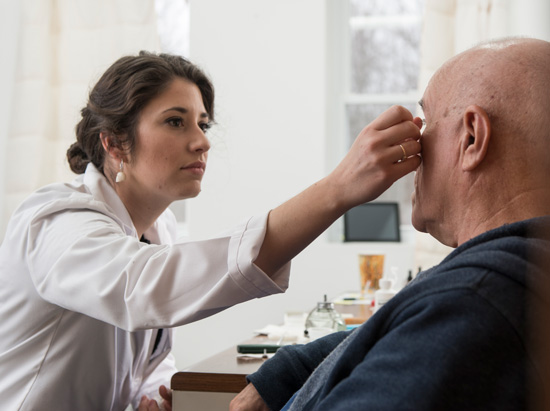
Building relationships with patients is one of the things Dougherty loves most about being an ocularist and anaplastologist. She meets with patients to take impressions, perform fittings, and provide maintenance.
John had been wearing a patch over his most damaged eye socket and an artificial eye in the other. “But because of the radiation [treatments] over the years,” Dougherty says, “he couldn’t wear the artificial eye anymore.”
Dougherty wanted to make John two orbitals—prostheses that replace the eye and its surrounding tissue—but she worried that a blind patient would have difficulty placing two separate prostheses correctly. She asked if he lived with anyone, and John told her that his wife was also blind. Since John didn’t have anyone to help with daily placement, and he’d comfortably worn sunglasses for years, Dougherty borrowed an old-fashioned technique and made him a spectacle-held prosthesis—two orbitals attached to a simple pair of eyeglasses.
“I was able to make him something that was comfortable and wearable that he could use every day and know it was going to be in right,” Dougherty says. “It’s an example of how you really have to talk to someone and get to know the person.”
Dougherty knows that having two lifelike eyes helps John interact more easily with friends and business associates. “I like making a difference on that very micro level,” she says. “It’s one person at a time, but it makes a big difference to that individual person.”
Patients often ask Dougherty if she still makes art. She laughs at the implication that what she’s doing for them—sculpting an ear, painting an iris—isn’t “art enough.” For her, she says, it very much is.
Actor Producer, Opera Producer, Graphic Novelist—Alums Redefine Their Fields
By Julie Butters
Banner image: Peter Paige ('91) (from left), Beth Morrison ('94), and Joel Christian Gill ('04) received 2016 CFA Distinguished Alumni Awards. Photo by Natasha Moustache for Boston University
Growing up, Joel Christian Gill (’04) developed a knack for storytelling—by fibbing to his friends that he owned all the newest and coolest toys. He pretended that, like Harry Potter, he “was just one giant-on-a-motorcycle away from a major adventure at Hogwarts— when I was just a poor kid from the projects.” As an adult, Gill’s imagination led him to tell more truthful, meaningful stories in his acclaimed graphic novel Strange Fruit: Uncelebrated Narratives from Black History (Fulcrum Publishing, 2014).
Gill, chair of foundations at the New Hampshire Institute of Art, received a CFA Distinguished Alumnus Award at a ceremony emceed by Emmy-winning actor Michael Chiklis (’85). The event, which honored alums for groundbreaking contributions to the arts and society, was part of BU’s annual Alumni Weekend. “History is written by people who actually look for the truth,” Chiklis said in introducing Gill. “In Strange Fruit you’ve brought content, depth, and artistry to the genre of graphic novels. You’ve taken the notion of heroes and legends, and shown us they are sometimes hidden, but equally as bold.”
“Opera. The word alone conjures up ideas to each of us,” said Chiklis in presenting a Distinguished Alumna Award to Beth Morrison (’94). “It’s pretty loaded. A little heavy. Maybe even a bit remote or untouchable. Except when you’re Beth Morrison. Then you just redefine it.” Morrison is creative producer of the indie opera company Beth Morrison Projects, which champions music-theatre, opera-theatre, and multimedia concert works by today’s most exciting emerging artists.
“The human condition [is] no stranger to art,” Chiklis said while honoring Peter Paige (’91) with a Distinguished Alumnus Award. “Generations of artists have been inspired by it, and the artist who digs into the human condition, pulls it out unapologetically, and holds it up saying this is the truth, this is what it means to be human. Well, that artist is Peter Paige,” co-creator and executive producer of the ABC Family drama The Fosters, which follows an interracial lesbian couple as they raise their family.
The Alumni Awards are BU's highest honors for alumni; these alums have distinguished themselves professionally through exemplary artistry and extraordinary leadership.
A version of this article originally appeared in BU Today.
Download the PDF
Ad1

Ad2
Ad3