

Category: Features
Lullabies that Inspire Hope
Musicians help at-risk mothers write lullabies for their babies
By Susan Seligson | Photos by Asher+Oak Photography
When Shana, a young Congolese immigrant living in Lynn, Massachusetts, was 26 weeks pregnant, her baby stopped moving.
Though doctors at nearby North Shore Medical Center (NSMC)/Salem Hospital said the baby’s heart was beating, they were sufficiently concerned to transfer Shana to Massachusetts General Hospital (MGH), where doctors performed an emergency C-section.
Baby Adriana weighed 1 pound 12 ounces at birth and was hospitalized for two months, first at MGH and then at NSMC. The uncertainty was frightening for Shana, but she found solace in music. Erin Peterson, a caseworker at Boston Medical Center, where Shana had planned to give birth, introduced her to the Lullaby Project, through which several CFA alums helped her craft a song for her baby girl.

Violinist Maya French (’15,’18), co-executive director and artistic director of Palaver Strings, leads the Boston branch of the Lullaby Project, a national outreach program that helps at-risk mothers create songs—and lasting memories—for their babies.
Members of the Boston-based chamber group Palaver Strings, known for using their talents for social awareness, have poured their hearts into the Lullaby Project, a national outreach program that helps mothers facing poverty, incarceration, or homelessness create songs—and lasting memories—for their babies.
Led by violinist Maya French (’15,’18), Palaver co-executive director and artistic director, and Elizabeth “Lizzie” Moore (’14), a violist and songwriter, Palaver Strings has been working for two years with schools and nonprofits in neighborhoods throughout greater Boston. They based their branch of the Lullaby Project at Boston Medical Center (BMC), where they had an opportunity to work with Moisès Fernández Via, director of Arts | Lab, a unique collaboration among CFA, Boston Medical Center, and BU Medical Campus that injects the arts into a clinical setting.
A familiar figure on campus, Fernández Via (’11) has forged artistic partnerships—through the Arts | Lab—at BMC for the last four years, with programs that had CFA students playing lobby concerts in the Menino Pavilion, providing impromptu solo serenades to patients recovering on BMC’s wards, and reading poetry to cancer patients as they received chemotherapy infusions.
“Palaver Strings has been part of the Medical Campus since the very first day of the Arts | Lab,” Fernández Via says. “I have seen them grow from a casual chamber group to a consolidated string ensemble, embodying the core mission of our task at BMC: turning individual ability into collective opportunities.” The Lullaby Project, he says, “belongs to a category of the Arts | Lab project called ‘Audienceless.’ Here, we test our capacity to include others in what we do.”
Fernández Via was moved to participate in the project because, as he put it, a lullaby is more than a song. “A lullaby is a musical fossil, a powerful narrative that encapsulates in a song all the complexities of parenthood: nurture, vulnerability, doubt, uncertainty, hope, resilience, tenderness,” he says. “Inviting young parents at-risk to write personalized lullabies seems to me a powerful opportunity: a chance to awaken their innate wisdom, so that it guides them through the vastness of parenthood.”
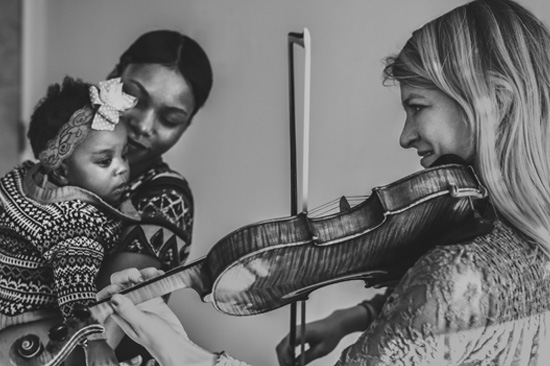
Shana (left), a Congolese immigrant, worked with CFA alums in the chamber group Palaver Strings—led by violinist Maya French (’15,’18) (right)—to write a lullaby for her baby girl.
Fernández Via recruited three participants through caseworkers at BMC. The musicians worked with Shana, then 20, while her baby was in the neonatal unit at NSMC/Salem Hospital. The second participant, Erina, learned she was pregnant at age 40, soon after she arrived from the Democratic Republic of Congo (DRC). Marle, a Congolese who befriended Erina in an ESL class while both lived at a Dorchester shelter for new immigrants, went to the BMC session with Erina for moral support and decided to participate in the project. She wrote a lullaby for her mother, who stayed in the DRC.
French and Moore surveyed the participants, asking about their backgrounds and concerns. For example, they asked, When your child is 18, how will you explain the project and why you participated? What do you do to create calm in your child’s daily life?
Two musicians worked with each woman to develop a custom lullaby. Matthew Brady, who attended BU, from the Boston-based band Milk, served as producer, recorder, and percussionist. Palaver cellist Nikolai Renedo, co-artistic director and community engagement coordinator, was Spanish translator. Fernández Via translated Marle’s interviews from French to English during the songwriting process.
“We had the moms write a letter to their baby, and used that as a starting point,” French says. With the help of the letter and evaluation, the musicians pieced together the women’s stories, passions, and concerns for their children to develop a tune unique to each. Shana, who had a toddler at home while caring for her newborn in the neonatal unit, says she uses music and poetry to cope with life’s hardships.
“I like poems, so I wrote one that they helped me put to a melody,” says Shana, whose tune is inspired by the music of American gospel singer Kirk Franklin. “My poem was about how what I went through was scary at first but it ends good.”
“Once you have words and ideas, you begin thinking about the shape of those words,” says Moore. “Sounds have shape, too, so from the lyrics it’s easier to create the tune, beginning with some chords. And often they’ll tell us a favorite song or songs that make them feel comfortable,” so the musicians can use those as a guide. Shana, for example, wanted the song to be upbeat and played a tune she likes on her phone. “She was trying to portray that this baby was a miracle,” French says.
The pair was surprised by how each lullaby had strong, distinct influences. Erina, though Congolese, is a Spanish speaker who had lived in Cuba and created the ballad “Bienvenido Al Mundo” with Spanish lyrics and a Spanish lilt to express her worries about her child’s future.
Marle, who is learning English, wrote her lullaby “Femme De Courage” to her mother in the DRC, in their native French. “Her whole family is in the Congo, including her children,” French says. “She is here hoping to provide more opportunity for her kids, and wanted to write an ode to her mother for her love and support.”
Shana’s Song
I was told you wouldn’t make it, the pain I couldn’t take it… Miracles come, miracles come, miracles come in small packages. I got down on my knees and prayed, asked my God to make a way, a way to take out pain and stress, and replace it with joy and happiness.
Shana’s song, “Mommy’s Miracle Baby,” written in English, is American R&B, chosen for her love of the upbeat sound.
The all-day process, in a BMC conference room, was followed by a recording session at Fernández Via’s apartment. Often the songs created through the Lullaby Project are recorded by professional singers, “but we want to encourage the women to sing their own songs,” French says. “These were their lullabies, and as long as they felt comfortable we felt they should have ownership, so when they play it for the baby, the baby hears his mother’s voice. We wanted them to be at the center of it.”
At first the women “were a little nervous, but we tried to keep it really relaxed,” French says. “It was such a new experience for them.” The musicians—instrumentation included upright bass, cello, viola, keyboards, guitars, and some background vocals—performed within the mothers’ vocal comfort zones so they could sing the lullabies easily and naturally. “It’s really for the women and their babies,” says French.
Despite her shyness, Shana sang her lullaby in front of an audience at an April 2016 Arts | Lab event, a stunning moment for her and for the musicians, who remain in touch with her. Her song acknowledges a debt to God for her baby’s survival.
Shana was nervous about singing in front of people, “but I wasn’t scared,” she says. “I sang in a church choir in my country.” The 30 people gathered in the BMC lobby were swept away by her song, says French. She sang solo. She had dressed up for the event and had posted about it with pride on Facebook. “She’d practiced the song a lot,” French says. “I cried when she sang.”
To help new mothers craft songs that their children are likely to sing to their own babies one day “was one of the most amazing creativity experiences,” says French. “We really bonded with them.” The mothers said they, too, hoped the songs would be passed along to future generations, “hopefully in a better place,” and in a better situation, with their kids having what they need in life, French says. Shana sings her lullaby to Adriana, who is “fine now.” Her words, set to music, “should give other mothers hope.”
The Science of Color
CFA class teaches color scientists how color fools our eyes
By Julie Butters | Banner image by Alison Staffin
How many colors do you see in the above image?
You may have guessed four: one for each of the four squares. But the answer is three. The two small squares are the same color; they only appear different because of their contrasting backgrounds.
The artwork, created by Alison Staffin (CAS’17) for a CFA studio class, reveals what a trickster color can be. It can change its appearance by “stealing” from the hues around it. The way our brain interprets color depends on context; as a result, the small squares appear to be different hues of gray.
(Not seeing the illusion? Distance can enhance the effect: try stepping away from your computer or device to view the artwork. Still no luck? Screen display settings, or differences in how color can appear across browsers, could be altering the true colors of the original image.)
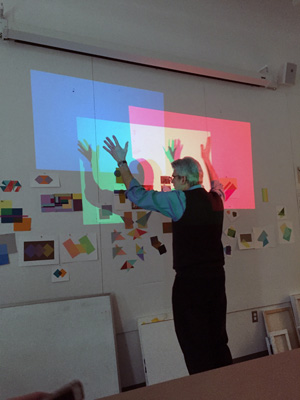
Professor Richard Raiselis shows students how mixing red, green, and blue light creates white. Photo by Morgan Bush
At CFA, students learn how to master this elusive element of art by studying color “problems,” experimenting with different combinations to create artistic sleights of hand. They discover that color isn’t so much about what viewers see as about what they think they see.
“Color class prepares us to be fooled, and to enjoy the swindle, to use [artist Josef] Albers’ word,” says Richard Raiselis, the associate professor of art who teaches the course. But the goal of learning about how colors affect each other, how context impacts perception, and how to quantify subtle differences in colors’ shades, isn’t just to perform impressive tricks—it’s to cultivate superior artistry.
To use color effectively—whether to grab attention in an ad, set mood with stage lighting, or create the appearance of depth in a painting—artists need to be as familiar with colors as magicians with cards in a deck, and manipulate them with the same dexterity.
Color Scientists at Work
Raiselis brought the class to CFA in the 1990s. Like many art instructors, he based it on what was likely the first such course in America, taught by German-born artist Josef Albers at Black Mountain College in North Carolina, and later at Yale University. Albers, who had studied and taught at Germany’s famous Bauhaus art school in the 1920s and early 1930s, was part of a mid-20th-century shift in art that rejected the depiction of real things or people in favor of focusing on color itself—and its power to create illusions.
“Color class prepares us to be fooled, and to enjoy the swindle, to use [artist Josef] Albers’ word.”
—Associate Professor Richard Raiselis
From the time he was a toddler, Raiselis was interested in art, but his parents encouraged him to choose what they considered a more practical career. He studied biology at Yale in the early 1970s, with an idea of continuing to medical school. But in his second term, while writing a paper about color vision in insects for a zoology class, “It was obvious that the art part of me was still alive,” he says. The next year, he took a color class under Richard Lytle, Albers’ former assistant in instruction, and switched his major to art. He was captivated by the beauty of the silk-screened Color-aid paper, the process of trial and error in completing color assignments, and the stimulating challenge posed by the seemingly simple task of cutting and pasting paper swatches. After graduation, he taught a color class at the City University of New York in Jamaica, New York, and the University of Michigan School of Art before arriving at BU.
Raiselis’ class, which meets in a studio on the fifth floor of 808 Comm Ave, is structured as a series of progressively difficult assignments derived from Albers’ 1963 book, Interaction of Color. It’s also peppered with museum visits and lectures by Raiselis on topics such as artists’ use of color throughout history. The class is open to all BU students, which allows for an exchange of perspectives and knowledge. For instance, Morgan Bush (CAS’16), who majored in psychology and minored in visual arts, says she “had something to contribute when we were talking about how the brain processes color.”
Sidebar
Color Illusion: Additive Light
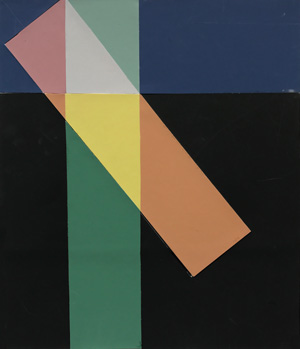
Students in CFA’s color class complete assignments that make optical illusions and show how colors affect each other.
For the assignment to the left, Alison Staffin (CAS’17) used paper to re-create lighting effects produced by overlapping slide projections. The project demonstrates additive light, in which mixing colored light creates lighter hues than those being mixed.
Raiselis introduces the class’ central concept—that color is relative—on day one, by asking students to line up two sheets of blue and red silk-screened Color-aid paper and stare at their boundary. The color of each paper acquires a neon brightness along the horizontal join, and the remaining portions of the papers seem to grow duller by comparison.
“Colors steal from each other what they already have,” explains Raiselis. “Blue wants to steal lightness and blueness from this red. Red wants to steal redness and darkness from this blue. You could call it simultaneous contrast. One exaggerates the differences of the other, just as positioning a tall person next to a short person exaggerates their differences.”
Each class assignment is treated as a problem for students to solve: for example, as in the artwork at the top of this page, how to make one color look like two (other assignments might include making two different colors seem the same or making three colors look like two). Raiselis shares examples of the color illusion they’re going to create—such as artwork by Albers himself—and weighs in as students work, but lets them discover “empirically, through trial and error,” how to create the desired effect. Students use various combinations of the 314 colors in their personal pack of Color-aid paper; in some assignments, they have the option of using stripes, squares, or rectangles. Although there’s no one solution to a problem, there are a lot of ways things can go wrong. As anyone who’s attempted to match socks in a dimly lit room knows, light affects how colors look. Students can unintentionally ruin their artwork by removing it from the natural sunlight of the north-facing studio to tinker under fluorescent dorm lights.
Sidebar
Color Illusion: Good Vibrations
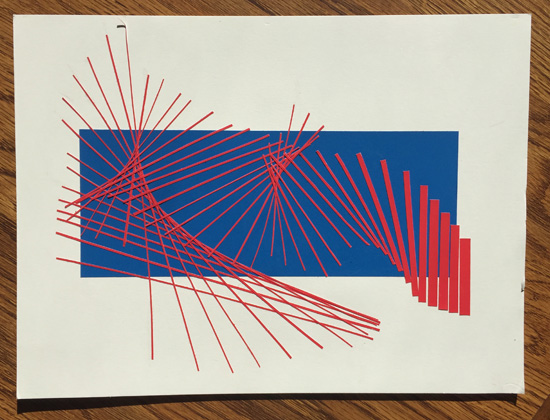
For the project above, students were told to use stripes of any thickness, color, and composition to create a vibration effect. This is achieved, says the artist, Alison Staffin (CAS’17), by choosing different hues with similar degrees of lightness or darkness and by using thin stripes as opposed to large swatches.
Students discover that “some colors are better actors than others,” Raiselis says. Take the artwork by Staffin: a neutral color works well for the small squares, because its muted nature makes them more susceptible to being influenced by surrounding colors. “It is impossible to see a single color in an isolated system without it being affected by anything else,” says Staffin. “You don’t see color for what it is, ever.”
Brain Teasers
The scientific explanation for why our eyes are fooled by this kind of illusion has to do with how the brain interprets color. “Your perception of the world is not based on what the actual visual world is,” says Jeff Gavornik, a College of Arts & Sciences assistant professor of biology. “It’s based on your brain’s attempt to make sense of that.”
“It is impossible to see a single color in an isolated system without it being affected by anything else. You don’t see color for what it is, ever.” —Alison Staffin (CAS’17)
The eye, he says, tells the brain what color it’s seeing in relation to adjacent colors—in terms of contrast and boundaries. When we look at a piece of white copy paper, our cornea and lens project that image onto the back of our retina. “What your brain responds to, what your retina responds to, are the retinal cells that lie across the edge of the paper in that image, where there’s high contrast,” says Gavornik. The brain effectively fills in the spaces between the edges to interpret the entire page as white. When we look at Staffin’s image, our eye can’t directly compare the color of the two small squares; it can only tell the brain about the color of each square relative to the color surrounding it.
Color class is a favorite with students, not only because it’s full of surprises, but because it elevates their craft. Tanner Gauvin ('18) says he’s become “more experimental” and “more knowledgeable of the colors that I’m using—picking and choosing when I really want to grab the viewer with a certain pairing of colors, and when I want the viewer to be relieved by a really subtle shift of colors.” Dina Martinelli (’15,’16), an art teacher at Jaworek Elementary School in Marlborough, Massachusetts, says what she’s learned about how dissimilar colors enhance each other has added stronger contrast and the illusion of depth to her collage work. And Staffin, a biology major who now studies graphic design, says she’ll use her color knowledge to control what elements in an infographic stand out to the viewer first.
Even Raiselis is still learning a thing or two. “I think there are color relationships in my paintings that didn’t exist [in my work] a couple of years ago,” he says—and although he’s been teaching color for decades, it still gives him a thrill. “To see people’s eyes open [to what color can do] is pretty exciting. For me it’s magical, and there’s always something we can learn.”
A New Stage for CFA
The lights go up on the Joan and Edgar Booth Theatre
By Esprit staff
Actors throughout the world make do with makeshift stages in cinemas, bars, and town halls. Even the greatest stars of screen and stage may spend a lifetime treading borrowed boards. As part of a major overhaul of its spaces for the arts, Boston University is bringing a new theatre complex to the heart of its Charles River Campus—and in late 2017, students will step onto a stage built just for them.
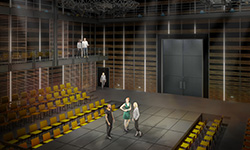
Joan and Edgar Booth Theatre
21,000
square feet
250
seats
9
motorized trusses for lighting, scenic elements, and more
1
motorized catwalk
Photo courtesy of Elkus Manfredi Architects
The project is funded in part by a naming gift of $10 million from leading global financier and self-described sports zealot Steve Zide. Zide, a Boston University trustee, says the gift is a fitting and poetic tribute to his theatre-loving wife, Janet Zide, and his in-laws, who brought the joy of stage performance into his life and the lives of the Zides’ four children.
Rising from a former parking lot at the edge of 808 Comm Ave in what will eventually be an arts campus within West Campus, the theatre will bear the names of Janet Zide’s parents as the Joan and Edgar Booth Theatre. Edgar Booth passed away recently, but Zide’s mother-in-law, Joan Booth, remains an active patron of the arts and a Broadway aficionado, says Zide (LAW’86).
“It’s not an area that I would normally have thought of, but it struck me as the perfect thing to honor Jan’s parents and to give back in a way that’s meaningful to Jan and to me,” says Zide, senior advisor of private equity at the New York offices of international private equity and investment capital firm Bain Capital. He believes that exposure to the arts is an essential part of the mission of all great universities and in the development of full and productive members of society.
“BU is ascendant in so many disciplines since President Brown became part of the community, and we really feel that performing arts are a critical piece of a great urban university,” Zide says. “We wanted to make sure that students interested in performing arts have the opportunity to pursue their passion, the way, for example, medical, law, and business students have the facilities to pursue theirs.”
President Robert A. Brown says he believes that the arts should be part of every student’s experience at Boston University. “When we open the Joan and Edgar Booth Theatre, we will have at the heart of our campus a state-of-the-art theatre as the centerpiece for the role that the students and faculty of the School of Theatre play in fulfilling this goal,” says Brown. “We are deeply grateful to the very generous gift from Steve and Jan Zide—honoring Jan’s parents—that made it possible for us to make this project a reality.”
Designed by the Boston architectural firm Elkus Manfredi, the 75,000-square-foot theatre complex will include the 250-seat Joan and Edgar Booth Theatre, production and costume shops, design labs, classrooms, and a landscaped plaza. When the complex opens, it will be the first time in decades that CFA performance and production students have been housed in the same dedicated location. The theatre will be the centerpiece, funded in part by monies from the 2016 sale of the BU Theatre, the longtime home of the Huntington Theatre Company.
Lynne Allen, CFA dean ad interim, says the gift from the Zides highlights how important theatre and the arts are to our culture. “The naming of the theatre is an incredible gift to the College of Fine Arts community,” Allen says. “It is also a gift to every BU student and faculty and staff member. The theatre will be accessible and central to every BU student’s life.”

The lobby will encourage the community to own the space. Photo courtesy of Elkus Manfredi Architects
In recognizing the generosity of Zide’s gift, Allen hopes it inspires others to support the new space. “This is an incredible moment in time for the School of Theatre, College of Fine Arts, and Boston University. The energy of this new chapter is palpable and alumni support is essential as we finish this space. I encourage our alumni to contribute to this campaign, support the endeavor, and join us in celebrating the space when it opens.”
Jim Petosa, director of the School of Theatre, hopes that a unified home for CFA’s performances and students at the heart of the Charles River Campus will spark cross-disciplinary collaborations and encourage more students, staff, and faculty to attend performances.
“What was most exciting about our project was participating in the design of a new purpose-built 21st-century cultural facility from the ground up,” says Petosa, who was part of a faculty team that collaborated with the architects. “We arrived at this extraordinary space that provides a performance venue that encourages innovation, teaching spaces that are appealing and a joy to inhabit, studio spaces that give students a wonderful environment in which to work, and production shop spaces that are fully dedicated to the productions we undertake.”
For Zide, the theatre is not just a way of showing his appreciation for his wife’s family. It’s a way of showing his appreciation for all of those who have invested in the future of the University. “We all benefit from those who came before us who took the time and interest to make investments and commitments in the future,” he says. “We wanted to be part of that same cycle, and we’ve been very fortunate to have the ability to invest in the BU community and current and future students.”
Opening our doors—and walls
A new studio for graphic design and a renovated façade for 855 Comm Ave

Graphic Design Studio
13,000
square feet
50
new workstations
2
open studios and new classrooms
Photo by Janice Checchio
Another program is already enjoying life in its exclusive, specially designed headquarters. Before moving into a 13,000-square-foot studio in summer 2016, graphic design faculty sometimes had to borrow classrooms—even making a temporary home in a former pizza restaurant. The newly opened graphic design studio at 808 Comm Ave has modular workstations, flexible presentation areas, classrooms, faculty offices, and stunning views of the Charles River. “We can take control of our environment and set it up the way we need to, to foster the kind of work we want to make,” says Kristen Coogan, an associate professor of graphic design. “Depending on what the project is, what the discourse is, we can design our space and be thoughtful and engaged practitioners.” The program’s enrollment numbers are at an all-time high and, thanks to the studio, the College expects to expand further.
CFA is not just opening doors to more students; it’s opening its walls. Nearly a century ago, when 855 Comm Ave was a Noyes Buick dealership, its façade was marked by towering arched windows. The arches were bricked up decades ago, but thanks to the support of generous donors, the windows are coming back, exposing galleries and theatre classrooms to the street.
“The biggest deficit of the current façade is that nobody knows what goes on in CFA unless they walk in the door—and let’s face it, if they don’t have a reason to, they don’t come in,” says Allen. “Opening the windows will allow the world to see activity, to see art in the gallery vitrines, to see students inside, and to have open access doorways that are inviting.”
The changes will “improve the look and feel of CFA along upper Commonwealth Avenue,” says Jane Pappalardo (’65). “To restore the openness that was once there and to create a destination for performance for students, alumni, and Boston arts lovers, is the most thrilling accomplishment for this esteemed University.” Jane's gift with her husband Neil Pappalardo, as well as gifts from Nina Tassler (’79, Hon.'16) and Gerald Levine (’79), and Andrew (Par’14) and Julie Stanton (Par’14) will help make the renovation possible.
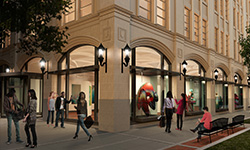
Façade
Free-standing walls
or vitrines, will be set back from the windows to create mini galleries for displaying art.
Windows
looking in on theatre classrooms can be darkened to create private rehearsal spaces.
Photo courtesy of Wilson Butler
Allen calls the projects a “facelift to the outside world” and says they—along with the $15 million construction of School of Music practice rooms in 2008 and 2009—demonstrate the University’s commitment to the College of Fine Arts. She hopes that encourages more donors to step forward to support the arts, and these projects in particular.
“The renovations and purpose-built structures send a message from the upper administration that the arts are important at BU, and BU is willing to support them,” she says. “In a major research university, which has a focus on STEM study and research, this is an example of how BU values all aspects of a creative life and believes it should be part of every student’s experience. We at CFA take that as a license to expand and explore beyond our own walls.”
SUPPORT CFA PROJECTS HERE. TO SUPPORT ACTIVITIES IN THE JOAN AND EDGAR BOOTH THEATRE AND DESIGN & PRODUCTION COMPLEX, CONTACT CHRIS MARRION, ASSISTANT DEAN, AT (617) 353-3345 OR CMARRION@BU.EDU.
Download the PDF
Ad1

Ad2
Ad3