Boston University Linguist Helps Preserve an Endangered Language in Papua New Guinea
Kate Lindsey worked with locals to develop a writing system for Ende and publish one of the first books in the language

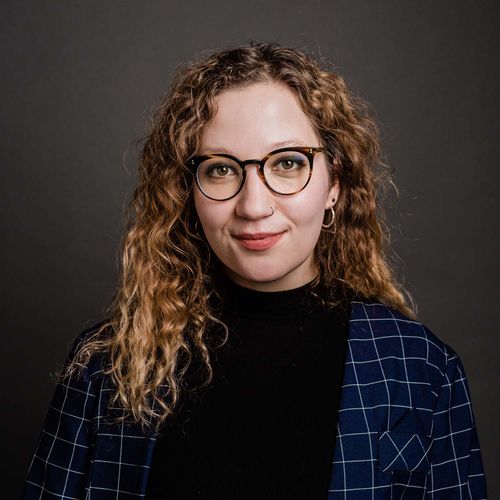
BU linguist Kate Lindsey, author of a new book of texts in the Ende language, was recently awarded a National Humanities Center fellowship. Photo by Jackie Ricciardi
Boston University Linguist Helps Preserve an Endangered Language in Papua New Guinea
Kate Lindsey worked with locals to develop a writing system for Ende and publish one of the first books in the language
Language, just like any aspect of a culture, can be vulnerable to erosion. Sometimes a language disappears as the result of colonialism; other times, a language quietly slips away, slowly forgotten as native speakers pass on, taking their knowledge with them.
Boston University linguist Kate Lindsey is deeply interested in these so-called “endangered languages,” with so few speakers they’re at risk of disappearing forever. By one count, around half of the world’s languages are endangered.
Lindsey, a native English speaker, has studied Russian, French, Arabic, Turkish, and American Sign Language. She’s also learned a handful of endangered languages—including Ende, spoken by fewer than 1,000 people in southwest Papua New Guinea.
Ende speakers have long endeavored to preserve their language, with limited success—until now. With Lindsey’s help, they’ve hit two major milestones in its conservation: creating an official writing system—for use in the community and in the local elementary school—and, most recently, publishing one of the first-ever works in Ende.
The book, The Ende Way: Short Stories and Songs from Limol Prepared with the Ende Language Committee (Language Science Press, 2025)—authored by Lindsey in collaboration with a team of locals turned linguists—is meant not just to safeguard the language for future generations, but also share a slice of Ende culture with the wider world.
“Preserving endangered languages involves documentation of words and linguistic practices, but more importantly, it involves supporting communities that speak those languages,” says Lindsey, a BU College of Arts & Sciences assistant professor of linguistics who was recently awarded a National Humanities Center fellowship. “Languages thrive when communities are empowered to teach their language to their children, use the language in public, in schools, at their jobs, and are free to practice their linguistic and cultural activities on their own terms.”
A Year in Papua New Guinea
Language in New Guinea is fragmented. More than 1,000 languages are spoken across the island, located just north of Australia. The most prominent in its eastern half—the country of Papua New Guinea—is an English Creole language called Tok Pisin; the official language of the west side of the island is Indonesian. The many villages that populate the island often use their own distinct language.

“Papua New Guinea is a really cool place for a linguist,” Lindsey says. Historically, the island’s wild jungle terrain made urbanization difficult in some regions and, as a result, there aren’t many roads in much of the country, she explains. “Because there isn’t a lot of contact between villages, you can walk five miles to the next village, and that village will speak a completely different language from the one you just left.”
The book project has its origins in Lindsey’s studies with Australian linguist Nicholas Evans, who had spent more than a decade doing fieldwork in southern Papua New Guinea. He’d been approached by a family in the country with a request: their community in the village of Limol wanted help creating a writing system for their language, called Ende, so the local elementary school could teach in the language. Did Evans know someone who could assist?
Lindsey jumped at the opportunity—and so did the committees that awarded her grants for fieldwork. So, in 2015, she spent two weeks traveling via commercial airliner, puddle jumper, motorboat, and canoe to Limol, located in Papua New Guinea’s South Fly District. Ultimately, Lindsey spent a year during her doctoral studies living in the village, immersing herself in everything Ende. A decade later, her efforts culminated in a book that she describes as a partnership between herself and the people of Limol.
The Ende Way
Storytelling is an integral part of Ende culture. The Ende Way is a collection of 20 of those short stories and songs. The entries include fables and folktales, like how the cuscus—a marsupial with big eyes and a fuzzy coat—got its tiny ears. But there are also real stories, such as one about the time an elder woman single-handedly killed a crocodile and carried it back home. All are accompanied by colorful illustrations created by local children.
Lindsey’s call for stories and songs yielded almost 100 to choose from. The final picks “really capture what life is like in Limol,” she says. One of her favorite stories in the book came from a father whose young son begged to join him on a canoe hunting trip. Right as dad was about to bag a deer, he realized his son was a little too quiet—and stopped pursuit to make sure the youngster hadn’t fallen in the river. He hadn’t, fortunately, but dad lost the shot at the deer. As soon as they got home—empty-handed—the son raced to tell mom about his cool hunting trip with dad.
Hearing stories about hunting crocodiles can make a community feel “very exotic, very far away,” Lindsey says. But many can relate to a child who wants to do whatever his parents are doing. Through the variety of texts, “I wanted to show that the Ende people are just like us, just in a different part of the world.”
The book is also an academic research document.
The introductory section contains extensive information on the Ende people and their language. And each featured text is accompanied by a parallel English translation, plus a glossary breaking down every sentence. “Anyone who’s interested in the linguistic structure could go through and see the meaning and morphologic breakdown of every single word,” Lindsey says. “If you wanted to do an analysis of the language, you could do so really easily.”
But how do you go from not speaking a language to publishing a definitive text on it?
The Ende Language Committee
Language, in its most basic form, is a series of rules that govern a variety of sounds. Sometimes, those sounds and rules are more straightforward, like in Turkish, where each letter of the alphabet corresponds to exactly one sound. Other times, things get a little wiggly, like in English, where “C” doubles as both a “K” and an “S” sound—and, for some reason, the letter “X” exists.
Of course, it’s a lot easier to learn those rules when you have dictionaries and grammar books to reference. For Lindsey, mastering Ende was a group effort. The Limol villagers—about a quarter of whom spoke English—taught her Ende word by word. When it came to the rules of grammar, “we figured it out together,” Lindsey says.
The writing system came next.
The efforts to formalize Ende in writing go back to 2003, when a group of locals formed the Ende Language Committee to translate the Bible’s Gospel of Mark into Ende. Years later, with Lindsey’s help, committee members and other interested villagers identified every sound in the Ende language. Building off the committee’s initial spelling system, they reassigned a Latin letter to each sound (partly because people already knew the Latin alphabet, and partly so they could text in Ende without needing a special keyboard, Lindsey explains). For Ende’s unique retroflex sounds—such as tuh and duh, pronounced by curling your tongue and pointing it backwards—they wrote them as “tt” and “dd,” respectively.
The process was democratic (and just a little tedious). For months, “we all sat down at this long table, and someone would say a word—kakayam, for example, is the word for bird of paradise—and we would say it over and over, talking about the sounds in it,” Lindsey says. “Someone would say, ‘Well, it starts with a kuh sound,’ so we’d write a ‘K’ and so on.”

As soon as people became proficient in writing, they began compiling a dictionary and translating stories for what would become The Ende Way. Lindsey paid anyone who worked on writing and translating through her grant money.
“The community led a lot of the documentation process,” Lindsey says. “That’s why the book title includes ‘Prepared with the Ende Language Committee’—this was me and a community doing something together.”
No Longer an Endangered Language
These days, Lindsey doesn’t think of Ende as an endangered language.
True, the language is still spoken by just around 800 speakers in Limol and other nearby towns and villages. But the local elementary school now teaches in Ende. And the Ende Language Committee’s efforts to improve community literacy are ongoing.
Lindsey’s grateful to be a part of those efforts. (And she continues to study the languages of the South Fly District.) Historically, anthropology and linguistics have both had a “white savior” problem, she says. But The Ende Way was born out of mutual respect.
“Language is not something you just go and pick up off the ground; it’s something that people have created and are using, and share with you,” Lindsey says. In Limol, “there was no, ‘Your language is dying and needs saving, and I’m the only one who can do it!’ This was such a unique project, where I was there to help at a community’s request, and we were able to accomplish something worthwhile. We all walked away feeling really good about our work.”