Boston University Program’s Name Change Reflects Its Transnational Focus
American Studies, formerly American & New England Studies, blends the global and the local
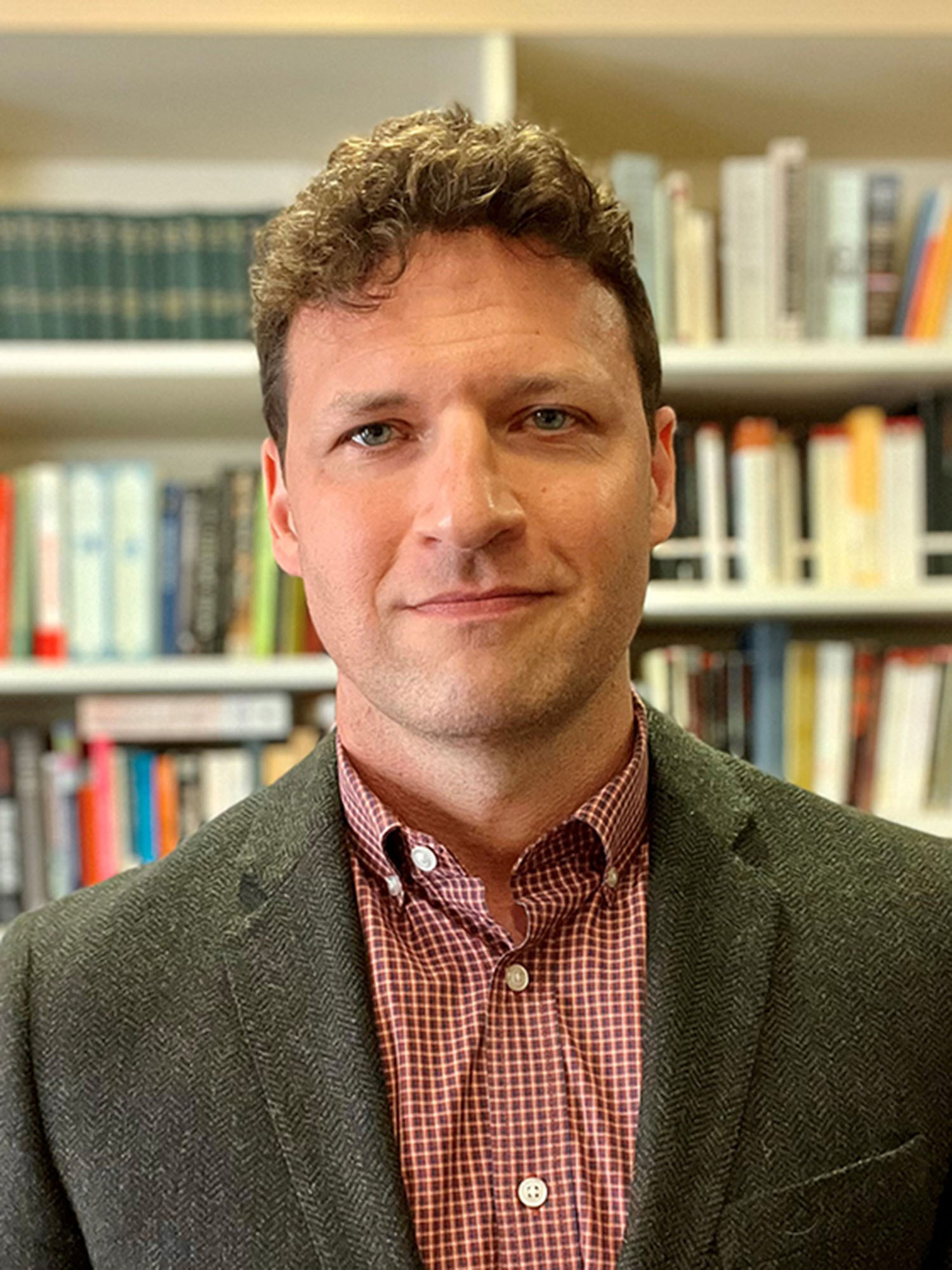
Joseph Rezek, director of BU’s American Studies, says dropping “New England” from the name reflects a long-standing change in the program’s focus. Photo courtesy of the College of Arts & Sciences
Boston University Program’s Name Change Reflects Its Transnational Focus
American Studies, formerly American & New England Studies, blends the global and the local
Boston University’s American & New England Studies Program launched in 1972 as an interdisciplinary lens on America’s culture and past, with faculty from departments in history, English, art history, sociology, archaeology, anthropology, political science, and musicology. But for decades, the mostly PhD-granting program, with a sprinkling of undergraduate majors, has seen its students’ New England focus diminish.
So it recently pared its name to American Studies.
The program hasn’t abandoned New England in its work, nor its long-standing partnerships with New England institutions, says Joseph Rezek, the program’s director and a College of Arts & Sciences associate professor of English. Rather, it’s blending both local and global prisms in its curriculum, he says, taught by about 60 affiliated faculty from numerous BU departments.
Rezek spoke with BU Today about the program’s evolution and how it led to a new name.
Q&A
with Joseph Rezek
BU Today: Why the name change?
Rezek: As the affiliated faculty has changed over the last 50 years, the New England focus has declined, and so it’s just no longer an accurate description of what we do. I commissioned a study on dissertations produced by the program over the last 50 years by one of our grad students. She found that in the last 10 or 15 years, only about a quarter or a third of dissertations had a New England focus. This program is mainly a PhD program [with] a strong undergraduate major. This name change is reflecting changes that have happened over decades.
We have lots of expertise in New England still, and the name change is also an opportunity to reaffirm our connections with New England institutions. But it’s really an American Studies program, in that we do a lot of transnational work, a lot of hemispheric work. The New England term also carries a kind of exceptionalist idea. “New England” was settler propaganda, coined by John Smith in 1616 in a pamphlet to encourage settlement in this area, which was not known as New England by the Indigenous people he was displacing.
We’re still in New England, and a lot of our students still do research in New England, and we’ll continue to maintain our ties to New England cultural institutions. I also have initiated a cluster hire in Indigenous, Native American studies, which is a growing field at BU.
BU Today: Can you talk more about this being an opportunity to reaffirm connections with New England institutions?
Rezek: We invited representatives from cultural institutions in the region to come to talk about possible partnerships. The representative from the Massachusetts Historical Society was talking about, how can we get students to internships at these places? I take my students to the Boston Athenaeum all the time; they have great archives for my field, early American book history and print culture. Faculty take students to the Museum of Fine Arts and the Masonic Temple.
We are in Boston, and Boston is in our University title, so we have no risk of losing the wonderful ties to Boston and the region.
To understand American history, you have to understand its embeddedness in a global context.
BU Today: How can you teach both local and transnational perspectives?
To understand American history, you have to understand its embeddedness in a global context. The history of the early United States, after it became an independent nation, was always tied to international contexts. Part of our undergraduate major is a requirement that two of your classes have to consider a geographical area outside of the continental United States.
Phillis Wheatley [the first African American to publish a poetry book, in 1773] encapsulates that. On the one hand, she wrote her poems in Boston, and she could be seen as a New England figure. On the other hand, she was born in West Africa and kidnapped as a young child and brought to Boston, where she was enslaved. And her book of poems was published in London, not in New England. So she must be seen in a kind of transnational, Atlantic, global context.
When I teach Phillis Wheatley—and I teach her all the time—we talk about Boston. She lived not far from where the Boston Massacre occurred, which she wrote about. There’s a lot of local stuff happening with Wheatley and a lot of transnational stuff happening with her.