A Robotic Approach to Engineering Living Cells
$4.5M award to fund BU-led project
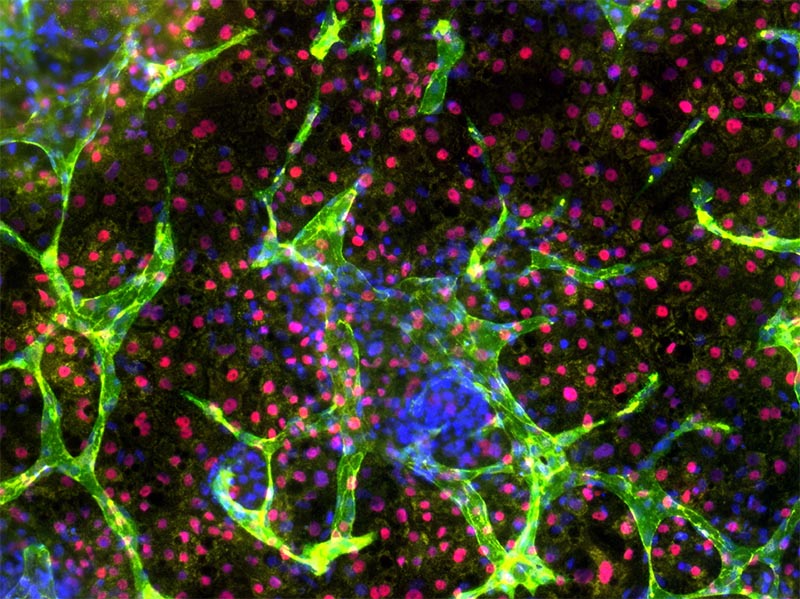
Researchers have long sought to enable collections of living cells to perform desired tasks that range from decontaminating waterways to growing tissue in the lab, but their efforts have largely relied on trial and error. Now a team of scientists and engineers led by Boston University is developing a more systematic approach through a deft combination of synthetic biology and micro-robotics. Supported by a National Science Foundation (NSF) five-year, $4.5 million Cyber-Physical Systems Program (CPS) Frontier grant, the researchers aim to engineer bacterial or mammalian cells to exhibit specified behaviors and direct a fleet of micro-robots to corral the engineered cells into working together to perform desired tasks.
Drawing on experts in control theory, computer science, synthetic biology, robotics, and design automation, the team includes Calin Belta, a BU College of Engineering (ENG) professor of mechanical engineering, electrical and computer engineering, and systems engineering and the lead principal investigator; Douglas Densmore, an ENG associate professor of electrical and computer engineering, biomedical engineering, and bioinformatics; Vijay Kumar, a professor at the University of Pennsylvania; Ron Weiss, professor and director of MIT’s Synthetic Biology Center; and members of SRI International.
“We came up with the idea of bringing robotics in to control in a smart way the emergence of desired behavior patterns among collections of engineered cells,” says Belta, who will develop algorithms to catalyze such behavior. “Our ultimate goal is to automate the entire process from engineering individual cells to controlling their global behavior, so that any user could submit requests from the desktop.”
If successful, the research could yield new insights in developmental biology, lead to greater standardization and automation in synthetic biology, and enable a diverse set of applications. These range from nanoscale robots that can manipulate objects at the micron (one-millionth of a meter) level to chip-scale technologies that transform stem cells into tissues and organs for human transplantation or drug design.
The team’s first main challenge is to advance a synthetic biology platform—what it calls a Bio-Design Automation (BDA) workflow system—that can predictably engineer cells to sense their environment, make decisions, and communicate with neighboring cells. To produce such “smart cells,” Densmore will use and enhance software he’s developed to specify, design, and assemble gene networks (also known as gene circuits) with desired functions, and insert them in living cells.
“The complex behaviors we wish to engineer are too difficult to manually specify and analyze,” says Densmore. “Design software makes this project manageable as well as formally captures the process so that it can be used in the future to enable new discoveries.”
The second challenge is to design micron-scale, mobile robots that can affect cells’ interactions so that they ultimately bring about a specified global behavior. Composed of organic and inorganic material and controlled by magnetic fields and light, each micro-robot interacts and communicates with individual cells at specified locations and times, implementing control strategies needed to achieve the desired global behavior. For example, the micro-robots could be controlled to optimize tissue formation from stem cells by triggering desired chemical reactions within the cells.
Finally, the researchers will test how well the micro-robots are able to direct the emergent, global behavior of collections of engineered bacterial cells and mammalian cells. They’ll attempt to form Turing patterns—dots and patches of varying sizes—in E. coli and hamster ovarian cells, and liver tissue from human stem cells. In the process, they will employ a magnetic manipulation system developed by SRI to control multiple robots with sub-millimeter precision.
Project leaders also plan to develop associated educational activities for high school students; lab tours and competitions for high school and undergraduate students; workshops, seminars and courses for graduate students; and specific initiatives for underrepresented groups. At BU, the Technology Innovation Scholars Program will develop hands-on design challenges and disseminate them in Boston schools.
Designed to address grand challenge research areas in science and engineering and limited to one or two multi-university teams per year, NSF CPS Frontier Awards support large-scale engineered systems built from, and dependent on, the seamless integration of computational algorithms and physical components.