Capturing a Broadway Legend on Film
COM alum’s documentary shows why Elaine Stritch was one of a kind

Elaine Stritch died at 89 on July 17, 2014, just months after the documentary was released. Photo courtesy of Isotope Films
This story has been updated to reflect the death of Elaine Stritch, who died on July 17, 2014 at 89.
Most people knew Elaine Stritch mainly as Alec Baldwin’s mother on the NBC comedy 30 Rock. And that’s a shame. Because while the role of Colleen Donaghy showcased the legendary actress’ considerable comedic talents and her irascible, commanding persona—and brought her an Emmy—Stritch was first and foremost a stage actress, who over the course of a seven-decade career earned a reputation as a fearless performer.
She garnered rave reviews for her work in William Inge’s Bus Stop in 1955, left an indelible impression in Broadway musicals, among them Noel Coward’s Sail Away and Stephen Sondheim’s Company, where she introduced one of his best-known anthems, “Ladies Who Lunch,” and later, in revivals of Hammerstein’s and Kern’s Show Boat, and Sondheim’s A Little Night Music. She proved equally adept at drama, starring in Who’s Afraid of Virginia Woolf? and A Delicate Balance, both by Edward Albee (Hon.’10).
But Stritch’s greatest triumph was always playing herself. She won a Tony Award (and later an Emmy) at the age of 77 for her critically acclaimed one-woman show, Elaine Stritch: At Liberty, which recounted her career and personal triumphs and tragedies. A born raconteur with flawless timing, the actress, who died last week at 89, is now the subject of a documentary by Chiemi Karasawa titled Elaine Stritch: Shoot Me.

Karasawa (COM’90) first met Stritch when she was working as a script supervisor on the set of the John Turturro film Romance and Cigarettes, where the actress played James Gandolfini’s mother. “The day she came to do her scene, she blew everyone away with her incredible energy and charisma,” says Karasawa. “It was like a tornado blew through town.”
She recalls a scene the actress had with Gandolfini and Steve Buscemi in a hospital room. “She was scolding Jim for something he had done, and one of her lines was “Shuuuut Upppp!” Karasawa says. “I think the craft service guy on the next stage dropped his knife, it was so explosive and intimidating.”
Several years later, Karasawa spotted Stritch at the hair salon they both frequented, and she began to think about directing a documentary about her. She asked her hairdresser if the woman was in fact Stritch. Yes, he said, adding, “You should be making a documentary about her!” Karasawa had recently started her own company, Isotope Films, and was looking for nonfiction material to produce.
At the time, she says, she had only “a layman’s knowledge” of Stritch’s career, but she went home and Googled the actress, downloading everything she could find about her. “I fell down the rabbit hole researching her,” the filmmaker says. What she discovered was “a woman with such singular talent, personality, charisma” that she knew she’d be a compelling subject. Watching D. A. Pennebaker’s 1970 documentary Company: The Original Cast Recording—she includes a clip of the documentary in her film—convinced her to try to persuade Stritch to agree to the project. “She has a fascinating scene where she sings ‘Ladies Who Lunch’ and cannot get the take right initially. Then, you listen to Elaine on the director’s commentary track. It’s completely enthralling,” says Karasawa. “She’s a filmmaker’s dream.”
It took a bit of courting to convince Stritch to allow cameras to follow her around once their hairdresser formally introduced them. The actress kept putting her off, saying, “We can start next month.” After four or five months of that, she finally relented, leaving a message on Karasawa’s answering machine at 2 a.m. saying they could begin.
In Elaine Stritch: Shoot Me, the actress speaks candidly about her diabetes (the film includes several harrowing scenes of her confronting medical crises), her long battle with alcohol, and her decision, after 24 years of sobriety, to resume drinking (one cocktail a day, despite the fact that she says nothing scares her more than drinking). She also forthrightly expresses frustration at no longer being able to recall the lyrics to songs she’s performed for decades.

The documentary is also hilarious. At one point, the ever-candid Stritch runs into an old friend and exclaims, “Your hair looks good for a change.” In another scene, after being kept waiting on the set of 30 Rock for Baldwin to arrive, Stritch jokingly refers to him as “Alec Joan Crawford Baldwin.” And there’s plenty of the kind of dishy stuff you’d expect from an actress of her stature, most notably a story she recounts about picking up a very young JFK, asking him to dinner, “because he was too attractive to leave behind,” and getting dumped by him after their second date when she wouldn’t put out.
Karasawa also includes plenty of testimonials from friends and colleagues, like Tony-winners Nathan Lane and Cherry Jones, that help to fill in the blanks. Hal Prince offers perhaps the most revealing observation, noting that Stritch has “the guts of a jailbird, but really what makes her so interesting is that the convent girl is still there, always.”
The filmmaker had unprecendented access to the actress, following her over 18 months as she completed a national tour of her one-woman show, rehearsed and performed a new show of Sondheim songs at her longtime home at the Carlyle Hotel in New York, and amidst growing health scares, made the decision to return to Michigan to be closer to family.
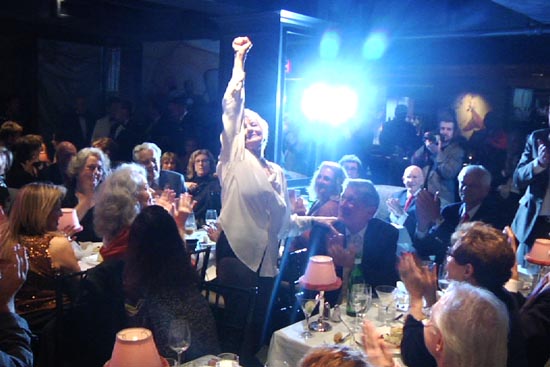
The COM alum acknowledges that there were a few prickly moments during the beginning of shooting “before we understood each other’s rhythms and some after the edit was completed, and she wasn’t exactly sure if she liked it.” But at the end of the day, she says, her subject “allowed me the freedom to create something about her without ultimately standing in the way.”
For Karasawa, the film represented a milestone in her career. Elaine Stritch: Shoot Me is her directorial debut. She had intended only to produce the documentary, but Stritch didn’t want anyone else around and insisted Karasawa direct the film herself. “She believed in me, and that was incredibly inspiring,” she says. “She has great confidence in people. It’s infectious. She knows what it’s like to be given an opportunity.”
Asked how she liked the experience of directing: “It’s a lot more fun,” she says, and in many ways, it involves less responsibility than producing.
The film, which debuted at last year’s Tribeca Film Festival, has earned strong praise from critics. The Village Voice’s Alan Scherstuhl calls it “a gift of a documentary celebrating its subject’s brittle brilliance.” ABC News describes it as “an irresistibly entertaining documentary.” Stephen Holden, reviewing the film in the New York Times earlier this month after its national release, writes that “on a deeper level, Shoot Me is an unflinchingly honest examination of a woman who is aware that the end is approaching,”

There is a decidedly elegiac tone to the film. Going through old photographs, Stritch movingly recalls her deceased parents and her husband, the actor John Bay, who died of a brain tumor in 1982. “I loved being married,” she confides, “and I loved being in love…but I never did find it again.” The film’s most affecting moment: Stritch is lying in a hospital bed after a weeklong hospitalization and looking very frail. “It’s time for me,” she says. “I can feel it. Everywhere.”
What was Stritch’s reaction to the final film? Karasawa says it was hard for her at first. “She is terribly hard on herself. She said, ‘I love it, it’s well shot, it’s well edited, it’s entertaining and engaging…I just don’t want to be in it!’ She initially thought it was sad.” But at each subsequent screening, seeing how inspired and invigorated audiences were leaving the theater, Stritch has been thrilled by the reception. “Secretly, I think she loves it.”
Filmmaker and actress remained close after work on the documentary ended, and Karasawa says that Stritch inspired her in countless ways. “She was incredibly courageous and inspired people to have the same courage,” she says. The filmmaker believes the project left her with a greater appreciation for her own parents, who are 80 and 90. “Elaine gives a very articulate voice in the film to the aging process,” she says. “She allowed herself to be documented in a way that makes the experience palpable, entertaining, poignant.”
View a trailer for Elaine Stritch: Shoot Me here.
Comments & Discussion
Boston University moderates comments to facilitate an informed, substantive, civil conversation. Abusive, profane, self-promotional, misleading, incoherent or off-topic comments will be rejected. Moderators are staffed during regular business hours (EST) and can only accept comments written in English. Statistics or facts must include a citation or a link to the citation.