Dream of Being a Fulbright Scholar? Hear from Recent Awardees
Eleven recipients will conduct research or teach English across 10 countries, including the Netherlands, Indonesia, and Italy
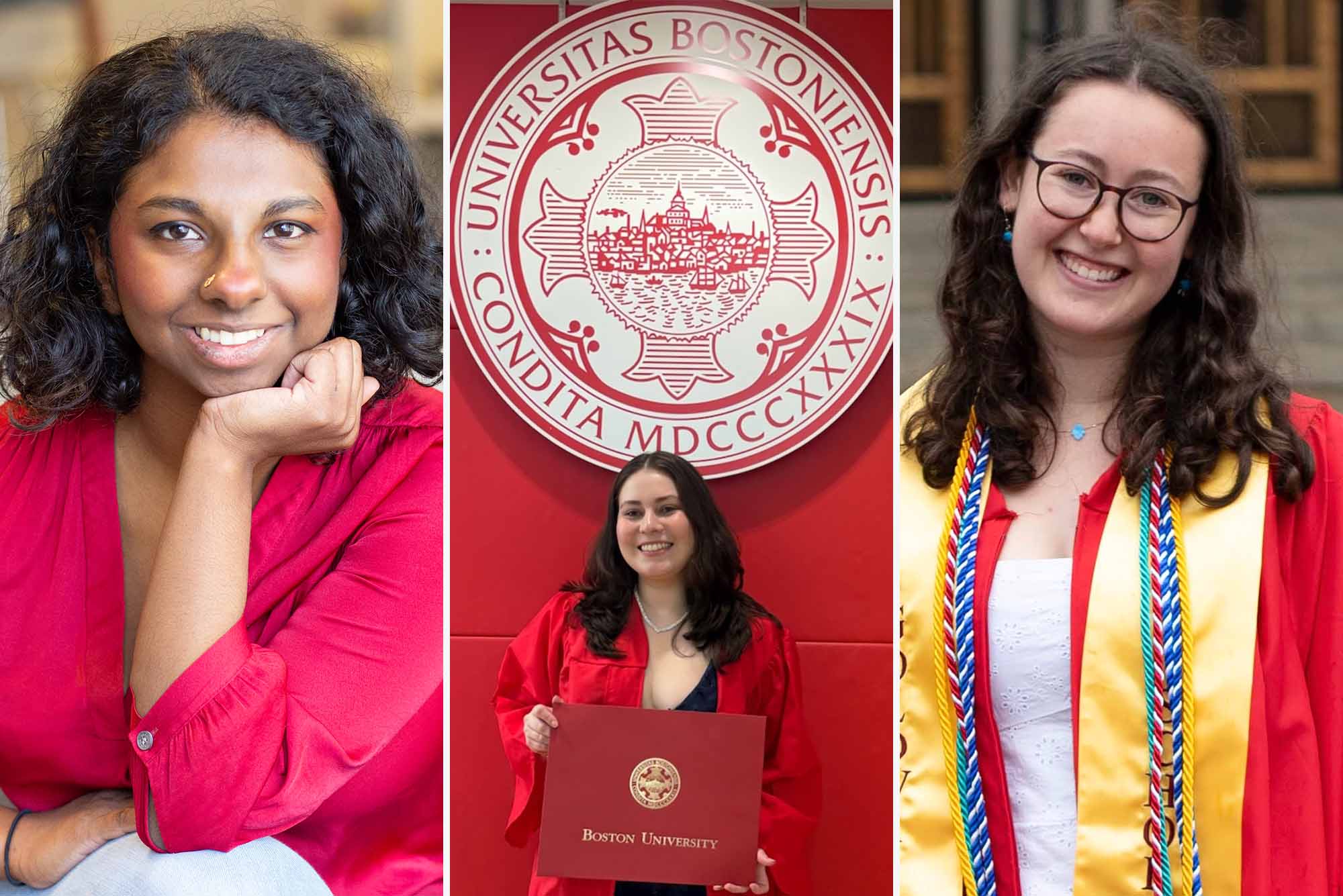
Photos courtesy of Niveditha Senthilvel (left), Natalia Díaz Clesse (center), Sarah Kornfeld
Dream of Being a Fulbright Scholar? Hear from Recent Awardees
Twelve recipients will conduct research or teach English across 10 countries, including the Netherlands, Indonesia, and Italy
From classrooms in Spain to research labs in England, 12 Boston University students and recent alumni will experience new adventures overseas in the coming months as recipients of Fulbright US Student Program grants. They will conduct research, teach English, and pursue graduate study in countries around the globe.
The Fulbright US Student Program is the US government’s flagship international educational exchange initiative and a prestigious honor. Since 1946, it has provided opportunities for graduating seniors, graduate students, young professionals, and artists pursuing independent research, graduate study, or English Teaching Assistantships (ETAs) in more than 140 countries.
For the sixth consecutive year, BU has been named a Fulbright Top Producing Institution, a distinction awarded by the US Department of State to colleges and universities with the highest number of Fulbright recipients. In the 2026–2027 cycle, 12 BU students and young alumni received grants, up from 10 recipients in the previous application cycle. Recipients are selected on the basis of their academic merit and leadership potential.
Jeffrey Berg, director of national and international scholarships in BU’s Office of the Provost, says he often reminds potential applicants that all of the distinct Fulbright pathways—research, graduate study, and English teaching—serve the same mission: fostering cultural exchange and mutual understanding.
“That mission hasn’t changed in Fulbright’s 80-year history,” he says. “The program was established in the wake of World War II to further international peace and understanding and expand perspectives and cross-cultural dialog. I see that mission as just as pressing and every bit as important today.”
One of this year’s recipients is Natalia Díaz Clesse, who will spend the 2026–2027 academic year in Oviedo, Asturias, in northern Spain, as an ETA, teaching middle and high school students. Díaz Clesse (Sargent’26), who recently earned a bachelor’s degree in human physiology with a minor in psychology, plans to apply to medical school. She says the Fulbright is a natural step toward that goal. “In this role, I will gain skills crucial for any clinical setting, as I believe education and healthcare always go hand in hand.”
Growing up in Puerto Rico, Díaz Clesse attended an International Baccalaureate bilingual school on scholarship. “I gained [English] fluency with mentor guidance and encouragement, which transformed my confidence as a learner,” she says. Inspired by that experience, she began tutoring other scholarship students in English during high school, helping them build confidence, take risks, and advocate for themselves.
She continued that work at BU through service projects and clinical research. She sees the ETA position as a way to strengthen her trust-building skills and her ability to break down complex topics across cultures and languages, lessons she plans to carry into her medical career. “I saw Hispanic patients shift from hesitancy to openly sharing their concerns the moment they realized I spoke Spanish,” Díaz Clesse says. As an aspiring physician, she learned that cultural fluency is a foundation for trust, which she sees as essential in any healthcare setting.
Sarah Kornfeld (CAS’26) will also spend the next academic year in Europe as a Fulbright Scholar, pursuing a graduate degree in reproductive and developmental biology at Imperial College London while researching endometriosis and polycystic ovary syndrome (PCOS). Together, these conditions affect more than 250 million women worldwide.
Kornfeld will work in a lab that studies key cell membrane receptors involved in women’s endocrine signaling. “Specifically, they study how these signaling pathways are regulated and controlled, particularly in disease models of endometriosis and PCOS,” she says.
By better understanding those pathways, researchers hope to develop improved treatments and diagnostics for many common, yet poorly understood, diseases.
She says she was inspired to apply after speaking to a BU alum who had traveled to Australia as a Fulbright Scholar. “She described her year with such passion and wonder,” Kornfeld says, “and I quickly realized this was a once-in-a-lifetime opportunity to pursue groundbreaking research alongside meaningful cultural exchange.”
Students and recent alums interested in applying for a 2027–2028 Fulbright have until October 6 to complete the national application, but BU’s internal deadline is August 12. Applicants must be US citizens.
Berg and his team guide applicants through every stage of the process—from answering questions to crafting application essays. Each applicant is paired with a member of BU’s Fulbright Campus Committee, a group of nearly two dozen BU faculty members who are also Fulbright Scholars, and who “know and appreciate the Fulbright mission,” Berg says.
Throughout July, August, and September, Berg’s office hosts information sessions and workshops and is also available to meet with Fulbright applicants individually to field questions, review materials, and give feedback. Applicants can also visit the Educational Resource Center’s Graduate Fellowship writing tutors for help with the essay questions.
Niveditha Senthilvel says she definitely used those resources when applying. Senthilvel (GRS’27) received a Fulbright Open Study/Research grant to investigate the lives of millions of people in India who were criminalized under British colonial rule.
Her project will examine the impact of the Criminal Tribes Acts, a series of laws enacted between 1871 and 1924 that subjected hundreds of communities across South Asia to surveillance, imprisonment, and forced relocation. “The very act of being ‘tribal’ was outlawed,” Senthilvel explains. “Children were separated from their parents and sent to ‘reform’ schools.”
Although millions of people were affected by these policies, relatively little is known about their experiences. Even the basic facts—such as how many of these reform schools existed and where they were located—remain unknown. “My research looks to document what life was like for those targeted by the state and forcefully institutionalized, and to link these experiences with global histories of indigeneity,” she says.
Senthilvel will travel to India in October, where she will spend eight to nine months conducting research, gathering information on various institutions, and interviewing.
She says the Fulbright had been on her radar for about two years before applying. “The application itself was quite extensive and took a few drafts,” she says. “The fellowships office was immensely helpful and supportive in this whole process, as were previous awardees at BU. For those interested in applying for a Fulbright, I’d say it’s never too early to start thinking about a project proposal, as it takes months of thinking and revising to get to a polished finished product.”
Berg says one of Fulbright’s defining strengths is its emphasis on bringing together people from a wide range of backgrounds and experiences.
“They really want to represent, given its mission, all that it means to be an American, and bring all of those different perspectives and experiences out there in the world,” he says.
Interested in applying for a Fulbright fellowship? BU’s internal application deadline is August 12; find information on how to apply here.