Extra! Extra! Global Warming Is Our Fault
BU prof Anthony Patt on what climate change means for our present and future
Anyone who is living in Boston this winter doesn’t have to watch An Inconvenient Truth to suspect that the climate is changing. It is, and it’s changing all over the world. Now it appears that the change is very likely our fault, as many scientists have been asserting for some time. A new report written by the United Nations Intergovernmental Panel on Climate Change (IPCC) points to human activity, such as coal-burning power plants, as the primary cause of global warming.
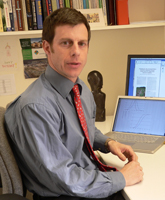
To learn what this change means for us, BU Today spoke with Anthony Patt, a College of Arts and Sciences research assistant professor of geography and environment, who has a joint appointment at the International Institute for Applied Systems Analysis in Austria. Patt has been a contributing author for the IPCC working group.
BU Today: What exactly is the U.N. Intergovernmental Panel on Climate Change?
Patt: The Intergovernmental Panel on Climate Change was created by the United Nations in the 1980s to assess climate change — namely, to report to the U.N., governments, and the world on the state of the science. With so many competing and complicated scientific claims about climate change, it was felt that having a group of the world’s leading climate change scientists analyze and summarize what is known about climate change, what is subject to debate, and where the major uncertainties lie would be very helpful.
The IPCC prepares a main report every six years — the one being released this year is its fourth — as well as numerous smaller reports on narrow issues.
What does the latest report reveal?
In 2001, the IPCC said that it was “likely” that humans are causing the changes we have already observed. Now its scientists are saying that it is “very likely.” “Likely” means that they think the chances are 67 to 90 percent, while “very likely” means that the chances are 90 to 99 percent.
The “likely” wording left open some chance that we would discover that natural variability in the climate system (perhaps caused by events like unusual sunspots, or multi-decadal weather patterns) were accounting for the rise in global temperatures that we have already observed. The change to “very likely” reflects the fact that in the last six years, no such discoveries have been made, and indeed all the recent evidence points to the human influence. We are still not 100 percent certain that humans have caused the observed changes, but are about as close to certainty as we can get (and it is hard to be absolutely certain when people have been consistently measuring temperatures with accurate thermometers for only about the last 100 to 150 years).
Is it likely that this report will pressure governments to enact stricter emissions controls?
This report is another brick in a solid wall of evidence that people — if they care about future generations and the global environment — need to act now. An economic analysis of climate change issued earlier this year by the British government, the Stern Report, suggested that the costs of climate change, if left unchecked, could be 5 to 20 percent of global economic output, while the costs of fixing the problem would be about 1 percent. The carbon dioxide that we emit today will be in the atmosphere for centuries to come, and if we continue on our current course, the rate of climate change will only accelerate. Beyond the next 100 years or so, nobody really knows where that will lead.
President Bush, in his State of the Union address, proposed cutting the nation’s gasoline usage by 20 percent in the next decade. Is this enough to get us out of this mess?
No. Governor Schwarzenegger has committed California to cutting its carbon dioxide emissions by 80 percent by 2050, and most scientists agree that this is what is needed at a global scale in order to limit climate change to safe levels over the next 100 years. Really solving the problem in the long term, of course, means that we need to reduce carbon dioxide emissions by 100 percent, and that is what I believe society will choose to do. We have the technology to do this; it’s just a little more expensive at the moment to generate power from wind or sunlight than it is to burn oil or coal.
To completely replace our coal and oil infrastructure over the next 50 years or so, the amount of renewable energy–generating capacity will have to grow by about 30 percent per year. That’s pretty fast growth, and while it will stimulate a lot of economic activity and jobs, it may be tough to sustain. That’s why we need energy conservation — and why we may also need to think about capturing and burying the carbon dioxide emissions from coal power plants — to take some of the pressure off of how fast we need to grow renewable energy. I am confident that this can all be achieved, and the political will is growing to make it happen.
Catherine Santore can be reached at csantore@bu.edu.