Skip to Main Content
Boston University
  • Bostonia
  • BU Today
  • The Brink
  • University Publications

    • Bostonia
    • BU Today
    • The Brink
  • School & College Publications

    • The Record
Other Publications
BU Today
  • Sections
News, Research, Community

Buzz Off

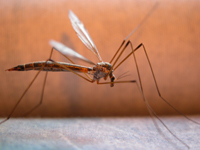
Mosquito bites aren’t just annoying. They can be dangerous and even deadly.
September 18, 2007
  • Meghan Noé
Twitter Facebook
Mosquito-proof yourself and your home to avoid West Nile virus and eastern equine encephalitis.

Buzzing at your head, biting at your ankles, leaving behind itchy, red welts — mosquitoes are just plain pesky. But that’s not the only reason to slather on the bug repellent. The insects can also carry viruses such as West Nile and eastern equine encephalitis (EEE), which can cause serious illnesses. Both viruses have been detected in mosquitoes in Massachusetts this summer.

About 20 percent of those infected with West Nile virus will develop symptoms, such as fever, headache, body aches, nausea, vomiting, and sometimes swollen lymph glands. A skin rash may also appear on the chest, stomach, and back. Fewer than one percent of those infected will develop severe illness, including encephalitis or meningitis. 

“Severe West Nile virus is more common in persons over 50 years of age,” says Cheryl Barbanel, director of BU’s Occupational Health Programs and the Occupational Health Center and a School of Medicine associate professor of medicine. “Most persons infected with West Nile recover, although a small number may have persistent neurological deficits.”

The virus has been detected in Boston every summer since 2000, according to the Boston Public Health Commission. Between 2000 and 2006, the Massachusetts Department of Public Health documented 54 cases of West Nile virus infection, with 6 deaths. This summer mosquitoes carrying the virus have been collected in several communities, including West Roxbury, Jamaica Plain, Medford, Marlborough, Brookline, Weymouth, and Berkley. As of September 4, two cases in humans were reported in Massachusetts, both of which are believed to have been contracted outside the state.

Often mosquitoes pick up the virus by feeding on infected birds. “Luckily, no birds have tested positive,” says Barbanel.

Eastern equine encephalitis can be more serious. The first symptoms of EEE, which appear 3 to 10 days after a person is bitten by an infected mosquito, are fever, stiff neck, headache, and lack of energy. The disease worsens rapidly, and patients may go into a coma within a week of being infected. Inflammation and swelling of the brain, called encephalitis, is the most dangerous and frequent complication.

“If people have any of the symptoms, especially neurological symptoms,” says Barbanel, “they should contact their physician or seek care in an emergency department,”

The most recent outbreak of EEE in Massachusetts began in 2004, and there have been 13 cases and 6 fatalities through 2006. The virus has been detected this summer in Raynham, Seekonk, Easton, and Rehoboth. The first human case of EEE in the region this year was reported recently in Newton, N.H., just over the Massachusetts border.

“EEE is rarely found in mosquitoes in Boston, and as of August 13 no EEE has been detected in the city this season,” says Barbanel. “Persons over age 50 and younger than age 15 seem to be at greatest risk for developing severe EEE when infected with the virus.”

Mosquitoes are most active between late July and late September, but if the weather remains warm the risk period can continue as long as November.

The state Executive Office of Health and Human Services offers tips to protect yourself against these mosquito-borne illnesses:

•    Avoid being outside during peak mosquito hours, from dusk to dawn.
•    Wear long sleeves, long pants, and socks when outdoors, if possible.
•    Apply insect repellent containing DEET, permethrin, picardin, or oil of lemon eucalyptus when going outdoors.
•    Mosquito-proof your home by draining standing water and installing or repairing window screens.

For more information, contact the Boston Public Health Commission’s Communicable Disease Control Division at 617-534-5611.

Explore Related Topics:

  • Faculty
  • Research
  • Share this story

Share

Buzz Off

Share

  • Twitter
  • Facebook
  • Reddit
  • LinkedIn
  • Email

Latest from BU Today

  • COMMENCEMEMT 2026

    Boston University Celebrates the Class of 2026 at 153rd Commencement

  • Commencement 2026

    Sights and Sounds from Boston University’s Class of 2026 Commencement

  • Campus Life

    Video: “Your Dreams Have a Lot of Power,” Says 2026 Graduate Mark Lucas

  • University News

    Following Thorough Investigation, BUPD and Other Agencies Make Arrest

  • Social Media

    Get Featured on the Jumbotron at Commencement: Use #BU2026

  • Commencement 2026

    Meet This Year’s BU Commencement Student Speaker

  • Student Life

    Brothers Graduating from College of Fine Arts School of Music Excited to Go from Ensemble to Solo

  • COMMENCEMENT 2026

    For Thousands of BU Graduate Students, Commencement Is a Step Toward a New Profession

  • College of General Studies

    Lynn O’Brien Hallstein Appointed Interim Dean of BU’s College of General Studies

  • Commencement 2026

    Photo Essay: Class of 2026, Then and Now

  • Commencement

    Looking for a Place to Take Grad Photos? These Spots Are Perfect

  • Accolades

    LAW’s Julie Dahlstrom Wins 2026 Metcalf Cup and Prize

  • Accolades

    Chobanian & Avedisian School of Medicine’s Monica Ann Pessina Named 2026 Metcalf Award Winner

  • Commencement 2026

    What These BU Seniors Would Tell Their Freshman Year Self

  • Commencement 2026

    Words of Wisdom for the Class of 2026: “Be Courageous”

  • New Appointment

    Manuel Cuevas-Trisán Will Be BU’s First Senior Vice President for People, Belonging, and Culture

  • Classes

    CAS Class Stresses That Religion and Science Are Reconcilable and Crucial

  • Student Life

    BU Students Showcase Real-World Data Projects at Spark! Demo Day

  • Watch Now

    CAS Writing Class Connects Terriers with Older Adults, One Story at a Time

  • Accolades

    Academic Advisors Celebrated at Annual Ceremony

Section navigation

  • Sections
  • Must Reads
  • Videos
  • Series
  • Close ups
  • Archives
  • About + Contact
Get Our Email

Explore Our Publications

Bostonia

Boston University’s Alumni Magazine

BU Today

News, Research, Community

The Brink

Pioneering Research from Boston University

  • Twitter
  • Facebook
  • Youtube
  • LinkedIn
  • Instagram
  • Weibo
  • TikTok
© Boston University. All rights reserved. www.bu.edu
© 2026 Trustees of Boston UniversityPrivacy StatementAccessibility
Boston University
Notice of Non-Discrimination: Boston University prohibits discrimination and harassment on the basis of race, color, natural or protective hairstyle, religion, sex or gender, age, national origin, ethnicity, shared ancestry and ethnic characteristics, physical or mental disability, sexual orientation, gender identity and/or expression, genetic information, pregnancy or pregnancy-related condition, military service, marital, parental, veteran status, or any other legally protected status in any and all educational programs or activities operated by Boston University. Retaliation is also prohibited. Please refer questions or concerns about Title IX, discrimination based on any other status protected by law or BU policy, or retaliation to Boston University’s Executive Director of Equal Opportunity/Title IX Coordinator, at titleix@bu.edu or (617) 358-1796. Read Boston University’s full Notice of Nondiscrimination.
Search
Boston University Masterplate
loading Cancel
Post was not sent - check your email addresses!
Email check failed, please try again
Sorry, your blog cannot share posts by email.
Buzz Off
0
share this