
Participants
Click on name to see their abstract and elevator pitch video.
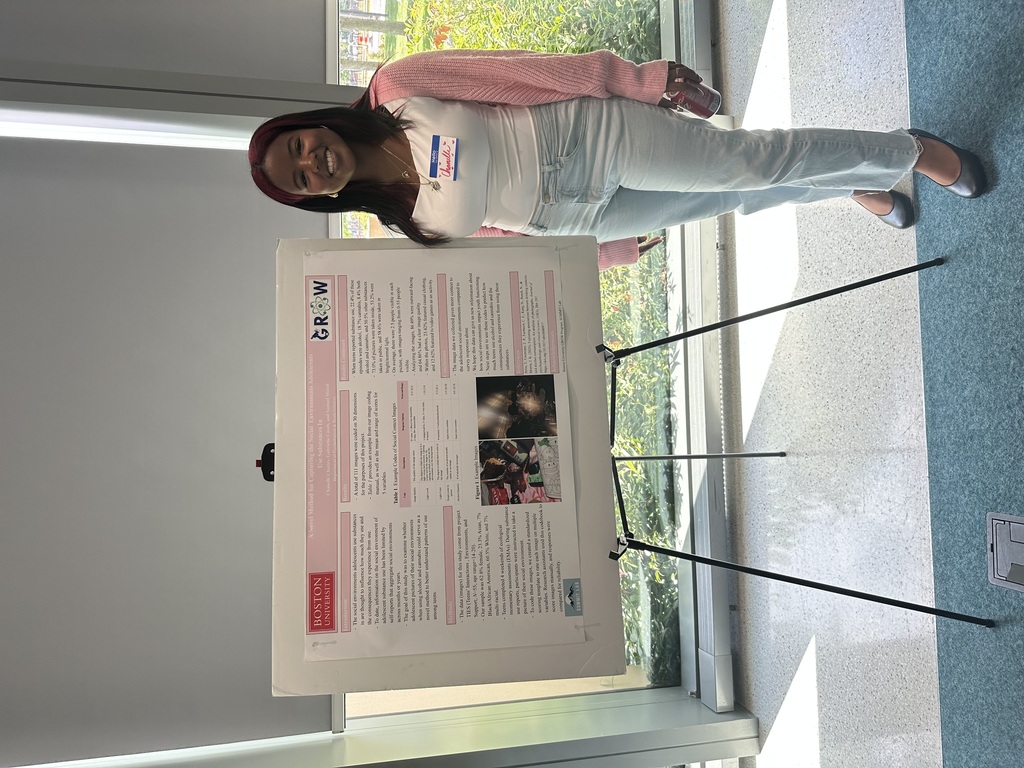
The social environments in which adolescents use substances are thought to influence how much they use and the consequences they experience from use. To date, information on the social environment of adolescent substance use has been limited by self-reports that aggregate social environments across months or years. The goal of the present study was to determine whether pictures taken by adolescents could enhance assessments of the social environment. Data for this study came from the Teens’ Interactions, Environments, and Support (TIES) study at BU’s SUMMIT Lab. We've enrolled 55 participants, ages ranging from 14-20. Adolescents first complete a baseline study visit with a friend and then complete four consecutive weekends of ecological momentary assessments (EMAs). During substance use reports, participants were instructed to take a picture of their social environment. A coding manual was developed by the lead author in collaboration with the study team. A total of 111 images were coded for 30 dimensions (e.g., light, peer context, location). Codes were double-entered by two separate lab members to ensure reliability. Results indicated that the average number of people in the images was 2.53 (range=0-55). On average, the number of alcohol products visible was 0.61 (range=0-14), and the number of cannabis products visible was 0.02 (range=0-2). Overall, these findings indicate that adolescents’ pictures of their social environments can be reliably coded. This data will be used to analyze how the social environment codes from these images predict alcohol and cannabis quantity and substance use consequences at the moment.
Elevator Pitch: ▶️

Artificial intelligence (AI) chatbots process sensitive data that users provide over the course of their conversation. However, when users utilize these chatbots, they risk having their conversations leaked into other users' conversations. Developers must manually implement security features for user history isolation while maintaining efficient recall in the chatbot. The SPACE Lab created LLMMarshal, a conversation management system that addresses these challenges: it manages sessions, stores chat histories, and provides access control in AI chatbots in web applications. To support ease of use, LLMMarshal must generalize across different frameworks. To test LLMMarshal’s generalizability, I built a chatbot using the Flask framework, a lightweight Python web framework, as a control condition to manage user history and session isolation manually. I then recreated the same application with the LLMMarshal plugin to handle user history and isolation. After testing, LLMMarshal simplifies integration for beginner developers by reducing the lines of code required for privacy features. Additionally, LLMMarshal achieved slower message retrieval times, showcasing its accessibility, but slower performance.
Elevator Pitch: ▶️

Organic semiconductors, such as organic light emitting diodes (OLEDs), use carbon-based molecules to allow electrons to flow through them. OLEDs are used in phones, televisions, and other digital displays. OLED displays are more cost effective, flexible and lightweight than their inorganic counterparts, but can have lower lifetimes which has made them less ideal for commercial use. Organic semiconductor molecules are conductive because they either naturally or have been chemically synthesized to have a specific overlap of pi orbitals called conjugation. The molecule’s conjugation allows electrons to be delocalized, which means they can move along the molecule and conduct electricity. This research involved synthesis of conjugated small molecules for OLEDs for a high-quality blue light emission. A true deep blue is difficult to make opposed to red or green light because it requires more photon energy for it to be emitted and can cause degradation and instability. While red and green light is used in displays, blue light is also needed (RGB) to create an absolute white, black, and fully complete display. The goal of this research is to synthesize and test two small molecules with similar backbones for both blue light emission and efficiency/brightness in OLEDs.
Elevator Pitch: ▶️

Amphiprion percula, better known as the orange clownfish, exhibits complex behaviors that support survival within its marine habitat. Observations and previous research show that clownfish rely on sea anemones for protection, feed on small invertebrates and algae, and live in structured social groups with one dominant female and one breeding male. This study examines behavioral patterns between male and female clownfish by observing and digitally annotating video footage collected in their natural habitat in Papua New Guinea. By tracking when specific behaviors occur, this study aims to identify recurring organizational patterns and explore whether these patterns resemble communication systems seen in other animal species. Although it is difficult to determine the exact dynamics of conspecific relationships, analyzing consistent patterns may help uncover the underlying causes of behavior and reveal aspects of their social dynamics. Statistical analyses revealed significant differences in the occurrence of massaging, mouthing, tending, and feeding behaviors, while clearing behavior did not differ significantly between males and females. These findings suggest that several key behaviors are associated with social role or sex within clownfish groups, whereas clearing may represent a more universally shared maintenance behavior. Together, these results provide insight into how behavioral organization contributes to the social structure and communication of A. Percula.
Elevator Pitch: ▶️

Mycorrhizal fungi are beneficial soil microbes that assist with forming a mutualistic bond with plant roots, exchanging nitrogen (N) and phosphorus (P) for sugars produced by photosynthesis. These fungi help to store carbon (C) underground in their hyphal biomass. With rising atmospheric concentrations of CO2, carbon (C) allocation between plants and fungi could be potentially altered, disrupting the natural soil nutrient cycle and soil carbon (C) storage. Furthermore, phosphorus (P) availability may influence fungal growth alongside causing disbalance to the diversity of microbial communities in phosphorus (P) limited soils. The combined effects of elevated eCO2 and enriched phosphorus (P) on the potential quantity of RNA found in mycorrhizal fungi-enhanced soils still remain unclear. We had two hypotheses: a) that elevated CO2 alongside P-fertilization in P-limited soil, increases RNA quantity in soil, and b) that the C3 grass type will have higher RNA concentration than C4. To begin this investigation, rhizospheric soil samples were collected from 6 rings of the EucFACE experiment, an arid, phosphorus (P)-limited mature Eucalyptus woodland. The study included three treatment combinations: elevated CO₂ with P fertilization (eCO₂ + P+; Rings 1 and 4), ambient CO₂ with P fertilization (aCO₂ + P+; Rings 2 and 3), and ambient CO₂ without P fertilization (aCO₂ + P−; Rings 7 and 8). In order to prepare the soil for RNA extraction, I pulverized each subsample of soil into fine powder using mortar and pestle, then I placed them into screw cap tubes. After this, I weighed 1.5-2gm of soil from each tube for RNA extraction. Following this, total RNA concentration and RNA quality was measured using a DeNovix spectrophotometer. Based on the results, RNA quantity measured highest in eCO2 and phosphorus (P) enriched locations compared to others. Meanwhile, there was no significant difference between C3 and C4 grass type regarding RNA quantity. These findings somewhat support our hypothesis and further contribute to understanding how ecosystems and their carbon cycling could respond to increased climate changes such as elevated CO₂.
Elevator Pitch: ▶️

Extreme urban heat is contributing to a growing public health crisis, and city planners are increasingly investing in heat mitigation strategies such as reflective cool roofs and expanded tree canopy. Ensuring these investments yield climate and health benefits requires quantifying their effectiveness at a hyper-local level, but existing urban air temperature models are often limited by a lack of in-situ measurements. Smith et al. (2025) modeled temperature as a function of local land cover using Boston weather station data, finding a 0.61°C decrease for every 0.1 increase in albedo. However, they validated their estimates only at weather station locations, which carry known biases. To address this gap, we took ground-based air temperature measurements at out-of-sample locations across the Greater Boston area in July and August 2026, using a Kestrel 5400 Heat Stress Meter (validated against a BU weather station) at three sites spanning a gradient of surface albedo and vegetation greenness. Sites showed distinct temperature differences within each measurement round, consistent with differences in surface albedo. For every 0.1 increase in built albedo, we found a 1.17°C decrease in air temperature (SD = 0.64°C), nearly double the effect reported by Smith et al. This is likely because our built-albedo sites reflected purely built surfaces rather than a mix of built and vegetation albedo. This cooling effect also depended on sky conditions (sunny vs. cloudy). Overall, urban air temperature gradients exist at spatial scales finer than those captured by widely used models, underscoring the importance of city-specific, ground-based observations for informing model development and local heat-mitigation policy.
Elevator Pitch: ▶️

With global rising temperatures, the severity and frequency of marine heatwaves have increased, driving bleaching—the stress-driven loss of algal symbionts—not just in corals but also in the closely related sea anemones that host the orange clownfish (Amphiprion percula). Prior work shows that bleached anemones can reduce anemonefish growth, metabolism, and fecundity and increase predation risk. However, few studies have characterized how bleaching affects the social behaviors of anemonefish, and none have done so in the wild. With the development of ethogram-based annotations utilizing the Behavioral Segment Anything Model (BSAM), this research addresses that gap while contributing to a new artificial intelligence approach to behavioral quantification. We hypothesized that clownfish social groups associated with bleached host anemones will have greater time allocation to a subset of stress-related behaviors, including territorial maintenance, greater behavioral sequence predictability, and lower behavioral diversity, than groups occupying healthy anemones. Social behaviors were compared between five clownfish groups associated with either bleached or healthy anemones using videos collected at field sites in Papua New Guinea. Clownfish groups associated with bleached anemones generally exhibited less diverse and more predictable behavior, with a greater proportion of time spent on maintenance. Although most differences were not statistically significant, Rank 1 females associated with bleached anemones showed significantly lower behavioral diversity than those associated with healthy anemones (p = 0.026), with a similar trend observed in Rank 2 fish. These shifts parallel patterns in frequently studied social animals, such as honeybees, demonstrating that environmental stressors can restrict and disrupt behavioral dynamics within complex social species. This work offers further insight into how climate change affects not only the biological but also the social systems within marine ecosystems.
Elevator Pitch: ▶️

As climate warming concerns continue to rise, attention is typically focused on the ecosystems of oceans and icecaps. However, Pamela Templer presented a new angle on the effects of climate change by introducing the concerns of climate warming for the northern hardwood temperate forest trees and foliage in her CCASE experiment. With 3 treatments divided into six separate plots, the CCASE lab observed foliar N efficiency, mass, and the resulting N:C ratio in reference plots, simulated warmer growing season temperatures, and simulated warmer growing seasons paired with warmer winter temperatures. These treatments were created by implementing warming cables in plots 3-6 of the soil to simulate the expected effects of an additional 5 degrees C of climate warming in the next century. Through CCASE, researchers found that foliage in plots treated with warmer growing seasons and warmer winters had a 70% increase in mass compared to the reference plots, while also increasing foliar N concentrations, whereas the reference and warming plots showed a decrease over time. Trees contribute so much to the effects of climate change, and with CCASE’s findings, policies and expected outcomes of climate change can be adjusted more accurately compared to the outdated references prior.
Elevator Pitch: ▶️