Federal Loan Schedule of Reduction
The Working Families Tax Cut Act (H.R. 1) (Formerly the One Big Beautiful Bill Act) introduced significant changes to federal aid programs scheduled to go into effect July 1, 2026 for students applying for federal aid with the 2026-27 Free Application for Federal Student Aid (FAFSAThe Free Application for Federal Student Aid (FAFSA) is used to determine eligibility for state and federal grants, scholarships, and loans. The FAFSA can be completed on the Federal Student Aid website. The Boston University FAFSA school code is 002130.).
Changes Effective after July 1, 2026
Enrollment Status
Full-Time Academic Year Enrollment:
- BU Undergraduate Students: must take at least 12 credits per semester (at least 24 credits in the academic year).
- BU Graduate/Professional/Doctoral Students: most BU Graduate students must take at least 12 academic credits per semester (at least 24 credits in the academic year).
- It is important that Graduate and Professional students check with their specific program, as some programs may have different requirements.
- For STH, 9 credits per semester (18 per academic year) is the full-time requirement.
- Some CFA Graduate students are considered full-time with 8 credits per semester (16 per academic year).
Half-time Enrollment: Students must be enrolled in at least a half-time basis to receive a Federal Direct Loan in a single semester.
- BU Undergraduate Students: at least 6 academic credits
- BU Graduate/Professional/Doctoral Students: at least 6 academic credits
Less than Full-Time Enrollment: Beginning with the 2026-27 Academic Year, Direct Loans for students not enrolled full-time for the entire academic year will need to be adjusted based on the Federal Schedule of Reduction (SOR). Unlike previous academic years, enrollment will now be measured for both the individual term and the academic year. Prior to H.R. 1, enrollment was only measured by terms.
Loan Eligibility
Under the new rules of H.R. 1, awards for students enrolled less than full-time will be determined as follows:
Calculation of Loan Eligibility:
Cost of Attendance – Gift Aid (Grants/Scholarships) – Federal Work Study = Remaining Loan Eligibility
Schedule of Reduction for less than full-time enrollment:
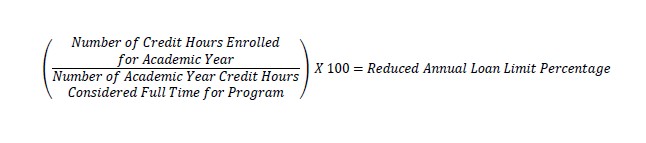
To determine the less than full-time loan amount, multiply the full-time annual loan eligibility by the reduced annual loan limit percentage calculated in the SOR.
Example 1: SOR Reduction for Planned Part-Time Enrollment
Planned Part-time Enrollment
In this example let’s consider the eligibility for an undergraduate senior planning to take 8 credits per semester. As a senior, their full-time Federal Direct Loan Eligibility is $7,500.
If they were to enroll in 8 credits per semester, their annual enrollment would be 16 credits.
Based of the SOR calculation, their reduced annual loan limit percentage would be:
(16/24) x 100 = 67%
Based on the SOR calculation, their less than full-time loan eligibility would be:
$7,500 x 67% = $5,025
This means they would be eligible for $2,512 per semester at 8 cr enrollment. (Full-Time eligibility would be $3,750/semester)
This example also applies for graduate students if they were instead to use the graduate loan limit and full-time credit requirement for their program.
Example 2: SOR Reduction for Unplanned Part-Time Enrollment
Unplanned Part-time Enrollment
In this example we will consider the same undergraduate senior, but instead of planning to enroll part-time, they instead enrolled full-time at 12 credits per semester. In this case, they would start the year with their full-time eligibility for Federal Direct Loans of $7,500.
After the semester starts, however, they unexpectedly had to drop one of their fall courses after their fall loans had disbursed. This unexpected change in enrollment would result in less than full-time enrollment as a W grade does not count towards full-time enrollment under then new H.R. 1. rules.
This change in enrollment would result in a reduction to the loans they can receive in the spring based on the SOR calculation:
New Academic Year Enrollment – 20 credits
(20/24) x 100 = 83%
Less than Full-Time Loan Eligibility
$7,500 x 83% = $6225
How this impacts Spring Loan Eligibility:
Since this student already had a full-time loan amount disbursed for the fall ($3,750), the full time amount must now be subtracted from the new less than full-time annual eligibility.
$6,225 – $3,750 = $2,475
This means that the student in this example would only be eligible for $2,475 in Federal Direct Loans in the spring, due to the change in Fall enrollment to less than full-time. Students should be very careful when making enrollment changes, as a SOR reduction after a loan has disbursed can result in a student receiving substantially less than they were anticipating in subsequent semesters.
Example 3: SOR Reduction for Planned Part-Time Enrollment for a Graduate Student
Planned Part-time Enrollment for a Graduate Student
In this example, let’s consider the eligibility for a graduate student planning to take 8 credits per semester.
If they enrolled in 8 credits per semester, their annual enrollment would be 16 credits.
12 credits per semester is considered full-time enrollment for most school/colleges. So, their reduced annual loan limit percentage would be:
(16/24) x 100 = 67%
The annual Direct Unsubsidized LoanAn Unsubsidized Federal Direct Student Loan is made to a borrower meeting specific eligibility requirements, but not based on financial need (FAFSA). The borrower is responsible for paying all interest that accrues throughout the life of an unsubsidized loan. During in-school status, deferment, and forbearance periods, the borrower may choose to pay the interest charged on the loan or allow the interest to be capitalized. eligibility is $20,500 for most full-time graduate students. Based on the SOR calculation, their less than full-time loan eligibility would be:
$20,500 x 67% = $13,735
They would be eligible for ~$6,867 per semester at 8 cr enrollment.
If you have any questions, you can reach out to your school/college’s Graduate Financial Aid Office.
The Schedule of Reduction rule applies to undergraduate, graduate, and professional students borrowing Federal Loans. Students who qualify as legacy borrowers for any federal loan programs will still be subject to the SOR calculation if enrolled less than full-time despite their legacy status.
*An important note: The SOR calculation applies to student borrowing, so the Federal Parent Plus Loan is not subject to SOR reductions for less than full-time study.
Frequently Asked Questions
How many credits are considered full-time for Direct Loan Eligibility?
Students must meet both the per term credit requirement and the per academic year requirement to be considered full-time for Direct Loan Eligibility
- Undergraduate Students:
- Full-Time Academic Year Credit Requirement: 24 Credits (12 Credits per term)
- At-least Half-Time per Term Credit Requirement: At-least 6 Academic Credits
- Graduate/Professional/Doctoral
- Full-Time Academic Year Credit Requirement: 24 Credits (12 Credits per term) – Unless otherwise explicitly stated by your school
- At-least Half-Time per Term Credit Requirement: At-least 6 Academic Credits
How does dropping a course with a W grade impact enrollment?
W grades do not count towards full-time academic year enrollment and may result in a SOR calculation and adjustment to Direct Loan Eligibility for subsequent semesters.
Will my Parent Plus Loan be reduced if I am enrolled for less than full-time?
Parent Plus loans are not reduced based on part-time enrollment. The Schedule of Reduction calculation only applies to Federal student borrowing, not parent borrowing.
Student enrolled less than full-time, however, may have a lower cost of attendance which could impact Parent Plus Loan eligibility.
How will my Federal Direct Loan eligibility change if I change to less than full-time enrollment after my loan is disbursed?
SOR adjustments are based on the academic year credit minimum rather than per term. If you complete the full-time academic year credit requirement for your specific program then you are considered full-time for Federal Direct Loan Eligibility. If you complete less than the academic year credit requirement then your loans are subject to being reduced based on the SOR.
For example, lets look at an undergraduate student with an academic year full-time enrollment requirement of 24 credits.
Here are a few scenarios:
Scenario #1 – Typical Enrollment
Fall Enrollment – 16 credits
Spring Enrollment – 16 credits
Academic Year Enrollment – 32 Credits (Full-time)
Scenario #2 – Student drops to 8 credits in Fall, 16 Credits in Spring
Fall Enrollment – 8 credits
Spring Enrollment – 16 Credits
Academic Year Enrollment – 24 Credits
Despite dropping to 8 credits in the fall, this student would still be eligible for Full-Time Federal Direct Loans because they were enrolled in at least 6 credits in the Fall and still completed 24 credits for the year, despite being less than full-time in the Fall. This student would not be subject to a SOR adjustment.
Scenario #3 – Student drops to 8 credits in Fall and Spring
Fall Enrollment – 8 Credits
Spring Enrollment – 8 Credits
Academic Year Enrollment – 16 Credits
In this scenario, the student would be considered less than full-time for the academic year and would be subject to a SOR adjustment:
(16/24) x 100 = 50%
New Undergrad Senior Academic Year Loan Eligibility – $3,750
What if I am registered in 4 credits for a semester?
Students registered for 4 credits in a single semester will not be eligible to receive an Federal Direct Loans during that semester because they do not meet the At least Half-Time enrollment requirement to borrow Federal Direct Loans.
What if I reduce my enrollment to less than full-time prior to my loans being disbursed?
If you change your enrollment to less than full-time prior to an academic year loan disbursing, but will adjust your loan according to the SOR and split you less than full-time annual eligibility between the fall and spring evenly.
For example, prior to the fall semester you reduce your enrollment to 8 credits. BU Financial Assistance assumes that a student will enroll for the same number of credits in the spring as they do in the fall unless otherwise notified by the student. BU would calculate your academic year enrollment based on 16 credits total and award your federal direct loan eligibility based on a 50% SOR. Since your loans have not yet disbursed, this total annual eligibility would be split evenly between the fall and the spring.
If a student increased their enrollment for the spring, the student must notify BU Financial Assistance in order to have a federal direct loan increase based on the new enrollment.
I am a legacy borrower for Graduate Plus Loan, will SOR impact my eligibility?
Yes, the SOR rules apply to all Federal Loans for student borrowers including students with legacy eligibility for Graduate Plus Loans.
What is my borrowing eligibility if I am an SPH student with legacy borrowing eligibility?
Here are examples of annual eligibility for a SPH student taking 8 credits in 2026-27 based on SPH Scholarship Percentage:
35% SPH Scholarship
| Fund | Fall 2026 (8 Credits) | Spring 2027 (8 Credits) | Total 2026-27 |
| Direct Loan | $11,055 | $11,055 | $22,110 |
| 35% SPH Scholarship | $6,392 | $6,392 | $12,748 |
| Grad Plus (if credit eligible) | $4,719 | $4,719 | $9,439 |
| Total | $22,166 | $22,166 | $44,332 |
40% SPH Scholarship
| Fund | Fall 2026 (8 Credits) | Spring 2027 (8 Credits) | Total 2026-27 |
| Direct Loan | $11,055 | $11,055 | $22,110 |
| 40% SPH Scholarship | $7,306 | $7,306 | $14,611 |
| Grad Plus (if credit eligible) | $4,107 | $4,107 | $8,214 |
| Total | $22,468 | $22,468 | $44,936 |
50% SPH Scholarship
| Fund | Fall 2026 (8 Credits) | Spring 2027 (8 Credits) | Total 2026-27 |
| Direct Loan | $11,055 | $11,055 | $22,110 |
| 50% SPH Scholarship | $9,132 | $9,132 | $18,264 |
| Grad Plus (if credit eligible) | $2,883 | $2,883 | $5,766 |
| Total | $23,070 | $23,070 | $46,140 |
What is I need more loan funding than is available through the FAFSA?
If you require additional loan funding, you can investigate private credit-based loans. Credible is a great tool to quickly compare private loan options. Credible utilizes a soft credit check which will not impact your credit but allow you to view pre-approved interest ratesA loan expense charged a borrower for the use of borrowed money. Interest is calculated as a percentage of the principal of the loan, which includes the original amount borrowed and any capitalized interest., borrowing limits, and repayment options available to you.
The Department of Education has not yet published final guidance for schools to implement the new rules set by H.R. 1. Due to these on-going changes, all information contained on this page as well as answers to FAQ’s are based on BU’s current understanding of the law. This information is subject to change and updates will be reflected on our website if/when they are available.
