News
BU Cybersecurity Expert on How to Protect Yourself from Internet Scams
Millions of Saks, Lord & Taylor customers compromised in recent hack

BU's cybersecurity director has tips for defeating online scams like the one that stole millions of customers’ information recently from Saks Fifth Avenue and Lord & Taylor. Photo credit: iStock/wdstock.
In the 21st century, it seems, life is a breach. Hackers made news again last week, when tony retailers Saks Fifth Avenue and Lord & Taylor revealed that financial information of five million of their customers had been compromised by a hack attack between May 2017 and last month.
“The criminals responsible appear to have installed malicious software on the cash registers that would collect the card number from any card swiped by the cashier, impacting all types of credit and debit cards,” says Eric Jacobsen (CAS’93, MET’03), BU’s information security director.
Investigators said the malware probably was installed when employees inadvertently clicked on links or attachments in emails sent by phishers—scammers who send emails masquerading as legitimate. Clicking on the links surreptitiously installed software that gave the hackers access to company computers.
The theft, one of the largest of its kind, is believed to have been committed by a group of Russian-speaking criminals known variously as Fin7 or JokerStash. The hacking group has offered 125,000 of the stolen records for sale.
BU Today asked Jacobsen for advice on protecting oneself from such hacks.
BU Today: The attacks were on patrons of stores mostly in New York and New Jersey. Is there any indication that card data of Terriers or their families were stolen?
Jacobsen: We have no information on who was affected by this. Since the malware was installed on cash registers in stores rather than the online store presence, the most likely victims would be those who have shopped in the physical stores in New York and New Jersey from May 2017 to March 2018.
What are the broader lessons here for the rest of us? BU has suffered phishing attacks as well.
In a phishing attack, the malicious actor wants an individual to either respond to an email or click on a link. The ploy often involves creating a sense of urgency, such as telling you that you only have a short time to respond to receive a benefit or avoid a penalty.
The best prevention techniques involve careful scrutiny of the email: why is this message urgent? Would the sender actually put time pressure on me for this task? Who sent the message? When in doubt, it’s best to verify with the apparent source. Take out your credit card or bank statement and call the number on that document—not the one provided in the email—and validate if the message is legitimate. The BU community can report phishing attempts to IS&T as well. If you fall victim to a phishing message, you should immediately change your password, scan your computer for spyware and viruses, and seek help from the IT Help Center.
Paying cash would eliminate some risk, but these were high-end retailers where that might be impractical. Is data theft a risk we have to assume when we use credit or debit cards to make purchases?
Most major retailers work very hard to avoid these kinds of events, but there is always some risk that they will occur. That said, consumers have good protection from fraudulent charges on their credit cards and generally have very limited liability, particularly compared to the risks associated with carrying large amounts of cash. There are important differences in how this liability works between credit and debit cards. In general, you have better protection from fraud when you use a credit card instead of a debit card, due to consumer protection regulations that govern the credit card industry.
If you suspect that your card might have been involved in a breach, you should check your recent transactions by calling the card issuer via their online portal, or when you receive your monthly statement. You should be sure you know what each transaction is. You can also get your credit report for free from each of the credit bureaus once per year and review that to ensure you know about all the sources of credit and debt associated with your name.
If you see fraudulent activity on your card, you should contact the financial institution associated with the card. Those institutions are very good at helping determine the best course of action, whether it is getting a new card number, changing a password or PIN number, or pursuing credit monitoring or a credit freeze.
What steps has BU taken institutionally to guard against this threat?
The retail functions of the University have to be compliant with a stringent set of IT and business requirements called the Payment Card Industry Data Security Standard (PCI-DSS). The University participates in an annual process involving an external assessor, in which we review and certify compliance with the standard. We also conduct these reviews any time we make changes to the information systems that support credit card processing. Over the past few years, we have also installed new credit card readers that encrypt transactions at the card reader, eliminating many sources of risk that the credit card number will be captured during processing.
Author, Rich Barlow can be reached at barlowr@bu.edu.
Groundbreaking for “New” Goldman School of Dental Medicine
Dean says SDM is “on its way into and beyond the 21st century”

Breaking ground for the Goldman School of Dental Medicine renovation and addition: Michael Donovan and Gary Nicksa, BU VPs (from left); Karen H. Antman, MED dean and Medical Campus provost; Jeffrey Hutter, SDM dean; David Lustbader, (CAS’86, SDM’86), SDM Dean’s Advisory Board chair; Robert A. Brown, BU president; and Marty Martinez, Boston’s chief of health and human services. All photos by Jake Belcher.
- Ground was broken April 5 for the School of Dental Medicine expansion and renovation
- The façade will be redone and two state-of-the-art additions constructed
- The facility will embody the vision of the group practice model of dental medicine
Under a wind-whipped tent on an unseasonably cold April 5, Jeffrey W. Hutter, dean of the Henry M. Goldman School of Dental Medicine, hosted a celebratory rite of spring he’d first envisioned nine years ago: the groundbreaking ceremony for his school’s three-year, $112 million renovation and expansion.
The idea for the major expansion—and cutting-edge modernization—of the school’s seven-story building at 100 East Newton Street grew out of the strategic planning that began in 2009, said Hutter, the Spencer N. Frankl Professor in Dental Medicine. “Our vision,” he said, “was to become the premier academic dental institution providing excellence across dental education, research, oral health care, and community service to the global population.”
Hutter said the project, which adds 48,000 square feet, includes a seven-story addition that will have administrative space, instruction, and preclinical spaces and a two-story addition with a new 140-seat auditorium. The new building will also have a state-of-the-art patient treatment center with 10 group practices and 10 patient treatment rooms in each, as well as a new patient entrance on the corner of East Newton and Albany Streets and a new reception area. A new façade with contemporary sheathing and lots of glass will allow in natural light. And while all this construction is going on, Hutter said, classes will continue as scheduled, and patients will be seen without interruption.

Jeffrey W. Hutter, School of Dental Medicine dean, hosted the groundbreaking ceremony for the state-of-the-art renovation and major expansion of his school’s building.
Other speakers at the groundbreaking were Robert A. Brown, University president, Karen Antman, dean of the School of Medicine and provost of the Medical Campus, David Lustbader (CAS’86, SDM’86), chair of the SDM Dean’s Advisory Board and a major contributor to the building’s renovation, and Marty Martinez, city of Boston chief of Health and Human Services.
Brown told the attendees that under Hutter’s strategic planning and “very careful fiscal management,” the dental school has followed “a path to academic leadership built around the group practice model for modern dental medicine.
“Living with the noise and the disruption of the construction will not be pleasant,” Brown said, “but the result will be spectacular.” SDM, he said, is “one of the very best dental schools in the country.”
Antman said the construction would require the temporary relocation of some students and staff. “But remarkably, everyone is eager,” she said. “One group will be moving three times and even they were eager. They were excited for the end result.”

A rendering of the completed Henry M. Goldman School of Dental Medicine. Image courtesy of SmithGroupJJR.
Lustbader recalled a lunch with Hutter in the dean’s office back in 2010, where it all began. “He laid out the vision for the new dental school and he asked me to write a large check—which I did,” Lustbader said. “This is really the culmination of one man’s vision. He’s very modest and he likes to say it’s a team effort, but a team needs a quarterback and this would not have happened without him.”
Also present yesterday were the lead architects for the project, Chris Purdy and David Johnson of the architectural firm SmithGroup JJR. Hutter thanked the architects, along with “the engineers, planners, communicators, faculty, staff and students, and many other professionals” who he said had become part of the SDM “project planning team.”
Author, Sara Rimer can be reached at srimer@bu.edu.
You’re Invited: Join the BU Global Development Policy Center
 BU IN DC
You're Invited
As financial leaders from around the world convene in Washington, DC, next week, join the Boston University Global Development Policy Center on April 18 for a discussion with two of the world's foremost leaders in global development finance. RSVP today
 NOTABLE ALUMNI
MLK, 50 Years Later
The BU community reflects on the legacy of the civil rights leader, who earned his PhD from BU in 1955, on the anniversary of his death. See what they have to say
 FACULTY EXPERT
What About All-Payer Health Care?
You may have heard of single-payer health care, but BU Public Health Professor Austin Frakt suggests a different way to control health care prices. Find out how
IN CASE YOU MISSED IT...
BU political scientist Maxwell Palmer explains how asking about citizenship status could alter the U.S. Census in The New York Times... BU graduate schools are ranked among the best in the annual assessments by the U.S. News and World Report... The Boston Globe features BU College of Arts & Sciencesanthropologist Cheryl Knott and her decades protecting orangutans... Michael Siegel of the BU School of Public Health talks about states' gun control legislation with the PBS NewsHour... BU Institute for Sustainable Energy directorPeter Fox-Penner comments on Shell's surprising predictions for global energy consumption in The Washington Post.
College of Engineering Will Now Require Data Science for All Majors
Change will prepare students for a digital and maker economy

In new mathematics and statistics courses, ENG students will learn to analyze huge data sets and be introduced to machine learning, a major component of autonomous systems, like self-driving cars and robotics.
For decades, product developers have depended on a primary engineering discipline to turn a design into a product. Car makers, for example, were helpless without the skills of mechanical engineers. But these days, those same car makers hire software engineers as well as computer, electrical, mechanical, and systems engineers. Why? Because today’s products, at least those produced by innovative companies, require an interdisciplinary approach, one that often uses massive amounts of data.
As the increasing importance of data science, not just in the design of cars, but in healthcare, urban design, the internet of things, and other fields, has changed the workplace for engineers, it has also changed undergraduate education at the College of Engineering. Beginning in the fall, all students will take courses in data science, and they will learn to apply relevant tools and techniques to some of today’s cutting-edge, multidisciplinary technologies.
“The era of the single-discipline engineer is over,” says Kenneth R. Lutchen dean of ENG. “Most innovation now requires multiple engineering disciplines interacting with large data sets. Making sure our students are literate in data analysis is in keeping with our mission to create societal engineers. With this knowledge, Boston University engineers will have the tools to improve society for many years to come.”
The curriculum change began in fall 2016, when an ENG task force was charged with recommending revisions to the undergraduate curriculum to ensure that graduates are better prepared to work in the emerging digital and maker economy.
“We are one of the first engineering schools nationally that has designed a curriculum for which students in every major will take an interdisciplinary, data-driven approach,” Lutchen says. “We are aware that in the future, every engineering discipline, from mechanical to biomedical to computer, will intersect with data science.”
The new curriculum will replace ENG’s existing two-credit linear algebra course with a three-credit computational linear algebra course. A single new four-credit probability, statistics, and data science for engineers course will replace the separate and distinct probability and statistics courses that had been offered by each department. The new course will include the tools and techniques to analyze huge data sets and an introduction to machine learning, which is becoming a large part of autonomous systems. Three 400-level elective courses—introduction to machine learning, smart and connected systems, and introduction to robotics—will also be offered and will be open to students in all majors.

Data sets can process data from in-home medical sensors or help to develop drug molecules targeting specific microbes.
“Typically, engineering students are not expected to have this data science foundation,” says Thomas Little, ENG associate dean for educational initiatives and a professor of electrical and computer engineering. “Our new curriculum introduces them to mathematical concepts that allow them to appreciate the analytical capabilities provided by contemporary large-scale computing.”
Little says data analytics and data-driven technological systems are playing a central role in many rapidly emerging technologies, such as smart cities and self-driving vehicles. “Cyber-physical systems are producing and consuming massive amounts of data, and safety is often critical,” he says. “We need to be sure our graduates are prepared to use these new analytical techniques to tackle these modern challenges.”
In another, related curriculum change, all freshmen will design and build a product—whether physical or software—as part of the introduction to programming and introduction to engineering modules. Little says this will help build a stronger connection between the challenging first-year coursework and what students will do after graduation.
“This reflects what is going on in the maker world,” he says. “Our Engineering Product Innovation Center allows us to bring this to all students. This will transform the freshman year. Our students come to us wanting to build things, and we need to keep that alive.”
The new curriculum will apply to all students in the next academic year. In addition to incoming freshmen, current students who have not yet taken linear algebra or probability and statistics will take the new courses that include data science.
“Students need this now,” says Lutchen. “The next wave of innovations that address our societal challenges and life quality need a workforce comfortable in the era of big-data and interdisciplinarity.”
Author, Michael Seele can be reached at mseele@bu.edu.
MLK, 50 Years Later: BU Community Reflects on Civil Rights Leader’s Legacy
TEXT BY BU TODAY STAFF | PHOTOS BY JANICE CHECCHIO
VIDEOS BY ALAN WONG

On the night of April 4, 1968, Martin Luther King, Jr. (GRS’55, Hon.’59) was gunned down on the balcony of a motel in Memphis, Tenn.
The most prominent voice in the US Civil Rights Movement of the 1950s and 1960s, King was a strong and influential advocate of nonviolent protest and civil disobedience in the struggle for equal rights for black Americans. For this work, the Baptist minister earned the Nobel Peace Prize in 1964. When he was assassinated, King was in Memphis to support African American sanitation workers, who were striking to protest unequal wages and working conditions.
His assassin, James Earl Ray, at first escaped, but was captured at London’s Heathrow Airport in June 1968. Sentenced to a 99-year jail term, he died in prison in 1998.
As the nation commemorates the 50th anniversary of MLK’s death, BU Today reached out to several BU faculty, staff, and students, asking them to reflect on King’s legacy. Read their essays and view their videos by visiting BU Today.
BU Honors Martin Luther King, Jr. (GRS’55, Hon.’59)
Events all week long commemorate the 50th anniversary of his death

Boston University will observe the 50th anniversary of the assassination of Martin Luther King, Jr. (GRS’55, Hon.’59) with a weeklong series of lectures, church services, and concerts. Photo by Jerónimo Bernot on Unsplash.
This week, the world is marking the 50th anniversary of the assassination of Martin Luther King, Jr. (GRS’55, Hon.’59) with special services, concerts, and other commemorative events. The pioneering civil rights leader was gunned down on a motel balcony on the night of April 4, 1968, in Memphis, Tenn. He was just 39 years old.
On Wednesday, bells will ring out across the nation starting at 6:01 pm Central Time to mark the moment he was killed.
King—who earned a PhD at BU in 1955 and whose philosophy of nonviolent resistance was shaped largely by his mentor Howard Thurman (Hon.’67), dean of Marsh Chapel from 1953 to 1965 and the first black dean of a predominantly white university—will be remembered by the University in a series of special events commemorating his life and legacy that will include lectures, prayer services, a jam session, and a concert at Symphony Hall. A full list of events is below.
Monday, April 2
Tell Them about the Dream: The Gotlieb Center Remembers King
In collaboration with The HistoryMakers, the nation’s largest African American video oral history collection, the Howard Gotlieb Archival Research Center hosts a program revisiting Martin Luther King, Jr., and his dream. Khalil Muhammad, a Harvard Kennedy School professor of history, race, and public policy, will interview poet Nikki Giovanni on what King’s dream means today. Other speakers are Walter Fluker (GRS’88), the School of Theology Martin Luther King, Jr., Professor of Ethical Leadership; Louis Chude-Sokei, George and Joyce Wein Chair in African American Studies; BU trustee emeritus Melvin Miller, owner and publisher of the Bay State Banner; and Julieanna Richardson, founder and CEO of the HistoryMakers. There will also be an exhibition of some of the thousands of items from the Gotlieb Center’s Martin Luther King, Jr., archive.
Tell Them about the Dream: The Gotlieb Center Remembers King is Monday, April 2, at 6 pm, at the George Sherman Union Metcalf Hall, 775 Commonwealth Ave., second floor; free and open to the public.

Tuesday, April 3
School of Theology Lowell Lecture and Reception
Community activist and civil rights leader Rev. Traci Blackmon, executive minister of Justice & Local Church Ministries for the United Church of Christ in Florissant, Mo., will deliver the School of Theology’s 2018 Lowell Lecture. Prior to becoming the first female pastor of Christ the King United Church of Christ, where she is now senior pastor, Blackmon was a nurse for 25 years. She gained national recognition for her community work after the 2014 killing of Michael Brown Jr., an 18-year-old African American man killed by a white police officer in Ferguson, Mo., in 2014. She was appointed to the President’s Advisory Council on Faith-Based Neighborhood Partnerships by President Barack Obama and served on the Ferguson Commission. She was also named to Ebony’s Power 100, a list of inspiring African Americans, in 2015. The lecture will be livestreamed. Blackmon will also speak at the STH Worship Service on Wednesday, April 4, at 11:10 am at Marsh Chapel.
The School of Theology Lowell Lecture is at 5 pm Tuesday, April 3, in the STH Community Center, 745 Commonwealth Ave., with a reception following in Room 325; free and open to the public, but registration is recommended.

Wednesday, April 4
School of Theology Worship Service
Traci Blackmon (see above) will speak at the School of Theology’s weekly community worship service starting at 11:10 am at Marsh Chapel. The ecumenical service will include music by the School of Theology Seminary Singers, prayers, and scripture readings.
The School of Theology worship service is Wednesday, April 4, from 11:10 am to noon, at Marsh Chapel, 735 Commonwealth Ave.; free and open to the public.
Service of Remembrance: In Memoriam, Martin Luther King, Jr.
Rev. Robert Allan Hill, dean of Marsh Chapel, will lead the University in an hour-long special prayer service to commemorate the 50th anniversary of MLK’s death and honor his legacy. Cornell William Brooks (STH’87, Hon.’15), STH and School of Law visiting professor of social ethics, law, and justice movements and former president of the National Association for the Advancement of Colored People, will deliver the sermon. Music will be provided by the Inner Strength Gospel Choir, the Marsh Chapel Choir, and the Thurman Choir.
Service of Remembrance: In Memoriam, Martin Luther King, Jr., is Wednesday, April 4, at 6 pm, at Marsh Chapel, 735 Commonwealth Ave.

Thursday, April 5
The Night That James Brown Saved Boston
On April 5, 1968—the day after Martin Luther King, Jr.. was assassinated—cities across America, including Boston, were bracing for a second consecutive night of violent unrest and riots. That night, African American singer and songwriter James Brown was scheduled to give a live concert at the Boston Garden. City officials persuaded him to allow the concert to be televised live on WGBH, Boston’s PBS television station, to try to quell potential riots. The plan worked. The broadcast was credited with keeping potential rioters off the streets, helping the city maintain order and calm. Kenneth Elmore (SED’87), associate provost and dean of students, and Victor Coelho, a College of Fine Arts professor of musicology, will lead a discussion about that seminal concert. A jam session will follow, featuring Fred Wesley, trombonist for the James Brown Band, along with clips from the 2008 PBS documentary The Night That James Brown Saved Boston.
The Night That James Brown Saved Boston starts at 5 pm Thursday, April 5, at BU Central, George Sherman Union, lower level, 775 Commonwealth Ave; free and open to the public.
Friday, April 6
Protest Without Words: The Arts and Social Change Panel Discussion
Louise Kennedy, former Boston Globe arts reporter and critic and WBUR senior producer for arts engagement and current BU Development & Alumni Relations writer and editor, will moderate a panel discussion exploring the role the fine arts have played in America’s history of protest, resistance, and resilience. Panelists are Harvey Young, dean of the College of Fine Arts, composer Kirke Mechem, whose piece Songs of a Slave will be performed at CFA’s Monday, April 9, Symphony Hall concert (see below), and Kerri Greenidge (GRS’09,’12), codirector of the Tufts University African American Freedom Trail Project. Cosponsored by the BU Arts Initiative and the School of Music, is designed as a prelude to the Symphony Hall concert.
Protest Without Words: The Arts and Social Change is Friday, April 6, at 7 pm, at the Photonics Center, Room 206, 8 Saint Mary’s St. The event is free and open to the public, but registration in advance is requested here.

Sunday, April 8
After Fifty Years: The King Legacy in Word and Song at Marsh Chapel
Former Massachusetts Governor Deval Patrick (Hon.’14), will be the special guest preacher at Marsh Chapel’s weekly Sunday 11 am interdenominational service, titled “After Fifty Years: The King Legacy in Word and Song.” The Marsh Chapel choir will perform the Wendell Whalun spiritual “Lily of the Valley” and “Amazing Grace.” The service will be followed by a guided walk to the Howard Gotlieb Archival Research Center in Mugar Memorial Library for a tour of its Martin Luther King, Jr., collection. On the walk to the Gotlieb Center, guests will be greeted by Marsh Chapel congregation members portraying various King contemporaries who were leaders in the Civil Rights Movement. Thomas Batson (CFA’20) will portray Rev. Ralph Abernathy, cofounder with King of the Southern Christian Leadership Conference. Those who cannot attend the service can listen to the broadcast live on WBUR 90.9 FM or at wbur.org.
The Marsh Chapel Sunday service “After Fifty Years: The King Legacy in Word and Song” is Sunday, April 8, at 11 am, at Marsh Chapel, 735 Commonwealth Ave., immediately followed by a guided walk to the Howard Gotlieb Archival Research Center, 771 Commonwealth Ave.
Monday, April 9
Protest Without Words: The Arts and Social Change Concert at Symphony Hall
For the first time, the three major performing ensembles of the CFA School of Music—the BU Symphony Orchestra, BU Symphonic Chorus, and BU Wind Ensemble—will perform together at Boston’s Symphony Hall. The concert program, part of BU’s observance of the 50th anniversary of MLK’s assassination, will feature music of protest, resistance, and resilience. The Symphony Orchestra, conducted by Neal Hampton, CFA associate director of orchestral activities, will perform Samuel Barber’s Adagio for Strings and Aaron Copland’s Lincoln Portrait, narrated by special guest Cornell William Brooks (STH’87, Hon.’15), School of Theology and School of Law visiting professor of social ethics, law, and justice movements and former NAACP president. David Martins, a CFA master lecturer, will direct the Wind Ensemble in Karl Husa’s Music for Prague 1968. And Miguel Ángel Felipe, a CFA visiting associate professor, will lead the Symphony Orchestra and Symphonic Chorus in William Grant Still’s Plain-Chant for America and Kirke Mechem’s Songs of the Slave, accompanied by soloists soprano Michelle Johnson (CFA’07) and baritone Brian K. Major (CFA’08,’10).
The College of Fine Arts concert is Monday, April 9, at 8 pm, at Symphony Hall, 301 Massachusetts Ave., Boston. The concert is free and open to the public, but tickets are required; register here for up to four tickets. The tickets will be available starting at 7 pm April 9 at the BU table in the Symphony Hall lobby (not at the BSO box office). Walk-up tickets will also be available at the BU table.
Sunday, April 29
In His Own Words: A Concert of New Compositions in Memory of MLK at Marsh Chapel
Five local Boston composers will premiere original compositions based on Martin Luther King, Jr.’s own words in this special concert at Marsh Chapel. Among the composers is Vartan Aghababian, a CFA lecturer, whose work In the Words of Dr. King will be performed along with work by Kathy Wonson Eddy, Pamela J. Marshall, Thomas Stumpf, and John M. Tarrh. The concert is being presented to reflect an order of service, with music for soprano and string trio interspersed with spoken-word readings and poetic reflections, a nod to King’s ministry.
In His Own Words: A Concert of New Compositions in Memory of MLK will take place at 3 pm at Marsh Chapel, 735 Commonwealth Ave. Suggested donation is $20.
Author, Madeleine O’Keefe (CAS '18) can be reached at mokeefe@bu.edu.
BU Researchers: The American Frontier Continues to Shape Us
Residents of these western areas more Republican, anti-tax, anti-regulation
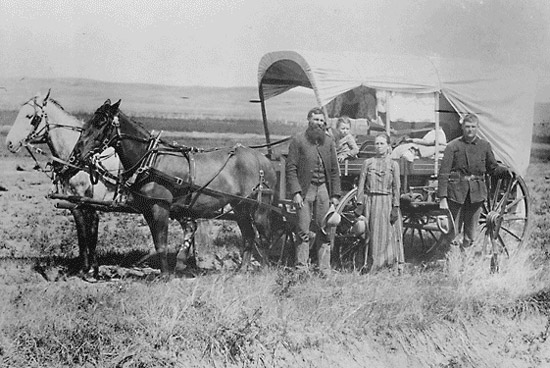
A family during the Great Western Migration, 1866. The frontier closed 130 years ago, but its individualist ethos continues to incline Americans living in old frontier counties to anti-government, anti-tax, anti-regulation views, say BU researchers. Public domain photo.
Easterners who heeded the 19th-century call to “Go West, young man” (and they were mostly men, given the harsh frontier conditions) were proverbial rugged individualists. That’s not just history: recent research by BU economists says those pioneers bequeathed their cultural DNA to Americans who live in the same places today.
Even though the frontier closed almost 130 years ago, the paper by Samuel Bazzi and Martin Fiszbein, both College of Arts & Sciences assistant professors of economics, and doctoral student Mesay Gebresilasse (GRS’19), found that people who live in American counties that had the longest frontier experience exhibit the most individualism in the 21st century. Residents of those counties tend to vote Republican for president, support lower property taxes and smaller government, and are averse to public spending, redistribution, and regulation of things like guns and pollution.
Each decade a county was part of the frontier, the paper notes, “is associated with 3.5 percent more votes for Republican candidates in presidential elections since 2000. This association ratchets up over the 2000s as each election exhibits a significantly larger effect.”
And as late as 1940—half a century after 1890, when the US Census Bureau declared the frontier closed and the last time it tracked popular children’s names at the county level—families in longtime frontier counties chose more unusual names for their children, favoring Reuben and Lucinda, for example. “We borrow our names-based measure of individualism from social psychologists, who note that individualistic types are prone to give their children infrequent names, reflecting a desire to stand out,” the paper’s authors write. (The paper was posted by the National Bureau of Economic Research.)
The upshot for the authors, says Bazzi, is that culture can trump changing economic circumstances, given that the frontier mind-set endures long after roads, homes, and other tendrils of civilization have reached into the old frontier.
“The way that people tell and sustain narratives about the past oftentimes motivates their reasoning and the way they view current events,” he says. “People come to view themselves as potentially carrying on that tradition.…Culture is sticky, and culture doesn’t change as quickly.” (This applies in other areas of life, according to Bazzi; for example, developmental economics teaches that cultures with big families cling to that practice even when economic circumstances make smaller families more feasible.)

Samuel Bazzi (from left), Martin Fiszbein, and Mesay Gebresilasse pored over census, election, and other data, including the names frontier residents gave their children, for their paper. Photo by Jackie Ricciardi.
The researchers used census data from 1790 to 1890, defining the frontier line as a point beyond which population density fell below two people per square mile. Counties within 100 kilometers of that line and having fewer than six people per square mile were counted as on the frontier in the research, and the researchers measured how long the counties remained frontier, as the frontier line gradually shifted westward over time.
“It’s individualists who were attracted to the frontier because of those conditions, and then once they’re there, those conditions further amplify the individualism and the importance of self-reliance,” Bazzi says. Those individualists were disproportionately male and in their prime (ages 15 to 49), he says, because “it was easier for men to strike off on their own and thrive in this harsh environment,” which could be crime-ridden and demanded manual labor and trekking over terrain without roads, and the pioneers might face and have to fight Native Americans hostile to their encroachment.
This turf made people resent government aid to those who the pioneers saw as less hardworking than themselves, the researchers found. The sense of Manifest Destiny, the idea that the continent was America’s for the conquering, sired attitudes against curbing pollution and environmental despoliation among today’s dwellers in longtime frontier counties.
“You see the frontier having this sort of lasting imprint on their preferences about things like regulation, even if we account for their partisanship or economic personal circumstances,” Bazzi says.
To conduct the study, the researchers studied and cross-referenced such records as census data, election returns, contemporary property tax rates, and opinion surveys measuring people’s attitudes toward public spending and redistribution.
They also studied psychological insights into the link between individualism and the frontier, which was noted as far back as 1893, when historian Frederick Jackson Turner suggested that the latter bred the former.
“His notion of individualists settling the frontier is something that social psychologists have extended to thinking about frontiers more generally,” Bazzi says. For example, he says, Japanese psychologist Shinobu Kitayama “documented similar sorts of traits in Japan” among frontier dwellers.
The researchers aren’t political scientists, but if the foregoing makes it sound like Democrats’ only hope in such counties is to muffle their progressive policies, even if it disgruntles their base, you won’t get a fight from Bazzi, who says, “I wouldn’t talk about them as much.”
Author, Rich Barlow can be reached at barlowr@bu.edu.
Research, Student Aid Slated for Huge Boost
BU IN DC
Provost Jean Morrison and Rachel Lapal and Barbara Moran of Marketing & Communications addressed the Public Affairs Network of the Association of American Universities on March 18 and 19. Senior Vice President for External Affairs Stephen Burgay and Vice President for Marketing & Creative Services Amy Hook also attended the meeting.
Jacob Bor of the School of Public Health delivered the National Institutes of Health Office of Disease Prevention's Early-Stage Investigator Lecture on March 19.
Peter Fox-Penner of the Institute for Sustainable Energy headlined an alumnievent about "New Horizons in Clean Electric Power" on March 19.
Graduate students from the College of Arts & Sciences and the School of Medicine participated in the American Association for the Advancement of Science Catalyzing Advocacy in Science and Engineering workshop and met with legislators between March 18 and 21.
RESEARCH, STUDENT AID SLATED FOR HUGE BOOST
Congress sent a large spending bill to the President this week which will significantly increase funding for federal research agencies and student aid for the remainder of fiscal year 2018. When the Consolidated Appropriations Act (H.R. 1625) is signed into law it will be nearly six months after the start of the fiscal year. As a result, federal agencies will rush to spend the money before the fiscal year concludes on September 30. The bill provides the following:
- National Institutes of Health: $37.0 billion, a 8.75% increase
- National Science Foundation: $7.77 billion, a 3.95% increase
- NASA Science: $6.22 billion, a 7.94% increase
- Department of Energy Office of Science: $6.26 billion, a 16.1% increase
- Department of Defense basic research: $2.34 billion, a 2.81% increase
- National Endowment for the Humanities: $153 million, a 1.87% increase
- Pell Grant: $6095 maximum grant, a 2.96% increase
- Federal Work Study: $1.13 billion, a 14.1% increase
The President is expected to sign the measure today.
EVENT NEWS YOU CAN USE
BU Research will present "Welcome to Federal Relations: How to Connect with Policymakers and Funding Agencies to Get Your Message Heard and Deliver Impact" on Wednesday, April 4 at 3:30 pm. Presenters from BU Federal Relations and Lewis-Burke Associates LLC will discuss effective communication practices that can engage elected officials and federal funders. Faculty respondents will also share their personal experiences. Space is limited, and registration is encouraged.
EVEN MORE EVENT NEWS YOU CAN USE
Join BU Research for two upcoming "Research on Tap" events designed to help you meet potential research collaborators. Spencer Piston of Political Science will host "Inequality in the United States" on March 29, and Associate Provost for Diversity & Inclusion Crystal Williams will host "Broadening Participation in STEM" on April 3. Both events will feature a curated set of micro-talks by BU faculty. Advance registration is encouraged.
A NOTE TO OUR READERS... With Congress headed home for a spring district work period, Beltway BUzz will not publish next week. We will keep an eye out for cherry blossoms and return in April.
U.S. News Rankings: BU Grad Schools among Nation’s Best
Six schools in top 50 in 2019 assessments
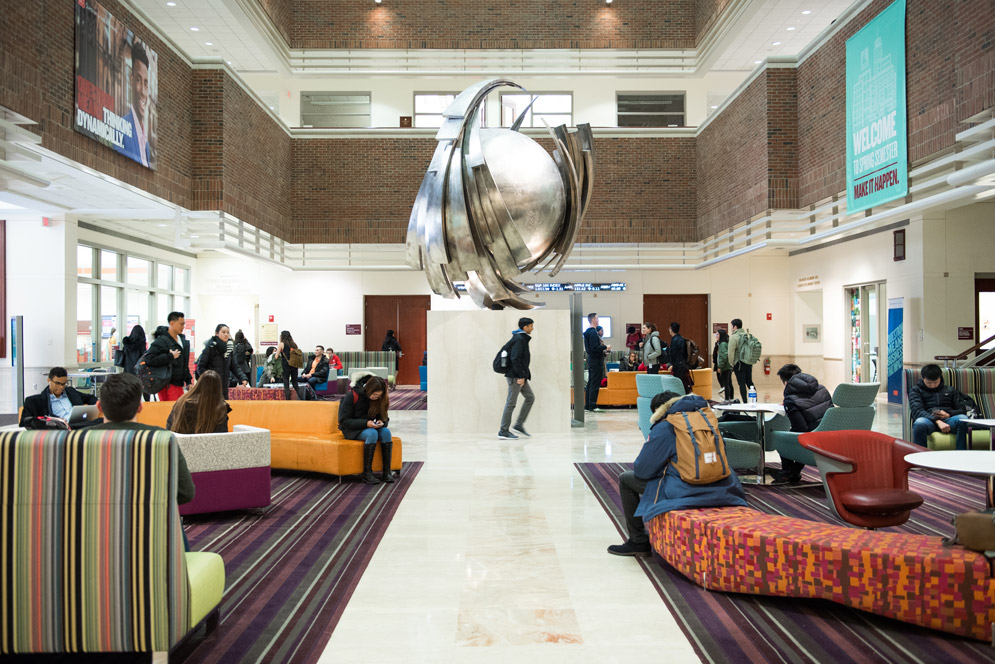 The Questrom School of Business part-time MBA program jumped 10 spots in the U.S. News 2019 rankings of the country’s best graduate school programs. Photo by Jackie Ricciardi.
Several schools within Boston University advanced in the latest U.S. News & World Report rankings of the country’s best graduate schools from their showings last year.
Among BU’s professional schools, the School of Medicine jumped 8 notches, to 26th, for the quality of its primary care education. MED advanced one notch, to 29th, in the magazine’s medical research category. (U.S. News rates medical schools in various categories.) The magazine reviewed a total of 124 medical schools nationwide.
“We are delighted with the rankings this year,” says Karen Antman, dean of MED and provost of the Medical Campus. She says that U.S. News changed the methodology in calculating this year’s research ratings: for the first time, it included as one metric all of a school’s research funding. Past rankings considered only funding from the National Institutes of Health.
“We did well,” Antman says, given this expanded metric.
Other BU schools faring well are the Questrom School of Business, which rose 2 notches, to 42nd in the country, out of 127 peers ranked by the magazine (its part-time MBA program jumped 10 spots, to 32nd); the School of Education (34th of 267, up 2 notches from last year); the School of Social Work (10th of 251, up 2 notches from 2016, the last time the magazine calculated social work school rankings; this is the first time SSW has made the top 10); and the College of Engineering (35th of 199, a drop of one notch).
The School of Law moved up one notch, to 22nd of 194, and also scored high for its education in certain specialties: 4th in healthcare law, 7th in tax law, 11th in intellectual property law, 31st for clinical training.
Sargent College’s occupational therapy program ranked number 1 in the country. The School of Public Health ranked 10th in the country for the second year.
“Rankings are inherently imperfect, but we appreciate the acknowledgement of the quality and reputation of our students, program, and alumni,” says Kenneth Freeman, Allen Questrom Professor and Dean in Management. “Each year, we adjust our curricular content in response to student needs and our increasingly engaged corporate partners to create experiential opportunities to bridge the classroom and industry.”
Catherine O’Connor, SED dean ad interim, says her school’s march upward in the rankings began under former dean Hardin Coleman, who “brought us into the top 50 in 2016.”
That SED is now “solidly within the top 40,” she says, owes to several factors: “Our faculty are having success getting large grants necessary for advanced research. Our reputation among peers continues to grow, and our graduate programs are attracting excellent students.”
“We aim to continue this work with the resources and opportunities,” says O’Connor, when BU’s merger with Wheelock College creates the University’s new Wheelock College of Education & Human Development as of June 1, 2018.
Jorge Delva, dean of SSW, says his school’s highest ever rating by the magazine “is a testament to the extraordinary work our community does to improve the lives of some of the most vulnerable populations in the world.”
Jean Morrison, University provost, says the rankings are important “in a graduate and professional landscape that only grows more competitive with each passing year. There is always room for improvement and clearly more work ahead of us, but the faculty and students in these programs should be very proud of what they are accomplishing.”
Author, Rich Barlow can be reached at barlowr@bu.edu.
Close Up: George J. Mitchell
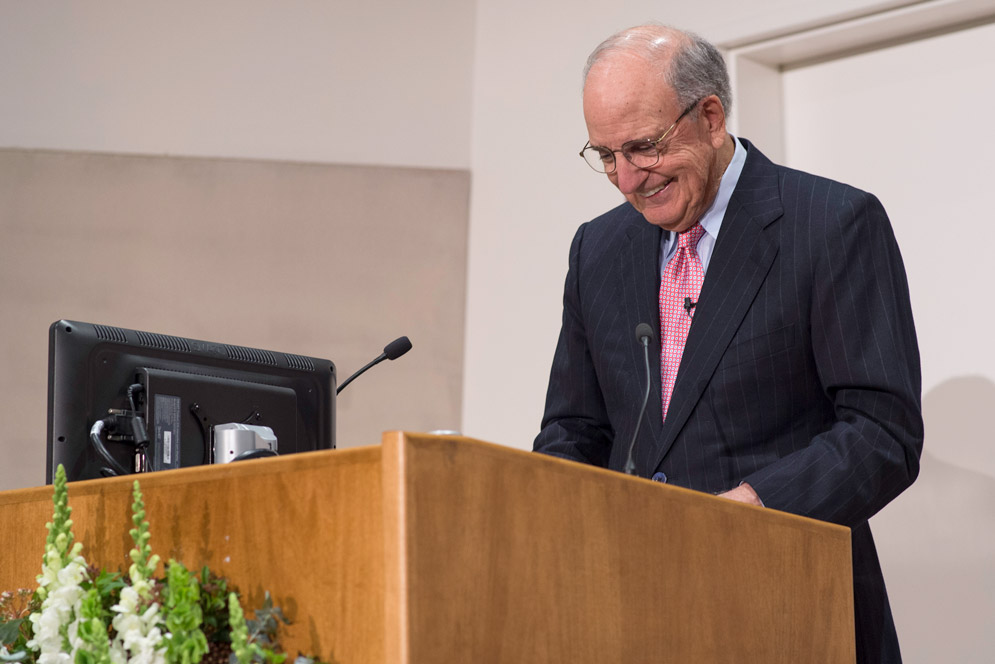
George J. Mitchell, former US senator from Maine, 1980-95, Senate Majority Leader, 1989-95, and US Special Envoy for Middle East Peace, 2009-11, delivered the annual Elie Wiesel Center for Jewish Studies Yitzhak Rabin Memorial Lecture March 14 at the LAW auditorium. "I was…proud…to call him a friend," he said of Rabin. Photo by Maddie Malhotra (COM'19).