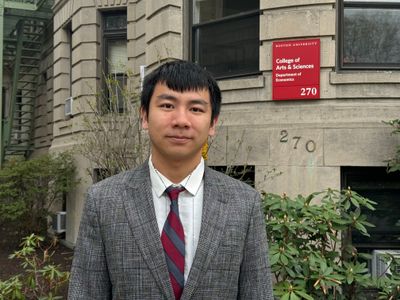
Profiles of 2025 MA Award Winners:

David Klein (MA in Economics, January 2025) grew up in Rockford, Illinois; and earned his bachelor’s degree in computer science from the University of Rochester. After working as a software engineering intern at Microsoft, he decided to take a break after graduation from academia and professional life for a period of creative self-discovery. He moved to Western Massachusetts to work as an artist – studying pottery, making functional ceramics, and engaging in rural community life. Yet his immersion in current events, his fierce intellectual curiosity in the broader world, and his quest for understanding how prosperous, equitable, and sustainable societies can be created and why public policies sometimes fail, finally drew him to Boston University and the Economics master’s program.
At BU, he was fascinated by interdisciplinary conversations about human behavior and utility theory in classes, such as EC590AA Behavioral Economics with Professor Jawwad Noor, EC513 Game Theory with Professor Bart Lipman, and EC590AA Political Economy with Professor Haldun Evrenk. He also enjoyed working as a research assistant with Professor David Lagakos, Professor Yuhei Miyauchi, and Dr. Peter Deffebach (when he was a doctoral candidate) on a project investigating urban geography.
David had developed a passion for teaching while he was still in college and he intends to pursue it as a career. For guidance and mentorship in developing his skills as an educator, he is especially grateful to Professor Bahar Erbas, who wrote:
“David Klein was a student in my MA course, EC561 Public Economics, as well as a teaching fellow for my undergraduate courses in Fall 2024. David earned an A in EC561, with an impressive presentation on ‘The McMansion Effect’. More importantly, David Klein’s approach to both learning and teaching is exemplary. For him, what he actually learns is always more important than what grades he may eventually get, and serving his students always takes priority over his own needs or plans. I was excited to have a student who would combine superlative academic performance with such an amazing attitude.”

Rosa Yuxin He (MA in Global Development Economics, January 2025) came from the historic city of Xi’an in China, and studied at Colorado State University, Fort Collins. After an initial concentration in biomedical engineering, Rosa’s intellectual passion took a decided turn for social science and the human condition; and she graduated with a bachelor’s degree in economics (minoring in mathematics). In her last semester at BU, she participated in EC798 The Global Development Capstone Project: “Water Access and Livelihoods of Tribal Populations in Central India,” supervised by Professor Dilip Mookherjee, as part of an ongoing study on behalf of a philanthropic organization. Rosa carried out the data analytics almost single-handedly, and won the respect of her teammates; she also captivated the audience with clarity and wit during a group presentation last December.
For Rosa, her graduate education and research experience at BU have been transformative. It gave her intellectual clarity and confidence, as well as a renewed sense of purpose and optimism. Since graduation she has been working as a research assistant at BU’s Global Development Policy Center, while continuing to look for other pre-doctoral research opportunities. She aspires to a doctoral degree, and ultimately a professional career in shaping policies that will not only foster economic stability but also uphold the dignity and autonomy of every individual.
Reflecting on her interactions with the faculty, Rosa said: “Our professors are brilliant — truly at the frontier of their fields — yet they always treated us, even in our most confused or clumsy moments, with unwavering patience and genuine equality.” Besides the guidance and inspiration she got from Professor Mookherjee in the capstone project, she has also taken classes with Professors Pankaj Tandon, Jordi Jaumandreu, Jean-Jacque Forneron, Christophe Chamley, Bahar Erbas, and Robert King. In their own way, each instructor showed caring and openness towards their students; and this was even true of faculty whom Rosa met in the hallway or the lounge. Rosa is no less grateful for the friendship, kindness, and support she received from her TAs and other PhD students. Their words, deeds, and personalities commanded her admiration and respect; their inspiring and encouraging examples led her forward.
During AY 2023-2024, Rosa served with Edith Joachimpillai as co-representative for master’s students on the board of the Graduate Economics Association. With their social grace, boundless energy and omnipresence, they formed a ‘dynamic duo’ that rallied master’s students in every academic, social, and cultural event; and made everyone feel welcome as part of a happy, extended family. After Edith’s graduation, Rosa continued her dedicated and successful service as a GEA leader with Eric Zhang during Fall 2024. Rosa referred to her fellow master’s students as “my peers, my dearest friends, my chosen family.” They sustained her soul, enriched her life and being at BU, and made Rosa “fall in love with the master’s program and the economics department.”
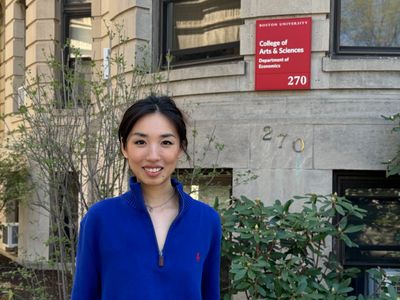
Eric Liying Zhang (BA in Economics and Mathematics/MA in Economics, May 2025) was originally from Shanghai, China. He had lived and studied in Southern California as a teenager before coming to BU as an undergraduate. After his admission to the BA/MA dual degree program, Eric had come to regard the Economics Department as his second home!
Professor Hsueh-Ling Huynh (Director of Master’s Programs in Economics) had the pleasure of teaching Eric in EC513 Game Theory, where he notched up the improbably high score of 98.5 (out of 100) in two very challenging exams. He also held an all-time record in EC507 Statistics taught by Professor Jordi Jaumandreu, and went on to become his research assistant under the RA-Mentor Program. In this work, Eric successfully designed a mechanism to merge large datasets by matching manufacturing firms’ names. Professor Bjorn Persson supervised his EC401-402 Senior Thesis, which examined the social contagion of speculative sentiments in financial markets, focusing on the short-squeeze on GameStop stocks in 2021. In EC565 Economic Institutions in Historical Perspective, Eric impressed Professor Christophe Chamley and his classmates with a learned and insightful presentation on the Grand Canal of China. Eric was also proud to have worked as a research assistant for Dr. Justin J. Hong (when Justin himself was a doctoral candidate), collecting data on Chinese mine accidents between 2000 and 2020 and contributing to the economic model in his paper, “Anti-Corruption and Human Supply Capital to the State.” Combining rigorous theoretical and quantitative training with valuable pre-doctoral research experience, the Economics master’s program had prepared Eric well for his PhD applications, and gave him a promising head start for a dream academic career. He received multiple admission offers in this challenging year, and began his doctoral studies this fall at the University of North Carolina at Chapel Hill.
Besides acing all his classes in economics and math, and even before becoming a GEA leader, Eric made himself an indispensable part of the social fabric of the Economics master’s program, well-known and well-liked by his fellow students. First with Rosa He in Fall 2024 and then with Eunji Park in Spring 2025, Eric continued to take the work of the GEA to ever greater heights, to the enrichment of the intellectual and social life of the master’s program. According to Eric, even though the department’s infrastructure might not be the greatest, the people – faculty, staff, PhD, and master’s students – had made the place special and unique in his heart. The atmosphere in the graduate lounge was always casual and collegial, where the free flow of conversations never failed to stimulate and inform, and friendships were formed that would last for years to come.